









- Which customer acquisition channels will be affected by cross-border marketing trends in 2026?Sep 06, 2026View details
- Which homogenization risks should be considered in an analysis of the AI-powered website building industry?Aug 30, 2026View details
- How Will AI Marketing Trends 2026 Change Advertising Budget AllocationAug 28, 2026View details
- Is the EV SSL certificate market shrinking or upgrading? How should companies assess certificate procurement?Aug 11, 2026View details
- Why the old AMP SEO 2020 practices no longer work and what has changed in current optimization prioritiesAug 02, 2026View details
- How to Choose Topics for an Industry News Section to Attract More Organic Search TrafficJul 29, 2026View details
How to Build a Korean-Language Official Brand Website? Recommendations for Sections and Visual Expression Suited to the Korean Market
For a Korean Brand Website, Don’t Rush to Build a “Translated Version”
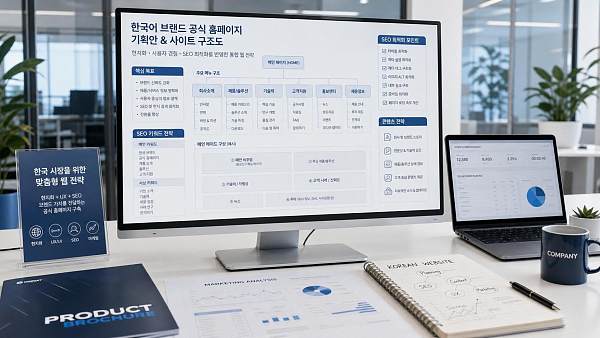
Building a Korean brand website may look like a simple language switch on the surface, but in practice it is more like reorganizing the entire website for the Korean market. How sections are arranged, what the homepage communicates first, and how buttons guide users will all affect time on site, inquiries, and brand trust.
In real applications, even when the goal is the same—building a brand website—the website structure will differ depending on whether it targets Korean agency partnerships, end-user retail, equipment inquiries, or local brand communication. The difference in requirements often lies not in the technology itself, but in the usage scenario and conversion path.
For integrated website and marketing service projects, a Korean brand website should not only aim to launch pages. It also needs to consider search visibility, advertising traffic reception, and ongoing content operations. This is why many companies entering the Japanese and Korean markets need their official websites to be designed in coordination with SEO, advertising, and social media.
Based on the practical service experience of 易营宝, if a multilingual website lacks localized section planning, even with a stable system and attractive pages, it can still easily face problems such as slow indexing, high bounce rates, and weak lead generation. To make a Korean brand website effective, the focus should be “market adaptation” rather than “page duplication”.
When Different Businesses Enter the Korean Market, the Key Evaluation Points for the Official Website Are Not the Same
Why do some Korean brand website projects emphasize brand stories, some prioritize product catalogs, and others place downloads, certifications, and case studies at the front? The reason is simple: visitor motivations are different, so the decision-making information they need is also different.
If the website is responsible for brand building, visual consistency, page completeness, company background, and locally credible information become more important. If the website mainly receives search traffic or advertising traffic, section depth, landing page logic, form paths, and mobile speed become more critical.
More commonly, an official website needs to support presentation, customer acquisition, and content distribution at the same time. In this case, a Korean brand website should not be built based only on page aesthetics. Instead, it should be analyzed according to the business journey: the homepage builds awareness, section pages filter needs, and detail pages drive conversion.
Websites Focused on Brand Presentation Place More Emphasis on Trust and a Sense of Order
This scenario is common in the early stage of overseas brand expansion. The focus is not to obtain a large number of inquiries at once, but to help Korean users quickly understand who the company is, what it does, and whether it is trustworthy. Page design should be restrained, information hierarchy should be clear, and an overly promotional feeling should be avoided.
In terms of sections, company profile, core products, solutions, certifications, cooperation cases, news updates, and contact information should usually be arranged in a stable way. In this type of Korean brand website project, visual expression is more important than flashy effects. Clean, clear, and professional presentation is often more effective.
Websites Focused on Inquiry Conversion Care More About the Distance from Information to Action
If the website is responsible for B2B inquiry generation, visitors will care more about specifications, delivery, application cases, and response methods. In this case, a Korean brand website should place product categories, application scenarios, technical parameters, downloadable materials, and inquiry entry points closer to the front.
For many projects, the problem is not traffic, but conversion breakpoints. The pages talk only about brand philosophy but do not provide a clear next step. Users in the Korean market usually want to quickly confirm whether the information is complete, so form fields, instant contact entry points, FAQ, and response commitments are all worth planning in advance.
Websites Focused on Marketing Growth Need to Leave Room for Future Advertising and SEO
When the official website needs to receive traffic from Google SEO, advertising campaigns, or social media, the section structure cannot be built only around company introduction. Topic pages, industry pages, case pages, and information pages should be reserved so that future content operations can continue to expand, instead of quickly encountering structural bottlenecks after launch.
This is also why integrated service platforms like 易营宝 often emphasize systematic website development. If self-developed intelligent website building, SEO optimization, and advertising journeys can be planned together at an early stage, a Korean brand website is more likely to create synergy among indexing, advertising, and conversion after launch.
How Sections Should Be Set Depends on the Real User Path
Section planning is not about putting together common modules. It is about identifying what visitors need to confirm first after entering the website. The following types of differences are the most common in Korean brand website development.
Many companies directly translate their Chinese official website into Korean and then copy the navigation structure over. This may seem convenient, but in practice it causes the Korean brand website to lose the reading rhythm of local users. Section names, order, and page depth should all be rearranged according to the target action.
In Visual Expression, the Korean Market Values “Clean, Clear, and Credible” More
Visual adaptation for a Korean brand website is not just about switching to Korean fonts. Brand websites commonly seen in the Korean market place more emphasis on whitespace, neat grids, stable colors, and clear information blocks. If a page is too crowded, it can easily appear unprofessional.
The first screen of the homepage should directly explain the core value, rather than stacking too many carousels and slogans. Product images, scenario images, certification images, and case images should be authentic, while large amounts of abstract materials should be avoided. The purpose of visuals is to help users make judgments, not to create emotional noise.
- Keep colors within a small number of main colors to avoid excessive visual burden.
- Button copy should directly express the action, such as view products, download materials, or submit requirements.
- Font and paragraph spacing should remain stable. Korean typography in particular should not be too dense.
- The first screen on mobile should present key information first, rather than hiding important information below.
If the official website also needs to support advertising campaigns and social media traffic, the visual expression should be consistent with the landing pages. After users click an ad and enter the website, if they find that the messaging, color tone, and commitments are inconsistent, their willingness to convert will decline significantly.
What Is Easily Overlooked Before Launch Is Not Technology, but Adaptation Details
One common misjudgment in Korean brand website development is understanding “multilingual” as “multi-version duplication”. Duplicating pages is fast, but local search terms, content structure, button wording, and consultation habits do not automatically synchronize.
Another frequent issue is focusing only on design drafts while ignoring later operations. Without content expansion positions, an SEO foundation structure, advertising tracking points, and conversion tracking, the website will struggle to support continuous marketing after launch.
A more reliable approach is to confirm several conditions before website development: how the Korean keyword layout should be defined, whether the official website needs to connect to an inquiry system, whether social media pages should be planned at the same time, and whether B2C store functions or dedicated landing pages need to be expanded later. This can reduce the cost of secondary redesigns.
For service models like 易营宝 that integrate AI website building, SEO/GEO optimization, advertising marketing, and multilingual websites, the value lies in connecting these conditions in advance. For a Korean brand website, if the system, content, and growth path are handled separately, repeated rework is often required later.
Truly Executable Recommendations Should Start with These Steps
If you are planning a Korean brand website, do not rush into the design stage. A more effective sequence is to first clarify the responsibilities of the official website, and then decide on the sections and visual solution.
- First confirm the main goal of the website: brand presentation, inquiry generation, or parallel support for SEO and advertising traffic.
- Then organize the core pages for the Korean market, including the homepage, product pages, case pages, download pages, and contact page.
- Develop the Korean keyword structure at the same time to avoid adding the SEO foundation only after launch.
- Check whether mobile reading, loading speed, form paths, and tracking points are complete.
- Finally, evaluate future scalability and confirm whether the website supports content operations, advertising landing pages, and multi-region replication.
Whether a Korean brand website is successful ultimately depends on whether it fits real business scenarios. Whether the sections address key questions, whether the visuals build trust, and whether the path drives action are more important than simply “finishing the translation”.
The next step can be to first organize the existing official website content and mark which parts are suitable for continued use in the Korean market, which parts need to be rewritten, and which sections need to be added. Put scenarios, content, conversion, and subsequent marketing into the same table before advancing the Korean brand website project. This will make implementation more stable and closer to real growth goals.
Related Articles
Related Products
 Yiyingbao SaaS Intelligent Website Building and Marketing SystemYiyingbao SaaS Intelligent Website Building and Marketing System, AI-powered no-code website building, rapid creation of multilingual B2B international websites in 10 minutes, global server acceleration, AI-powered SEO optimization, helping businesses connect efficiently with global markets. The perfect integration of technology and operation makes building an international trade website remarkably simple
 AI+SEM Intelligent Advertising Marketing SystemAI+SEM drives intelligent ad creation, empowering full-funnel precision advertising marketing. The system automatically generates weekly/monthly reports, AI recommends keywords and target countries, monitors core metrics in real-time with intelligent alerts, and enables one-click high-conversion ad solutions to help quickly acquire customers and improve ROI.
 AI+SEO Dual-Engine System Optimization ServicesYiyingbao’s AI+SEO dual-engine optimization system helps foreign trade enterprises acquire high-quality organic traffic through AI-powered keyword research, content generation, and comprehensive technical optimization, significantly improving search rankings and conversion rates.
 AI+SNS Social Media Marketing SystemYingbao AI+SNS Social Media Marketing System - Precision social capture for the social media era. Supports one-click content synchronization across major platforms like Facebook and LinkedIn. AI intelligently rewrites posts for enhanced relevance. 24/7 AI customer service and user profiling analysis empower businesses to efficiently expand into global markets.
 AI+SEO营销解决方案易营宝AI+SEO营销解决方案,通过AI批量写作、智能生成TDK、精准关键词扩词等功能,全面优化网站SEO效果,提升流量与转化率。助力企业构建高效智能网站新生态。
 AI+SEM Advertising Marketing SolutionsAI+SEM Advertising Marketing Solution leverages AI technology to deeply empower SEM ad campaigns. It automatically generates weekly/monthly reports using AI, presenting account data across multiple dimensions for comprehensive insights into campaign performance and trends. The system precisely recommends keywords and target countries, intelligently generates high-conversion ad copy, and enables one-click activation of efficient campaign plans to help businesses rapidly acquire customers. Simultaneously, it monitors core metrics in real time, intelligently identifies abnormal fluctuations, and issues timely alerts to ensure stable, high-return advertising results.
 Domain Name ServicesEasyWin provides professional domain name services, including intelligent queries, one-stop registration, brand protection, and full lifecycle management, helping businesses build a digital brand image.
 EasyOperate B2C Cross-Border E-Commerce Platform & Independent WebsiteEasyStore B2C Cross-border E-commerce Independent Store is an intelligent website building and cross-border e-commerce integrated solution independently developed by EasyStore Information Technology (Beijing) Co., Ltd. The system is specially designed for small and medium-sized as well as large export enterprises, integrating 'website building, operation, marketing, advertising, and conversion' into one, helping enterprises quickly establish cross-border e-commerce independent stores to achieve brand globalization and global sales growth.
The platform supports multiple languages, multiple currencies, and multi-channel marketing, with built-in AI intelligent translation and SEO optimization systems, suitable for mainstream markets such as Southeast Asia, Europe and America, Latin America, and the Middle East, assisting Chinese manufacturing enterprises in efficiently deploying international e-commerce strategies. SSL证书易营宝提供专业SSL安全证书服务,包括单域名和泛域名证书,确保网站数据传输加密、身份验证和完整性保护,助力企业建立安全可信的在线业务环境。









