









- Which customer acquisition channels will be affected by cross-border marketing trends in 2026?Sep 06, 2026View details
- Which homogenization risks should be considered in an analysis of the AI-powered website building industry?Aug 30, 2026View details
- How Will AI Marketing Trends 2026 Change Advertising Budget AllocationAug 28, 2026View details
- Is the EV SSL certificate market shrinking or upgrading? How should companies assess certificate procurement?Aug 11, 2026View details
- Why the old AMP SEO 2020 practices no longer work and what has changed in current optimization prioritiesAug 02, 2026View details
- How to Choose Topics for an Industry News Section to Attract More Organic Search TrafficJul 29, 2026View details
How to optimize SEO for a multilingual foreign trade website? First, clarify the website group, directories, and hreflang.
SEO optimization for multilingual foreign trade websites starts with structural analysis.
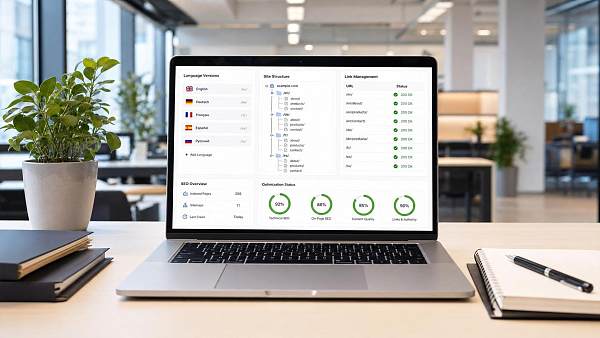
When optimizing SEO for multilingual international trade websites, the real difference often lies not in the quantity of content, but in the accuracy of the initial structural assessment. How to split the language site, how to differentiate between country versions, and whether independent domains are needed all affect crawling efficiency, authority accumulation, and subsequent conversion rates.
In practice, many websites only address their multilingual strategies after launch. The result is competition between English and less commonly used language sites, duplicate indexing of the same product page, fragmented inquiry entry points, and difficulty in coordinating advertising and organic traffic. SEO optimization for multilingual international trade websites requires first clarifying the site network, subdirectories, and hreflang before considering content expansion.
This is also the most easily underestimated aspect of an integrated website and marketing service project. Website building, SEO, advertising, and social media may seem like different modules, but if the site structure is off from the start, the subsequent promotion costs will continue to increase.
Why do similar business operations often have different structural solutions?
There is no single, universal answer to SEO optimization for multilingual international trade websites. This is because different businesses face varying levels of market maturity, product complexity, regional differences, and customer acquisition paths. The SEO strategy must align with business objectives, not just technological habits.
If the focus is on long-term organic traffic from North America and Europe, then the concentration of authority on the main site is usually more important. If multiple regions are targeted and operated independently, with significant differences in policies, pricing, and content, then the management value of a network of independent sites becomes higher. While they may all appear to be going global, the actual judgment points are completely different.
More commonly, some companies have both a brand website and a cross-border e-commerce platform, while also handling B2B inquiries and B2C transactions. In this case, SEO optimization for multilingual foreign trade websites cannot focus solely on search engine rankings; it must also consider content production efficiency, page reuse, ad landing page retention, and subsequent data attribution.
Let's first look at three high-frequency structures: site clusters, subdirectories, and subdomains.
When the main site is strong, subdirectories are usually more stable.
If the main domain already has a certain level of indexing, and the core products, brand information, and technical content are not significantly different across language versions, subdirectories are often a more suitable approach. For example, placing German, Spanish, and French versions under the same main site helps concentrate authority and makes unified maintenance easier.
In this scenario, the focus of SEO optimization for multilingual foreign trade websites is not on creating more websites, but on solidifying the site's information architecture, language switching logic, and regional page mapping. As long as the directory is clear and the content is not machine-translated, growth will be more stable.
When there are significant regional differences, website clusters are more likely to amplify the localization effect.
Some industries have significantly different search habits and conversion paths in the Middle East, Russian-speaking regions, and Latin America, and their product certifications, delivery methods, and case studies also differ. In these cases, continuing to place everything on a single main site may not be the best option. A network of independent websites allows for the separate setting of content pacing, conversion pages, and advertising strategies for each market.
However, a website network is not as simple as just opening more websites. It is more suitable for projects with continuous operational capabilities; otherwise, it is easy for each website to have insufficient content depth and weak indexing, resulting in seemingly wider coverage but actually more scattered authority.
Subdomains are suitable for separating business lines, but not for lazy transitions.
Subdomains are often seen as a compromise, but they are better suited for scenarios where product lines, online stores, and official websites are separated, or where the technical architecture must be independent. If different languages are split into subdomains simply for ease of development, SEO optimization of multilingual foreign trade websites will be more difficult later on, and the transfer of authority will not be as direct as with subdirectories.
The key considerations differ depending on the business scenario.
To avoid making structural selections based on intuition, it's advisable to break down the business scenario first. The following categories are the most common in actual projects.
If the project itself also requires advertising, social media traffic generation, and AI search visibility enhancement, the site structure must further support omnichannel collaboration. Platforms like YiYingBao, which cover website building, SEO, advertising, and content optimization, are valuable because they allow for integrated planning of the technical structure and customer acquisition path from the outset, rather than fragmented decision-making.
hreflang is not a technical detail, but rather a diversion valve for SEO optimization of multilingual foreign trade websites.
Many websites don't lack content; rather, search engines can't distinguish which version to assign to which region. If hreflang is done correctly, English pages won't repeatedly compete with Australian and Canadian pages; if it's done incorrectly, at best the indexing will be chaotic, and at worst, multiple versions will lose visibility simultaneously.
Before implementation, three things need to be confirmed: whether the language code is standardized, whether the pages correspond one-to-one, and whether different versions refer back to each other. Many projects only set hreflang on the homepage, without synchronizing it on product pages and article pages, resulting in the core traffic pages being the first to experience problems.
- For the same language but different regions, you should differentiate by region version, and not just write a single universal language code.
- Do not force cross-links between pages that do not have corresponding translations, otherwise it will cause incorrect mappings.
- If you are redirected back to the homepage after switching languages, it means that the structure has not been truly integrated.
Rapid content creation does not equate to effective SEO optimization for multilingual e-commerce websites.
A common misconception is to translate hundreds of pages in batches first, and then gradually fix the structure. In reality, structural errors will amplify the problems as new content is added. This is especially true when product parameter pages, application pages, and case study pages use the same template, resulting in a very high degree of repetition.
Another misjudgment is treating all languages with the same priority. In real-world operations, the content strategies for North American English websites, multilingual European websites, and Russian-speaking websites cannot be completely identical. SEO optimization for multilingual e-commerce websites requires prioritizing primary and secondary languages, then varying the depth of application, rather than applying a one-size-fits-all approach.
For manufacturing websites, the focus is typically on creating core product pages, solution pages, and high-intent article pages first. For cross-border e-commerce platforms, it's even more important to prioritize category pages, filter pages, brand pages, and review content. The priority of structure and content must align with the business path.
Truly practical adaptation suggestions often focus on these steps.
If you are preparing to start SEO optimization for a multilingual foreign trade website, you can first make judgments in this order, instead of directly entering the translation and article posting stage.
- First, identify the target market level, distinguishing between core markets, test markets, and supplementary markets.
- Further confirm the site structure: is the main site centralized, or are key areas separated into individual sites?
- Plan hreflang, canonical links, and sitemaps together to avoid adding them later.
- Establish multilingual keyword mappings around inquiry pages, category pages, and product pages.
- Simultaneously consider reusing ad landing pages, social media entry points, and AI search content.
The value of this process lies in viewing website building and marketing within the same framework. This is especially important for multi-regional projects; without a robust system, it's difficult to simultaneously balance page generation efficiency, technical specifications, and subsequent growth momentum.
Ask these questions before you land.
Whether SEO optimization for a multilingual international trade website is effective can often be determined before launch. The key is not which solution is chosen, but whether that solution matches existing resources and future operational pace.
Let's start by addressing four key questions: Does the core market require a separate content strategy? Does the existing main site already have a solid authority base? Does it have the capability for continuous updates? Can pages in different languages truly correspond? Once these questions are answered clearly, the structural choices will usually become clear.
Website clusters, directories, and hreflang may seem like technical options, but they are essentially about designing a growth path. By first clarifying the scenario, goals, and execution conditions, SEO optimization for multilingual foreign trade websites will go beyond superficial indexing and truly capture overseas traffic and conversions.
Related Articles
 What are the fundamental differences between B2B website translation and B2C website translation?
 Website Localization Is More Than Translation: What Else Should Be Adjusted Before Entering a New Market?
 How Can Multilingual Website Translation Avoid Machine Translation Distortion and Brand Messaging Inconsistencies


Related Products
 Yiyingbao SaaS Intelligent Website Building and Marketing SystemYiyingbao SaaS Intelligent Website Building and Marketing System, AI-powered no-code website building, rapid creation of multilingual B2B international websites in 10 minutes, global server acceleration, AI-powered SEO optimization, helping businesses connect efficiently with global markets. The perfect integration of technology and operation makes building an international trade website remarkably simple
 AI+SEM Intelligent Advertising Marketing SystemAI+SEM drives intelligent ad creation, empowering full-funnel precision advertising marketing. The system automatically generates weekly/monthly reports, AI recommends keywords and target countries, monitors core metrics in real-time with intelligent alerts, and enables one-click high-conversion ad solutions to help quickly acquire customers and improve ROI.
 AI+SEO Dual-Engine System Optimization ServicesYiyingbao’s AI+SEO dual-engine optimization system helps foreign trade enterprises acquire high-quality organic traffic through AI-powered keyword research, content generation, and comprehensive technical optimization, significantly improving search rankings and conversion rates.
 AI+SNS Social Media Marketing SystemYingbao AI+SNS Social Media Marketing System - Precision social capture for the social media era. Supports one-click content synchronization across major platforms like Facebook and LinkedIn. AI intelligently rewrites posts for enhanced relevance. 24/7 AI customer service and user profiling analysis empower businesses to efficiently expand into global markets.
 AI+SEO营销解决方案易营宝AI+SEO营销解决方案,通过AI批量写作、智能生成TDK、精准关键词扩词等功能,全面优化网站SEO效果,提升流量与转化率。助力企业构建高效智能网站新生态。
 AI+SEM Advertising Marketing SolutionsAI+SEM Advertising Marketing Solution leverages AI technology to deeply empower SEM ad campaigns. It automatically generates weekly/monthly reports using AI, presenting account data across multiple dimensions for comprehensive insights into campaign performance and trends. The system precisely recommends keywords and target countries, intelligently generates high-conversion ad copy, and enables one-click activation of efficient campaign plans to help businesses rapidly acquire customers. Simultaneously, it monitors core metrics in real time, intelligently identifies abnormal fluctuations, and issues timely alerts to ensure stable, high-return advertising results.
 Domain Name ServicesEasyWin provides professional domain name services, including intelligent queries, one-stop registration, brand protection, and full lifecycle management, helping businesses build a digital brand image.
 EasyOperate B2C Cross-Border E-Commerce Platform & Independent WebsiteEasyStore B2C Cross-border E-commerce Independent Store is an intelligent website building and cross-border e-commerce integrated solution independently developed by EasyStore Information Technology (Beijing) Co., Ltd. The system is specially designed for small and medium-sized as well as large export enterprises, integrating 'website building, operation, marketing, advertising, and conversion' into one, helping enterprises quickly establish cross-border e-commerce independent stores to achieve brand globalization and global sales growth.
The platform supports multiple languages, multiple currencies, and multi-channel marketing, with built-in AI intelligent translation and SEO optimization systems, suitable for mainstream markets such as Southeast Asia, Europe and America, Latin America, and the Middle East, assisting Chinese manufacturing enterprises in efficiently deploying international e-commerce strategies. SSL证书易营宝提供专业SSL安全证书服务,包括单域名和泛域名证书,确保网站数据传输加密、身份验证和完整性保护,助力企业建立安全可信的在线业务环境。









