









- Which customer acquisition channels will be affected by cross-border marketing trends in 2026?Sep 06, 2026View details
- Which homogenization risks should be considered in an analysis of the AI-powered website building industry?Aug 30, 2026View details
- How Will AI Marketing Trends 2026 Change Advertising Budget AllocationAug 28, 2026View details
- Is the EV SSL certificate market shrinking or upgrading? How should companies assess certificate procurement?Aug 11, 2026View details
- Why the old AMP SEO 2020 practices no longer work and what has changed in current optimization prioritiesAug 02, 2026View details
- How to Choose Topics for an Industry News Section to Attract More Organic Search TrafficJul 29, 2026View details
How should a multilingual product page development solution be planned? Specification display, translation strategy, and SEO layout recommendations
For a multilingual product page development plan, first clarify the information architecture
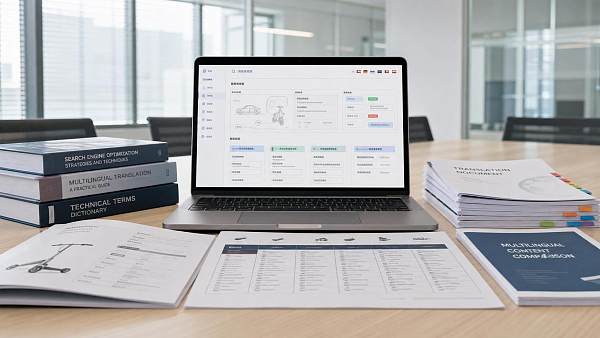
How to define a multilingual product page development plan may seem like a page-level issue on the surface, but in practice it affects inquiry efficiency, project collaboration, and subsequent promotion costs.
Many companies rush into translation at the very beginning. As a result, after the pages go live, specifications are confusing, terminology is inconsistent, and search traffic fails to grow.
For engineering, manufacturing, and global expansion companies, a product page is not a brochure. It is a core entry point that combines sales communication, technical explanation, and search-driven lead generation.
Therefore, a multilingual product page development plan must first solve three practical questions: whether customers can understand it, whether the team can maintain it, and whether search engines can accurately understand it.
Recent changes show that overseas procurement increasingly relies on search and self-service comparison. Once the page information is incomplete, users will leave very quickly.
This also means that a good multilingual product page development plan is not simply about changing Chinese content into another language, but about reorganizing information around the actual decision-making path.
How specifications are presented determines whether customers are willing to continue the conversation
Specification presentation is the foundational layer in a multilingual product page development plan, and it is also the layer most easily underestimated.
If a page only lists product selling points without key parameters, it is difficult for procurement and technical personnel to move to the next step.
A more common problem is that there are many parameters, but they are arranged in a confusing order and use inconsistent units, forcing overseas customers to confirm details repeatedly by themselves.
Follow the decision-making order first, not the order of internal materials
In actual business scenarios, product pages should prioritize answering what customers care about first, rather than copying the structure of a brochure catalog.
It is generally recommended to organize the content by “application scenarios, core capabilities, key parameters, standards and certifications, delivery methods, and customization support”.
This arrangement better matches the browsing habits of overseas users and is also more suitable for SEO to identify the page topic.
Structure specification information as much as possible
In a multilingual product page development plan, specification content is best presented with tables, grouped lists, and short paragraphs, rather than long-form explanations.
Structured presentation has two benefits: first, users can scan information faster; second, later multilingual expansion becomes more stable.
For complex equipment, selection guidance, common configuration combinations, and download access points can also be added to reduce repetitive communication in the early stage.
Specification presentation should also support conversion
A high-quality multilingual product page development plan will not separate the parameter section from the conversion section.
Placing action entry points near the parameters, such as requesting a quote, requesting samples, downloading specifications, and getting a solution, makes conversion more natural.
Do not pursue speed alone in translation strategy; consistency and maintainability matter more
Translation strategy is the part of a multilingual product page development plan that is most prone to rework. Many projects go online slowly not because technology becomes a bottleneck, but because the content is revised repeatedly.
The reason is straightforward: no terminology database has been built, language priorities have not been set, and review responsibilities are unclear.
Segment content first, then decide the translation depth
Not all content needs the same level of refinement. A multilingual product page development plan can divide content into three levels.
- Core sales layer: titles, selling points, parameters, and inquiry forms, with manual proofreading as the priority.
- Supporting explanation layer: application scenarios, delivery explanations, and FAQs, using AI first drafts plus human review.
- Extended content layer: news, cases, and partial explanations, which can be gradually completed according to market priority.
This arrangement is more suitable for cost control and also enables the multilingual product page development plan to be implemented quickly.
Terminology, units, and standard names must be consistent
The translation risk for engineering products does not lie in whether the sentences sound polished, but in whether professional terms are accurate.
If the same component has two different names, or metric and imperial units are mixed, customers will directly question the level of professionalism.
Therefore, before a multilingual product page development plan goes live, at minimum a terminology list, unit conversion rules, and a list of prohibited terms should be established.
For different markets, do not rely on literal translation only
North America, Europe, the Middle East, and Southeast Asia do not prioritize the same information on product pages.
Some markets look at certifications first, some care more about lead times, and some focus on comparing after-sales support.
At this point, the multilingual product page development plan needs localized expression rather than mechanical translation.
How SEO layout should work together to make product pages truly generate traffic
Without an SEO layout, even the most complete multilingual product page development plan may only become an online resource library.
Pages that can continuously acquire customers are usually well executed in content structure, keyword strategy, and technical settings at the same time.
Keywords should align with procurement search behavior
Application-solution pages are not suitable for focusing on only one broad keyword. A combined layout is more effective.
- Core keyword: multilingual product page development plan.
- Long-tail keywords: product page translation strategy, specification presentation solution, multilingual SEO layout.
- Scenario keywords: global website for manufacturing companies, engineering equipment product page optimization, overseas inquiry page development.
- Question keywords: how to build multilingual product pages, how to improve indexing for product specification pages.
The benefit of doing this is that it can cover both decision-making searches and searches for practical problems.
Each language page should have independent value
A multilingual product page development plan cannot rely only on automatic language switching. Each language page should have its own title, description, and body content focus.
At the same time, page URLs, breadcrumbs, internal linking relationships, and language annotations should also be planned together to avoid confusion in search engine recognition.
The content layout should serve both indexing and conversion
A more obvious signal is that product pages with stable rankings are usually not thin pages.
In addition to basic introductions, they also supplement application scenarios, FAQs, certification explanations, delivery processes, and related product recommendations.
This type of content can increase time on page and also strengthen the search performance of a multilingual product page development plan.
How to advance implementation to reduce rework and communication costs
Even the best multilingual product page development plan can easily remain at the document stage if there is no clear process.
A more stable approach is to proceed by “validating on a small scale first, then replicating in batches”.
- First select 1 to 3 core products to validate the page structure, translation process, and SEO rules.
- Build a terminology database, parameter templates, and document naming standards at the same time.
- Set the first batch of launch languages and priority pages according to the target markets.
- After launch, track indexing, bounce rate, inquiry rate, and time on page.
- Replicate effective templates to product series and form a standardized development mechanism.
For companies that need to coordinate website development, SEO, and overseas marketing, choosing a service provider with systematic capabilities will significantly improve implementation efficiency.
AI-driven website development and marketing platforms like 易营宝 are better suited to handling page generation, content optimization, and promotion coordination issues in multilingual product page development plans.
Especially in multilingual site management, Google SEO optimization, advertising landing page connection, and AI search visibility improvement, they can reduce a great deal of repetitive work.
Ultimately, a multilingual product page development plan is not a single-page task, but a set of content and operation mechanisms oriented toward overseas growth.
Only by first making specification presentation clear, then connecting the translation strategy and SEO layout, can the page truly become a business asset that can be indexed, converted, and continuously amplified.
Related Articles

Related Products
 Yiyingbao SaaS Intelligent Website Building and Marketing SystemYiyingbao SaaS Intelligent Website Building and Marketing System, AI-powered no-code website building, rapid creation of multilingual B2B international websites in 10 minutes, global server acceleration, AI-powered SEO optimization, helping businesses connect efficiently with global markets. The perfect integration of technology and operation makes building an international trade website remarkably simple
 AI+SEM Intelligent Advertising Marketing SystemAI+SEM drives intelligent ad creation, empowering full-funnel precision advertising marketing. The system automatically generates weekly/monthly reports, AI recommends keywords and target countries, monitors core metrics in real-time with intelligent alerts, and enables one-click high-conversion ad solutions to help quickly acquire customers and improve ROI.
 AI+SEO Dual-Engine System Optimization ServicesYiyingbao’s AI+SEO dual-engine optimization system helps foreign trade enterprises acquire high-quality organic traffic through AI-powered keyword research, content generation, and comprehensive technical optimization, significantly improving search rankings and conversion rates.
 AI+SNS Social Media Marketing SystemYingbao AI+SNS Social Media Marketing System - Precision social capture for the social media era. Supports one-click content synchronization across major platforms like Facebook and LinkedIn. AI intelligently rewrites posts for enhanced relevance. 24/7 AI customer service and user profiling analysis empower businesses to efficiently expand into global markets.
 AI+SEO营销解决方案易营宝AI+SEO营销解决方案,通过AI批量写作、智能生成TDK、精准关键词扩词等功能,全面优化网站SEO效果,提升流量与转化率。助力企业构建高效智能网站新生态。
 AI+SEM Advertising Marketing SolutionsAI+SEM Advertising Marketing Solution leverages AI technology to deeply empower SEM ad campaigns. It automatically generates weekly/monthly reports using AI, presenting account data across multiple dimensions for comprehensive insights into campaign performance and trends. The system precisely recommends keywords and target countries, intelligently generates high-conversion ad copy, and enables one-click activation of efficient campaign plans to help businesses rapidly acquire customers. Simultaneously, it monitors core metrics in real time, intelligently identifies abnormal fluctuations, and issues timely alerts to ensure stable, high-return advertising results.
 Domain Name ServicesEasyWin provides professional domain name services, including intelligent queries, one-stop registration, brand protection, and full lifecycle management, helping businesses build a digital brand image.
 EasyOperate B2C Cross-Border E-Commerce Platform & Independent WebsiteEasyStore B2C Cross-border E-commerce Independent Store is an intelligent website building and cross-border e-commerce integrated solution independently developed by EasyStore Information Technology (Beijing) Co., Ltd. The system is specially designed for small and medium-sized as well as large export enterprises, integrating 'website building, operation, marketing, advertising, and conversion' into one, helping enterprises quickly establish cross-border e-commerce independent stores to achieve brand globalization and global sales growth.
The platform supports multiple languages, multiple currencies, and multi-channel marketing, with built-in AI intelligent translation and SEO optimization systems, suitable for mainstream markets such as Southeast Asia, Europe and America, Latin America, and the Middle East, assisting Chinese manufacturing enterprises in efficiently deploying international e-commerce strategies. SSL证书易营宝提供专业SSL安全证书服务,包括单域名和泛域名证书,确保网站数据传输加密、身份验证和完整性保护,助力企业建立安全可信的在线业务环境。









