









- Which customer acquisition channels will be affected by cross-border marketing trends in 2026?Sep 06, 2026View details
- Which homogenization risks should be considered in an analysis of the AI-powered website building industry?Aug 30, 2026View details
- How Will AI Marketing Trends 2026 Change Advertising Budget AllocationAug 28, 2026View details
- Is the EV SSL certificate market shrinking or upgrading? How should companies assess certificate procurement?Aug 11, 2026View details
- Why the old AMP SEO 2020 practices no longer work and what has changed in current optimization prioritiesAug 02, 2026View details
- How to Choose Topics for an Industry News Section to Attract More Organic Search TrafficJul 29, 2026View details
For Multilingual SEO Site Structure: Should You Use Subdirectories or Subdomains First?
When many companies move forward with overseas independent websites, what really holds up the project is often not whether to implement multiple languages, but an earlier question: should the basic multilingual SEO structure of the independent website use directories or subdomains first? This decision may appear to be a technical choice, but it actually affects indexing efficiency, authority transfer, content collaboration, development schedules, and even the pace of subsequent advertising and localization operations. For project managers and engineering leads, it is more important to clarify the structure at the beginning than to keep repairing it later.
If a multilingual website is viewed as a long-term growth project, “directory or subdomain” is not an aesthetic question, but a resource allocation issue. Will your website rapidly expand into multiple markets, or will it initially focus on a few key countries? Does the team have stable technical support? Will content updates be managed centrally, or will each language operate independently? These factors determine that there will never be only one answer.
The conclusion first: directories are more suitable for most companies in the early stage; consider subdomains when operating multiple markets independently
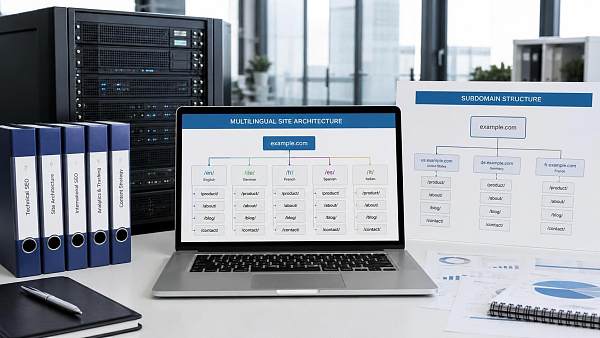
In most international expansion projects, especially those with limited budgets, limited SEO history, and teams that want to launch quickly and establish a complete indexing cycle, a directory structure is usually the more stable choice. For example:
example.com/en/example.com/de/example.com/ja/
The core advantage of this approach is not simply that it “looks tidy,” but that it makes it easier to consolidate the authority of the main domain. When a new website has not yet accumulated sufficient history and backlinks in Google, directories generally make it easier to share the trust signals already established by the main site than subdomains do. For project implementation, directories also facilitate unified technical deployment, template maintenance, internal linking, and data analysis.
A subdomain structure, on the other hand, looks like this:
en.example.comde.example.comja.example.com
This does not mean that subdomains cannot be used. On the contrary, they are well suited to companies whose regional markets differ significantly, whose operations teams are distributed, whose content strategies are independent, or whose server deployment and legal requirements vary. However, subdomains generally require higher management costs, SEO startup costs, and coordination capabilities.
Why do project leaders often hesitate repeatedly over this issue?
Because this is not a decision that can be made by a single department. Technical teams consider deployment complexity, marketing teams focus on SEO performance, content teams care about translation and update efficiency, and management is more concerned with whether the business can scale smoothly in the future. Many projects initially focus only on “which structure is more SEO-friendly,” but discover three months after launch that the real time-consuming issues are confusing URL rules, interference between language versions, and inconsistent hreflang annotations. Eventually, the project can only be reworked.
Therefore, the key to building the basic multilingual SEO structure of an independent website is not to apply a “standard answer,” but first to determine how your website will develop over its next three steps.
What scenarios are directory structures suitable for?
If your goal is to quickly expand one primary brand across multiple languages, directories are more suitable. They are especially appropriate for the following types of projects:
- The main domain is new and its SEO authority is still accumulating
- Multilingual pages are centrally managed through the same CMS or website-building system
- Development, content, and SEO are coordinated by one core team
- The core products are the same, with only language adaptations for different countries
- You want internal links, resource pages, and blog content to share SEO value as much as possible
For engineering leads, directory structures offer another very practical benefit: path rules are clear, making sitemaps, canonical tags, language switching, log monitoring, and permission configuration easier to standardize. This is particularly important for teams focused on delivery efficiency.
Take an integrated website-building and international marketing project as an example. If a company is still at the stage of “testing the market first and gradually expanding language versions,” directories can usually reduce the cost of trial and error. Platforms such as 易营宝, which support multilingual website development, SEO optimization, and coordinated subsequent promotion, essentially help companies place website development, indexing, and marketing data into a system where they can work together more easily. A directory structure is often more conducive to this type of centralized management.
Subdomain structures are not outdated; they are more like a choice of organizational capabilities
Some teams immediately rule out subdomains when they hear that “subdomain authority is dispersed,” but this is not entirely accurate. Google does not simply classify subdomains as an inferior structure. The real question is whether you have the ability to operate each subdomain as a semi-independent website.
Subdomains are more suitable in the following situations:
- Product lines, pricing, and content systems differ significantly between country websites
- Each region has an independent operations team that needs to publish and iterate autonomously
- Server, compliance, or access-speed requirements differ across markets
- The brand portfolio is complex and stronger management boundaries are desired for different regions
- Some websites may eventually develop into independent regional business units
For example, a company may operate a European and American B2B corporate website, a localized brand website for the Middle East, and a Japan-specific online store at the same time. These three sites differ not only in language, but also in user journeys, conversion objectives, and page design logic. In such cases, forcing them into the same directory may not be more convenient than using subdomains. Although this may appear to save effort on SEO structure, it could actually create greater risks for team collaboration.
What really affects SEO performance is not just “directory vs. subdomain”
Many people place too much emphasis on structural selection while overlooking several fundamentals that determine the success or failure of multilingual SEO. Even if you use a directory structure that is “theoretically more advantageous,” indexing and rankings may still suffer if the following details are not handled properly.
1. hreflang annotations must be accurate
Multilingual pages must clearly tell search engines that they are corresponding versions of the same topic in different languages or regions. If hreflang is missing, pages do not reference each other, or language codes are used incorrectly, page mismatches can occur easily. Users in Germany may find an English page, while users in Japan may find a Simplified Chinese page. This directly affects user experience and conversions.
2. Do not publish machine-translated content in bulk without review
When a project is rushing to meet a schedule, the easiest mistake is to think, “Put the translations online first and deal with the rest later.” However, multilingual SEO is not simply about converting text into another language; it is about localizing search intent. Industry terminology, purchasing expressions, usage scenarios, and title formats may all differ. What appears to save time may later slow overall performance because of low-quality content, high bounce rates, and duplicate pages.
3. Standardize URL rules from the beginning
For example, should language directories always use lowercase? Should the original English slug be retained? How should translated URLs be handled? Should product pages and blog pages follow the same rules? If these issues are adjusted frequently after launch, they can generate numerous redirects and indexing fluctuations. Project leaders are often most concerned about this kind of “rework after launch.”
4. Do not implement language switching as merely a front-end button
Many websites appear to offer language switching, but in practice they only redirect users to the homepage, or the pages in different languages do not correspond one-to-one. A user may switch from an English product page to German, only to be returned to the German homepage. This experience affects both conversions and search engines’ ability to understand the relationships between pages.
If the website is still in the planning stage, use this logic to make a quick decision
To prevent the discussion from becoming abstract, you can make the decision by asking four questions:
- Has your main domain accumulated significant SEO authority? If not, prioritize directories to consolidate authority.
- Is multilingual content managed by a centralized team? If so, directories reduce communication costs.
- How different are the websites for different countries? If the only difference is language, directories are sufficient; if the business models are also different, subdomains offer greater flexibility.
- Will you significantly expand your language versions and regions over the next year? If expansion will involve independent teams, subdomains can reserve clearer management boundaries in advance.
The value of this decision-making method is that it prevents technical decisions from becoming detached from business objectives. What project managers need most is not the “most correct” structure, but the structure least likely to undermine execution at the current stage.
Common misconception: trying to achieve “internationalization” all at once and ending up weakening the foundation
When many companies first build overseas websites, they like to design a grand architecture: more than a dozen languages, multiple subdomains, complex redirection rules, local server distribution, and so on. It sounds comprehensive, but during implementation they discover that content, maintenance, and SEO signals cannot keep up or remain centralized. In the end, every language website looks unfinished.
For most foreign trade companies, manufacturing factories, and brands expanding internationally, a more practical approach is to first build a sustainable multilingual main-site framework and then gradually deepen operations around key markets. This pace aligns better with how search engines understand website growth and is also more suitable for the execution capabilities of real teams.
When implementing the project, include the “structural decision” in the requirements document
If you are responsible for advancing a website development project, do not decide verbally in meetings whether to use directories or subdomains. Instead, document the relevant rules in the requirements document, including:
- Naming conventions for language versions and country versions
- URL structure rules and rules for future expansion
- hreflang implementation method
- Sitemap segmentation logic
- Scope of page template reuse
- Content update processes for different languages
- Whether SEO, advertising, and social media landing pages will share the same structure
The purpose is straightforward: to reduce rework and enable the website development, SEO, advertising, and content teams to work from the same blueprint. Especially for companies implementing Google SEO, advertising, and overseas social media lead generation at the same time, if the website structure is disorganized from the beginning, the cost will increase with every additional channel.
Returning to the original question, should the basic multilingual SEO structure of an independent website start with directories or subdomains? If you want an answer suitable for most projects, it is this: first use directories to establish a stable main site, then evaluate whether to split into subdomains based on the need for independent regional operations. This is not a conservative approach; it is a path that better reflects the principles of SEO accumulation and the realities of project management.
When structure serves growth instead of merely making a website “look international,” a multilingual website can truly deliver long-term value. For engineering leads and project managers, what is most worth pursuing is never an architecture that is conceptually perfect, but one that the team can execute continuously, search engines can understand, and global customers can access smoothly.
Related Articles
Related Products
 Yiyingbao SaaS Intelligent Website Building and Marketing SystemYiyingbao SaaS Intelligent Website Building and Marketing System, AI-powered no-code website building, rapid creation of multilingual B2B international websites in 10 minutes, global server acceleration, AI-powered SEO optimization, helping businesses connect efficiently with global markets. The perfect integration of technology and operation makes building an international trade website remarkably simple
 AI+SEM Intelligent Advertising Marketing SystemAI+SEM drives intelligent ad creation, empowering full-funnel precision advertising marketing. The system automatically generates weekly/monthly reports, AI recommends keywords and target countries, monitors core metrics in real-time with intelligent alerts, and enables one-click high-conversion ad solutions to help quickly acquire customers and improve ROI.
 AI+SEO Dual-Engine System Optimization ServicesYiyingbao’s AI+SEO dual-engine optimization system helps foreign trade enterprises acquire high-quality organic traffic through AI-powered keyword research, content generation, and comprehensive technical optimization, significantly improving search rankings and conversion rates.
 AI+SNS Social Media Marketing SystemYingbao AI+SNS Social Media Marketing System - Precision social capture for the social media era. Supports one-click content synchronization across major platforms like Facebook and LinkedIn. AI intelligently rewrites posts for enhanced relevance. 24/7 AI customer service and user profiling analysis empower businesses to efficiently expand into global markets.
 AI+SEO营销解决方案易营宝AI+SEO营销解决方案,通过AI批量写作、智能生成TDK、精准关键词扩词等功能,全面优化网站SEO效果,提升流量与转化率。助力企业构建高效智能网站新生态。
 AI+SEM Advertising Marketing SolutionsAI+SEM Advertising Marketing Solution leverages AI technology to deeply empower SEM ad campaigns. It automatically generates weekly/monthly reports using AI, presenting account data across multiple dimensions for comprehensive insights into campaign performance and trends. The system precisely recommends keywords and target countries, intelligently generates high-conversion ad copy, and enables one-click activation of efficient campaign plans to help businesses rapidly acquire customers. Simultaneously, it monitors core metrics in real time, intelligently identifies abnormal fluctuations, and issues timely alerts to ensure stable, high-return advertising results.
 Domain Name ServicesEasyWin provides professional domain name services, including intelligent queries, one-stop registration, brand protection, and full lifecycle management, helping businesses build a digital brand image.
 EasyOperate B2C Cross-Border E-Commerce Platform & Independent WebsiteEasyStore B2C Cross-border E-commerce Independent Store is an intelligent website building and cross-border e-commerce integrated solution independently developed by EasyStore Information Technology (Beijing) Co., Ltd. The system is specially designed for small and medium-sized as well as large export enterprises, integrating 'website building, operation, marketing, advertising, and conversion' into one, helping enterprises quickly establish cross-border e-commerce independent stores to achieve brand globalization and global sales growth.
The platform supports multiple languages, multiple currencies, and multi-channel marketing, with built-in AI intelligent translation and SEO optimization systems, suitable for mainstream markets such as Southeast Asia, Europe and America, Latin America, and the Middle East, assisting Chinese manufacturing enterprises in efficiently deploying international e-commerce strategies. SSL证书易营宝提供专业SSL安全证书服务,包括单域名和泛域名证书,确保网站数据传输加密、身份验证和完整性保护,助力企业建立安全可信的在线业务环境。









