









- Which customer acquisition channels will be affected by cross-border marketing trends in 2026?Sep 06, 2026View details
- Which homogenization risks should be considered in an analysis of the AI-powered website building industry?Aug 30, 2026View details
- How Will AI Marketing Trends 2026 Change Advertising Budget AllocationAug 28, 2026View details
- Is the EV SSL certificate market shrinking or upgrading? How should companies assess certificate procurement?Aug 11, 2026View details
- Why the old AMP SEO 2020 practices no longer work and what has changed in current optimization prioritiesAug 02, 2026View details
- How to Choose Topics for an Industry News Section to Attract More Organic Search TrafficJul 29, 2026View details
How much does it cost to have a website in 2 languages based on its features and maintenance model
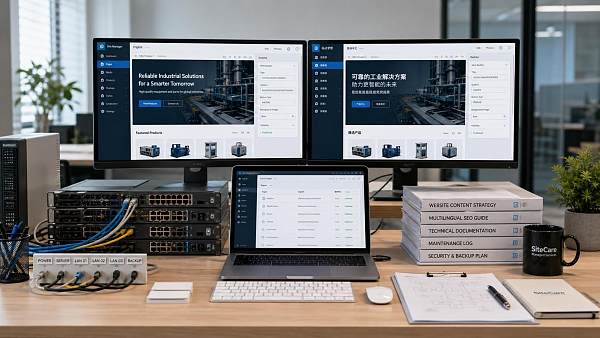
cuanto cuesta tener una web en 2 idiomas — don't rush to ask for a fixed quote. What really creates the cost difference is usually not the fact that there is “one more language version,” but two types of variables: one is how extensive the website's functions need to be, and the other is who will maintain it later and how it will be maintained. If the procurement stage focuses only on the number of homepage sections or the total number of pages, additional budget will often be required later for translation rework, page synchronization, plugin renewals, and technical adjustments.
If it is only a showcase website with a relatively simple structure, where the two language versions share the same layout and content differences between product pages, news pages, and contact pages are limited, the cost is usually concentrated on language-switching logic, bilingual content entry, basic SEO field configuration, and link and layout proofreading before launch. If the website includes inquiry forms, product filtering, member login, quotation downloads, regional redirection, an independent blog directory, or different content for different markets and languages, development, testing, and maintenance hours will increase significantly. What many people underestimate is not the initial construction cost, but the fact that “a second language is not a copy, but the ongoing management of two sets of content.”
Break down the total cost first instead of focusing only on the website development fee
Regarding the question cuanto cuesta tener una web en 2 idiomas, common expenses generally fall into several areas. The domain name, server, or cloud resources are only the underlying costs. What is more easily overlooked includes template or front-end customization, content translation, image replacement, URL rules, language directory configuration, the language of form notifications, whether the on-site search supports both languages, and whether bilingual pages are updated synchronously each time the website is revised.
For example, some websites use the directory structure /es/ and /zh/, while others use subdomains or separate domains. The former is generally easier to maintain centrally, while the latter is more flexible for dividing regional markets, but deployment, analytics, certificates, redirection rules, and SEO management may be more complex. The cost difference may not necessarily appear at the first launch. It becomes apparent later, whenever a new section is added, the navigation is modified, or a form field is replaced, because another round of checks is required.
Translation should not be understood only in terms of word count. Titles, buttons, navigation, product specifications, text embedded in images, PDF materials, pop-up notices, and automatic email replies may all involve language versions. If the original website contains Spanish copy embedded in images, the process is not simply “translating the text once.” New images must also be created, their dimensions checked, and line overflow on mobile devices avoided. This is often where budgets begin to exceed expectations.
When functional complexity changes, the cost structure changes as well
Even when both websites use two languages, the cost logic of a showcase website and a transactional website is completely different. The former focuses on page creation and content organization, while the latter must address more operational details. For example, shopping carts, inventory notices, tax information, shipping coverage, payment pages, refund policies, and invoice information may not be directly shared when different languages correspond to different regions. Even if the program framework is the same, the scope of copy review and testing will expand.
In B2B scenarios, many websites appear to be product showcases but actually have a strong lead-generation function: inquiry forms need to be separated by language, automatic reply emails need to be separated by language, downloadable materials need to be provided in different versions, and product specification tables may involve units such as millimeters, inches, kilograms, and pounds. If the website also has filters, specification comparisons, file downloads, a case library, or a news module, adding a second language does not simply mean entering another copy of the text. It is also necessary to ensure that filters, tags, URLs, breadcrumbs, and on-site recommendation logic all work properly.
The more functions there are, the higher the testing cost. Moreover, this cost cannot be accurately estimated by “page count.” A product center with filtering and search may require more work than ten ordinary content pages. After switching languages, it is necessary to verify separately whether search results are correct, whether any filter options remain untranslated, and whether the no-results page displays the corresponding language prompt.
The maintenance method determines whether additional budget will be repeatedly required later
“Build it first and deal with it later” is usually the beginning of an uncontrolled bilingual website. The reason is that two languages are not a one-time deliverable, but an ongoing system. Different maintenance methods can create a substantial difference in the total cost of ownership for cuanto cuesta tener una web en 2 idiomas.
If each page is maintained manually, every newly added article, product, or landing page must be created, translated, uploaded, linked, and proofread separately. The advantage is controllability, making this approach suitable for websites with limited content and a low update frequency. The disadvantage is that it depends heavily on the process. If only the primary language is updated on one occasion, the other language will gradually fall behind, eventually resulting in inconsistent page information, inconsistent price units, and unsynchronized contact details.
If an associated multilingual content structure is used, maintenance efficiency is generally better, but the initial setup requirements are higher. Field design must be more standardized, and page components, category systems, URL mapping, and language-switching logic must all be planned in advance. If this step is skipped at the beginning, maintenance problems will arise as the number of sections increases, such as “having to manually add associations whenever a language version is added,” “the switch button becoming invalid after an old page is deleted,” and “old links not being redirected.”
Another common misconception is treating machine translation as a complete maintenance solution. It may be suitable for quickly generating a first draft and can shorten entry time, especially when there are many product specification texts. However, titles, industry terminology, button length, marketing copy, legal terms, after-sales information, and Meta information generally still require manual proofreading. Otherwise, although the pages may appear complete, they may contain inaccurate meanings, unnatural wording, or misplaced keywords after launch, ultimately affecting conversion and indexing.
The costs most easily overlooked are often not on the first page of the contract
The hidden costs of a bilingual website often appear in detailed maintenance after launch. For example, plugins, themes, font licenses, map components, form services, email delivery services, security certificates, multisite backups, CDN, image compression, and caching components may be charged per site, per domain, according to traffic, or according to functional modules. If it is not confirmed during procurement whether these are one-time or recurring expenses, the annual costs that follow will be inaccurate.
Content migration is another consideration. If the old website already contains dozens or even hundreds of pages, migrating it to a bilingual website is usually not as simple as copying in bulk. Inconsistent image sizes, irregular old URLs, titles that are unsuitable for another language, tables misaligned on mobile devices, and disorganized download file names will all increase the amount of time required for organization. Technical content such as product models, materials, application descriptions, installation steps, and after-sales terms requires repeated checking during translation and entry and cannot be estimated in the same way as ordinary promotional copy.
The server and access regions also affect long-term costs. If target markets are widely distributed, it may be necessary to consider static resource loading speed, image format compression, caching strategies, and basic protection. Two languages do not necessarily mean double server costs, but as the number of pages, media resources, and backup volume increases, storage, traffic, and operations workload generally increase as well.
To determine whether a quotation is reasonable, check whether the delivery scope is clearly defined
When faced with different quotations, the key is not simply to compare the prices, but to examine the boundaries. “The same item on the surface but different in practice” is especially common with bilingual websites. For example, all quotations may state “multilingual functionality,” but some include only a front-end switching button and not content association. They may all state “page production,” but some include only pages in the primary language, with the second language limited to content entry and excluding layout adjustments. They may all state “SEO configuration,” but some only create the homepage title and description, while others handle the URLs, tags, and sitemaps for each language version.
The questions that really need to be asked are: Who provides the translation, and who proofreads it afterward? Will foreign-language text in images be recreated? Will Meta information be generated separately for each language version? Will email notifications after form submissions be sent according to language? Are reusable templates available for newly added pages? Is content updating charged per occasion or by working hours? Does technical maintenance include security updates, backup restoration, and troubleshooting?
If these boundaries are unclear, the question cuanto cuesta tener una web en 2 idiomas has no basis for comparison. A quotation that appears inexpensive may simply exclude translation, data entry, detailed SEO work, content proofreading, and later maintenance from the contract.
Two common approaches have very different cost logic
One approach is to build a monolingual website first and add a second language later. This method is suitable for projects with tight schedules or content that has not yet been fully organized, provided that a multilingual structure was reserved during the initial construction. Otherwise, when the additional language is added, the navigation, categories, URLs, sitemap, and template fields may all need to be rebuilt. The budget saved initially will then be spent on restructuring.
Another approach is to plan the website as bilingual from the beginning. Even if only some pages are launched in the first phase, the content model, language directories, field standards, and template relationships are established in advance. The initial investment is usually somewhat higher, but subsequent expansion of sections, addition of products, and creation of dedicated pages will be more stable, and maintenance costs will be easier to predict. For websites with a high content update frequency, this difference will gradually become more significant over time.
There is also a practical issue: the two language versions do not necessarily need to be completely equivalent. Some websites provide complete articles, case studies, and downloadable resources in the primary language, while the second language retains only core pages and key products. This approach makes costs more manageable, but it is necessary to define in advance which content must be synchronized and which content may be different. Otherwise, execution can easily become confusing: substantial savings may not be achieved, while the user experience is affected.
If the only purpose is to obtain a number to answer “cuanto cuesta tener una web en 2 idiomas,” the conclusion will often have little reference value. A more reliable approach is to first clarify the functional scope, translation depth, content volume, image processing scope, SEO requirements, and maintenance period. Only after these conditions are clear can the website development fee, renewal costs, and subsequent modification costs be compared meaningfully. The parts of a bilingual website that truly cost money are often not the “second language” itself, but the synchronization, proofreading, testing, and long-term maintenance that surround it.
Related Articles


Related Products
 Yiyingbao SaaS Intelligent Website Building and Marketing SystemYiyingbao SaaS Intelligent Website Building and Marketing System, AI-powered no-code website building, rapid creation of multilingual B2B international websites in 10 minutes, global server acceleration, AI-powered SEO optimization, helping businesses connect efficiently with global markets. The perfect integration of technology and operation makes building an international trade website remarkably simple
 AI+SEM Intelligent Advertising Marketing SystemAI+SEM drives intelligent ad creation, empowering full-funnel precision advertising marketing. The system automatically generates weekly/monthly reports, AI recommends keywords and target countries, monitors core metrics in real-time with intelligent alerts, and enables one-click high-conversion ad solutions to help quickly acquire customers and improve ROI.
 AI+SEO Dual-Engine System Optimization ServicesYiyingbao’s AI+SEO dual-engine optimization system helps foreign trade enterprises acquire high-quality organic traffic through AI-powered keyword research, content generation, and comprehensive technical optimization, significantly improving search rankings and conversion rates.
 AI+SNS Social Media Marketing SystemYingbao AI+SNS Social Media Marketing System - Precision social capture for the social media era. Supports one-click content synchronization across major platforms like Facebook and LinkedIn. AI intelligently rewrites posts for enhanced relevance. 24/7 AI customer service and user profiling analysis empower businesses to efficiently expand into global markets.
 AI+SEO营销解决方案易营宝AI+SEO营销解决方案,通过AI批量写作、智能生成TDK、精准关键词扩词等功能,全面优化网站SEO效果,提升流量与转化率。助力企业构建高效智能网站新生态。
 AI+SEM Advertising Marketing SolutionsAI+SEM Advertising Marketing Solution leverages AI technology to deeply empower SEM ad campaigns. It automatically generates weekly/monthly reports using AI, presenting account data across multiple dimensions for comprehensive insights into campaign performance and trends. The system precisely recommends keywords and target countries, intelligently generates high-conversion ad copy, and enables one-click activation of efficient campaign plans to help businesses rapidly acquire customers. Simultaneously, it monitors core metrics in real time, intelligently identifies abnormal fluctuations, and issues timely alerts to ensure stable, high-return advertising results.
 Domain Name ServicesEasyWin provides professional domain name services, including intelligent queries, one-stop registration, brand protection, and full lifecycle management, helping businesses build a digital brand image.
 EasyOperate B2C Cross-Border E-Commerce Platform & Independent WebsiteEasyStore B2C Cross-border E-commerce Independent Store is an intelligent website building and cross-border e-commerce integrated solution independently developed by EasyStore Information Technology (Beijing) Co., Ltd. The system is specially designed for small and medium-sized as well as large export enterprises, integrating 'website building, operation, marketing, advertising, and conversion' into one, helping enterprises quickly establish cross-border e-commerce independent stores to achieve brand globalization and global sales growth.
The platform supports multiple languages, multiple currencies, and multi-channel marketing, with built-in AI intelligent translation and SEO optimization systems, suitable for mainstream markets such as Southeast Asia, Europe and America, Latin America, and the Middle East, assisting Chinese manufacturing enterprises in efficiently deploying international e-commerce strategies. SSL证书易营宝提供专业SSL安全证书服务,包括单域名和泛域名证书,确保网站数据传输加密、身份验证和完整性保护,助力企业建立安全可信的在线业务环境。









