









- Amazon Raises Fulfillment Fees Twice, Yet the Median Platform Fee Remains Around 40%Oct 22, 2026View details
- AliExpress and YouTube Partner to Expand Marketing Opportunities for Chinese Brands Going GlobalOct 22, 2026View details
- Publicis says AI marketing is developing at two speeds, with agentic AI helping win clientsOct 21, 2026View details
- Salesforce Plans to Acquire Braze for $5.66 Billion to Enhance AI Marketing CapabilitiesOct 21, 2026View details
- Levanta’s Inaugural China Summit Held in Shenzhen, Focusing on AI and Cross-Border Brand GrowthOct 20, 2026View details
- The October Edition of the 2026 GGE Shenzhen Cross-Border E-Commerce Expo OpensOct 20, 2026View details
Can AI content localization cause brand terminology errors?
Yes. AI content localization can indeed lead to brand terminology errors, especially when multilingual websites, advertising landing pages, product catalogs, and social media content need to be produced quickly at scale. It may not mistranslate an entire sentence in an obvious way; more commonly, it replaces seemingly similar terms: product line names are translated literally, feature names are written differently across pages, trademark suffixes are omitted, or industry abbreviations are translated into expressions not used in the local market.
The problem with these issues is not merely that they are “not idiomatic enough.” For overseas users, inconsistent terminology can reduce their perception of brand professionalism; for search engines and AI search systems, repeatedly using different names for the same product entity can also weaken the connections between pages. When technical specifications, compliance statements, medical products, industrial equipment, or software features are involved, even a minor terminology deviation may cause customers to misunderstand product capabilities.
The difference between AI localization, human translation, and machine translation is not whether errors occur
Viewing AI content localization simply as translation often underestimates the risks. Translation aims to convert source content into another language; localization must also address market-specific expression habits, units of measurement, page conversion copy, search terms, cultural context, and brand expression. Therefore, all three approaches can make mistakes; the difference lies in the types of errors and how they are controlled.
Therefore, the question should not be “Will AI content localization cause brand terminology errors?” but rather: Can the current process enable AI to identify which terms must never be changed and which terms can be adjusted for the local market?
The most error-prone items are not just brand names
The primary brand name is usually easier to protect because it can be required to remain unchanged. What is more easily overlooked are other components of the “brand language system.”
- Product lines and models: If series names, module names, and version names are translated into descriptive terms, overseas customers may be unable to match them with the official website, quotations, and manuals.
- Feature and service names: Expressions such as “intelligent inquiry allocation,” “rapid website building,” and “full-funnel marketing” may be fixed product names or merely marketing descriptions. The two types of content should follow different rules.
- Industry terminology: The same Chinese term may correspond to different purchasing practices and professional names in different markets. A literal translation may be correct, but that does not mean buyers will search for it that way.
- Certification, material, and specification descriptions: This type of content is not suitable for allowing models to improvise freely. Units, grades, test names, and restrictions must all be fixed based on the original materials.
- Brand slogans and calls to action: Slogans can usually be localized rather than translated word for word, but core commitments must not be exaggerated or changed during rewriting.
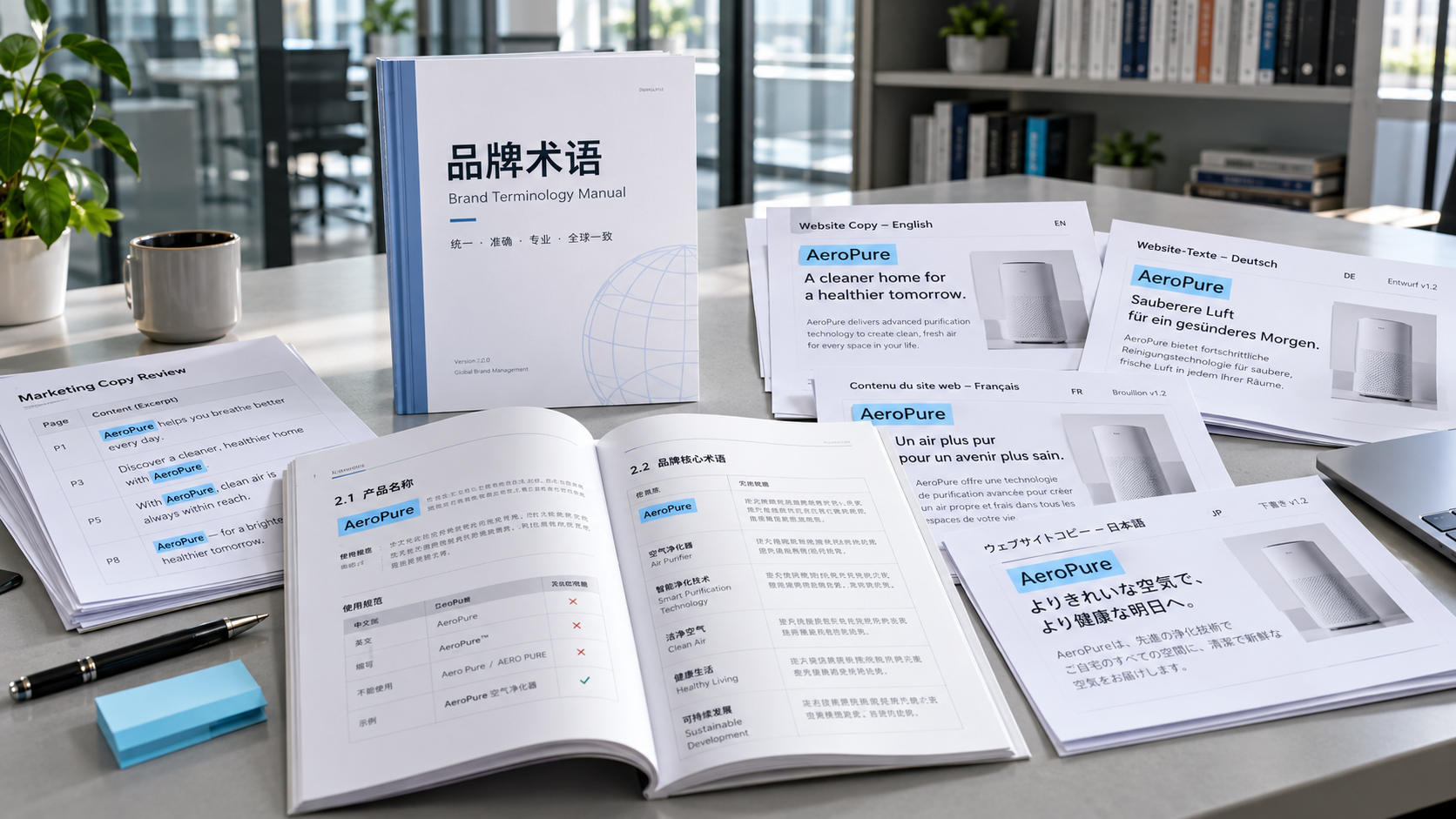
A common misconception is to create a brand glossary but include only the company name. A truly usable terminology database should at least distinguish between “absolutely non-translatable,” “fixed translations permitted,” “requires contextual translation,” and “obsolete names or competitive expressions prohibited.” This prevents AI from treating all proprietary terms as ordinary text.

Input quality and the publishing process determine the level of risk
AI does not inherently know whether a term is a proprietary product name, an industry convention, or ordinary rhetoric. If the source text lacks consistent naming—for example, the Chinese website uses “cloud platform,” sales materials use “intelligent system,” and product pages call it a “management tool”—translation into multiple languages will only create further fragmentation. Standardizing the source language first is often more effective than repeatedly revising translations.
The type of content also determines the level of review required. Blogs, social media topics, and routine SEO pages can use an “AI generation plus spot-checking” approach; however, core product pages, homepage positioning, advertising claims, inquiry form descriptions, and technical materials should not rely on spot checks alone. Once errors appear in such content, they may be reused across templates, ad groups, or sites in multiple countries, making the cost of correction far higher than pre-publication review.
Four practical lines of control
- Organize terminology assets first. Create a maintainable list of brand names, product names, models, feature names, commonly used industry terms, prohibited terms, and target-language standards, and provide application examples.
- Provide the rules to the generation tool. Do not simply enter “translate into English” or “localize into German.” Clearly specify the target market, audience, page purpose, terms to retain, and expressions that must not be exaggerated.
- Review by risk level. Prioritize verification of brand terms, numbers, units, links, and product specifications; tone and readability can be addressed in a second round.
- Establish a feedback loop. Once an error is identified, update the terminology database, prompting rules, and site components rather than correcting only the current page. Otherwise, similar errors will recur in the next generation cycle.
The value of this process lies in shifting from “relying on an individual to remember the correct wording” to “enabling the content system to operate according to consistent rules.” When a website involves multiple versions in English, German, Spanish, Japanese, Arabic, and other languages, whether rules can be centrally maintained has a greater impact on long-term stability than the quality of a single translation.
Which content can allow AI more freedom, and which content must be tightly controlled
Not all copy requires the same level of strict control. If market-oriented expressions are overly restricted, content may become rigid; if high-precision information is insufficiently restricted, it can easily become misleading. A more reasonable approach is to define permissions based on the purpose of the content.
Content that can retain greater room for rewriting includes alternative article titles, short social media copy, blog introductions, scenario descriptions on non-core pages, and long-tail keyword expansion. AI can help adapt common local word order, title length, and expression habits, but it is still necessary to avoid replacing fixed brand terminology with generic terms.
Content that requires strict control includes navigation menus, product names, models, prices and terms, specification parameters, downloadable materials, form fields, promises on advertising landing pages, and privacy and after-sales service statements. The localization goal here is accuracy, clarity, and consistency, rather than stylistic elegance.
For integrated website and overseas marketing operations, terminology consistency should also extend to search promotion and social media channels. If the official website uses one product name, Google Ads uses another translation, and social media topics use yet another wording, customers will experience a disconnect after entering the page from an ad, while data attribution and content maintenance will also become more difficult.
When choosing an AI localization solution, first assess whether it can manage terminology
When comparing tools or services, looking only at “how many languages are supported” is not enough. More practical criteria include: whether a terminology database can be imported and maintained; whether different rules can be applied by site, market, or product line; whether checks can be synchronized after content updates; whether human edits can be consolidated into reusable standards; and whether website pages, SEO content, advertising, and social media content use the same brand language.
For platforms such as Yiyingbao that cover multilingual website building, SEO, advertising, and overseas social media operations, particular attention should be paid in actual use to whether content assets can remain consistent across different marketing touchpoints. For companies that need to continuously update independent websites, run advertisements, and manage content in multiple languages, the value of AI is not merely generating pages faster, but reducing the disconnect between terminology rules, page content, and promotional materials.
AI content localization can significantly improve the efficiency of multilingual content production, but it cannot replace brand naming decisions or assume ultimate responsibility for factual accuracy. Before going live, first confirm whether the terminology database is complete, whether the source content is consistent, and who will review key pages; then decide which content should be handled automatically by AI. By managing these three aspects well, brand terminology errors can shift from uncontrollable hidden risks to manageable content quality issues.
Related Articles
 Building a Website for the Russian-Speaking Market: Is Translating the Website Enough?
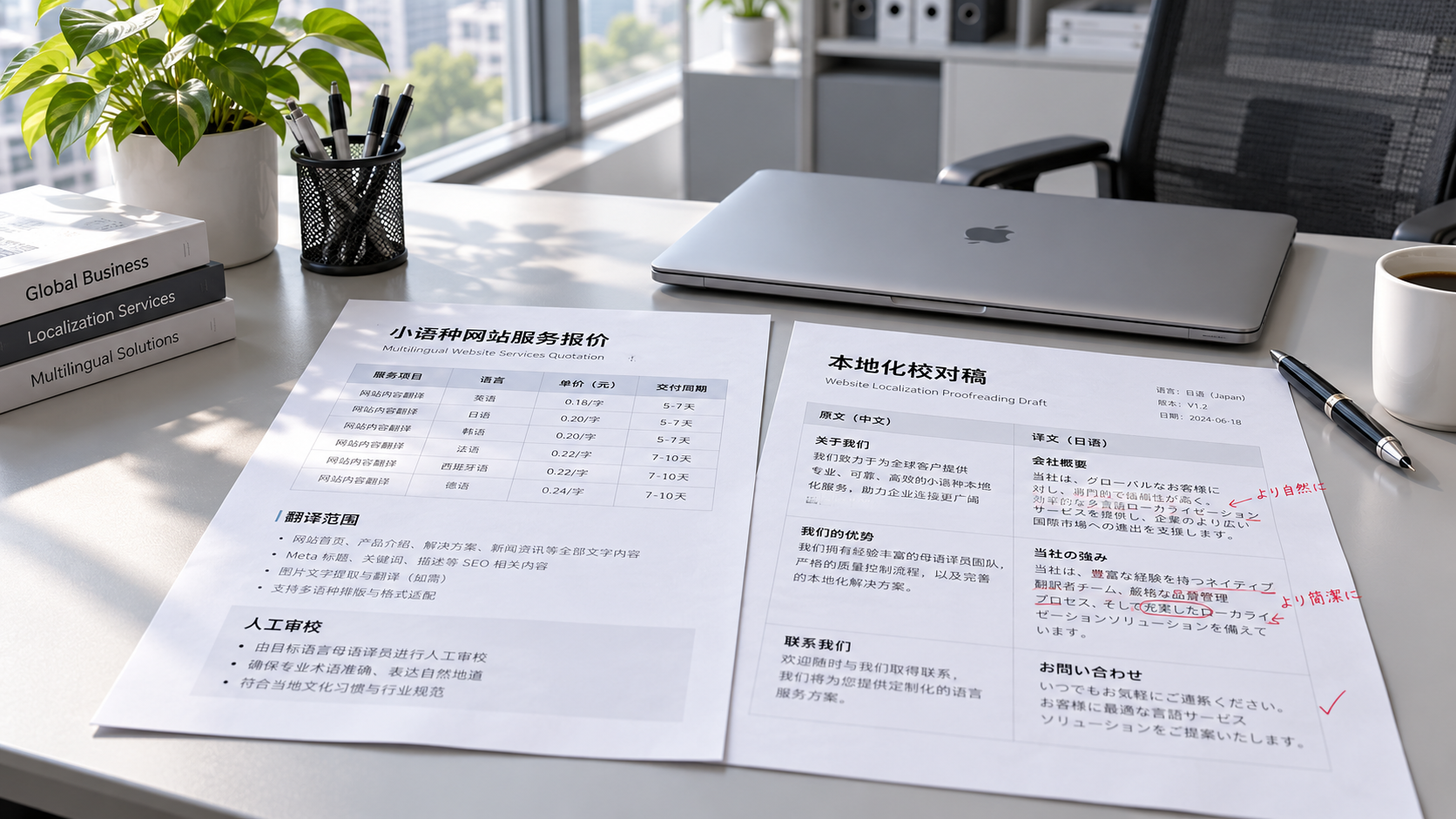
 Does the quote for building a website in a less commonly used language include localization and translation?
 Can an AI translation platform standardize brand terminology across multilingual websites?

Related Products
 Yiyingbao SaaS Intelligent Website Building and Marketing SystemYiyingbao SaaS Intelligent Website Building and Marketing System, AI-powered no-code website building, rapid creation of multilingual B2B international websites in 10 minutes, global server acceleration, AI-powered SEO optimization, helping businesses connect efficiently with global markets. The perfect integration of technology and operation makes building an international trade website remarkably simple
 AI+SEM Intelligent Advertising Marketing SystemAI+SEM drives intelligent ad creation, empowering full-funnel precision advertising marketing. The system automatically generates weekly/monthly reports, AI recommends keywords and target countries, monitors core metrics in real-time with intelligent alerts, and enables one-click high-conversion ad solutions to help quickly acquire customers and improve ROI.
 AI+SEO Dual-Engine System Optimization ServicesYiyingbao’s AI+SEO dual-engine optimization system helps foreign trade enterprises acquire high-quality organic traffic through AI-powered keyword research, content generation, and comprehensive technical optimization, significantly improving search rankings and conversion rates.
 AI+SNS Social Media Marketing SystemYingbao AI+SNS Social Media Marketing System - Precision social capture for the social media era. Supports one-click content synchronization across major platforms like Facebook and LinkedIn. AI intelligently rewrites posts for enhanced relevance. 24/7 AI customer service and user profiling analysis empower businesses to efficiently expand into global markets.
 AI+SEO营销解决方案易营宝AI+SEO营销解决方案,通过AI批量写作、智能生成TDK、精准关键词扩词等功能,全面优化网站SEO效果,提升流量与转化率。助力企业构建高效智能网站新生态。
 AI+SEM Advertising Marketing SolutionsAI+SEM Advertising Marketing Solution leverages AI technology to deeply empower SEM ad campaigns. It automatically generates weekly/monthly reports using AI, presenting account data across multiple dimensions for comprehensive insights into campaign performance and trends. The system precisely recommends keywords and target countries, intelligently generates high-conversion ad copy, and enables one-click activation of efficient campaign plans to help businesses rapidly acquire customers. Simultaneously, it monitors core metrics in real time, intelligently identifies abnormal fluctuations, and issues timely alerts to ensure stable, high-return advertising results.
 Domain Name ServicesEasyWin provides professional domain name services, including intelligent queries, one-stop registration, brand protection, and full lifecycle management, helping businesses build a digital brand image.
 EasyOperate B2C Cross-Border E-Commerce Platform & Independent WebsiteEasyStore B2C Cross-border E-commerce Independent Store is an intelligent website building and cross-border e-commerce integrated solution independently developed by EasyStore Information Technology (Beijing) Co., Ltd. The system is specially designed for small and medium-sized as well as large export enterprises, integrating 'website building, operation, marketing, advertising, and conversion' into one, helping enterprises quickly establish cross-border e-commerce independent stores to achieve brand globalization and global sales growth.
The platform supports multiple languages, multiple currencies, and multi-channel marketing, with built-in AI intelligent translation and SEO optimization systems, suitable for mainstream markets such as Southeast Asia, Europe and America, Latin America, and the Middle East, assisting Chinese manufacturing enterprises in efficiently deploying international e-commerce strategies. SSL证书易营宝提供专业SSL安全证书服务,包括单域名和泛域名证书,确保网站数据传输加密、身份验证和完整性保护,助力企业建立安全可信的在线业务环境。









