









- Ministry of Commerce: Online retail sales grew 4.4% in the first three quarters, while cross-border e-commerce maintained relatively rapid growthOct 29, 2026View details
- CCTV reports: AI-powered smart hardware is expanding overseas at a faster pace, with orders for some best-selling products booked through next yearOct 29, 2026View details
- Alphabet Q3 Earnings: Google Search Advertising Revenue Rises 10.5% to $82 BillionOct 29, 2026View details
- AliExpress Announces New Service Rules for Russia, Linked to Wildberries Product IntegrationOct 28, 2026View details
- Black Friday Preparations Enter the Final Sprint Week as Cross-Border E-Commerce Platforms Roll Out Their PlansOct 28, 2026View details
- CBP Finalizes Electronic Rail Export Manifest Rule, Effective October 26, 2026Oct 26, 2026View details
Can AI translation and localization be published directly? Methods for controlling brand tone and terminology
An initial draft generated by AI translation can enter the editing workflow, but it should not directly overwrite multilingual corporate websites, advertising landing pages, product pages, or email templates. Whether it can be published depends on whether the content falls within the defined brand expression scope, whether key terminology is controlled, and whether the commitments, parameters, legal notices, and calls to action on the page have undergone targeted review. Fluent wording does not necessarily mean semantic accuracy, much less suitability for the local market.
First, classify content by publication risk to avoid spreading limited review time evenly across all text. Low-risk content such as navigation, general buttons, and non-critical blog body text can use “machine translation + sample review”; high-risk content, including product specifications, quotation terms, after-sales boundaries, certification statements, and privacy and payment instructions, should retain human approval checkpoints. Although ad headlines and search snippets are short, they directly affect click expectations and should not be approved based solely on the naturalness of the translation.
First assess: which translations can be published quickly
A common misjudgment is to treat “a translation that is close in meaning when translated back into the original language” as the approval standard. Back-translation can only identify obvious omissions; it cannot detect wording that does not align with industry conventions in the target language. For example, a literal translation of the Chinese term “high cost-performance ratio” may sound overly promotional; “solution” can become an empty promise on some pages if no specific deliverables are defined. Similarly, “free” and “trial” do not have exactly the same scope of application in different languages. If page conditions are not updated accordingly, disputes may arise during inquiries, payments, or contract discussions.
A publishable machine-generated draft should meet at least three conditions simultaneously: the source version has been frozen, so the Chinese text is not changed while translation is underway; the target market, page purpose, and audience scenario are clear; and a terminology database and tone-of-voice rules are available for the relevant language. If any one of these is missing, AI output is better used as a draft rather than as publishable content.
Brand tone of voice cannot be defined by only a few adjectives
“Professional, trustworthy, and friendly” is difficult to use as guidance for models or review actions. An actionable tone-of-voice standard should be converted into assessable language rules: whether exclamation marks are allowed; whether the second person is used; whether technical pages state performance conditions before marketing conclusions; what conservative wording should be used for functions that cannot be confirmed; and the appropriate range of forms of address, honorifics, and colloquial language in different languages.
Brand tone of voice should also be divided by page type. The hero section of the homepage needs to be concise and distinctive; product specification pages emphasize accuracy and verifiability; troubleshooting pages should avoid imperative language or vague rhetoric; and ad copy needs to retain core benefits within character limits. Applying the same “lively” or “formal” rules to every page often leads to over-packaged product detail pages while making the help center appear rigid.
A set of comparison excerpts can be established: for each page type, retain the source text, acceptable translation, unacceptable translation, and reasons for rejection. Both model prompts and human review can reference these excerpts, which is more stable than abstract definitions. For multilingual websites, tone-of-voice benchmarks should not center on Chinese word order; natural expression in the target language takes priority, but the strength of commitments, scope of responsibility, and product facts must not be changed.

Terminology databases should distinguish between “must be consistent” and “variants allowed”
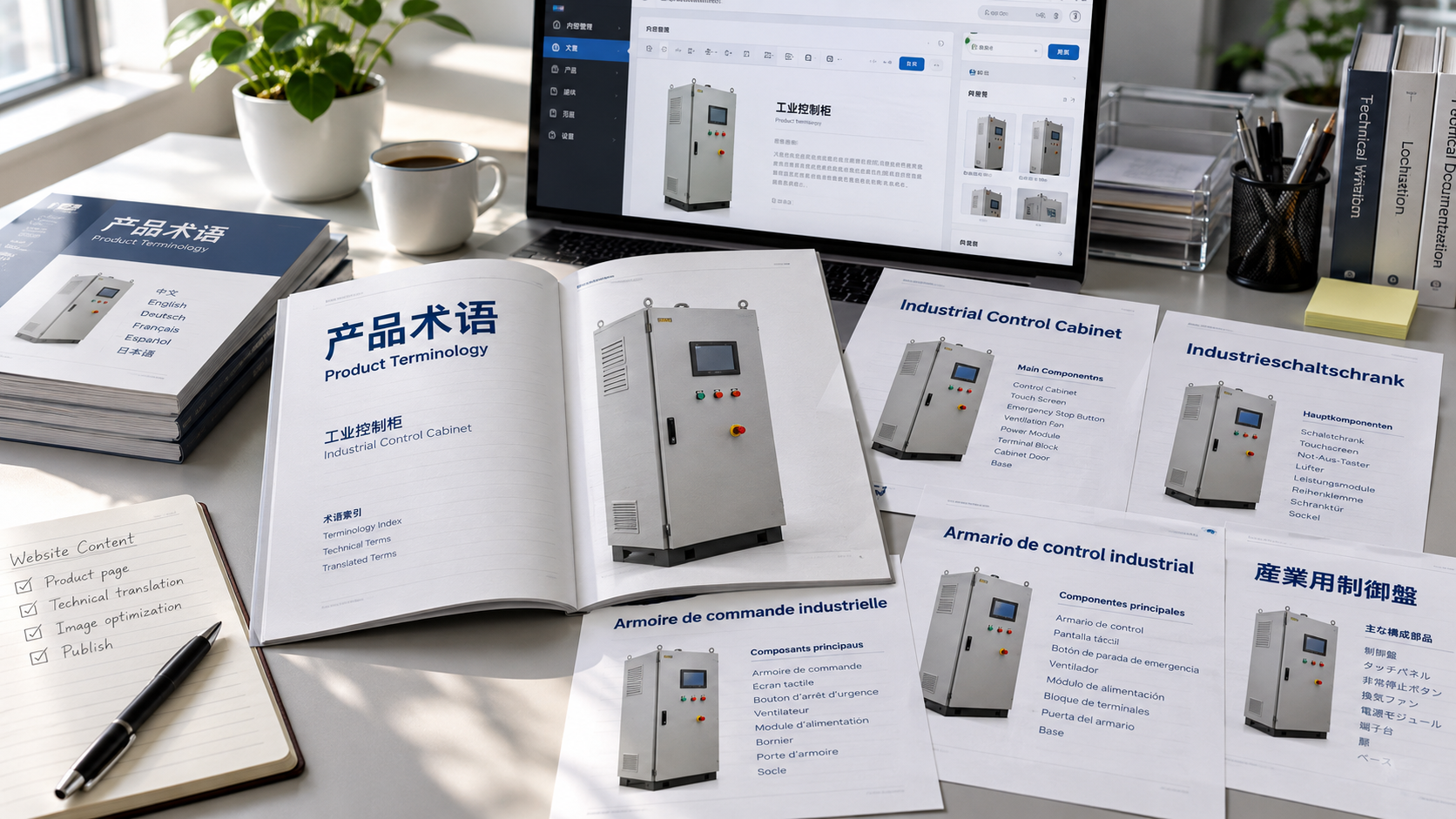
The challenge of terminology control is not collecting nouns, but determining the constraint level for each term. Product models, material names, interface specifications, units, certificate names, trademark formats, system fields, and button names typically require strict consistency; marketing expressions such as “inquiry,” “case study,” and “service support” can have preferred and alternative translations to accommodate local reading habits. If all terms are locked, linguistic naturalness is sacrificed; if all terms may be freely translated, inconsistencies will appear across on-site search, advertising materials, and sales collateral.
Terminology entries should not contain only “Chinese term–foreign-language term.” At a minimum, record the part of speech, page of use, whether translation is allowed, preferred translation, prohibited translations, contextual examples, and update date. For example, “lead” can refer to a prospective customer in a marketing context, but may refer to a material or electrical lead in manufacturing text; forcing a unified translation without context will instead create errors. Abbreviations should also be managed separately, with clear rules for whether they are expanded on first use, how plural forms are handled, and whether English can be retained.
Embed review into the publishing workflow
A more reliable process is not to find errors collectively after translation is complete, but to classify content before it enters the system. When source copy is submitted, mark the page type, target language, whether it contains price or performance commitments, and whether it cites external standards; the translation engine calls terminology databases and tone prompts; the system performs terminology matching, number comparison, and link and placeholder validation on translations; content triggering high-risk rules enters the human review queue, while the rest is reviewed according to the sampling ratio. This prevents editors from focusing only on linguistic fluency while overlooking page elements such as currencies, dates, downloadable files, and form fields.
During review, distinguish between “translation errors” and “source-text issues.” If a selling point is difficult to express accurately in multiple language versions, the reason may be that the source text lacks conditions, has an unclear subject, or presents a technical description as an absolute conclusion. In this case, revising the source text and then synchronizing updates across all language versions is more controllable than applying patches in each language. For content involving organizational processes, field definitions, and cross-department collaboration, refer to the unified-definition approach in Research on Enterprise Financial Digital Transformation Under the Financial Shared Services Model: first confirm the source of data and definitions, then address the display language.
Risk interception should focus on easily overlooked areas
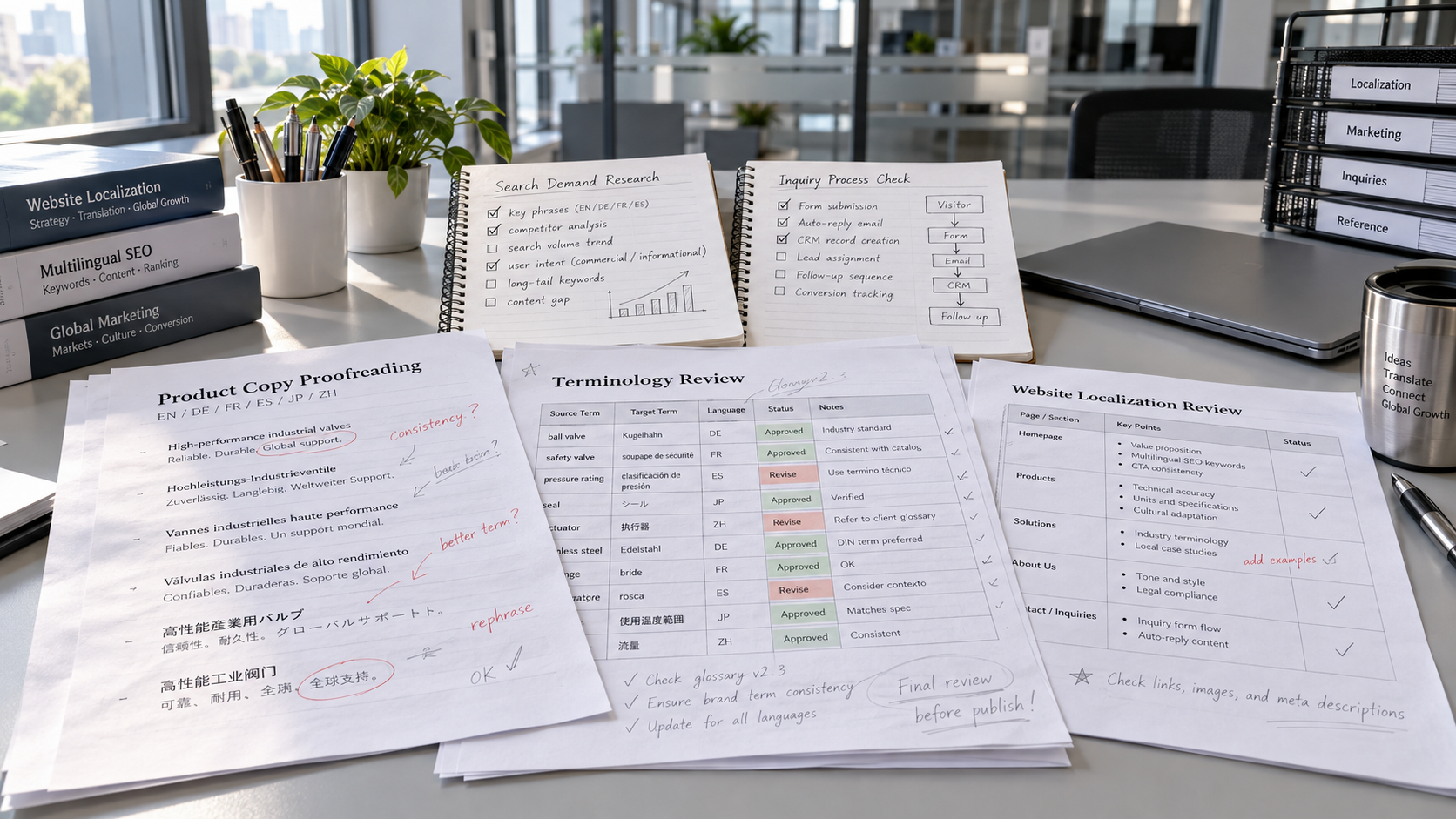
Text outside the main body often bypasses review: embedded text in images, PDF download filenames, form validation messages, pop-ups, structured data, automated email replies, 404 pages, and cookie notices may all retain terminology from older versions. Multilingual pages also need to check whether hreflang targets, URLs after language switching, regional currencies, and contact phone numbers correspond to the copy. A correct translation that links to a page in the wrong language will undermine users’ perception of the website’s integrity.
For absolute wording in AI output, trigger-word review should be configured. Expressions such as “guaranteed,” “permanent,” “fully compatible,” “lowest,” and “only” may be carried over from the source text or strengthened during editing. Review conclusions should not simply state “approved” or “returned”; they should record the issue type, such as terminology conflict, expanded commitment, cultural incompatibility, missing variable, or unclear source text. After a period of accumulation, frequently occurring errors can be fed back into prompts, terminology databases, and source-text templates.
Version tracking should still be retained after publication. Whenever terminology, page positioning, or brand tone is adjusted, old translations do not need to be fully retranslated immediately, but affected pages should be identifiable and scheduled for re-review. The value of AI translation and localization lies in reducing initial-draft time; what truly determines whether content can be published consistently is traceable rules, clear exception handling, and verification of key facts before publication.
Related Articles
 How Can Brands Going Global Assess a Multilingual Website Provider’s Localization Capabilities?
 How to Validate RTL Layouts for Arabic Website Development Services in Shanghai
 How Can You Keep Product Terminology Consistent Across Multilingual Website Translations?

Related Products
 Yiyingbao SaaS Intelligent Website Building and Marketing SystemYiyingbao SaaS Intelligent Website Building and Marketing System, AI-powered no-code website building, rapid creation of multilingual B2B international websites in 10 minutes, global server acceleration, AI-powered SEO optimization, helping businesses connect efficiently with global markets. The perfect integration of technology and operation makes building an international trade website remarkably simple
 AI+SEM Intelligent Advertising Marketing SystemAI+SEM drives intelligent ad creation, empowering full-funnel precision advertising marketing. The system automatically generates weekly/monthly reports, AI recommends keywords and target countries, monitors core metrics in real-time with intelligent alerts, and enables one-click high-conversion ad solutions to help quickly acquire customers and improve ROI.
 AI+SEO Dual-Engine System Optimization ServicesYiyingbao’s AI+SEO dual-engine optimization system helps foreign trade enterprises acquire high-quality organic traffic through AI-powered keyword research, content generation, and comprehensive technical optimization, significantly improving search rankings and conversion rates.
 AI+SNS Social Media Marketing SystemYingbao AI+SNS Social Media Marketing System - Precision social capture for the social media era. Supports one-click content synchronization across major platforms like Facebook and LinkedIn. AI intelligently rewrites posts for enhanced relevance. 24/7 AI customer service and user profiling analysis empower businesses to efficiently expand into global markets.
 AI+SEO营销解决方案易营宝AI+SEO营销解决方案,通过AI批量写作、智能生成TDK、精准关键词扩词等功能,全面优化网站SEO效果,提升流量与转化率。助力企业构建高效智能网站新生态。
 AI+SEM Advertising Marketing SolutionsAI+SEM Advertising Marketing Solution leverages AI technology to deeply empower SEM ad campaigns. It automatically generates weekly/monthly reports using AI, presenting account data across multiple dimensions for comprehensive insights into campaign performance and trends. The system precisely recommends keywords and target countries, intelligently generates high-conversion ad copy, and enables one-click activation of efficient campaign plans to help businesses rapidly acquire customers. Simultaneously, it monitors core metrics in real time, intelligently identifies abnormal fluctuations, and issues timely alerts to ensure stable, high-return advertising results.
 Domain Name ServicesEasyWin provides professional domain name services, including intelligent queries, one-stop registration, brand protection, and full lifecycle management, helping businesses build a digital brand image.
 EasyOperate B2C Cross-Border E-Commerce Platform & Independent WebsiteEasyStore B2C Cross-border E-commerce Independent Store is an intelligent website building and cross-border e-commerce integrated solution independently developed by EasyStore Information Technology (Beijing) Co., Ltd. The system is specially designed for small and medium-sized as well as large export enterprises, integrating 'website building, operation, marketing, advertising, and conversion' into one, helping enterprises quickly establish cross-border e-commerce independent stores to achieve brand globalization and global sales growth.
The platform supports multiple languages, multiple currencies, and multi-channel marketing, with built-in AI intelligent translation and SEO optimization systems, suitable for mainstream markets such as Southeast Asia, Europe and America, Latin America, and the Middle East, assisting Chinese manufacturing enterprises in efficiently deploying international e-commerce strategies. SSL证书易营宝提供专业SSL安全证书服务,包括单域名和泛域名证书,确保网站数据传输加密、身份验证和完整性保护,助力企业建立安全可信的在线业务环境。









