









- Can the average annual growth rate reflect real opportunities in overseas markets?Oct 07, 2026View details
- Which customer acquisition channels will be affected by cross-border marketing trends in 2026?Sep 06, 2026View details
- Which homogenization risks should be considered in an analysis of the AI-powered website building industry?Aug 30, 2026View details
- How Will AI Marketing Trends 2026 Change Advertising Budget AllocationAug 28, 2026View details
- Is the EV SSL certificate market shrinking or upgrading? How should companies assess certificate procurement?Aug 11, 2026View details
- Why the old AMP SEO 2020 practices no longer work and what has changed in current optimization prioritiesAug 02, 2026View details
How Can Manufacturers Structure a Long Decision-Making Cycle for Overseas Lead Generation
For manufacturers seeking overseas customers, the challenge often lies not in obtaining initial traffic or inquiries, but in the lengthy and repeatedly changing decision-making process customers undergo from stating a requirement through internal project approval, technical confirmation, commercial price comparison, and contract approval. This is particularly true for equipment, components, customized production lines, and engineering support products: performance limits are the focus at the early stage; materials, interfaces, and delivery time are checked at the middle stage; and price, payment, and after-sales service are discussed only later. If websites and marketing content focus only on “Request a Quote Now,” they can easily lose potential leads that are not yet ready to purchase at an early stage.
A more suitable approach is to present the same product separately according to the different questions in the decision-making chain, allowing visitors to find relevant answers whenever they search again, communicate internally, or supplement information. Content does not need to be overly broad, but it must relate to actual product selection and project progress.
Organize information by decision points rather than piling up pages by product catalog
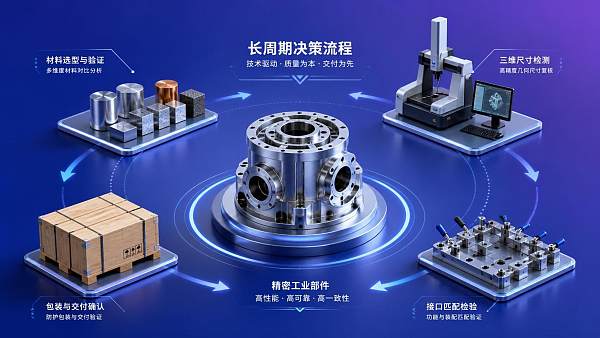
Many manufacturing websites focus on models, dimensions, and product images. This suits customers who already have clear specifications, but it is difficult to answer early-stage evaluation questions. In long-cycle projects, visitors often initially search for operating-condition issues, such as whether materials remain stable in high-temperature environments, how wear can be controlled during continuous operation, and whether non-standard dimensions can match existing interfaces. Entering a model page directly at this stage does not provide enough information to support internal discussions.
Website content can establish entry points around “problem—conditions—solution boundaries.” Taking industrial components as an example, even for the same corrosion-resistance requirement, the concentration of acidic or alkaline media, operating temperature, pressure fluctuations, cleaning frequency, and sealing structure all affect material selection. Simply stating “corrosion-resistant” can easily generate unqualified inquiries; explaining which parameters require further confirmation under different media conditions makes it easier to identify genuine projects.
The content architecture can be divided into three levels: the first explains application scenarios and common causes of failure to capture problem-based searches; the second provides selection criteria such as structure, material, machining accuracy, and installation space; and the third addresses models, drawings, quotation materials, and delivery conditions. Clear internal links should connect these three levels, allowing the visitor journey to naturally move from understanding the problem to submitting project information, rather than leaving each page isolated.
Technical content must withstand verification
In a long decision-making cycle, the most valuable content is not a generic introduction to product advantages, but technical information that can be forwarded, downloaded, and verified. Performance parameters must specify the applicable conditions. For example, load data should distinguish between static, dynamic, and impact loads; flow data should state the medium viscosity, pipe diameter, or differential pressure range; machining capability should not merely state “high precision,” but should also specify controllable tolerances, surface treatment methods, and whether complex structures are affected by fixturing conditions.
The same parameter is often compared incorrectly when detached from its boundaries. Sufficient strength of a component does not mean the assembled system will also be stable; a suitable material grade for a welded part does not mean that the heat-affected zone, deformation control, and subsequent machining will not affect fitting dimensions. Including these relationships on technical pages can reduce repeated questions such as “Can you make it?” and instead encourage the other party to provide more complete drawings, operating conditions, and acceptance requirements.
For highly customized projects, it is advisable to create a separate page on “Conditions to Confirm Before Submitting Information,” but it should not be presented as a mechanical checklist. It can explain requirements according to the actual collaboration sequence: when drawings are available, the version and critical dimensions need to be marked; when the design has not yet been finalized, the installation position, connection method, and maintenance space should be clarified; when replacing existing components, failure photos, operating cycles, and on-site media should be added. Leads generated in this way are closer to the input conditions required for engineering communication.
Let different channels serve tasks at different stages
Search traffic is suitable for addressing clear issues and long-term search needs; advertising landing pages are better suited to focusing on a specific application, material, or product series; and social content is suitable for continuously demonstrating machining processes, testing methods, installation precautions, and common fault assessment. Using the same product copy across several channels creates repetitive touchpoints without advancing understanding.
Search content should cover issues that repeatedly arise as projects progress, such as “sealing methods for a certain medium,” “how to secure large equipment before transport,” and “requirements for protective structures in outdoor installation.” Advertising pages should not carry too many models, and are best centered on one clear need with parameter ranges, document access points, and a contact form. Social content can break longer technical explanations into graphics and text, short videos, or Q&A segments, but should still link back to complete pages to prevent technical information from being scattered in locations where it cannot be searched or retained.
As the number of website pages grows, the layout of titles, descriptions, and keywords can easily become unmanageable: multiple pages may compete for the same search intent, or pages may become difficult to distinguish because of repeated templates. When using AI+SEO Marketing Solutions for keyword expansion, page topic organization, and TDK generation, terminology and parameters must still be verified against business materials, especially model naming, material descriptions, and application limitations. Automatically generated content must not replace technical review.
Lead follow-up should retain project status rather than only contact details
Silence following overseas inquiries does not always mean that demand has disappeared. Some are still collecting technical information, some are waiting for end-customer confirmation, and some have postponed purchasing due to budget cycles. If all leads are urged for pricing at the same frequency, the professional impression established at an early stage can easily be disrupted. A more practical approach is to arrange subsequent touchpoints based on known status.
- For leads that have provided drawings but lack operating-condition information, follow-up content should focus on items awaiting confirmation, such as material, medium, temperature, and installation method, avoiding inaccurate quotations too early.
- For projects undergoing technical comparison, structural differences, machining processes, testing methods, and maintenance requirements can be supplemented, so that comparison is based on operating conditions rather than a single unit price.
- After entering the commercial stage, the focus should shift to delivery time composition, packaging methods, transportation restrictions, spare parts arrangements, and acceptance documentation, reducing rework before contract signing caused by different understandings of delivery.
Follow-up records should also indicate the source page and content viewed. Visiting a material comparison page, downloading installation instructions, and repeatedly viewing a delivery-time page correspond to different concerns. Classifying leads only by “inquiry date” and “product name” makes it impossible to determine what information should be added in the next communication, and also makes it difficult to assess which pages actually contributed to conversion.
Place conversion actions where information needs arise
Long-cycle projects should not retain only one generic “Contact Us” entry. The end of technical articles can guide visitors to submit operating conditions and drawings; model pages can provide access to obtain dimension tables or confirm delivery time; transport and installation pages are suitable for handling inquiries about packaging requirements, on-site conditions, or after-sales documentation. Form fields should also vary with the page topic: product selection pages require application parameters, non-standard machining pages need drawing formats, quantities, and critical tolerances, while engineering support pages should prioritize collecting project stage and interface information.
Overly long forms reduce willingness to submit, while too few fields cause subsequent communication to remain at the level of basic questions and answers. Contact details and core requirements can be set as mandatory, while complex technical information can be provided through file uploads or supplementary notes. After submission, links to related materials can be provided so that visitors who have not yet completed an inquiry can continue reading.
Ultimately, the content layout for overseas customer acquisition in manufacturing should serve the process of gradually completing project information. Every search, reading session, download, and return visit should eliminate one uncertainty. Websites that can continuously address technical, delivery, and installation issues are more likely to remain discoverable and be reassessed throughout a lengthy decision-making chain.
Related Articles

Related Products
 Yiyingbao SaaS Intelligent Website Building and Marketing SystemYiyingbao SaaS Intelligent Website Building and Marketing System, AI-powered no-code website building, rapid creation of multilingual B2B international websites in 10 minutes, global server acceleration, AI-powered SEO optimization, helping businesses connect efficiently with global markets. The perfect integration of technology and operation makes building an international trade website remarkably simple
 AI+SEM Intelligent Advertising Marketing SystemAI+SEM drives intelligent ad creation, empowering full-funnel precision advertising marketing. The system automatically generates weekly/monthly reports, AI recommends keywords and target countries, monitors core metrics in real-time with intelligent alerts, and enables one-click high-conversion ad solutions to help quickly acquire customers and improve ROI.
 AI+SEO Dual-Engine System Optimization ServicesYiyingbao’s AI+SEO dual-engine optimization system helps foreign trade enterprises acquire high-quality organic traffic through AI-powered keyword research, content generation, and comprehensive technical optimization, significantly improving search rankings and conversion rates.
 AI+SNS Social Media Marketing SystemYingbao AI+SNS Social Media Marketing System - Precision social capture for the social media era. Supports one-click content synchronization across major platforms like Facebook and LinkedIn. AI intelligently rewrites posts for enhanced relevance. 24/7 AI customer service and user profiling analysis empower businesses to efficiently expand into global markets.
 AI+SEO营销解决方案易营宝AI+SEO营销解决方案,通过AI批量写作、智能生成TDK、精准关键词扩词等功能,全面优化网站SEO效果,提升流量与转化率。助力企业构建高效智能网站新生态。
 AI+SEM Advertising Marketing SolutionsAI+SEM Advertising Marketing Solution leverages AI technology to deeply empower SEM ad campaigns. It automatically generates weekly/monthly reports using AI, presenting account data across multiple dimensions for comprehensive insights into campaign performance and trends. The system precisely recommends keywords and target countries, intelligently generates high-conversion ad copy, and enables one-click activation of efficient campaign plans to help businesses rapidly acquire customers. Simultaneously, it monitors core metrics in real time, intelligently identifies abnormal fluctuations, and issues timely alerts to ensure stable, high-return advertising results.
 Domain Name ServicesEasyWin provides professional domain name services, including intelligent queries, one-stop registration, brand protection, and full lifecycle management, helping businesses build a digital brand image.
 EasyOperate B2C Cross-Border E-Commerce Platform & Independent WebsiteEasyStore B2C Cross-border E-commerce Independent Store is an intelligent website building and cross-border e-commerce integrated solution independently developed by EasyStore Information Technology (Beijing) Co., Ltd. The system is specially designed for small and medium-sized as well as large export enterprises, integrating 'website building, operation, marketing, advertising, and conversion' into one, helping enterprises quickly establish cross-border e-commerce independent stores to achieve brand globalization and global sales growth.
The platform supports multiple languages, multiple currencies, and multi-channel marketing, with built-in AI intelligent translation and SEO optimization systems, suitable for mainstream markets such as Southeast Asia, Europe and America, Latin America, and the Middle East, assisting Chinese manufacturing enterprises in efficiently deploying international e-commerce strategies. SSL证书易营宝提供专业SSL安全证书服务,包括单域名和泛域名证书,确保网站数据传输加密、身份验证和完整性保护,助力企业建立安全可信的在线业务环境。









