









- Which customer acquisition channels will be affected by cross-border marketing trends in 2026?Sep 06, 2026View details
- Which homogenization risks should be considered in an analysis of the AI-powered website building industry?Aug 30, 2026View details
- How Will AI Marketing Trends 2026 Change Advertising Budget AllocationAug 28, 2026View details
- Is the EV SSL certificate market shrinking or upgrading? How should companies assess certificate procurement?Aug 11, 2026View details
- Why the old AMP SEO 2020 practices no longer work and what has changed in current optimization prioritiesAug 02, 2026View details
- How to Choose Topics for an Industry News Section to Attract More Organic Search TrafficJul 29, 2026View details
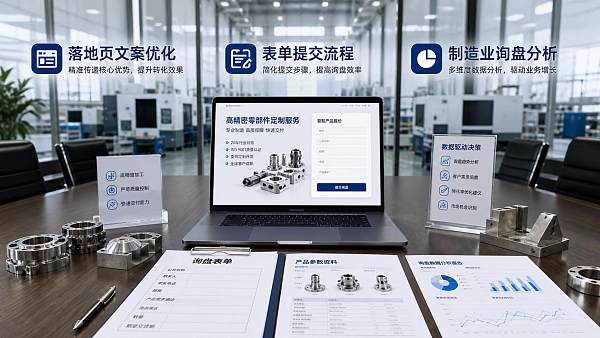
For Manufacturing Advertising Landing Page Optimization, Should You Improve the Copy or the Form First?
For manufacturing advertising landing page optimization, whether to revise the copy or the form first should generally not be decided based on experience alone. When page conversions drop quickly, the problem is often not that a single module has failed independently, but that key information is not presented in the right order when visitors are deciding whether “this factory can handle my project.” Some visitors click through and first look for materials, processes, and delivery ranges, only to find vague descriptions; others already have purchase intent but are blocked at the submission stage by lengthy fields, attachment restrictions, or unclear inquiry entry points. To improve inquiry quality, first determine whether the loss occurs during the reading stage or the submission stage, and then set the priority accordingly.
The assessment method is not complicated. First, break the landing page down into two actions: “willingness to continue reading” and “willingness to leave an inquiry.” If visitors stay only briefly after clicking the ad, scroll only a short distance, and hardly anyone views the core modules, the problem is likely in the copy structure. Manufacturing procurement decisions are usually not driven by impulse clicks. People entering the page quickly look for specifications, application scenarios, delivery limitations, minimum order quantities, prototyping processes, certification or testing information, and packaging and shipping conditions. If these questions are not clearly answered within the first three screens, even a well-designed form will have difficulty making up for it.
When Revising the Copy First Is Usually the Better Choice
Many manufacturing pages describe “company strength” in great detail but fail to explain what operating conditions the product is actually suitable for. For example, when offering metal parts, automation equipment, industrial consumables, electronic connectors, or plastic injection-molded parts, visitors are more concerned about material grades, size ranges, tolerance capabilities, surface treatment methods, compatible equipment, installation environments, temperature and corrosion resistance requirements, and how the process transitions from prototyping to mass production. If the copy remains at the level of general statements such as “extensive experience, consistent quality, and customization support,” it effectively fails to answer the visitor’s questions.
Optimizing this type of page does not mean rewriting a longer introduction; it means rearranging the order of information. The headline in the first screen should directly address the application and supply capabilities, while the subheadline should supplement it with key parameter limits. This should be followed immediately by content that best reduces the cost of initial evaluation, such as available processing materials, common specifications, delivery formats, supported file formats, and sample approval milestones. The focus of manufacturing advertising landing page optimization is to help visitors determine “whether it is a match” in the shortest possible time, rather than asking them to learn the company story first.
Another common misjudgment is placing different product lines on the same landing page. The information required for inquiries about sheet metal and CNC machining, complete machines and spare parts, or standard and non-standard parts is fundamentally different. If the keywords used for advertising are already specific, the page copy cannot remain generic. Someone searching for “aluminum alloy CNC enclosure machining” will typically not continue reading after seeing “we handle all types of hardware parts machining,” because this wording does not clarify details such as wall thickness, hole-position accuracy, anodizing color control, or drawing version requirements. In this situation, revising the form first will only collect low-quality inquiries more completely; it will not increase the number of high-intent visitors.
The copy also has another easily overlooked task: filtering out unsuitable requirements in advance. For example, the delivery area may be restricted, shipping methods may be limited, oversized parts may require segmented packaging, certain materials may need to be supplied by the customer, or some processes may only be verifiable at the sample stage. If these conditions are not clearly stated, the form will accumulate large numbers of inquiries that cannot be advanced later. A landing page is not intended to accept everyone; it is intended to retain inquiries that can be moved forward.
When the Form Should Be Revised First, Clear Obstacles Usually Already Exist
If page dwell time, scrolling, and clicks on parameter modules are all satisfactory but the submission rate is low, the problem is often form friction. Submitting a manufacturing inquiry is naturally more complex than purchasing an ordinary consumer product, because many projects require drawings, BOMs, operating-condition descriptions, material requirements, and sometimes details about assembly interfaces, operating temperatures, target markets, and estimated volumes. An improperly designed form can drive away people who originally had genuine interest.
The most typical problem is that the form is too demanding from the outset. Visitors who are just beginning to engage are not always willing to immediately provide complete procurement information, company size, budget, delivery schedule, address, and instant messaging details. Especially in cross-border scenarios, some people only want to confirm whether the project is feasible, whether a certain type of processing is supported, or whether a particular file format is accepted. If the form requires more than a dozen fields to be completed at once and also forces users to upload attachments, the submission rate will usually be affected.
Form optimization is not simply a matter of making the form “as short as possible.” If a manufacturing inquiry form is too short, sales and technical teams cannot assess feasibility, and subsequent back-and-forth clarification will consume more time. A more reasonable approach is to collect information in layers: retain only the name, email or other core contact details, a brief description of the requirement, and attachment upload in the first round; place information such as material, quantity, dimensions, tolerances, surface treatment, and required delivery date in guided prompts, allowing prepared users to provide more complete details while enabling less-prepared users to submit an initial inquiry. Field instructions should reflect actual business needs, such as “Please provide the material grade or currently used alternative material” and “PDF, STEP, DWG, and other common file formats are accepted,” rather than simply saying “Please enter details.”
If the page targets projects involving complete machines, production-line equipment, or system integration, the form must also avoid creating incorrect expectations. For example, some requirements cannot be quoted until an on-site survey is completed, while some solutions require confirmation of installation space, power conditions, takt time requirements, and maintenance methods. In such cases, instead of using “Get a Quote Now,” it is better to make the form title consistent with the actual process and change it to “Submit Project Parameters” or “Send Drawings and Operating Conditions.” This does not necessarily reduce conversions; instead, it can reduce ineffective communication caused by making promises too early.
Advertising Landing Page Optimization in Manufacturing: The First Thing to Examine Is Not the Module but the Search Term
The same page content may require completely different optimization priorities when targeting different advertising terms. For parameter-oriented search terms such as “high-temperature-resistant sealing ring material selection” and “stainless steel laser cutting tolerance,” visitors are more likely to encounter problems with the copy because they arrive with specific technical questions. For action-oriented search terms such as “submit drawings for a quote” and “custom part prototyping,” if the page has already addressed basic capabilities, visitors are more likely to get stuck at the form. Reviewing the keywords first and then checking whether the advertising promise aligns with the landing page is more effective than arguing separately about the copy or the form.
If the advertisement says “small-batch prototyping supported,” the landing page should clearly explain minimum order conditions, whether the prototyping lead time is affected by material procurement, the sample approval method, and the limits on revision rounds. If the advertisement says “multilingual overseas inquiry pages available,” the page should at least enable visitors from different regions to understand the contact information, file submission method, and basic technical descriptions, rather than retaining only Chinese industry terminology. This may also involve the form capabilities, file compatibility, and multilingual field handling of the website-building system itself, but all of these should serve the conversion path rather than simply accumulating feature names.
What Is Most Easily Overlooked on the Page Is the Connection Between Technical and Commercial Information
A manufacturing inquiry is not purely a sales action; it often sits between technical confirmation and commercial evaluation. If the copy discusses processes but not delivery limitations, visitors may doubt whether the project can be implemented later. If it discusses only service responsiveness but not parameter capabilities, it cannot establish basic trust. A more reliable approach is to interweave technical information and commercial conditions. For example, after describing processing capabilities, explain the common file formats; after introducing the application industries, add packaging, shipping, or installation coordination requirements; after discussing material selection, explain whether alternative materials require a new prototype. This type of page is closer to the actual sequence of project advancement.
The same applies to the form. Do not put all technical questions into the remarks box. For variables that frequently occur and determine order conversion efficiency, a small number of selection options can reduce the cost of understanding, such as “Are drawings available?”, “Target quantity range,” “Is a sample required?”, and “Does the application environment involve high temperatures/corrosion/outdoor use?” However, there should not be too many options, or the page will begin to resemble an internal process form. The purpose of advertising landing page optimization is to reduce information friction during the first contact, not to move all project management activities to the front end.
Do Not Make Major Changes to Both Ends at the Same Time
Many pages cannot determine the results after a redesign because the copy, layout, form, button wording, and field count were all changed together. Manufacturing inquiry cycles are often long, and traffic sources are dispersed, making it difficult to determine which change produced the result if too many changes are made at once. A more reliable approach is to keep the advertising entry point fixed and change only one primary variable on a single page. If the biggest current problem is insufficient technical information, first improve the first-screen messaging, parameter modules, and application descriptions. If the main problem is submission abandonment, first reduce the number of fields and optimize the attachment instructions and button promise. Each iteration should focus on one obstacle so that subsequent reviews have a clear basis.
Publishing risks must also be considered. Copy changes may appear minor, but if parameters are written incorrectly, the material range is overstated, or the delivery wording is too absolute, subsequent communication can be directly affected. Form changes can lead to lost leads, failed attachment uploads, abnormal mobile display, or false positives from anti-spam measures. Before going live, verify the submission path separately on mobile and desktop, and confirm that the prompts, required-field logic, file-size limits, and success-page feedback all work properly.
To put this into practice, asking three questions is usually enough: After entering the page, can visitors quickly see the materials, processes, and application conditions relevant to their needs? When they are willing to submit an inquiry, are they being blocked by unnecessary fields and unclear prompts? Is the information submitted sufficient to support the next technical assessment? Start by addressing whichever question presents the most prominent problem. There is no fixed order for optimizing a manufacturing landing page; only pages that more closely reflect the actual procurement and evaluation process are more likely to generate inquiries that can be advanced.
Related Articles
 Which core features should be prioritized for investment when building a cross-border e-commerce standalone website?
 How Should Overseas Customer Acquisition Solutions Be Structured by Market, Channel, and Sales Stage?
 How can cross-border e-commerce overseas marketing solutions be tailored to different markets?



Related Products
 Yiyingbao SaaS Intelligent Website Building and Marketing SystemYiyingbao SaaS Intelligent Website Building and Marketing System, AI-powered no-code website building, rapid creation of multilingual B2B international websites in 10 minutes, global server acceleration, AI-powered SEO optimization, helping businesses connect efficiently with global markets. The perfect integration of technology and operation makes building an international trade website remarkably simple
 AI+SEM Intelligent Advertising Marketing SystemAI+SEM drives intelligent ad creation, empowering full-funnel precision advertising marketing. The system automatically generates weekly/monthly reports, AI recommends keywords and target countries, monitors core metrics in real-time with intelligent alerts, and enables one-click high-conversion ad solutions to help quickly acquire customers and improve ROI.
 AI+SEO Dual-Engine System Optimization ServicesYiyingbao’s AI+SEO dual-engine optimization system helps foreign trade enterprises acquire high-quality organic traffic through AI-powered keyword research, content generation, and comprehensive technical optimization, significantly improving search rankings and conversion rates.
 AI+SNS Social Media Marketing SystemYingbao AI+SNS Social Media Marketing System - Precision social capture for the social media era. Supports one-click content synchronization across major platforms like Facebook and LinkedIn. AI intelligently rewrites posts for enhanced relevance. 24/7 AI customer service and user profiling analysis empower businesses to efficiently expand into global markets.
 AI+SEO营销解决方案易营宝AI+SEO营销解决方案,通过AI批量写作、智能生成TDK、精准关键词扩词等功能,全面优化网站SEO效果,提升流量与转化率。助力企业构建高效智能网站新生态。
 AI+SEM Advertising Marketing SolutionsAI+SEM Advertising Marketing Solution leverages AI technology to deeply empower SEM ad campaigns. It automatically generates weekly/monthly reports using AI, presenting account data across multiple dimensions for comprehensive insights into campaign performance and trends. The system precisely recommends keywords and target countries, intelligently generates high-conversion ad copy, and enables one-click activation of efficient campaign plans to help businesses rapidly acquire customers. Simultaneously, it monitors core metrics in real time, intelligently identifies abnormal fluctuations, and issues timely alerts to ensure stable, high-return advertising results.
 Domain Name ServicesEasyWin provides professional domain name services, including intelligent queries, one-stop registration, brand protection, and full lifecycle management, helping businesses build a digital brand image.
 EasyOperate B2C Cross-Border E-Commerce Platform & Independent WebsiteEasyStore B2C Cross-border E-commerce Independent Store is an intelligent website building and cross-border e-commerce integrated solution independently developed by EasyStore Information Technology (Beijing) Co., Ltd. The system is specially designed for small and medium-sized as well as large export enterprises, integrating 'website building, operation, marketing, advertising, and conversion' into one, helping enterprises quickly establish cross-border e-commerce independent stores to achieve brand globalization and global sales growth.
The platform supports multiple languages, multiple currencies, and multi-channel marketing, with built-in AI intelligent translation and SEO optimization systems, suitable for mainstream markets such as Southeast Asia, Europe and America, Latin America, and the Middle East, assisting Chinese manufacturing enterprises in efficiently deploying international e-commerce strategies. SSL证书易营宝提供专业SSL安全证书服务,包括单域名和泛域名证书,确保网站数据传输加密、身份验证和完整性保护,助力企业建立安全可信的在线业务环境。









