









- The U.S. has ended the $800 de minimis exemption for non-postal shipments; express courier packages must be formally declared.Nov 16, 2026View details
- ASEAN Signs Digital Economy Framework Agreement, Moving Toward Harmonized Cross-Border E-Commerce RulesNov 15, 2026View details
- Shenzhen Becomes the First City in Mainland China to Exceed RMB 5 Trillion in Foreign TradeNov 15, 2026View details
- Fujian Announces the First Batch of Provincial-Level Cross-Border E-Commerce Industrial Parks and Key Brands for CultivationNov 14, 2026View details
- Amazon Global Store Announces the Launch of the 2026 Black Friday Global Shopping SeasonNov 14, 2026View details
- CCTV.com Examines APEC’s Role in China’s Foreign TradeNov 12, 2026View details
How Can Manufacturers Identify the Right Target Markets for a Customized International Marketing Plan?
When customizing an export marketing plan for a manufacturing business, how should it choose its target markets? Companies need to consider their product advantages, overseas demand, and competitive landscape to identify markets with greater growth potential. For decision-makers, the key is to find markets where demand is real, their products can gain entry, and customer acquisition costs are affordable.
A large market does not necessarily mean it should be prioritized. For manufacturers, a more prudent approach is to shortlist three to five candidate markets, compare entry requirements, customer needs, and sales costs, and then select one or two for small-scale validation.
Step 1: First Determine Who the Product Is Right For
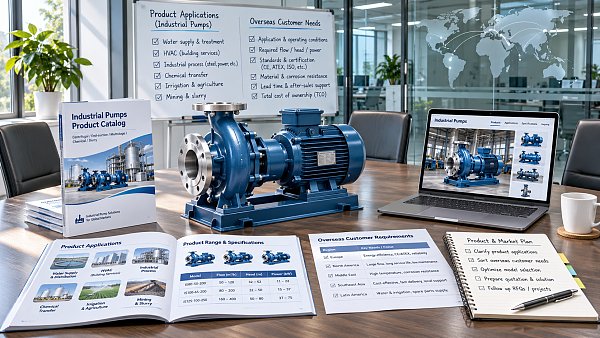
Before choosing a market, review the product’s applications, price range, production capacity, delivery lead time, and after-sales capabilities. For example, even if both are industrial pumps, products for food processing and those for mining may have very different target customers and purchasing requirements.
Next, identify the purchasing roles. Distributors care about supply reliability, profit margins, and regional support; end-user factories are more concerned with technical specifications, installation and maintenance, and operating costs; engineering contractors may prioritize project experience, lead times, and tender documentation.
Companies should also assess their own strengths objectively. If a product is competitively priced but the company lacks local certifications and service capabilities, it should not enter a market with high barriers to entry based on low price alone. Identifying selling points the company can deliver on is essential to determining which customers are most likely to buy.
Step 2: How Do You Shortlist Markets Worth Researching?
Start by assessing whether demand is sustained. Companies can review target-country import statistics, industry association reports, trade fair information, and search trends to understand the import volume of relevant products, major sources of supply, and changes in recent years. Data from a single year can be skewed by large orders or policy changes.
Search demand can also offer useful clues, but the meaning of search terms needs to be verified. Buyers may search using locally common product names, specifications, or application terms rather than the English names a company typically uses. Compare the search trends for these terms and check whether the results include suppliers and procurement pages.
Then assess whether demand matches the company’s products. A country with high import value may mainly import large, complete equipment systems. If a company manufactures standard components, it still needs to confirm whether there is local demand for maintenance, ancillary components, or replacements. Total import value should not be treated as an opportunity without further analysis.
For the initial screening, keep three to five candidate markets and record the data sources, reporting years, and product classifications. Customs codes sometimes cover a broad range, so check them against specific product specifications to avoid counting demand for similar but non-substitutable products.
Step 3: Are Entry Barriers and Competitive Costs Manageable?
Before comparing marketing opportunities, confirm that the product can be sold legally. Depending on the product category and intended use, companies should check the target market’s certification, labeling, environmental, safety, and import requirements, and confirm applicable rules with local professional organizations or potential buyers.
Market entry costs go beyond certification fees. They also include testing and corrective actions, document translation, registration timelines, and ongoing compliance expenses. If the time required to enter the market exceeds the company’s acceptable payback period, the market should be given lower priority or an alternative market should be considered, even if its size is attractive.
Competitive analysis should focus on the actual criteria customers use to choose suppliers. Review the websites, product specifications, case studies, lead times, and after-sales commitments of local and international competitors. Determine whether they win business primarily through price, technology, distribution channels, or local service, then identify differentiators the company can substantiate.
At the same time, calculate the customer’s total procurement costs, including product price, shipping, duties, installation, maintenance, and spare parts. A competitive quote does not necessarily mean the product will remain competitive once delivered to the customer’s site. Logistics and service are especially important for heavy equipment and products requiring frequent maintenance.
Companies should also assess payment methods, exchange-rate fluctuations, customer creditworthiness, and changes in local policies. For orders with long payment terms or extensive customization, risks can be managed through measures such as staged payments and clearly defined acceptance criteria. Specific terms should be determined based on the customer’s credentials and the circumstances of the transaction.
Step 4: How Do You Rank Markets and Decide Where to Invest First?
The decision-making team can create a scoring matrix covering demand potential, product fit, competitive intensity, entry costs, and delivery risks. Score each item from one to five, then set weightings based on the company’s objectives so that different departments can discuss markets using the same criteria.
For example, demand potential and product fit could each account for 30%, competitive intensity and entry costs 15% each, and delivery risk 10%. A higher score indicates that a market is more worth validating first, but markets should be ruled out if the necessary certification cannot be obtained or the profit cannot cover the costs.
Suppose a component manufacturer is comparing two markets: Market A has greater demand but requires higher investment in certification and local services; Market B has lower demand but already has suitable product certification and a partner distributor. With a limited budget, Market B may be a better choice for the initial pilot.
Scoring is a decision-making tool and should not obscure data gaps. Mark items without reliable information as “to be validated” and arrange sales interviews, channel inquiries, or sample testing. Do not let a piece of information carry too much weight in the decision simply because it is easy to obtain.
After Selecting a Market, How Can You Validate Whether Marketing Investment Is Effective?
First, set pilot objectives and an observation period. For industrial products with long purchasing cycles, it is not appropriate to look only at short-term orders. Instead, assess performance using metrics such as the number of qualified inquiries, the share of target customers, sample requests, quoting opportunities, and follow-up progress. The observation period should cover the product’s actual decision-making process.
A website is an important touchpoint for validating demand. For the selected market, prepare product pages that local customers can understand, clearly stating specifications, applications, certifications, delivery scope, and contact details. For complex equipment, selection guides can also help procurement professionals decide whether further discussion is worthwhile.
Customer acquisition channels should match customer habits. Search engine optimization is suitable for building long-term visibility, search ads can be used to test keywords and landing pages, and social platforms and industry content can help reach purchasing decision-makers. Adjust the channel mix based on budget, product, and market performance.
The pilot budget can be allocated across website and content preparation, channel testing, sales follow-up, and necessary local support, with room set aside for adjustments. Record spending, inquiry sources, and customer feedback every week. Do not assume a market merits greater investment based only on visits or clicks.
To assess return on investment, first divide marketing expenses by the number of qualified inquiries to calculate the cost per qualified inquiry. Then estimate customer acquisition economics based on quote conversion, sales conversion, and order gross margins. If the sales cycle is still underway, treat the results as provisional.
For example, if a pilot costs RMB 100,000 and generates 20 qualified inquiries, the cost per inquiry is RMB 5,000. If two orders are subsequently won, each contributing RMB 80,000 in gross margin, the company still needs to deduct related sales, delivery, and after-sales costs to evaluate the actual return.
If there are many inquiries but the customers are a poor fit, review the keywords, page content, and advertising locations. If many prospects drop out after receiving a quote, analyze pricing, certification, lead times, or trust-building materials. If the pilot still fails to meet preset criteria after a sustained observation period, adjust the plan or pause any expansion in investment.
How Do You Choose a Service Plan That Supports Market Validation?
The value of an external service provider lies in helping connect market research, website development, and customer acquisition testing. When choosing a provider, consider whether it understands manufacturing procurement processes, can support its market analysis with evidence, and offers data tracking and regular reviews.
Yiyingbao provides multilingual websites, search optimization, advertising, and overseas social media services, and can plan a service mix based on the markets a company has selected and its customer acquisition goals. Before entering into an engagement, companies should clarify deliverables, fees, data ownership, and the evaluation period, rather than making decisions based solely on promises of traffic.
Ultimately, manufacturers choosing a target market need to answer three questions: Is there a matching local demand? Can the company deliver at a manageable cost? Can marketing investment generate sustainable business opportunities? Screening markets with data first, then validating them through small-scale pilots, gives companies a sounder basis for future investment.
Related Articles
 How Can Manufacturers Identify the Right Target Markets for a Customized International Marketing Plan?
 Retail Ecommerce Website Development Costs: Features, Integrations, and Ongoing Maintenance
 Building a consumer-facing online store: how to plan payments, logistics, and the checkout process


Related Products
 Yiyingbao SaaS Intelligent Website Building and Marketing SystemYiyingbao SaaS Intelligent Website Building and Marketing System, AI-powered no-code website building, rapid creation of multilingual B2B international websites in 10 minutes, global server acceleration, AI-powered SEO optimization, helping businesses connect efficiently with global markets. The perfect integration of technology and operation makes building an international trade website remarkably simple
 AI+SEM Intelligent Advertising Marketing SystemAI+SEM drives intelligent ad creation, empowering full-funnel precision advertising marketing. The system automatically generates weekly/monthly reports, AI recommends keywords and target countries, monitors core metrics in real-time with intelligent alerts, and enables one-click high-conversion ad solutions to help quickly acquire customers and improve ROI.
 AI+SEO Dual-Engine System Optimization ServicesYiyingbao’s AI+SEO dual-engine optimization system helps foreign trade enterprises acquire high-quality organic traffic through AI-powered keyword research, content generation, and comprehensive technical optimization, significantly improving search rankings and conversion rates.
 AI+SNS Social Media Marketing SystemYingbao AI+SNS Social Media Marketing System - Precision social capture for the social media era. Supports one-click content synchronization across major platforms like Facebook and LinkedIn. AI intelligently rewrites posts for enhanced relevance. 24/7 AI customer service and user profiling analysis empower businesses to efficiently expand into global markets.
 AI+SEO营销解决方案易营宝AI+SEO营销解决方案,通过AI批量写作、智能生成TDK、精准关键词扩词等功能,全面优化网站SEO效果,提升流量与转化率。助力企业构建高效智能网站新生态。
 AI+SEM Advertising Marketing SolutionsAI+SEM Advertising Marketing Solution leverages AI technology to deeply empower SEM ad campaigns. It automatically generates weekly/monthly reports using AI, presenting account data across multiple dimensions for comprehensive insights into campaign performance and trends. The system precisely recommends keywords and target countries, intelligently generates high-conversion ad copy, and enables one-click activation of efficient campaign plans to help businesses rapidly acquire customers. Simultaneously, it monitors core metrics in real time, intelligently identifies abnormal fluctuations, and issues timely alerts to ensure stable, high-return advertising results.
 Domain Name ServicesEasyWin provides professional domain name services, including intelligent queries, one-stop registration, brand protection, and full lifecycle management, helping businesses build a digital brand image.
 EasyOperate B2C Cross-Border E-Commerce Platform & Independent WebsiteEasyStore B2C Cross-border E-commerce Independent Store is an intelligent website building and cross-border e-commerce integrated solution independently developed by EasyStore Information Technology (Beijing) Co., Ltd. The system is specially designed for small and medium-sized as well as large export enterprises, integrating 'website building, operation, marketing, advertising, and conversion' into one, helping enterprises quickly establish cross-border e-commerce independent stores to achieve brand globalization and global sales growth.
The platform supports multiple languages, multiple currencies, and multi-channel marketing, with built-in AI intelligent translation and SEO optimization systems, suitable for mainstream markets such as Southeast Asia, Europe and America, Latin America, and the Middle East, assisting Chinese manufacturing enterprises in efficiently deploying international e-commerce strategies. SSL证书易营宝提供专业SSL安全证书服务,包括单域名和泛域名证书,确保网站数据传输加密、身份验证和完整性保护,助力企业建立安全可信的在线业务环境。









