









- Can the average annual growth rate reflect real opportunities in overseas markets?Oct 07, 2026View details
- Which customer acquisition channels will be affected by cross-border marketing trends in 2026?Sep 06, 2026View details
- Which homogenization risks should be considered in an analysis of the AI-powered website building industry?Aug 30, 2026View details
- How Will AI Marketing Trends 2026 Change Advertising Budget AllocationAug 28, 2026View details
- Is the EV SSL certificate market shrinking or upgrading? How should companies assess certificate procurement?Aug 11, 2026View details
- Why the old AMP SEO 2020 practices no longer work and what has changed in current optimization prioritiesAug 02, 2026View details
How can a product demo script highlight the value customers care about?
How Product Demo Scripts Can Highlight the Value Customers Care About
An effective product demo script should not merely showcase features. It should clearly connect operational steps with the value customers care about, such as lead generation efficiency and improved conversion. Especially in projects where website building, overseas promotion, advertising, and content optimization are interconnected, customers usually do not lack “feature introductions”; what they lack is an understanding of how the actual work will move forward: Can the website be found after it is built? Are multilingual pages easy to maintain? How do visits generated by ads enter the inquiry process? How much additional work do operations staff need to perform each day?
Therefore, the core of a product demo script is not how many pages or buttons are arranged, but how to connect “the customer’s current problem—the operation in the system—the business result generated by the operation—how to verify it afterward” into a complete path. For users and operators, this type of demonstration is more valuable as a reference than a series of dazzling feature switches, and it makes it easier to judge whether the solution can be implemented.
Start with Business Gaps Before Entering the System Interface
Many demos begin by opening the backend and showing templates, editors, keyword tools, or advertising accounts. The problem is that viewers have not yet established criteria for evaluation, so they can easily interpret the demonstration as “there are many features” without knowing whether those features solve their own problems. A more appropriate product demo script should begin with a specific gap.
For example, a manufacturing company wants to obtain overseas inquiries, but its existing website has issues such as slow product information updates, inconsistent quality of English pages, and disconnects between landing pages and advertising content. The presenter can first clarify the objective: it is not simply to “build a website,” but to enable the same team to continuously manage new product launches, promotional page creation, organic search content accumulation, and lead handling. When the backend is then used to demonstrate product page creation, language version management, form configuration, and content optimization, the audience will understand what result each step is related to.
It is best to avoid dismissing a feature with a single statement such as “this feature is very powerful.” A more persuasive expression would be: “What is modified here are the core product parameters. After saving, they can be synchronized to the corresponding language pages. Operations staff do not need to repeatedly submit revision requests to technical personnel; page update speed depends on the internal review process rather than the development schedule.” The former is an evaluation, while the latter explains the operational boundaries and source of efficiency.
Translate Features into Observable Work Results
The value of integrated website and marketing services often appears in the connections between different stages. Showing intelligent website building, search optimization, or advertising management separately can easily lead customers to believe that these are independent modules. In actual operations, however, traffic quality, page content, and lead handling are continuous. Product demo scripts should proactively explain this continuity thoroughly.
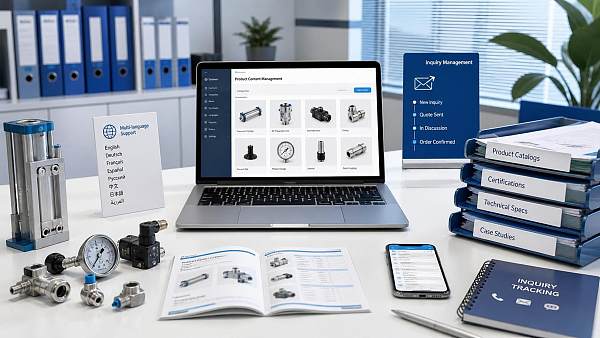
The focus here is not to promise a fixed growth figure. Overseas markets, product categories, quotation methods, website foundations, and sales follow-up capabilities vary greatly, and any result must be assessed in the context of the project. What a demo should show is a controllable process: whether pages can be edited, whether content can be managed, whether channel data can be reviewed, and whether leads have a clear destination. The clearer the controllability, the easier it is for customers to assess whether subsequent investment is reasonable.
Replace a “Full Feature Tour” with a Real Operational Rhythm
What operators usually care about is not what the system can theoretically do, but how many steps a daily task takes, who is responsible, and whether adjustments can be made after an error occurs. A good demo script can revolve around a complete task, such as “adding a new industrial product for the German market and launching it with search promotion.” It can be demonstrated in the actual sequence, from creating product information, generating or organizing basic content, configuring German pages, checking mobile presentation, and setting form fields, to linking promotional landing pages.
During this process, points requiring manual involvement should be deliberately explained. AI-assisted content generation can improve the efficiency of first drafts, but professional parameters, industry terminology, delivery conditions, and compliance wording still need to be confirmed by the company. Multilingual content should not be assessed only for grammatical fluency; units, usage scenarios, inquiry habits, and the information local customers care about must also be checked. This reminder does not weaken the value of the solution. On the contrary, it can prevent customers from interpreting automation as “no operations required.”
Likewise, demos should explain permissions and collaboration methods. Marketing personnel are responsible for pages and content, sales personnel review inquiries, managers review channel performance, and external service teams undertake optimization work. All of these directly affect the user experience after delivery. If every minor adjustment in a system must be completed by professional developers, even the most extensive marketing features will be difficult to truly integrate into daily workflows.
Extend “Visibility” to “Decision-Making”
Product demo scripts should also reserve a verification stage. For overseas independent websites, it is not enough to show that the website has been successfully published; the demo should also explain what to review after publication: whether pages can be accessed normally, whether important content is displayed completely, whether forms can receive submissions, whether promotional links are correct, and whether visits from search and advertising enter the corresponding pages. As for organic search performance, advertising costs, and inquiry quality, these need to be observed over a certain operating cycle in combination with data and sales feedback. Short-term page launches should not be equated with long-term customer acquisition results.
Since its establishment in 2013, Yingbao Information Technology (Beijing) Co., Ltd. has continuously developed service capabilities around intelligent website building, SEO optimization, social media marketing, and advertising. What it provides to foreign trade companies, manufacturing plants, cross-border sellers, and companies expanding brands overseas is not only website-building tools, but also coordinated pathways related to cross-border stores, advertising marketing, content optimization, and AI search visibility. For teams needing to cover North America, Europe, Southeast Asia, the Middle East, or other overseas markets, the significance of such integrated capabilities is that website building, promotion, and content maintenance do not need to be repeatedly switched between multiple disconnected systems.
However, whether platform capabilities are suitable for a specific company still depends on detailed judgments in the demo: whether existing product information is complete, who reviews multilingual content, how advertising accounts and data permissions are handed over, how sales handles inquiries from different sources, and whether subsequent page updates are handled internally or by the service team. Incorporating these questions into the script is closer to real decision-making than simply displaying the number of pages.
Make the Demo a Preview of Delivery
At the end of a valuable demonstration, viewers should not be left only with the impression that “the system looks good.” Instead, they should be able to describe the future workflow: where product information enters, how pages are published, where promotional traffic lands, who follows up on inquiries, and which metrics are used for review. If these questions cannot be answered clearly during the demo, subsequent implementation is still likely to encounter problems such as missing content, unclear responsibilities, or disconnected channels.
Before preparing a product demo script, it is worth first collecting three pieces of information: which stage currently creates the biggest customer acquisition bottleneck, who will most often operate the system after launch, and which market or product line is expected to be verified first. Use this to determine the demonstration path, and features will naturally serve value rather than overshadow it.
Related Articles


Related Products
 Yiyingbao SaaS Intelligent Website Building and Marketing SystemYiyingbao SaaS Intelligent Website Building and Marketing System, AI-powered no-code website building, rapid creation of multilingual B2B international websites in 10 minutes, global server acceleration, AI-powered SEO optimization, helping businesses connect efficiently with global markets. The perfect integration of technology and operation makes building an international trade website remarkably simple
 AI+SEM Intelligent Advertising Marketing SystemAI+SEM drives intelligent ad creation, empowering full-funnel precision advertising marketing. The system automatically generates weekly/monthly reports, AI recommends keywords and target countries, monitors core metrics in real-time with intelligent alerts, and enables one-click high-conversion ad solutions to help quickly acquire customers and improve ROI.
 AI+SEO Dual-Engine System Optimization ServicesYiyingbao’s AI+SEO dual-engine optimization system helps foreign trade enterprises acquire high-quality organic traffic through AI-powered keyword research, content generation, and comprehensive technical optimization, significantly improving search rankings and conversion rates.
 AI+SNS Social Media Marketing SystemYingbao AI+SNS Social Media Marketing System - Precision social capture for the social media era. Supports one-click content synchronization across major platforms like Facebook and LinkedIn. AI intelligently rewrites posts for enhanced relevance. 24/7 AI customer service and user profiling analysis empower businesses to efficiently expand into global markets.
 AI+SEO营销解决方案易营宝AI+SEO营销解决方案,通过AI批量写作、智能生成TDK、精准关键词扩词等功能,全面优化网站SEO效果,提升流量与转化率。助力企业构建高效智能网站新生态。
 AI+SEM Advertising Marketing SolutionsAI+SEM Advertising Marketing Solution leverages AI technology to deeply empower SEM ad campaigns. It automatically generates weekly/monthly reports using AI, presenting account data across multiple dimensions for comprehensive insights into campaign performance and trends. The system precisely recommends keywords and target countries, intelligently generates high-conversion ad copy, and enables one-click activation of efficient campaign plans to help businesses rapidly acquire customers. Simultaneously, it monitors core metrics in real time, intelligently identifies abnormal fluctuations, and issues timely alerts to ensure stable, high-return advertising results.
 Domain Name ServicesEasyWin provides professional domain name services, including intelligent queries, one-stop registration, brand protection, and full lifecycle management, helping businesses build a digital brand image.
 EasyOperate B2C Cross-Border E-Commerce Platform & Independent WebsiteEasyStore B2C Cross-border E-commerce Independent Store is an intelligent website building and cross-border e-commerce integrated solution independently developed by EasyStore Information Technology (Beijing) Co., Ltd. The system is specially designed for small and medium-sized as well as large export enterprises, integrating 'website building, operation, marketing, advertising, and conversion' into one, helping enterprises quickly establish cross-border e-commerce independent stores to achieve brand globalization and global sales growth.
The platform supports multiple languages, multiple currencies, and multi-channel marketing, with built-in AI intelligent translation and SEO optimization systems, suitable for mainstream markets such as Southeast Asia, Europe and America, Latin America, and the Middle East, assisting Chinese manufacturing enterprises in efficiently deploying international e-commerce strategies. SSL证书易营宝提供专业SSL安全证书服务,包括单域名和泛域名证书,确保网站数据传输加密、身份验证和完整性保护,助力企业建立安全可信的在线业务环境。









