









- CBP Finalizes Electronic Rail Export Manifest Rule, Effective October 26, 2026Oct 26, 2026View details
- Amazon’s 2026 peak season surcharge takes effect on October 25Oct 26, 2026View details
- AI Is Eating SaaS: Three Real-World Cases in One AfternoonOct 25, 2026View details
- Exiger CEO: The SaaS Apocalypse Is Real, but It Means Something DifferentOct 25, 2026View details
- Hengqin Cooperation Zone Shares Cross-Border E-Commerce Developments, Focusing on Macao-Hengqin Collaboration and International MarketsOct 24, 2026View details
- A Shenyang study highlights the development of the “cross-border e-commerce + industrial cluster” modelOct 24, 2026View details
How to Verify Improved Search Visibility for Spanish-Language Website SEO
To verify whether the search visibility of a Spanish-language website has improved, it is not enough to look only at the ranking positions of a few keywords. A more reliable assessment should also consider organic search impressions, effective rankings, the quality of traffic reaching pages, and whether these visits continue to generate inquiries, form submissions, catalog downloads, or orders. Especially when targeting different markets such as Spain, Mexico, and Argentina, search habits, device shares, and commercial intent for the same term differ. Data must first be segmented to avoid mistaking short-term fluctuations for optimization results.
First, standardize the comparison criteria to prevent inconsistencies in data
Before starting the assessment, save a clear baseline: reporting period, target country or region, language directory, organic search channel filter conditions, core landing pages, and conversion event definitions. Use the same criteria for every subsequent comparison. For example, if Spanish content covers both es-ES and Latin American Spanish versions, the total impressions of the two versions cannot be directly compared with clicks from a single country.
The comparison period should not be too short either. Search results can be affected by holidays, promotional activities, seasonal industry demand, and search engine recrawling. For B2B terms with low search volume, weekly reviews can easily show sharp fluctuations caused by zero clicks or a single click. Reviewing trends monthly, then checking weekly changes for key pages, provides a more stable assessment. After a page redesign, bulk publication of new content, or adjustment of language tags, the date should be noted in the record; otherwise, it is difficult to distinguish whether visibility changes come from content optimization or technical changes.
Review impression growth together with ranking positions
Search impressions reflect opportunities for pages to appear in search results, but more impressions do not automatically mean higher traffic value. If the additional impressions mainly come from low-ranking long-tail terms with weak query intent, clicks may not increase accordingly. Conversely, when a core term moves from the second page of search results to the first page, impressions may change only slightly while clicks improve significantly.
Average ranking is particularly easy to misinterpret when viewed in isolation. It is an aggregated value across multiple queries, pages, and positions. Major changes in branded terms or fluctuations in a small number of broad terms with high impressions can affect the average. A more meaningful approach is to group queries by topic and review product model terms, product category terms, application scenario terms, problem-solving terms, and purchase-intent terms separately. This reveals whether visibility is expanding toward genuinely relevant search demand or merely gaining broad exposure.
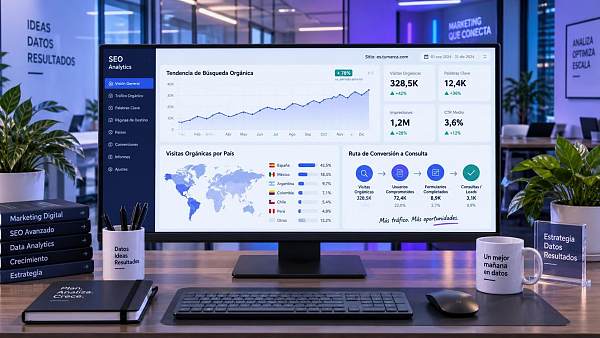
Segment data by country, device, and page
“Spanish” is not a single search market. Terms commonly used in Spain may not apply in Mexico or Chile; the same product may also use different units of measurement, industry terminology, or procurement terms across regions. If pages use general Spanish but data from all regions is mixed together, improvement in one market may conceal a decline in another.
Review countries or regions, URL directories, and device types separately. If regional versions exist, first confirm that each version is correctly assigned to its corresponding language and region to avoid similar pages competing with each other. A Mexican page gaining impressions in Spain is not necessarily a positive signal; it may indicate that the search engine has not yet accurately understood the page's geographic targeting. Mobile rankings and click-through rates should also be reviewed independently. When mobile search accounts for a high share of Spanish-language markets, strong desktop performance does not prove that the landing page's visibility and visitor experience on mobile have improved as well.
Use search queries to determine whether the right content is being seen
After exporting search queries, do not only filter for the terms with the highest number of clicks. Focus on whether newly acquired terms align with the page topic. For example, a page selling industrial equipment may gain many impressions from informational queries such as “manual” or “definición.” Traffic may appear to grow, but these queries may be more suitable for informational content rather than product detail pages. In this case, consider adding explanatory pages and use internal links to guide visitors with purchase intent to the relevant product pages, rather than forcibly expanding the topic of the original page.
Also pay attention to Spanish accent marks, singular and plural forms, gender variations, and regional vocabulary. Searchers may enter spellings with or without accents, or use localized names. These can be combined into the same intent group for analysis, but variants should not be mechanically repeated and stuffed into the body text. If a variant has high impressions but a low click-through rate, first verify whether the page title accurately addresses the need behind that term, rather than immediately increasing keyword density.
After traffic, verify whether pages have completed the intended actions
Improved visibility should ultimately be reflected in trackable on-site behavior. Appropriate metrics vary by page type: product pages can focus on inquiry submissions, specification sheet downloads, and clicks on contact entry points; content pages can focus on the proportion of users entering product pages, internal searches, and subsequent sessions; store pages should be assessed together with add-to-cart, checkout initiation, and order events. Measuring all pages with the same conversion rate will underestimate content that serves an early-stage educational role and may also conceal conversion issues on transactional pages.
When attributing conversions, exclude test visits, internal visits, and invalid forms, and ensure that form event names are consistent across language versions. If clicks on Spanish pages increase while inquiries decline, first check whether telephone country codes, address formats, required field prompts, privacy notices, and form error messages have been localized into Spanish. Incomplete translation, no feedback after submission, or buttons obscured on mobile can all create the illusion that “search performance has improved while business actions have deteriorated.”
Establish reviewable change records
Whenever adjusting titles, content structure, internal links, canonical URLs, redirects, or language and regional annotations, record the page, the changes made, and the publication time. When ranking anomalies occur, first check index status, crawl issues, duplicate pages, and incorrect redirects before explaining them through content quality. Technical issues can suddenly make a page ineligible for display, and keyword ranking tools alone often cannot explain the cause.
An effective monthly record does not need to be filled with charts. It only needs to answer several questions: which topics gained more effective impressions in the target market; which pages converted impressions into clicks; whether new visits entered the intended path; and whether pages that did not improve are blocked at the indexing, ranking, click-through rate, or conversion stage. Only by reviewing along this chain can you confirm whether the increase in search visibility for a Spanish-language website is real and sustainable.
Related Articles
 How Can an SEO Content Strategy Prevent Keyword Cannibalization?
 Website Rankings Stuck on Page Two? How to Find Opportunities for Improvement
 SEO traffic suddenly dropped. How can you identify the affected pages?



Related Products
 Yiyingbao SaaS Intelligent Website Building and Marketing SystemYiyingbao SaaS Intelligent Website Building and Marketing System, AI-powered no-code website building, rapid creation of multilingual B2B international websites in 10 minutes, global server acceleration, AI-powered SEO optimization, helping businesses connect efficiently with global markets. The perfect integration of technology and operation makes building an international trade website remarkably simple
 AI+SEM Intelligent Advertising Marketing SystemAI+SEM drives intelligent ad creation, empowering full-funnel precision advertising marketing. The system automatically generates weekly/monthly reports, AI recommends keywords and target countries, monitors core metrics in real-time with intelligent alerts, and enables one-click high-conversion ad solutions to help quickly acquire customers and improve ROI.
 AI+SEO Dual-Engine System Optimization ServicesYiyingbao’s AI+SEO dual-engine optimization system helps foreign trade enterprises acquire high-quality organic traffic through AI-powered keyword research, content generation, and comprehensive technical optimization, significantly improving search rankings and conversion rates.
 AI+SNS Social Media Marketing SystemYingbao AI+SNS Social Media Marketing System - Precision social capture for the social media era. Supports one-click content synchronization across major platforms like Facebook and LinkedIn. AI intelligently rewrites posts for enhanced relevance. 24/7 AI customer service and user profiling analysis empower businesses to efficiently expand into global markets.
 AI+SEO营销解决方案易营宝AI+SEO营销解决方案,通过AI批量写作、智能生成TDK、精准关键词扩词等功能,全面优化网站SEO效果,提升流量与转化率。助力企业构建高效智能网站新生态。
 AI+SEM Advertising Marketing SolutionsAI+SEM Advertising Marketing Solution leverages AI technology to deeply empower SEM ad campaigns. It automatically generates weekly/monthly reports using AI, presenting account data across multiple dimensions for comprehensive insights into campaign performance and trends. The system precisely recommends keywords and target countries, intelligently generates high-conversion ad copy, and enables one-click activation of efficient campaign plans to help businesses rapidly acquire customers. Simultaneously, it monitors core metrics in real time, intelligently identifies abnormal fluctuations, and issues timely alerts to ensure stable, high-return advertising results.
 Domain Name ServicesEasyWin provides professional domain name services, including intelligent queries, one-stop registration, brand protection, and full lifecycle management, helping businesses build a digital brand image.
 EasyOperate B2C Cross-Border E-Commerce Platform & Independent WebsiteEasyStore B2C Cross-border E-commerce Independent Store is an intelligent website building and cross-border e-commerce integrated solution independently developed by EasyStore Information Technology (Beijing) Co., Ltd. The system is specially designed for small and medium-sized as well as large export enterprises, integrating 'website building, operation, marketing, advertising, and conversion' into one, helping enterprises quickly establish cross-border e-commerce independent stores to achieve brand globalization and global sales growth.
The platform supports multiple languages, multiple currencies, and multi-channel marketing, with built-in AI intelligent translation and SEO optimization systems, suitable for mainstream markets such as Southeast Asia, Europe and America, Latin America, and the Middle East, assisting Chinese manufacturing enterprises in efficiently deploying international e-commerce strategies. SSL证书易营宝提供专业SSL安全证书服务,包括单域名和泛域名证书,确保网站数据传输加密、身份验证和完整性保护,助力企业建立安全可信的在线业务环境。









