









- Which customer acquisition channels will be affected by cross-border marketing trends in 2026?Sep 06, 2026View details
- Which homogenization risks should be considered in an analysis of the AI-powered website building industry?Aug 30, 2026View details
- How Will AI Marketing Trends 2026 Change Advertising Budget AllocationAug 28, 2026View details
- Is the EV SSL certificate market shrinking or upgrading? How should companies assess certificate procurement?Aug 11, 2026View details
- Why the old AMP SEO 2020 practices no longer work and what has changed in current optimization prioritiesAug 02, 2026View details
- How to Choose Topics for an Industry News Section to Attract More Organic Search TrafficJul 29, 2026View details
What Should You Do When the Indexing Rate of a Foreign Trade SEO French Website Drops? From Crawling, Duplicate Pages to Content Quality Checks
When French website indexing suddenly drops, first determine which layer the problem is in
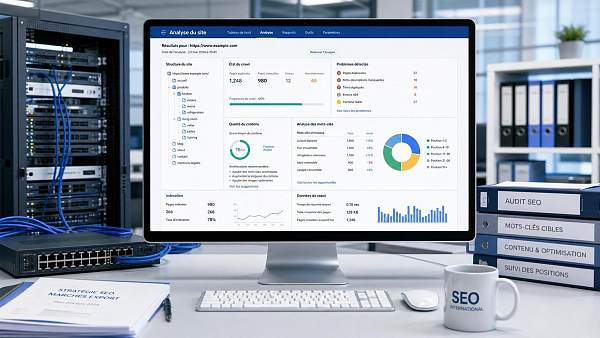
How should foreign trade SEO French website indexing decline be handled? The real pain point is often not that the content is too thin, but that the site has deviated in crawling, indexing, and de-duplication. The French market covers France, Belgium, Canada’s French-speaking regions, and parts of Africa. Search competition, page structure, and localization requirements vary by region, so a drop in indexing cannot be addressed with a single method.
In website and marketing integration projects, this kind of issue is more common in multilingual independent sites, French subdirectory sites, and sites after system migration. On the surface, it looks like fewer pages are indexed, but in reality it may be that the crawl budget is being consumed by duplicate pages, or that the quality signals of French pages are weak, causing search engines to stop allocating crawl frequency.
Therefore, when asking how to handle a drop in foreign trade SEO French website indexing, the first step is not to mass-edit titles, but to break down the problem: can the pages be crawled, can crawled pages be indexed, will indexed pages be replaced, and is the page itself worth retaining? This is more effective than simply adding more content.
During actual troubleshooting, the key focus differs by business scenario
The reasons for a drop in indexing on French websites are also different for B2B inquiry sites and cross-border e-commerce sites. The former often faces issues such as deep category structures, thin product pages, and heavy translation traces; the latter is more likely to have too many filter pages, parameter pages, and pagination pages, resulting in duplicated content buildup.
If the site uses a multilingual website-building system, another common situation is that the technical structure is fine, but the language versions are competing with each other. If the French and English pages are too similar, or if the canonical tags are improperly configured, search engines may keep only one version, while the rest remain online but are not indexed for a long time.
This is also why, when dealing with the question of how to handle a drop in foreign trade SEO French website indexing, you cannot look only at the total curve. More valuable to judge is: which directory the drop is concentrated in, whether it happened after a redesign or after content updates, whether the French site is a new site or an old site, or whether it is a language site split from the main site.
Comparison of common business scenarios and troubleshooting priorities
First look at crawl efficiency, because many indexing drops are actually stuck at the entry point
When asking how to handle a drop in foreign trade SEO French website indexing, the crawl layer usually needs to be checked first. This is especially true when a large number of French pages have been added, but search engine visits in the logs have not increased accordingly; in many cases the issue is not with the copy, but with the entry design and resource allocation.
A more common scenario is that the French directory is buried too deep, the homepage and navigation provide almost no entry points, and pages can only be discovered passively through the sitemap. In this case, even if links are submitted, crawl priority may still not be high. If server response is slow, JS loading is heavy, or mobile resources are bloated, French pages will be crawled even less.
- Check whether the French directory can reach core pages within three clicks.
- Verify robots rules to avoid accidentally blocking normal pages outside parameters.
- Review server logs to confirm whether crawls are concentrated on low-value URLs.
- Synchronize mobile speed checks, especially the French template page first screen loading.
If you use a platform with both website building and SEO coordination capabilities, handling will be much smoother. Platforms like 易营宝, which support long-term multilingual independent-site services, usually consider site structure, indexing logic, and subsequent promotion together, which is more cost-effective than separate remediation later.
When there are too many duplicate pages, French pages are easily compressed by the system
In practical application, duplicate pages are one of the easiest layers for French websites to be ignored. Many teams see pages online and titles different, and assume they are not duplicate content. But search engines also evaluate the body text, template ratio, language version differences, and URL parameter structure.
For example, the same product generates French links for color pages, specification pages, print pages, and pages with tracking parameters. The backend sees four addresses, but the search engine may see only one content item. If English and German pages are mechanically translated into French, semantic changes are minimal, and the French version is naturally harder to retain indexing eligibility.
At this point, when dealing with the question of how to handle a drop in foreign trade SEO French website indexing, the focus is not on continuing to publish more pages, but on first reducing duplication. Set canonical tags for duplicate parameter pages, restrict indexing of filter pages without independent value, and add independent copy, case information, and regional expressions to genuinely core French landing pages so that indexing is more likely to recover.
Several points that are easy to judge incorrectly before launch
- Treating multilingual pages as simple translation tasks and ignoring localized rewriting.
- Only handling a single page without addressing duplicate rules across the whole template category.
- Looking only at the number of indexed pages, not the source of excluded pages.
- Changing the canonical, but not synchronizing internal link paths.
After indexing rule changes, the recovery paths for old and new sites are not the same
Some French websites do not suddenly fail; rather, after search engines raise the indexing threshold, pages that were originally marginally indexable get screened out again. This is more common on old sites, especially those with a lot of historical content, complex category layers, and sites that previously relied on batch page expansion.
New sites are different. Newly built French sites often get fewer indexations because of insufficient trust and incomplete structural signals. The number of pages does not necessarily need to be large, but it must clearly tell search engines which pages are most important, which language versions correspond to each other, and which content is part of the site’s ongoing operation.
If it is an old site upgraded to a new system, it is recommended to keep the historical high-quality URL logic and at least ensure that the core paths for product pages, solution pages, and content pages remain stable. In multilingual site construction, 易营宝 emphasizes “promotable, indexable, convertible,” and the reason is here: technical structure and marketing content cannot be separated, especially in the French market.
Content quality review is not about word count, but whether the page has retained value
When discussing how to handle a drop in foreign trade SEO French website indexing, the final step should return to content quality. But quality here is not just about article length. If a French page is a direct translation of the English original, the terminology will sound stiff, the paragraph structure will not match French reading habits, and even if the grammar is correct, search engines will still judge the page as lacking independent value.
A more effective approach is layered optimization by page type. Product pages should strengthen parameter explanations, application conditions, and delivery information; solution pages should explain applicable scenarios and implementation differences; content pages should revolve around common search questions in the French market. This not only reduces duplication, but also better fits the long-term operating logic of website and marketing service integration.
Make remediation a closed loop, and indexing can rise back steadily
How should a drop in foreign trade SEO French website indexing be handled? A more stable process is: first segment the directories to see the scope of the decline, then check crawl entry points, then clean up duplicate pages and erroneous indexing, and finally focus on improving the quality of core French pages. This avoids adding content on one hand while continuing to generate invalid URLs on the other.
At launch, you can first select a French core directory as a sample, observe crawl and indexing feedback for two to four weeks, and then decide whether to expand the adjustment scope. For projects that do website building, SEO, advertising, and multichannel customer acquisition at the same time, this layered troubleshooting is especially important, because after indexing recovers, subsequent organic traffic, ad landing page quality, and AI search visibility can all build on a stable foundation.
If you still cannot determine whether the current problem is closer to technical, structural, or content-level, first organize four items of data: French directory crawl logs, excluded page types, duplicate URL sources, and content differences on core pages. Once these four items are clear, the answer to how to handle a drop in foreign trade SEO French website indexing usually will not go off track.
Related Articles


Related Products
 Yiyingbao SaaS Intelligent Website Building and Marketing SystemYiyingbao SaaS Intelligent Website Building and Marketing System, AI-powered no-code website building, rapid creation of multilingual B2B international websites in 10 minutes, global server acceleration, AI-powered SEO optimization, helping businesses connect efficiently with global markets. The perfect integration of technology and operation makes building an international trade website remarkably simple
 AI+SEM Intelligent Advertising Marketing SystemAI+SEM drives intelligent ad creation, empowering full-funnel precision advertising marketing. The system automatically generates weekly/monthly reports, AI recommends keywords and target countries, monitors core metrics in real-time with intelligent alerts, and enables one-click high-conversion ad solutions to help quickly acquire customers and improve ROI.
 AI+SEO Dual-Engine System Optimization ServicesYiyingbao’s AI+SEO dual-engine optimization system helps foreign trade enterprises acquire high-quality organic traffic through AI-powered keyword research, content generation, and comprehensive technical optimization, significantly improving search rankings and conversion rates.
 AI+SNS Social Media Marketing SystemYingbao AI+SNS Social Media Marketing System - Precision social capture for the social media era. Supports one-click content synchronization across major platforms like Facebook and LinkedIn. AI intelligently rewrites posts for enhanced relevance. 24/7 AI customer service and user profiling analysis empower businesses to efficiently expand into global markets.
 AI+SEO营销解决方案易营宝AI+SEO营销解决方案,通过AI批量写作、智能生成TDK、精准关键词扩词等功能,全面优化网站SEO效果,提升流量与转化率。助力企业构建高效智能网站新生态。
 AI+SEM Advertising Marketing SolutionsAI+SEM Advertising Marketing Solution leverages AI technology to deeply empower SEM ad campaigns. It automatically generates weekly/monthly reports using AI, presenting account data across multiple dimensions for comprehensive insights into campaign performance and trends. The system precisely recommends keywords and target countries, intelligently generates high-conversion ad copy, and enables one-click activation of efficient campaign plans to help businesses rapidly acquire customers. Simultaneously, it monitors core metrics in real time, intelligently identifies abnormal fluctuations, and issues timely alerts to ensure stable, high-return advertising results.
 Domain Name ServicesEasyWin provides professional domain name services, including intelligent queries, one-stop registration, brand protection, and full lifecycle management, helping businesses build a digital brand image.
 EasyOperate B2C Cross-Border E-Commerce Platform & Independent WebsiteEasyStore B2C Cross-border E-commerce Independent Store is an intelligent website building and cross-border e-commerce integrated solution independently developed by EasyStore Information Technology (Beijing) Co., Ltd. The system is specially designed for small and medium-sized as well as large export enterprises, integrating 'website building, operation, marketing, advertising, and conversion' into one, helping enterprises quickly establish cross-border e-commerce independent stores to achieve brand globalization and global sales growth.
The platform supports multiple languages, multiple currencies, and multi-channel marketing, with built-in AI intelligent translation and SEO optimization systems, suitable for mainstream markets such as Southeast Asia, Europe and America, Latin America, and the Middle East, assisting Chinese manufacturing enterprises in efficiently deploying international e-commerce strategies. SSL证书易营宝提供专业SSL安全证书服务,包括单域名和泛域名证书,确保网站数据传输加密、身份验证和完整性保护,助力企业建立安全可信的在线业务环境。









