









- Which customer acquisition channels will be affected by cross-border marketing trends in 2026?Sep 06, 2026View details
- Which homogenization risks should be considered in an analysis of the AI-powered website building industry?Aug 30, 2026View details
- How Will AI Marketing Trends 2026 Change Advertising Budget AllocationAug 28, 2026View details
- Is the EV SSL certificate market shrinking or upgrading? How should companies assess certificate procurement?Aug 11, 2026View details
- Why the old AMP SEO 2020 practices no longer work and what has changed in current optimization prioritiesAug 02, 2026View details
- How to Choose Topics for an Industry News Section to Attract More Organic Search TrafficJul 29, 2026View details
Why Foreign Trade B2B Website SEO Strategies Often Get Stuck on Product Page Indexing
In B2B foreign trade website SEO strategies, product pages that remain unindexed for a long time are usually not simply due to "product descriptions being too short." Search engines first need to discover the page, access it properly, determine whether it should enter the index, and only then assess which search rankings it is suitable to participate in. If any step is hindered by configuration, templates, or site structure, even a large number of product pages may remain in a "discovered but not indexed" state for a long time, or may not be discovered at all.
When addressing this type of issue, do not rush to rewrite descriptions in bulk. A more effective approach is to investigate in the order of crawling, indexing, duplicate content, and multilingual configuration, separating technical issues from content issues.
First distinguish: has the page not been crawled, or has it not been indexed after crawling?
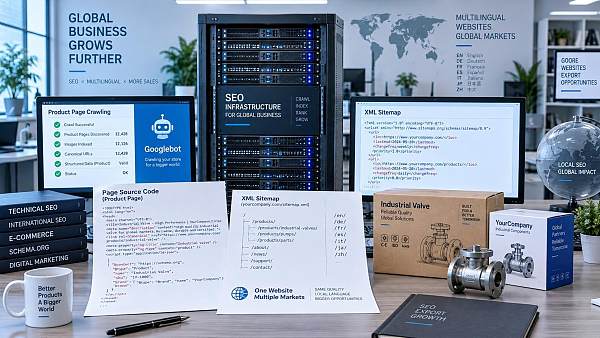
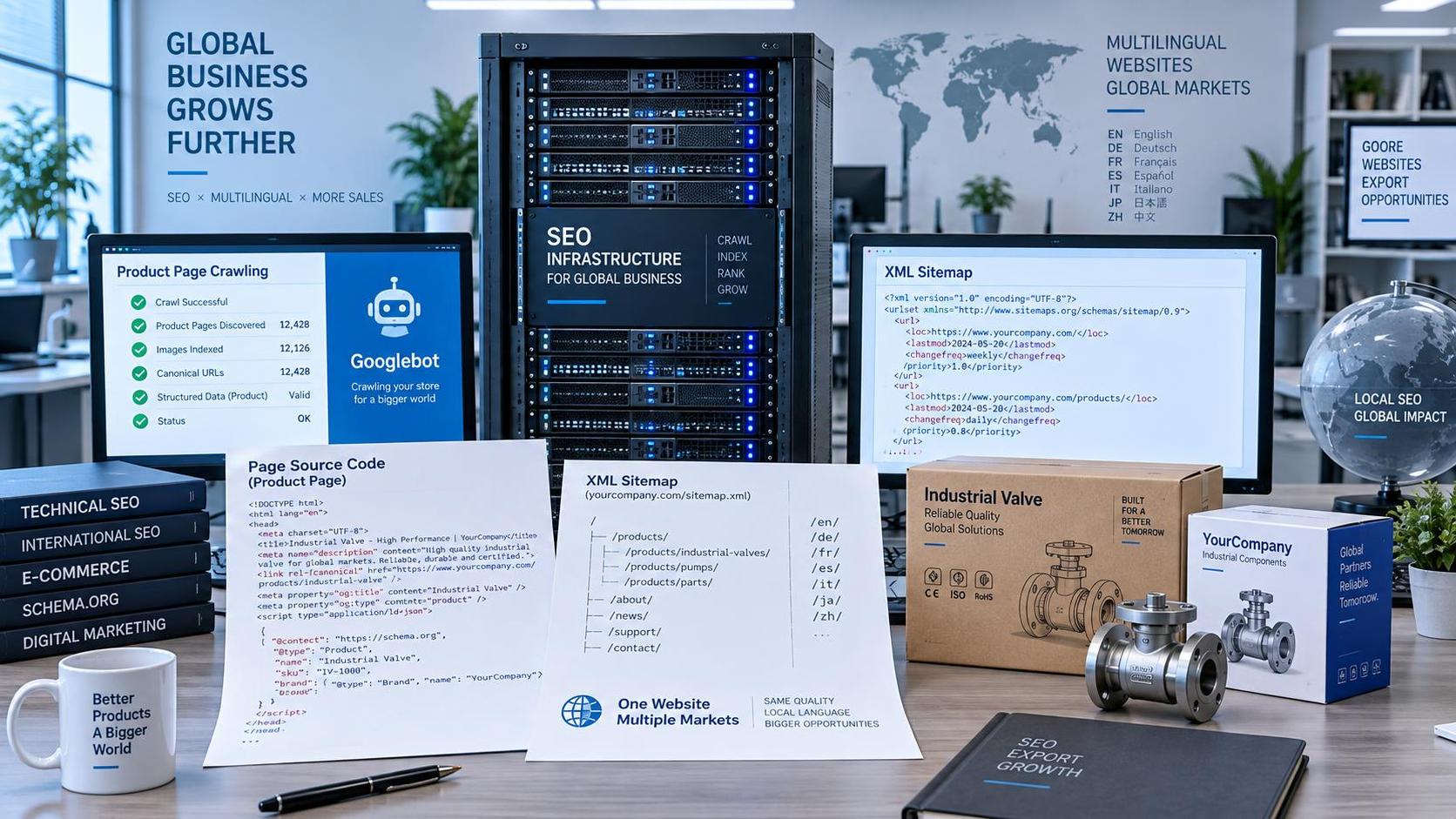
The solutions for these two issues are completely different. You can use the URL Inspection tool in Google Search Console to check the status of an individual product link, and determine the cause by combining the sitemap and page source code.
A common misconception is that if a product page can be opened in a browser, Google must also be able to crawl it. In fact, if a page can only be accessed through on-site search, filter parameters, or JavaScript interactions, crawlers may not be able to discover it consistently. Every product page intended to participate in organic search should be accessible through regular links from at least a product category page, related product module, or HTML site structure.
If product page indexing is blocked, first rule out four basic types of restrictions
The first type is residual indexing directives. Many websites retain noindex during testing, redesigns, or template duplication. Some pages may have no meta tag but still send a no-index directive through HTTP response headers. Product detail templates, pagination pages, and multilingual pages should all be spot-checked separately; do not inspect only the homepage or one normal page.
The second type is unintended blocking by robots.txt. The robots file is originally used to restrict low-value paths, such as backend areas, search result pages, or shopping carts; however, some website-building systems block product directories, language directories, and even image resource directories at the same time. If Google cannot load key content or access product links, subsequent content optimization has no practical value.
The third type is an incorrect Canonical. The purpose of Canonical is to tell search engines which page is the primary version among multiple similar pages. Common issues on foreign trade websites include all product pages pointing to a category page or homepage, or retaining an old product URL when copying pages. In this case, search engines will treat the current product page as an alternative version and naturally will not index it separately. Under normal circumstances, each product detail page for independent sales or inquiries should preferably use a self-referencing Canonical.
The fourth type is unstable response status. Pages that occasionally load slowly, return 5xx errors, or have excessively long redirect chains will all reduce crawling efficiency. This is particularly important for overseas access, where servers, CDN configurations, redirect rules, and SSL certificates need to remain stable. Do not test only in a domestic network environment; confirm that pages can load properly in the target market.
Duplicate content is not duplicate only when the text is identical
Product specifications on manufacturing and trading websites are often similar: the same equipment may differ only in size, material, power, or color; similar parts may differ only by model. If dozens of pages reuse the same titles, selling points, specification tables, and images, changing only one model number, it is difficult for search engines to determine what distinct search need each URL addresses.
This does not mean that every model must be forced into a long-form article. The criterion is whether the page has value to be searched for independently and to generate inquiries independently. If customers look for products by model, material, application industry, or technical parameters, the standalone page should be retained and supplemented with differentiating content, such as compatible equipment, key specification ranges, processing capabilities, usage limitations, optional configurations, delivery formats, and corresponding applications. If the difference is only an internal SKU variation and the page has no independent value for purchasing decisions, consolidating it into the main product page and using a specification selector or parameter table will often be more beneficial for concentrating authority.
Images should also help create differentiation. Using the same main image on all product pages does not necessarily prevent indexing, but it further reinforces the signal that the pages are highly similar. Images that show differences in models, interfaces, dimensions, packaging, or actual applications are more helpful in demonstrating the page's independence.
Multilingual configurations are most likely to create large numbers of "seemingly normal" duplicate pages
Multilingual foreign trade websites commonly offer English, German, Spanish, and other versions, but language switching does not mean international SEO is complete. If URLs in different languages display the same English content, or if machine translation changes only the menu and footer, search engines may regard them as near-duplicate pages.
Three areas require particular attention: whether each language has an independent, accessible URL; whether the page correctly declares language and regional relationships through hreflang; and whether the Canonical points to the current language version itself rather than uniformly back to the English page. hreflang addresses which version should be shown to users in a particular region and language, while Canonical addresses which page is the primary version; the two cannot replace each other.
In addition, when targeting different markets, product descriptions should not simply have their language replaced. North American buyers may be more concerned with certifications, lead times, and application cases, while European customers may pay more attention to materials, compliance information, or how specifications are presented. Organizing content in line with local search habits offers more indexing and ranking value than simply adding languages.
Place product pages back into a site structure that can be understood
Even if isolated product pages are indexed, they are unlikely to accumulate topical relevance. A clear structure is generally as follows: industry or solution pages explain application scenarios, category pages define the product scope, product pages address specific models and inquiry needs, and related articles or technical materials supplement product selection and usage questions. Category pages linking to product pages, and product pages linking to similar models, supporting products, and corresponding application pages, can help search engines understand page relationships and make it easier for visitors to continue browsing.
Anchor text for internal links should describe the actual item, such as "industrial water pump for irrigation," rather than repeatedly using "click to view" or only a model number. URLs generated by parameter filters, on-site search results, sorting pages, and duplicate pagination pages should have their indexing scope controlled to avoid crawlers spending substantial crawl budget on low-value variants.
Content optimization should answer buyers' questions, not merely add word count
Being indexed does not mean a page can generate inquiries, but once indexing issues are eliminated, content quality determines whether a product page is worth retaining over the long term. In B2B foreign trade website SEO strategies, product pages should prioritize answering the questions buyers use to screen suppliers: what scenarios the product is used for, how to select key specifications, which configurations can be customized, how minimum order quantities or packaging methods are communicated, and what information is needed for samples, drawings, and quotations.
There is no need to make every page into a corporate promotional page. The title, opening paragraph, specification table, application description, and inquiry form should remain consistent: if the page is about a specific product, the form should allow customers to submit the model, specifications, quantity, or drawings, rather than merely providing a generic "Contact Us." The clearer the page topic, the easier it is for search engines and potential customers to understand its purpose.
It is recommended to address issues in this order rather than changing every page at once
- Select 10 to 20 representative product pages and confirm their indexing status and exclusion reasons in Search Console.
- Check whether pages return a 200 status, and whether noindex, robots restrictions, or abnormal Canonical settings exist.
- Confirm that every important product page can be discovered through normal HTML links from category pages or related content pages, and is included in the XML Sitemap.
- Consolidate or restrict indexing for highly duplicate SKU pages with no independent search value, reserving resources for priority products and pages addressing genuine purchasing needs.
- Check the URL, Canonical, and hreflang relationships of multilingual pages one by one to prevent language versions from overriding one another.
- After fixes, update the sitemap and request reindexing for key pages; then observe changes in indexing status rather than judging results by rankings on the same day.
If the website-building platform itself cannot flexibly manage URLs, sitemaps, Canonical settings, language tags, and page indexing rules, subsequent optimization will be repeatedly constrained. When selecting foreign trade website-building and marketing services, these basic SEO control capabilities should be included in the evaluation criteria. The value of platforms such as Yiyingbao, which cover multilingual website building, SEO optimization, and coordinated promotion, does not lie in replacing content judgment, but in enabling page structure, indexing configurations, and ongoing operations to be managed within the same workflow.
When product page indexing remains stagnant for a long time, the first thing to confirm is not "whether to add more keywords," but whether search engines can actually discover, crawl, and recognize the page as an independent version. Once technical access is established, supplementing content around product differences, purchasing scenarios, and language markets is more likely to turn organic traffic into effective inquiries.
Related Articles


Related Products
 Yiyingbao SaaS Intelligent Website Building and Marketing SystemYiyingbao SaaS Intelligent Website Building and Marketing System, AI-powered no-code website building, rapid creation of multilingual B2B international websites in 10 minutes, global server acceleration, AI-powered SEO optimization, helping businesses connect efficiently with global markets. The perfect integration of technology and operation makes building an international trade website remarkably simple
 AI+SEM Intelligent Advertising Marketing SystemAI+SEM drives intelligent ad creation, empowering full-funnel precision advertising marketing. The system automatically generates weekly/monthly reports, AI recommends keywords and target countries, monitors core metrics in real-time with intelligent alerts, and enables one-click high-conversion ad solutions to help quickly acquire customers and improve ROI.
 AI+SEO Dual-Engine System Optimization ServicesYiyingbao’s AI+SEO dual-engine optimization system helps foreign trade enterprises acquire high-quality organic traffic through AI-powered keyword research, content generation, and comprehensive technical optimization, significantly improving search rankings and conversion rates.
 AI+SNS Social Media Marketing SystemYingbao AI+SNS Social Media Marketing System - Precision social capture for the social media era. Supports one-click content synchronization across major platforms like Facebook and LinkedIn. AI intelligently rewrites posts for enhanced relevance. 24/7 AI customer service and user profiling analysis empower businesses to efficiently expand into global markets.
 AI+SEO营销解决方案易营宝AI+SEO营销解决方案,通过AI批量写作、智能生成TDK、精准关键词扩词等功能,全面优化网站SEO效果,提升流量与转化率。助力企业构建高效智能网站新生态。
 AI+SEM Advertising Marketing SolutionsAI+SEM Advertising Marketing Solution leverages AI technology to deeply empower SEM ad campaigns. It automatically generates weekly/monthly reports using AI, presenting account data across multiple dimensions for comprehensive insights into campaign performance and trends. The system precisely recommends keywords and target countries, intelligently generates high-conversion ad copy, and enables one-click activation of efficient campaign plans to help businesses rapidly acquire customers. Simultaneously, it monitors core metrics in real time, intelligently identifies abnormal fluctuations, and issues timely alerts to ensure stable, high-return advertising results.
 Domain Name ServicesEasyWin provides professional domain name services, including intelligent queries, one-stop registration, brand protection, and full lifecycle management, helping businesses build a digital brand image.
 EasyOperate B2C Cross-Border E-Commerce Platform & Independent WebsiteEasyStore B2C Cross-border E-commerce Independent Store is an intelligent website building and cross-border e-commerce integrated solution independently developed by EasyStore Information Technology (Beijing) Co., Ltd. The system is specially designed for small and medium-sized as well as large export enterprises, integrating 'website building, operation, marketing, advertising, and conversion' into one, helping enterprises quickly establish cross-border e-commerce independent stores to achieve brand globalization and global sales growth.
The platform supports multiple languages, multiple currencies, and multi-channel marketing, with built-in AI intelligent translation and SEO optimization systems, suitable for mainstream markets such as Southeast Asia, Europe and America, Latin America, and the Middle East, assisting Chinese manufacturing enterprises in efficiently deploying international e-commerce strategies. SSL证书易营宝提供专业SSL安全证书服务,包括单域名和泛域名证书,确保网站数据传输加密、身份验证和完整性保护,助力企业建立安全可信的在线业务环境。









