









- Is the EV SSL certificate market shrinking or upgrading? How should companies assess certificate procurement?Aug 11, 2026View details
- Why the old AMP SEO 2020 practices no longer work and what has changed in current optimization prioritiesAug 02, 2026View details
- How to Choose Topics for an Industry News Section to Attract More Organic Search TrafficJul 29, 2026View details
- Digital Marketing Shenzhen Market Insights: Why Are Companies Expanding Overseas Looking for Growth Teams in Shenzhen?Jul 31, 2026View details
- Can Zhejiang foreign trade independent websites still be developed today? Look at changes in traffic and lead generationJul 28, 2026View details
- What New Signals Are Emerging in Enterprise Services SaaS Marketing ReportsJul 27, 2026View details
Which Signals Should You Check First When SEO Traffic Drops?
When SEO traffic suddenly drops, don't rush to redesign the site, rewrite content, or stop your campaigns. For after-sales maintenance personnel, the first step is to confirm whether these five types of signals—indexing, rankings, crawling, servers, and conversions—are showing abnormalities at the same time. Once you distinguish a localized fluctuation from a systemic issue, troubleshooting becomes much faster and unnecessary losses can be reduced.
First, determine: Is this a “real traffic issue” or a “tracking or page issue”?
A drop in SEO traffic does not necessarily mean that search performance has actually deteriorated. Common causes include tracking failure, changes to GA settings, page template modifications, or redirects and noindex being mistakenly added to certain landing pages.
The first thing after-sales maintenance personnel should check is whether traffic has declined only in a specific segment, such as a particular country, device, directory, or page type. If only one segment has dropped significantly, the issue is usually closer to the page or configuration layer rather than an algorithm fluctuation affecting the entire site.
If the entire site declines at the same time, then review Search Console, index coverage, crawler status, and server logs. This makes it possible to narrow the issue down to one or two types of causes quickly, instead of blindly testing content, backlinks, and technical factors.
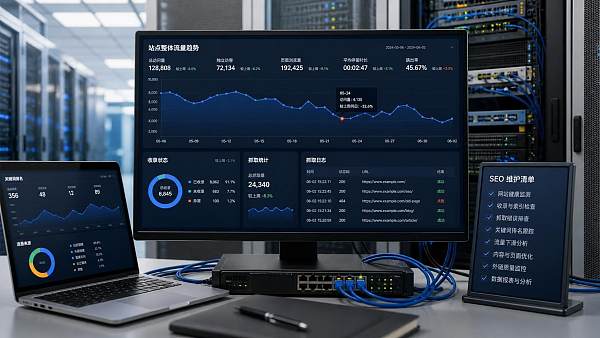
The key to this assessment is not to ask first, “Why did rankings drop?” but to confirm first whether “traffic, rankings, indexing, and click-through rate are changing in the same direction.” Only by reviewing all four signals together can you determine whether to fix technical issues first or supplement the content first.
The four signals to check first: indexing, rankings, click-through rate, and crawling
A decline in indexed pages usually means that pages have been excluded, the canonical tag is incorrect, the sitemap has failed, or new content has not been discovered in time. If the number of indexed pages has not declined, the problem may be further upstream and may not be with the pages themselves.
When rankings decline while indexing remains stable, common causes include stronger competitors, weaker content relevance, insufficient alignment with search intent, or changes in the distribution of internal link equity. Do not modify the entire site immediately; first check whether the decline affects core keywords or long-tail keywords.
When click-through rate declines but rankings do not change significantly, focus on checking whether the title, description, rich snippets, or search result display has been rewritten. In many cases, the decline in SEO traffic comes from “being visible but receiving no clicks,” rather than “not ranking at all.”
Crawling anomalies are more closely related to technical issues. If logs show fewer crawler visits, more response codes, longer response times, or important directories failing to be crawled, search engines are encountering obstacles at the access level. Simply waiting for a natural recovery will usually not help.
Why must server and page status be investigated at the same time?
When SEO traffic declines, server health is often more important to check first than making content adjustments. Slow responses, an increase in 5xx errors, CDN issues, and unstable DNS resolution can all affect crawling and visibility at the same time.
If a page opens in a browser but the crawler receives a blank page, an overly long redirect chain, or different content from different regions, it can create the typical illusion that “everything looks fine when checked manually, but search traffic has dropped.” After-sales maintenance personnel need to verify real-user access and crawler access separately.
You should also check whether a template redesign, JS rewriting, language-switching logic, or access control was recently launched. Independent websites and multilingual sites can easily encounter problems in these areas, especially overseas sites, where regional redirects, cache pollution, and incorrect canonicals are common.
If the decline occurs only on mobile devices or in a specific country site, prioritize checking whether above-the-fold loading, resource blocking, and indexable content on that platform are complete. Many traffic losses are not because “search engines did not provide traffic,” but because the page is not sufficiently readable in a specific environment.
How can you distinguish an algorithm fluctuation from an on-site failure?
Algorithm fluctuations usually appear as simultaneous changes across multiple pages and keywords, while indexing and crawling may not be abnormal. On-site failures are more likely to be concentrated in a specific directory, group of templates, or language version. Do not look only at daily data; review trends over at least 7 to 14 days.
If similar pages decline collectively while branded keywords, direct traffic, and returning-user traffic remain stable, the issue is more likely related to content relevance or page structure. If branded keywords and long-tail keywords also decline simultaneously, suspect technical and accessibility issues first rather than content quality.
When search result click-through rate is normal and rankings fluctuate slightly but conversions suddenly decline significantly, also check landing-page consistency, form usability, whether inquiry buttons are working, and whether the payment or consultation process has been interrupted. For after-sales maintenance personnel, traffic does not equal business results.
What should the most effective troubleshooting sequence be?
First, review Search Console and analytics platforms to confirm which countries, devices, and page types are affected by the traffic decline. Second, check indexing and index coverage to rule out noindex, canonical, robots, and sitemap issues.
Third, examine the relationship between ranking and click-through-rate changes to determine whether pages are “visible but not receiving clicks” or whether they are “being displayed less often altogether.” Fourth, check server logs and response codes to confirm whether crawlers are being blocked, delayed, or redirected incorrectly.
Fifth, manually verify key pages, checking the title, above-the-fold content, language versions, forms, internal links, and calls to action. If the issue is concentrated in a small number of templates, fix the templates first. If the entire site is fluctuating in the same direction, then assess the content, architecture, and competitive environment.
This sequence helps avoid common misjudgments, such as treating a technical failure as a content issue or mistaking a short-term fluctuation for long-term decline. The value of after-sales maintenance is not to “make changes” quickly, but to “identify the issue correctly” quickly.
Which situations require immediate escalation?
If indexed pages decline significantly, key directories are mistakenly blocked, the main site returns a large number of 5xx errors, or multilingual pages simultaneously lose crawl access, immediately escalate the issue to the development, operations, and SEO leads for joint handling. Do not simply leave it waiting in a maintenance ticket queue.
If only a small number of long-tail keywords fluctuate or an individual piece of content loses rankings, while overall traffic and conversions remain stable, you can first observe the content update schedule, changes in competing pages, and title click performance before deciding whether to make adjustments.
For businesses, the most important thing is to establish a fixed anomaly checklist: indexing, rankings, CTR, crawling, response time, and conversion rate. Each time SEO traffic declines, review these items in the same order so that troubleshooting does not become increasingly disorderly.
Conclusion: Check the signals before deciding what to do
A decline in SEO traffic is not an isolated issue but a combination of signals. Only by checking indexing and crawling first, then rankings and click-through rate, and finally the server and conversion process, can you accurately determine where the problem lies.
For after-sales maintenance personnel, the truly efficient approach is not to modify pages immediately, but to classify the anomaly first: Is it a tracking discrepancy, a page failure, a technical blockage, or declining content competitiveness? Once the issue is clearly classified, recovery will be faster and losses will be more controllable.
Related Articles
Related Products
 Yiyingbao SaaS Intelligent Website Building and Marketing SystemYiyingbao SaaS Intelligent Website Building and Marketing System, AI-powered no-code website building, rapid creation of multilingual B2B international websites in 10 minutes, global server acceleration, AI-powered SEO optimization, helping businesses connect efficiently with global markets. The perfect integration of technology and operation makes building an international trade website remarkably simple
 AI+SEM Intelligent Advertising Marketing SystemAI+SEM drives intelligent ad creation, empowering full-funnel precision advertising marketing. The system automatically generates weekly/monthly reports, AI recommends keywords and target countries, monitors core metrics in real-time with intelligent alerts, and enables one-click high-conversion ad solutions to help quickly acquire customers and improve ROI.
 AI+SEO Dual-Engine System Optimization ServicesYiyingbao’s AI+SEO dual-engine optimization system helps foreign trade enterprises acquire high-quality organic traffic through AI-powered keyword research, content generation, and comprehensive technical optimization, significantly improving search rankings and conversion rates.
 AI+SNS Social Media Marketing SystemYingbao AI+SNS Social Media Marketing System - Precision social capture for the social media era. Supports one-click content synchronization across major platforms like Facebook and LinkedIn. AI intelligently rewrites posts for enhanced relevance. 24/7 AI customer service and user profiling analysis empower businesses to efficiently expand into global markets.
 AI+SEO营销解决方案易营宝AI+SEO营销解决方案,通过AI批量写作、智能生成TDK、精准关键词扩词等功能,全面优化网站SEO效果,提升流量与转化率。助力企业构建高效智能网站新生态。
 AI+SEM Advertising Marketing SolutionsAI+SEM Advertising Marketing Solution leverages AI technology to deeply empower SEM ad campaigns. It automatically generates weekly/monthly reports using AI, presenting account data across multiple dimensions for comprehensive insights into campaign performance and trends. The system precisely recommends keywords and target countries, intelligently generates high-conversion ad copy, and enables one-click activation of efficient campaign plans to help businesses rapidly acquire customers. Simultaneously, it monitors core metrics in real time, intelligently identifies abnormal fluctuations, and issues timely alerts to ensure stable, high-return advertising results.
 Domain Name ServicesEasyWin provides professional domain name services, including intelligent queries, one-stop registration, brand protection, and full lifecycle management, helping businesses build a digital brand image.
 EasyOperate B2C Cross-Border E-Commerce Platform & Independent WebsiteEasyStore B2C Cross-border E-commerce Independent Store is an intelligent website building and cross-border e-commerce integrated solution independently developed by EasyStore Information Technology (Beijing) Co., Ltd. The system is specially designed for small and medium-sized as well as large export enterprises, integrating 'website building, operation, marketing, advertising, and conversion' into one, helping enterprises quickly establish cross-border e-commerce independent stores to achieve brand globalization and global sales growth.
The platform supports multiple languages, multiple currencies, and multi-channel marketing, with built-in AI intelligent translation and SEO optimization systems, suitable for mainstream markets such as Southeast Asia, Europe and America, Latin America, and the Middle East, assisting Chinese manufacturing enterprises in efficiently deploying international e-commerce strategies. SSL证书易营宝提供专业SSL安全证书服务,包括单域名和泛域名证书,确保网站数据传输加密、身份验证和完整性保护,助力企业建立安全可信的在线业务环境。









