









- Which customer acquisition channels will be affected by cross-border marketing trends in 2026?Sep 06, 2026View details
- Which homogenization risks should be considered in an analysis of the AI-powered website building industry?Aug 30, 2026View details
- How Will AI Marketing Trends 2026 Change Advertising Budget AllocationAug 28, 2026View details
- Is the EV SSL certificate market shrinking or upgrading? How should companies assess certificate procurement?Aug 11, 2026View details
- Why the old AMP SEO 2020 practices no longer work and what has changed in current optimization prioritiesAug 02, 2026View details
- How to Choose Topics for an Industry News Section to Attract More Organic Search TrafficJul 29, 2026View details
Why Do Cross-Border Marketing Emails Always End Up in Spam?
Why Do Cross-Border Email Marketing Campaigns Always End Up in the Spam Folder
For many companies running cross-border email marketing campaigns, the most common frustration is not that “no one replies,” but that the emails do not reach the inbox at all. The sending status in the backend shows successful delivery, yet customers say they did not see the email, or they occasionally receive it only to find it categorized under promotions, updates, or even spam. The problem is often not whether the content is polished enough, but whether there are issues with sender reputation, domain configuration, list quality, and localization strategy.
When an email system determines whether a cross-border email should be allowed through, its logic is more objective than many people imagine. It does not first consider whether you are “conducting serious marketing.” Instead, it checks whether the sender is trustworthy, whether recipients are likely to open the email, whether there have been previous complaints, and whether the domain and server appear to belong to a legitimate business. In other words, cross-border marketing emails usually end up in the spam folder not because of one isolated issue, but because several minor problems overlap.
Before Revising the Copy, Check Your Sender Reputation
When delivery rates become unstable, many marketers immediately start changing the subject line, adding emojis, or revising the copy. In reality, if the reputation of the sending domain and IP address is poor, making the copy sound more like “a real person’s communication” only changes the packaging. Overseas email service providers look at long-term behavior: whether the bounce rate is high, whether the sender is frequently reported, whether the volume of bulk emails has suddenly surged, and whether the same domain has suddenly started sending to a large number of unfamiliar recipients.
This is especially true when a new domain, new mailbox, and new IP address are launched at the same time—the system will naturally be more cautious. To meet deadlines, many foreign trade teams send bulk emails directly from a newly registered domain, only to have their delivery restricted during the first week. A more reliable approach is to warm up the domain first, gradually building sending volume, open rates, and reply rates before expanding the reach. This process is not fast, but it is much more reliable than “building a website today, sending bulk emails tomorrow, and complaining about spam the day after.”
Poor Domain Configuration Makes the Email Look Unprofessional
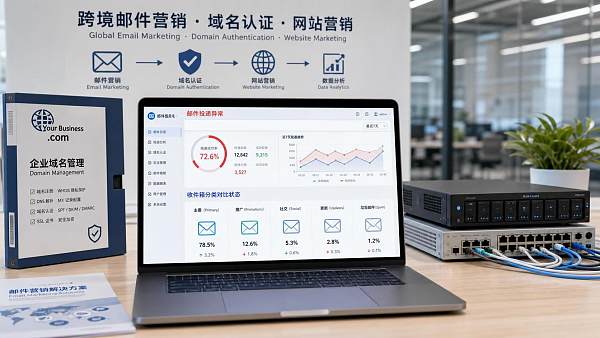
In cross-border email marketing, domain authentication is practically the foundation. If SPF, DKIM, and DMARC are not configured correctly, or if they are configured but not aligned, the recipient’s mail server will question whether the email was genuinely sent by you. For many companies, the problem is not that authentication was never set up, but that it was only partially completed. For example, the primary domain may be used for the website while emails are sent from another subdomain; the signature and bounce address may not match; or the email header information may be disorganized. In such cases, the system may decide that the email does not come from a complete business mailing system.
If you also operate an independent website, landing pages, form submissions, and automated emails, the relationships between your domains need to be clearly defined. The links among your website, forms, email, and CRM should be as consistent as possible. Otherwise, when a user submits an inquiry on your website but the follow-up email comes from another unfamiliar domain, both trust and deliverability may be affected. When companies integrate website development with marketing services, the real difference is often not how attractive the pages are, but whether these underlying configurations have been properly connected.
Poor List Quality Is More Damaging Than You Think
Some teams have poor email deliverability not because they are being “targeted by an algorithm,” but because their lists are simply unclean. Examples include purchased email databases, old lists that have not been maintained for a long time, addresses mechanically imported from trade show business cards, and contacts who unsubscribed but were later added back. All of these can reduce overall performance. In cross-border scenarios, list-related issues are more complex because email usage habits vary significantly across countries and industries. Some regions are less tolerant of marketing emails and have lower thresholds for complaints.
In practice, the more reliable approach is not to pursue quantity, but to clean the list first: remove invalid addresses, addresses with long-term inactivity, and clearly irrelevant contacts; then segment the remaining contacts by source, country, and role; and finally conduct sending tests in batches. Many companies consider this inconvenient, but after running several rounds, they realize that sending fewer emails to more relevant recipients is often more effective than sending to everyone at once. The “dirtier” the list, the more the impact of all subsequent optimization efforts will be diluted.
Content Can Also Trigger Filtering—but Not Just Because of “Sensitive Words”
Many people attribute emails landing in the spam folder to “a particular word in the subject line,” but that explanation is too simplistic. The real problem is usually that the content pattern looks too much like a mass-mailing template: a vague subject, an overly short body, too many links, an oversized attachment, an unusual image-to-text ratio, an overly aggressive CTA, or awkward mixing of Chinese and English. Systems may classify this type of email as low-quality marketing traffic.
Even more problematic is inadequate localization. Cross-border email marketing is not simply a matter of translating Chinese content directly into English. Communication habits vary significantly across markets: some markets are more receptive to direct quotation-based communication, while others place greater importance on qualifications, application scenarios, and factory capabilities; some recipients prefer short emails, while others are more willing to read clearly structured explanations. If an email starts with a sales pitch, recipients may skip it; if the introduction is too long, both systems and users may lose patience. Finding the right balance requires gradual adjustment based on actual campaigns rather than copying a template.
To Improve Deliverability, Treat Sending Emails as a Systematic Project
A reliable approach is usually not to pursue “sending more” first, but to build a solid foundation. On the website side, you need a stable brand domain and clear company information; on the email side, authentication and warm-up must be completed; on the list side, data must remain clean; and on the content side, messaging must match the target market. For a more complete setup, the independent website, forms, email automation, remarketing, and social media outreach should ideally work together. In this way, when users leave a lead on the website, subsequent emails will not seem abrupt, and the system will be more likely to recognize them as normal business communication rather than pure bulk-mailing noise.
In actual projects for some foreign trade companies, email deliverability issues are often not solved by the email tool itself. They become stable only after the website and the marketing funnel are adjusted together. For example, when building the website, the form submission process, inquiry mailbox, domain authentication, landing page content, and follow-up mechanism can be planned together. Later, when Google SEO, advertising, and social media lead generation are implemented, email can naturally follow this process and receive the leads, rather than operating as isolated bulk mailing.
Several Easily Overlooked Checkpoints
If you want to investigate the issue now, start by checking the following: whether the bounce rate has remained high; whether a large number of emails are being classified as low activity without being opened; whether the sending domain matches the website domain; whether SPF, DKIM, and DMARC are all active; whether the source of the list is clear; whether automated emails are being sent too frequently; and whether the recipient’s country is more sensitive to marketing emails. If two or three of these issues occur at the same time, the likelihood of landing in the spam folder will increase significantly.
Cross-border email marketing is not a channel where “sending an email guarantees results.” It is more like an asset that requires long-term maintenance. If you treat your domain, website, list, and content as one-time tasks, the system will treat you as a one-time sender. Conversely, if you integrate email into a complete overseas customer acquisition funnel, it is more likely to change from an “intrusion” into a message that is received normally. This is also why many companies eventually consider website development, SEO, advertising, and email together—not to accumulate features, but to ensure that every touchpoint sounds like it comes from the same company.
Related Articles


Related Products
 Yiyingbao SaaS Intelligent Website Building and Marketing SystemYiyingbao SaaS Intelligent Website Building and Marketing System, AI-powered no-code website building, rapid creation of multilingual B2B international websites in 10 minutes, global server acceleration, AI-powered SEO optimization, helping businesses connect efficiently with global markets. The perfect integration of technology and operation makes building an international trade website remarkably simple
 AI+SEM Intelligent Advertising Marketing SystemAI+SEM drives intelligent ad creation, empowering full-funnel precision advertising marketing. The system automatically generates weekly/monthly reports, AI recommends keywords and target countries, monitors core metrics in real-time with intelligent alerts, and enables one-click high-conversion ad solutions to help quickly acquire customers and improve ROI.
 AI+SEO Dual-Engine System Optimization ServicesYiyingbao’s AI+SEO dual-engine optimization system helps foreign trade enterprises acquire high-quality organic traffic through AI-powered keyword research, content generation, and comprehensive technical optimization, significantly improving search rankings and conversion rates.
 AI+SNS Social Media Marketing SystemYingbao AI+SNS Social Media Marketing System - Precision social capture for the social media era. Supports one-click content synchronization across major platforms like Facebook and LinkedIn. AI intelligently rewrites posts for enhanced relevance. 24/7 AI customer service and user profiling analysis empower businesses to efficiently expand into global markets.
 AI+SEO营销解决方案易营宝AI+SEO营销解决方案,通过AI批量写作、智能生成TDK、精准关键词扩词等功能,全面优化网站SEO效果,提升流量与转化率。助力企业构建高效智能网站新生态。
 AI+SEM Advertising Marketing SolutionsAI+SEM Advertising Marketing Solution leverages AI technology to deeply empower SEM ad campaigns. It automatically generates weekly/monthly reports using AI, presenting account data across multiple dimensions for comprehensive insights into campaign performance and trends. The system precisely recommends keywords and target countries, intelligently generates high-conversion ad copy, and enables one-click activation of efficient campaign plans to help businesses rapidly acquire customers. Simultaneously, it monitors core metrics in real time, intelligently identifies abnormal fluctuations, and issues timely alerts to ensure stable, high-return advertising results.
 Domain Name ServicesEasyWin provides professional domain name services, including intelligent queries, one-stop registration, brand protection, and full lifecycle management, helping businesses build a digital brand image.
 EasyOperate B2C Cross-Border E-Commerce Platform & Independent WebsiteEasyStore B2C Cross-border E-commerce Independent Store is an intelligent website building and cross-border e-commerce integrated solution independently developed by EasyStore Information Technology (Beijing) Co., Ltd. The system is specially designed for small and medium-sized as well as large export enterprises, integrating 'website building, operation, marketing, advertising, and conversion' into one, helping enterprises quickly establish cross-border e-commerce independent stores to achieve brand globalization and global sales growth.
The platform supports multiple languages, multiple currencies, and multi-channel marketing, with built-in AI intelligent translation and SEO optimization systems, suitable for mainstream markets such as Southeast Asia, Europe and America, Latin America, and the Middle East, assisting Chinese manufacturing enterprises in efficiently deploying international e-commerce strategies. SSL证书易营宝提供专业SSL安全证书服务,包括单域名和泛域名证书,确保网站数据传输加密、身份验证和完整性保护,助力企业建立安全可信的在线业务环境。









