









- Hengqin Cooperation Zone Shares Cross-Border E-Commerce Developments, Focusing on Macao-Hengqin Collaboration and International MarketsOct 24, 2026View details
- A Shenyang study highlights the development of the “cross-border e-commerce + industrial cluster” modelOct 24, 2026View details
- Three China Advertising Association GEO group standards take effect on October 23Oct 24, 2026View details
- Amazon Raises Fulfillment Fees Twice, Yet the Median Platform Fee Remains Around 40%Oct 22, 2026View details
- AliExpress and YouTube Partner to Expand Marketing Opportunities for Chinese Brands Going GlobalOct 22, 2026View details
- Publicis says AI marketing is developing at two speeds, with agentic AI helping win clientsOct 21, 2026View details
How to conduct SEO keyword research? Methods for selecting keywords from core terms to inquiry terms for B2B independent websites.
First, put keyword research back into the customer acquisition scenario.
How to conduct SEO keyword research? On the surface, it's about finding keywords, but in reality, it's about determining who will come, why they will come, and whether they will leave an inquiry after they come.

For B2B independent websites, focusing solely on keyword search volume often results in page views rather than business opportunities. Truly effective keyword selection should consider ranking potential, page load capacity, and conversion intent simultaneously.
This is why websites and marketing must work together. Site structure, page content, and product presentation all influence search engine understanding and visitor decisions.
In an increasingly competitive environment for overseas expansion, SEO keyword research is no longer just a simple traffic driver, but a fundamental judgment for the growth of independent websites.
Core keywords, traffic keywords, and inquiry keywords are not the same thing.
Many websites fail to produce results not because they lack content, but because their keyword ranking is mixed up. Different types of keywords correspond to different pages and different objectives.
Core keywords determine the boundaries of a website's theme.
Core keywords typically revolve around product categories, service categories, and industry needs, such as product names, process names, and solution keywords.
These types of keywords may not be the easiest to rank for, but they determine how search engines identify a website's main focus and also affect the structure of its sections, title system, and internal link layout.
Traffic keywords are responsible for increasing visibility.
Traffic keywords tend to focus on questions, knowledge, scenarios, and parameters, making them suitable for blogs, knowledge pages, and case study pages.
They can bring more exposure and help a site establish topic relevance, but they should not be mistaken for direct sales keywords.
Inquiry keywords are closer to commercial conversion
Inquiry keywords usually carry a clear purchasing or comparison intent, such as limiting information like customization, supplier, factory, quotation, wholesale, certification, and application industry.
If SEO keyword research fails to isolate these types of keywords, it can easily lead to situations where website visits increase but inquiries don't.
A more suitable filtering path for execution
In practice, SEO keyword research can be broken down into four steps. This makes it easier to divide the work and facilitates continuous iteration.
The first step is to start with the business language.
Don't just look at the tool's recommended keywords right away. First, organize your company's product line, process characteristics, materials, certifications, application industries, and delivery methods.
This layer determines whether the thesaurus closely reflects real business operations, rather than remaining at the level of general industry expressions.
The second step is to group the words according to their meaning.
Within the same thesaurus, at least four categories should be distinguished: brand awareness, information search, solution comparison, and procurement decision.
The value of doing this is that the page format for each type of keyword will be clearer, and product pages will not be required to handle knowledge-based searches.
The third step is to filter out high-traffic, low-relevance keywords.
Many keywords have impressive search volumes, but they are far from generating sales. In particular, broad technical terms, conceptual terms, and industry news terms often bring in invalid visits.
The real value of keyword research lies not only in finding keywords that are worth pursuing, but also in eliminating keywords that are not worth pursuing.
Fourth step, establish a priority table.
It is recommended to evaluate four dimensions simultaneously: relevance, competitiveness, business intent, and page relevance. The higher the score, the higher the priority.
Website structure directly affects keyword performance.
SEO keyword research isn't a spreadsheet exercise; it ultimately comes down to the website itself. Even with accurate keyword selection, if the website's load is weak, the results will still be limited.
From the perspective of integrating website and marketing services, the website building phase should consider column layering, language versions, page templates, and conversion entry points.
YiYingBao has long served foreign trade and overseas projects. One obvious lesson learned is that websites that consistently generate inquiries are often not those with the most content, but rather those with more complete integration of keywords, pages, and marketing links.
By leveraging AI-powered website building, multilingual website development, SEO optimization, advertising placement, and GEO capabilities, keyword strategies can be transformed into actual visibility and conversion data more quickly.
Industrial manufacturing scenarios are particularly reliant on content structure
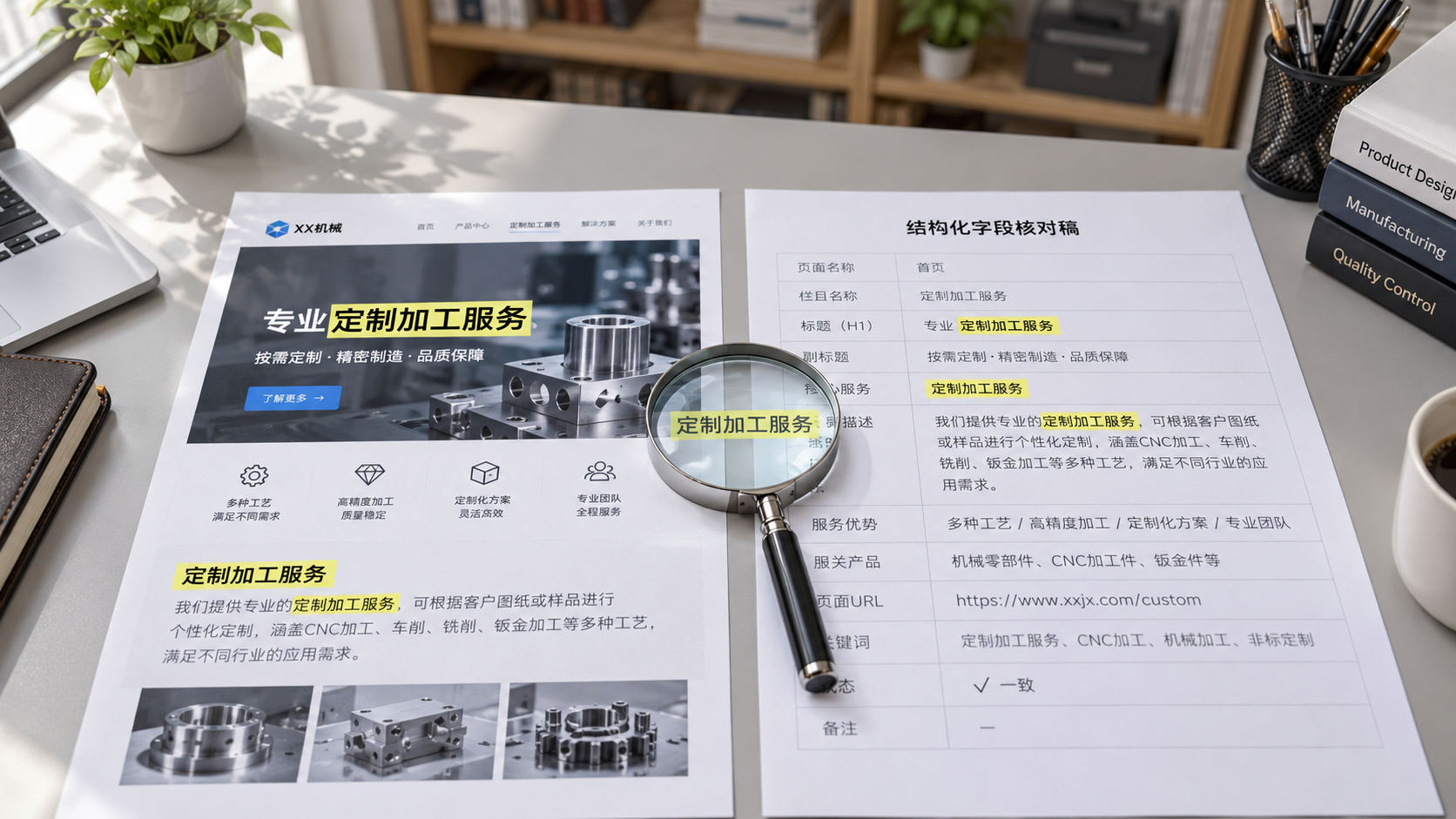
For example, when industrial manufacturing companies showcase their processes and products, they cannot simply pile up pictures and parameters; they must also clearly explain the decision-making information behind the search terms.
For pages related to precision machining and hardware components , using structured sections to showcase product centers, application solutions, quality control, and global contact channels makes it easier to attract high-intent searches.
The value of these types of pages lies not only in showcasing products, but also in aligning technical capabilities, delivery logic, and business communication strategies.
Three common misconceptions from the dictionary to the webpage
When conducting SEO keyword research, the most common problems are not complicated, but they can consistently drag down the results.
- Focusing solely on tool data while ignoring the recurring demand terms in sales communications.
- Placing all the important keywords on the homepage makes the page's theme unclear.
- There is a content release schedule, but there is no review of rankings, bounce rates, or sources of inquiries.
More importantly, many websites completely separate keyword research from advertising and social media content. This results in the loss of a significant amount of reusable search language.
If high-click search terms in ads, highly interactive topics on social media, and frequently asked questions in inquiry forms cannot flow back to the SEO keyword database, it will be difficult for the entire marketing system to form an incremental closed loop.
Research habits suitable for continuous execution
SEO keyword research is not a one-off project, but a continuous process of refinement. Industry keywords change, competitors change, and clients' questioning methods also change.
Typically, a monthly update mechanism can be established, and newly added keywords, pages with missing keywords, pages with inquiries, and inefficient pages can be observed in the same table.
If your site is targeting multiple languages or regions, it's even more important to analyze the search habits of different countries and avoid using the same set of literal translations to cover all markets.
The next, more prudent approach is to first review the existing keyword database and page mapping relationship, then complete the query keyword landing pages, and subsequently observe whether ranking, dwell time, and conversion rates improve in tandem.
When SEO keyword research truly serves website architecture, content production, and marketing synergy, it brings more than just ranking changes; it brings a clearer assessment of growth potential.
Related Articles
 How Can an SEO Content Strategy Prevent Keyword Cannibalization?
 How can you check whether Schema markup matches the visible page content?
 Why Are Core Web Vitals Still Failing After Website Speed Optimization?

Related Products
 Yiyingbao SaaS Intelligent Website Building and Marketing SystemYiyingbao SaaS Intelligent Website Building and Marketing System, AI-powered no-code website building, rapid creation of multilingual B2B international websites in 10 minutes, global server acceleration, AI-powered SEO optimization, helping businesses connect efficiently with global markets. The perfect integration of technology and operation makes building an international trade website remarkably simple
 AI+SEM Intelligent Advertising Marketing SystemAI+SEM drives intelligent ad creation, empowering full-funnel precision advertising marketing. The system automatically generates weekly/monthly reports, AI recommends keywords and target countries, monitors core metrics in real-time with intelligent alerts, and enables one-click high-conversion ad solutions to help quickly acquire customers and improve ROI.
 AI+SEO Dual-Engine System Optimization ServicesYiyingbao’s AI+SEO dual-engine optimization system helps foreign trade enterprises acquire high-quality organic traffic through AI-powered keyword research, content generation, and comprehensive technical optimization, significantly improving search rankings and conversion rates.
 AI+SNS Social Media Marketing SystemYingbao AI+SNS Social Media Marketing System - Precision social capture for the social media era. Supports one-click content synchronization across major platforms like Facebook and LinkedIn. AI intelligently rewrites posts for enhanced relevance. 24/7 AI customer service and user profiling analysis empower businesses to efficiently expand into global markets.
 AI+SEO营销解决方案易营宝AI+SEO营销解决方案,通过AI批量写作、智能生成TDK、精准关键词扩词等功能,全面优化网站SEO效果,提升流量与转化率。助力企业构建高效智能网站新生态。
 AI+SEM Advertising Marketing SolutionsAI+SEM Advertising Marketing Solution leverages AI technology to deeply empower SEM ad campaigns. It automatically generates weekly/monthly reports using AI, presenting account data across multiple dimensions for comprehensive insights into campaign performance and trends. The system precisely recommends keywords and target countries, intelligently generates high-conversion ad copy, and enables one-click activation of efficient campaign plans to help businesses rapidly acquire customers. Simultaneously, it monitors core metrics in real time, intelligently identifies abnormal fluctuations, and issues timely alerts to ensure stable, high-return advertising results.
 Domain Name ServicesEasyWin provides professional domain name services, including intelligent queries, one-stop registration, brand protection, and full lifecycle management, helping businesses build a digital brand image.
 EasyOperate B2C Cross-Border E-Commerce Platform & Independent WebsiteEasyStore B2C Cross-border E-commerce Independent Store is an intelligent website building and cross-border e-commerce integrated solution independently developed by EasyStore Information Technology (Beijing) Co., Ltd. The system is specially designed for small and medium-sized as well as large export enterprises, integrating 'website building, operation, marketing, advertising, and conversion' into one, helping enterprises quickly establish cross-border e-commerce independent stores to achieve brand globalization and global sales growth.
The platform supports multiple languages, multiple currencies, and multi-channel marketing, with built-in AI intelligent translation and SEO optimization systems, suitable for mainstream markets such as Southeast Asia, Europe and America, Latin America, and the Middle East, assisting Chinese manufacturing enterprises in efficiently deploying international e-commerce strategies. SSL证书易营宝提供专业SSL安全证书服务,包括单域名和泛域名证书,确保网站数据传输加密、身份验证和完整性保护,助力企业建立安全可信的在线业务环境。









