









- Which customer acquisition channels will be affected by cross-border marketing trends in 2026?Sep 06, 2026View details
- Which homogenization risks should be considered in an analysis of the AI-powered website building industry?Aug 30, 2026View details
- How Will AI Marketing Trends 2026 Change Advertising Budget AllocationAug 28, 2026View details
- Is the EV SSL certificate market shrinking or upgrading? How should companies assess certificate procurement?Aug 11, 2026View details
- Why the old AMP SEO 2020 practices no longer work and what has changed in current optimization prioritiesAug 02, 2026View details
- How to Choose Topics for an Industry News Section to Attract More Organic Search TrafficJul 29, 2026View details
How to Evaluate the Crawling and Indexing Capabilities of a Global Website-Building SaaS SEO System
Crawling and Indexing Are Not Add-ons After “Building a Website”
When evaluating the SEO capabilities of global website-building SaaS platforms, many people first look at templates, loading speed, multilingual support, or even whether the system supports automatically generating titles and descriptions. However, what truly determines whether a website can enter the search engine's field of view is often not whether the page has been created, but whether search engines can successfully crawl, understand, and include it in their index. Crawling addresses whether search engines can reach a page, while indexing addresses whether the page is valuable enough to be included in the database and participate in ranking. If either of these stages is poorly handled, subsequent investments in content optimization, link building, and advertising coordination will still struggle to generate stable organic traffic.
For technical evaluations of the SEO capabilities of global website-building SaaS platforms, crawling and indexing are not represented by a single button, nor can they be summarized by the words “built-in SEO.” They actually correspond to a complete set of underlying capabilities: whether URLs are stable, whether page structures are parseable, whether sitemaps are supported, whether robots rules are controllable, whether canonical, pagination, and multilingual tags can be output correctly, whether the system avoids generating large numbers of low-value duplicate pages, and whether it can provide clear signals to search engines during redesigns, deactivations, and migrations.
One point that technical evaluators most often overlook is that the site seen by search engines is not exactly the same as the site seen by operators in a browser. A complete-looking front end does not necessarily mean that the crawling path is complete; configurable settings in the backend do not necessarily mean that the output complies with search engine processing logic. This is why, even among SaaS website-building platforms, some sites are indexed quickly after launch, while others have a considerable number of pages but remain limited to the homepage or a few category pages for a long time.
Assess “Crawlability” Before Discussing “Optimization”
The key to evaluating crawlability is not whether an SEO settings entry exists, but whether the system provides sufficiently clear and accessible paths when search engine crawlers visit the site. A mature global website-building SaaS platform should at least ensure that important pages have independent, accessible URLs with correct status codes, and that these URLs do not expand indefinitely because of filtering parameters, language switching, tracking parameters, or session mechanisms.
There is a common misunderstanding here: if a page can be opened, it can be crawled. In reality, this is not necessarily true. If the main page content relies on complex scripts for delayed rendering, or if key content only appears after interaction, search engines may be able to access the page address but may not be able to consistently obtain its main content. This issue is particularly common in multilingual independent websites, B2B product catalogs, and cross-border e-commerce stores with large numbers of pages. If the system relies too heavily on front-end rendering, it can easily create a situation in which content is “visible to users but weakly visible to crawlers,” significantly affecting indexing efficiency.
Therefore, technical evaluations should focus on several points: whether important content can be obtained directly from the source code; whether navigation, breadcrumbs, product categories, and detail-page entrances form a clear internal linking network; whether XML sitemaps can be generated automatically and updated with content; whether robots.txt supports crawl-boundary controls; and whether the system generates large numbers of low-value URLs such as search pages, filter pages, and tag pages. These system-level details are often what truly affect the crawl budget.
If a company targets multiple regional markets, crawling issues can become even more pronounced. For example, when North American, European, and Southeast Asian sites share one content framework, can the system reasonably separate them by language, country, or directory structure? Can different versions point to one another correctly? Could similar pages be mistakenly classified as duplicate content? For global websites, crawling is not simply about “letting the spider visit once.” It is about enabling search engines to continuously, reliably, and cost-effectively crawl the correct pages over the long term.
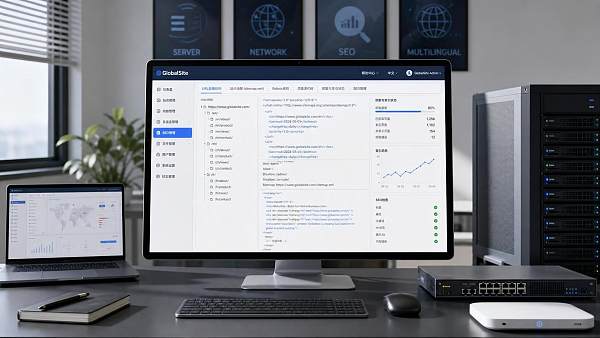
Indexing Capability Concerns Whether a Page Is Worth Including After It Has Been Crawled
Many project problems do not occur during crawling but during indexing. Search engines may have visited a page without including it in the effective index, or may exclude it soon after indexing it. Technically, this is usually not an isolated failure, but the combined result of page-quality signals, duplication signals, and structural signals.
Whether the SEO capabilities of a global website-building SaaS platform are adequate often depends on whether it can help businesses reduce the amount of duplication “manufactured by the system.” For example, does the same product exist under multiple path versions? Are URLs generated by pagination, sorting, and filtering all open for indexing? Are multilingual pages merely machine replacements of a few fields? Does the same content appear repeatedly on desktop, mobile, campaign, and landing pages without canonical handling? Search engines do not favor these types of sites because they consume crawling resources without necessarily providing sufficiently unique information.
This is why the canonical tag is important. It does not simply tell search engines, “Please look at this page.” Instead, when duplicate content is difficult to avoid completely, it provides a clear signal for the primary version. If a SaaS system does not support flexible canonical output, or if its default logic is inconsistent, category pages, product pages, and language pages can easily compete with one another, ultimately making it difficult for any of them to maintain stable indexing.
Another aspect that is easily underestimated is status-code management. When a page is taken offline, a product becomes unavailable, or content is migrated, if the system continues returning 200, search engines will continue treating it as a valid page. If a permanent redirect is required but only a front-end redirect is implemented, the transfer of authority will also be weakened. A technical evaluation should not only ask whether 301 redirects can be configured, but also whether rules can be managed in batches, whether directory-level mapping is supported, and whether the solution is suitable for multi-site and multilingual migrations.
Indexing Evaluation Is Much More Complex for Multilingual Websites Than for Single-Language Sites
In integrated website and marketing service scenarios, multilingual websites are nearly standard. The issue is that multilingual does not simply mean translating pages. From a search engine's perspective, whether versions in different languages constitute independent pages depends on whether their content differences, regional targeting, and page relationships are clearly expressed. A website-building system capable of serving global markets should ideally support standardized hreflang output, at least enabling search engines to understand that English, German, Japanese, and other language pages correspond to one another rather than being duplicates.
However, hreflang cannot be treated as a universal solution. If the main content of a page differs only slightly, or if a large number of language pages contain only placeholder translations, search engines may still lower their indexing priority. What a technical system can do is provide accurate structural signals. The true determinant of indexing quality remains whether the page content offers localized value. In other words, platform capabilities solve the problem of “not losing points because of system design,” while content strategy solves the problem of “having a reason to be indexed and ranked.” The two should not be conflated.
During Technical Evaluations, Review These Underlying Elements Directly
If you only listen to a sales demonstration, it is easy to understand SEO capabilities as a few backend forms. An effective evaluation should focus as much as possible on verifiable output. The following items are generally more valuable for assessment than simply asking whether the system supports SEO settings.
The purpose of this table is not to list features, but to highlight a way of thinking: when evaluating the SEO capabilities of a global website-building SaaS platform, the focus should not be on how many fields can be completed in the backend, but on whether the results output by the system to search engines are stable, explainable, and maintainable over time.
Why Integrated Platforms Need to Pay More Attention to Crawling and Indexing
For systems that provide website building, SEO, advertising, and social media traffic acquisition at the same time, crawling and indexing issues can directly affect subsequent marketing coordination. The reason is practical: advertising landing pages can obtain visits immediately, but if a brand website, product pages, and knowledge content pages are indexed slowly, the company's assets in organic search, branded-keyword defense, and long-tail keyword coverage cannot be established. The marketing chain may appear complete, while its underlying foundation lacks search entry points that can accumulate value over time.
Platforms such as Yiyingbao, which target foreign trade companies, manufacturing factories, cross-border sellers, and brands expanding overseas, typically serve scenarios involving multiple languages, product lines, and regional sites, while sometimes also supporting both B2B inquiry websites and B2C independent websites. In such cases, SEO functionality that remains limited to page title and description settings is far from sufficient. What is truly valuable is whether the system can connect website output, content publishing, site structure, index controls, and subsequent optimization, preventing crawling and indexing issues from recurring every time a company adds a country site or a new batch of product pages.
The Real Question to Ask Is Not “Does It Have SEO Functionality?”
If a technical evaluator only asks, “Does this system support SEO?” they are unlikely to receive an answer that supports a meaningful assessment. More effective questions include: How do search engines discover new pages? How does the system avoid duplicate URLs? How are multilingual relationships expressed? Which status code is returned after a page is taken offline? Does the sitemap synchronize after large-scale content updates? Does important content depend on script rendering? Only when questions reach this level are you evaluating crawling and indexing capabilities rather than reviewing a feature list.
Ultimately, the foundation of SEO functionality in a global website-building SaaS platform is not “writing a few keywords,” but enabling search engines to continuously understand the site's structure, boundaries, and priorities. How smoothly crawling works determines whether pages can be seen; how stable indexing is determines whether content can become a long-term asset. Once technical evaluation reaches this level, content operations, SEO growth, and overseas customer acquisition can finally begin from a reliable foundation.
Related Articles

Related Products
 Yiyingbao SaaS Intelligent Website Building and Marketing SystemYiyingbao SaaS Intelligent Website Building and Marketing System, AI-powered no-code website building, rapid creation of multilingual B2B international websites in 10 minutes, global server acceleration, AI-powered SEO optimization, helping businesses connect efficiently with global markets. The perfect integration of technology and operation makes building an international trade website remarkably simple
 AI+SEM Intelligent Advertising Marketing SystemAI+SEM drives intelligent ad creation, empowering full-funnel precision advertising marketing. The system automatically generates weekly/monthly reports, AI recommends keywords and target countries, monitors core metrics in real-time with intelligent alerts, and enables one-click high-conversion ad solutions to help quickly acquire customers and improve ROI.
 AI+SEO Dual-Engine System Optimization ServicesYiyingbao’s AI+SEO dual-engine optimization system helps foreign trade enterprises acquire high-quality organic traffic through AI-powered keyword research, content generation, and comprehensive technical optimization, significantly improving search rankings and conversion rates.
 AI+SNS Social Media Marketing SystemYingbao AI+SNS Social Media Marketing System - Precision social capture for the social media era. Supports one-click content synchronization across major platforms like Facebook and LinkedIn. AI intelligently rewrites posts for enhanced relevance. 24/7 AI customer service and user profiling analysis empower businesses to efficiently expand into global markets.
 AI+SEO营销解决方案易营宝AI+SEO营销解决方案,通过AI批量写作、智能生成TDK、精准关键词扩词等功能,全面优化网站SEO效果,提升流量与转化率。助力企业构建高效智能网站新生态。
 AI+SEM Advertising Marketing SolutionsAI+SEM Advertising Marketing Solution leverages AI technology to deeply empower SEM ad campaigns. It automatically generates weekly/monthly reports using AI, presenting account data across multiple dimensions for comprehensive insights into campaign performance and trends. The system precisely recommends keywords and target countries, intelligently generates high-conversion ad copy, and enables one-click activation of efficient campaign plans to help businesses rapidly acquire customers. Simultaneously, it monitors core metrics in real time, intelligently identifies abnormal fluctuations, and issues timely alerts to ensure stable, high-return advertising results.
 Domain Name ServicesEasyWin provides professional domain name services, including intelligent queries, one-stop registration, brand protection, and full lifecycle management, helping businesses build a digital brand image.
 EasyOperate B2C Cross-Border E-Commerce Platform & Independent WebsiteEasyStore B2C Cross-border E-commerce Independent Store is an intelligent website building and cross-border e-commerce integrated solution independently developed by EasyStore Information Technology (Beijing) Co., Ltd. The system is specially designed for small and medium-sized as well as large export enterprises, integrating 'website building, operation, marketing, advertising, and conversion' into one, helping enterprises quickly establish cross-border e-commerce independent stores to achieve brand globalization and global sales growth.
The platform supports multiple languages, multiple currencies, and multi-channel marketing, with built-in AI intelligent translation and SEO optimization systems, suitable for mainstream markets such as Southeast Asia, Europe and America, Latin America, and the Middle East, assisting Chinese manufacturing enterprises in efficiently deploying international e-commerce strategies. SSL证书易营宝提供专业SSL安全证书服务,包括单域名和泛域名证书,确保网站数据传输加密、身份验证和完整性保护,助力企业建立安全可信的在线业务环境。









