









- Can the average annual growth rate reflect real opportunities in overseas markets?Oct 07, 2026View details
- Which customer acquisition channels will be affected by cross-border marketing trends in 2026?Sep 06, 2026View details
- Which homogenization risks should be considered in an analysis of the AI-powered website building industry?Aug 30, 2026View details
- How Will AI Marketing Trends 2026 Change Advertising Budget AllocationAug 28, 2026View details
- Is the EV SSL certificate market shrinking or upgrading? How should companies assess certificate procurement?Aug 11, 2026View details
- Why the old AMP SEO 2020 practices no longer work and what has changed in current optimization prioritiesAug 02, 2026View details
How Can the SEO Structure of a Machinery Export Website Avoid Duplicate Product Pages?
Duplicate product pages on machinery export websites are often caused not by “too many pages,” but by the website splitting models, specifications, language versions, and filter parameters into numerous URLs that search engines struggle to distinguish. To buyers, these pages all appear to describe the same type of equipment; to search engines, they may be near-duplicate copies differing only in titles, image names, or a few parameters. As a result, indexing resources are dispersed, important product pages compete with one another, and inquiry entry points are reduced instead.
A key SEO structural consideration for machinery export websites is to first determine which differences are sufficient to support standalone pages and which should only serve as optional parameters within the same page. Without clearly defining this boundary, even the most refined content templates can hardly avoid duplication.
Divide pages by “procurement decision differences,” not by every parameter
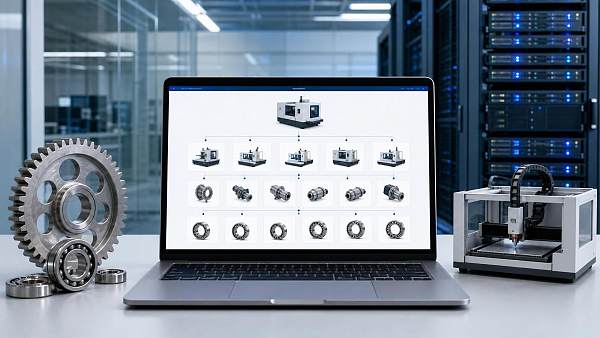
Machinery products have numerous parameters and more complex model combinations. Power, stroke, processing dimensions, voltage, control systems, accessories, colors, and packaging methods may all vary. If every option automatically generates a product page, the website will quickly produce dozens or even hundreds of highly similar URLs.
Whether a standalone page should be created should not depend solely on whether the SKU differs, but on whether the difference changes how overseas buyers search and make purchasing decisions. For example, buyers may separately search for different equipment types such as “CNC pipe cutting machine” and “fiber laser tube cutting machine,” and may also compare different workpieces, core processes, and capacity ranges; such differences are generally suitable for separate landing pages.
However, 380V/480V voltage options, different plug standards, optional feeding lengths, or non-core accessories for the same machine model usually do not need their own indexable pages. A more appropriate approach is to explain them through specification tables, configuration selectors, or downloadable materials on the main product page. This retains technical information while avoiding treating a configuration difference as an independent product.
A simple criterion can be used for screening: can the pages answer different procurement questions? If the answer is merely “the equipment is the same, with different optional configurations,” they should be merged as a priority; if the equipment structure, processing capability, applicable materials, target industry, or delivery solution already differs, separation should be considered.
Category pages, series pages, and product pages should have clear roles
Duplication problems often begin with a disorganized information architecture. Category pages are written as product details, series pages copy product page content, and product pages repeat introductions to the entire category. For technical evaluators, a more stable structure should allow each page level to serve a different search intent.
For example, “sheet metal laser cutting machine” can be a category page; a certain series of platform fiber laser cutting machines can be a series page; and only a specific combination of processing size, laser power, and structure should become a model product page. Once the hierarchy is clear, internal links also become more natural: category pages point to series and representative models, while product pages link back to their series and related application pages, rather than having all products fully interlink with one another.
URLs should also reflect this hierarchy. Paths do not need to stack large numbers of keywords, but they should be stable and readable, while avoiding multiple access addresses for the same product, such as versions with and without trailing slashes, different capitalization, different parameter orders, or parallel URLs created after category path changes. Search engines treat these addresses as different candidate pages and then have to rely on their indexing systems to “guess” the primary version, at considerable cost.
Manage indexable URLs before addressing content similarity
After discovering duplicate content, many teams first ask editors to rewrite product descriptions. This is necessary, but it is usually not the highest-priority action. If filters, on-site search, sorting pages, pagination, tracking parameters, and language switching continually generate new URLs, even highly differentiated copy cannot prevent the expansion of indexing entry points.
The website should first inventory the types of URLs that can actually be crawled and indexed, with particular attention to the following:
- Whether specification filters generate accessible and indexable parameter pages, such as URLs filtered by power, size, or price range;
- Whether on-site search result pages are crawled by search engines;
- Whether sorting, pagination, and advertising tracking parameters create large numbers of duplicate URLs;
- Whether legacy URLs, pre-migration paths, and new paths all return normal pages at the same time;
- Whether products assigned to multiple categories create multiple paths for the same detail page.
For parameter combination pages without independent search value, internal link controls, canonicalization, and indexing rules can be used to restrict their entry into the index. For duplicate versions that must remain accessible, the primary URL should be clearly specified so that authority and indexing signals are consolidated on the target page. Two concepts should be distinguished here: canonical tags indicate “which version is preferred among multiple similar URLs”; noindex is used to prevent a type of page from appearing in search results. Applying noindex indiscriminately to all duplicate pages may prevent signals for important products from being properly consolidated; pointing all pages to the homepage will lose the product hierarchy. Neither should be used as a bulk handling method.
Product templates should standardize fields, not entire blocks of content
Machinery websites need unified templates; otherwise, technical information will be incomplete and page quality will vary. However, template consistency does not mean using the same English introduction on every page and then replacing the model number. Search engines can identify this type of replacement-based content, and buyers will also find it difficult to make model decisions from it.
A better product page generally retains a fixed information framework while requiring each model to include its own specific information. Fixed sections may include the product name, specification table, inquiry module, and certification or delivery information; the sections that should demonstrate differences include the processing tasks solved by the model, key structural configurations, performance limits, compatible materials or workpieces, optional automation solutions, and trade-offs compared with other models in the same series.
For example, if two machines differ only in processing size, the main text should explain how the different sizes affect sheet utilization, site requirements, loading and unloading methods, and typical orders, rather than simply replacing “1500×3000 mm” with “2000×4000 mm.” If this difference cannot be explained through an independent application context, it may be more appropriate as an option on the same page rather than a separate SEO product page.
Multilingual versions cannot rely solely on page-by-page translation
Duplicate issues on export machinery websites also frequently occur in multilingual deployment. If English, German, Spanish, and other pages do not have clear language and regional targeting, search engines may display pages to the wrong markets; if different language versions are mixed within the same path or point to inconsistent URLs, crawling and evaluation costs will also increase.
Each language should use stable, independent URL rules and establish accurate reciprocal language links. Page content should serve buyers in that language market rather than merely rely on machine translation. Machinery terminology, units of measurement, electrical standards, contact details, case descriptions, and delivery information may all affect whether a page is genuinely suitable for local buyers. For language versions without sufficient content maintenance capacity, it is better to first cover core categories and key models than to generate large numbers of weak pages in bulk.
To determine whether duplicate product pages are under control, do not only look at whether pages are indexed. More valuable checks include: whether each core category has a clear entry page; whether each key model has only one indexable primary version; whether similar models each have content that supports procurement comparison; and whether filter, search, and parameter URLs are unintentionally consuming crawl resources. First consolidate the structure, then strengthen content in layers, so the number of product pages shifts from “appearing numerous” to “every page having a reason to exist.”
Related Articles


Related Products
 Yiyingbao SaaS Intelligent Website Building and Marketing SystemYiyingbao SaaS Intelligent Website Building and Marketing System, AI-powered no-code website building, rapid creation of multilingual B2B international websites in 10 minutes, global server acceleration, AI-powered SEO optimization, helping businesses connect efficiently with global markets. The perfect integration of technology and operation makes building an international trade website remarkably simple
 AI+SEM Intelligent Advertising Marketing SystemAI+SEM drives intelligent ad creation, empowering full-funnel precision advertising marketing. The system automatically generates weekly/monthly reports, AI recommends keywords and target countries, monitors core metrics in real-time with intelligent alerts, and enables one-click high-conversion ad solutions to help quickly acquire customers and improve ROI.
 AI+SEO Dual-Engine System Optimization ServicesYiyingbao’s AI+SEO dual-engine optimization system helps foreign trade enterprises acquire high-quality organic traffic through AI-powered keyword research, content generation, and comprehensive technical optimization, significantly improving search rankings and conversion rates.
 AI+SNS Social Media Marketing SystemYingbao AI+SNS Social Media Marketing System - Precision social capture for the social media era. Supports one-click content synchronization across major platforms like Facebook and LinkedIn. AI intelligently rewrites posts for enhanced relevance. 24/7 AI customer service and user profiling analysis empower businesses to efficiently expand into global markets.
 AI+SEO营销解决方案易营宝AI+SEO营销解决方案,通过AI批量写作、智能生成TDK、精准关键词扩词等功能,全面优化网站SEO效果,提升流量与转化率。助力企业构建高效智能网站新生态。
 AI+SEM Advertising Marketing SolutionsAI+SEM Advertising Marketing Solution leverages AI technology to deeply empower SEM ad campaigns. It automatically generates weekly/monthly reports using AI, presenting account data across multiple dimensions for comprehensive insights into campaign performance and trends. The system precisely recommends keywords and target countries, intelligently generates high-conversion ad copy, and enables one-click activation of efficient campaign plans to help businesses rapidly acquire customers. Simultaneously, it monitors core metrics in real time, intelligently identifies abnormal fluctuations, and issues timely alerts to ensure stable, high-return advertising results.
 Domain Name ServicesEasyWin provides professional domain name services, including intelligent queries, one-stop registration, brand protection, and full lifecycle management, helping businesses build a digital brand image.
 EasyOperate B2C Cross-Border E-Commerce Platform & Independent WebsiteEasyStore B2C Cross-border E-commerce Independent Store is an intelligent website building and cross-border e-commerce integrated solution independently developed by EasyStore Information Technology (Beijing) Co., Ltd. The system is specially designed for small and medium-sized as well as large export enterprises, integrating 'website building, operation, marketing, advertising, and conversion' into one, helping enterprises quickly establish cross-border e-commerce independent stores to achieve brand globalization and global sales growth.
The platform supports multiple languages, multiple currencies, and multi-channel marketing, with built-in AI intelligent translation and SEO optimization systems, suitable for mainstream markets such as Southeast Asia, Europe and America, Latin America, and the Middle East, assisting Chinese manufacturing enterprises in efficiently deploying international e-commerce strategies. SSL证书易营宝提供专业SSL安全证书服务,包括单域名和泛域名证书,确保网站数据传输加密、身份验证和完整性保护,助力企业建立安全可信的在线业务环境。









