









- Is the EV SSL certificate market shrinking or upgrading? How should companies assess certificate procurement?Aug 11, 2026View details
- Why the old AMP SEO 2020 practices no longer work and what has changed in current optimization prioritiesAug 02, 2026View details
- How to Choose Topics for an Industry News Section to Attract More Organic Search TrafficJul 29, 2026View details
- Digital Marketing Shenzhen Market Insights: Why Are Companies Expanding Overseas Looking for Growth Teams in Shenzhen?Jul 31, 2026View details
- Can Zhejiang foreign trade independent websites still be developed today? Look at changes in traffic and lead generationJul 28, 2026View details
- What New Signals Are Emerging in Enterprise Services SaaS Marketing ReportsJul 27, 2026View details
What are the Google ranking optimization techniques? 7 practical methods for corporate websites
For Corporate Websites Doing Google Ranking Optimization, Do Not Rush to Change Keywords First
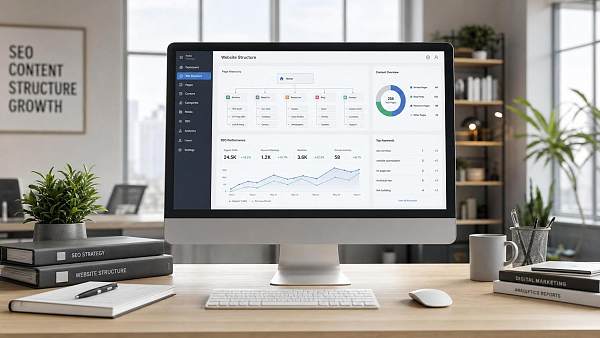
When trying to grow traffic for an official website, many people start by stuffing keywords. However, the real issues with corporate websites are often not the keywords themselves, but the lack of alignment in the site foundation, page structure, and conversion path. Whether Google ranking optimization techniques work usually depends on the current stage of the website, rather than whether a checklist is followed mechanically.
This is especially true for websites targeting overseas markets. If a website needs to handle brand presentation, inquiry generation, product indexing, and ad traffic landing at the same time, optimization decisions become more complex. Platforms like 易营宝, which have long served multilingual official websites, independent websites, and overseas marketing scenarios, usually look at the website goals first and then decide the optimization sequence. This is more stable than simply chasing rankings.
At Different Business Stages, the Focus of Google Ranking Optimization Techniques Is Not the Same
Even for corporate official websites, the needs of new websites, established websites, multilingual websites, and product-driven websites can vary greatly. New websites usually lack crawlability and trust, established websites more often suffer from aging content, and websites with many product pages are prone to duplicate information and chaotic structures.
A more common way to make a judgment is to answer three questions first: whether Google can easily index the site, whether the pages can match search intent, and whether there is a clear conversion action after a visit. By arranging specific Google ranking optimization techniques around these three points, execution efficiency will be much higher.
Stabilize the Site Foundation First: These Are Methods 1 and 2
Method 1: Help Search Engines Understand the Website Structure First
Many official websites have plenty of pages, but the relationships between sections are confusing, with products, cases, and news disconnected from one another. Even if such a site keeps adding content, Google will still find it difficult to determine the main topic focus. A practical Google ranking optimization technique is to unify navigation, breadcrumbs, URL hierarchy, and the sitemap first.
If the website also serves as a landing page for advertising campaigns, it is even more important to avoid the massive accumulation of temporary pages. Promotable pages and short-term campaign pages should be managed in layers; otherwise, the crawl budget can easily be wasted.
Method 2: Prioritize Indexing Barriers and Loading Issues
Some websites have decent content but fail to gain rankings over the long term. The problem is often at the technical level. For example, duplicate titles, incorrect canonical tags, slow mobile loading, oversized images, and script blocking can all affect crawling and user experience.
This type of Google ranking optimization technique may not look obvious, but it is often the easiest way to achieve foundational improvements. This is especially important for intelligent website building and multilingual websites, where every language version must be independently crawlable and correctly indexed.
How to Build Content Is Not as Simple as Publishing More Articles
Method 3: Rewrite Core Pages Based on Search Intent
A common misjudgment for corporate official websites is treating the homepage as the landing page for all keywords. In reality, brand keywords, product keywords, solution keywords, and problem-based keywords correspond to different types of pages. Among Google ranking optimization techniques, the most worthwhile investment is restructuring core pages rather than spreading efforts evenly across everything.
For example, product keywords are better suited to category pages or product detail pages, solution keywords are better suited to dedicated topic pages, and problem-based keywords are suitable for knowledge content. Once pages match search intent, rankings and conversions usually improve together.
Method 4: Build Content Clusters Around Business Scenarios
If a website targets foreign trade lead generation, cross-border e-commerce stores, or global brand expansion, search terms can vary greatly across different scenarios. Some users search for product specifications, some search for delivery capabilities, and others search for regional services and case proof.
Therefore, content should not revolve around a single main keyword only. Instead, topic clusters should be built. By connecting industry pages, product pages, application pages, FAQs, and case pages, Google can more easily recognize the site's professional depth. This is also a long-term content strategy adopted by many integrated marketing platforms.
When There Are Many Products and Multiple Languages, Methods 5 and 6 Become More Critical
Method 5: Use Internal Links to Promote Key Pages
For websites with a large number of products, the common problem is not a lack of content, but dispersed authority. Internal linking is not simply about linking pages to one another. It is about continuously elevating core pages through category pages, topic pages, related articles, and case pages.
In actual applications, inquiry-driven official websites especially need to place high-value pages at the center of internal linking, such as high-converting product pages, strong industry pages, and key country pages. This type of Google ranking optimization technique has a particularly direct effect on improving qualified traffic.
Method 6: Multilingual Websites Should Not Only Be Translated; They Need Localized Expression
Many companies directly translate Chinese content into multiple languages. The pages may seem complete, but rankings never improve. The reason is that search habits, terminology, and purchasing concerns differ across regions, and direct translation often fails to create an effective match.
A more reliable Google ranking optimization technique is to recreate titles, descriptions, core selling points, and FAQs by region. Pages targeting North America, Europe, and Southeast Asia often have different content focuses, and this step directly affects the quality of subsequent organic traffic.
Rankings Alone Are Not Enough: Method 7 Determines Inquiry Quality
Method 7: Build the Conversion Path Into SEO Page Design
For a corporate official website, the ultimate goal of using Google ranking optimization techniques is not to produce attractive screenshots, but to turn visits into leads. Many pages rank well but generate no inquiries, usually because the page does not build trust and does not provide a clear action entry point.
Actionable practices include placing clear forms, delivery explanations, case proof, certification information, and FAQs on core pages; contact methods should be arranged within the reading path rather than only in the footer. Only when SEO pages work together with the website building system, form system, and data tracking can conversion efficiency remain stable.
Several Misjudgments Easily Overlooked Before Implementation
Many websites fail to improve over the long term not because they do not know how to use Google ranking optimization techniques, but because the order of judgment is wrong. Focusing only on keyword tools while ignoring whether the page truly solves the search problem is the most common deviation.
- Putting all keywords on the homepage, causing core pages to remain weak for a long time.
- Publishing only news or informational content without strengthening product pages and solution pages, causing a disconnect between traffic and inquiries.
- Doing translation only without localization, resulting in multilingual pages being indexed but not clicked.
- Focusing only on website aesthetics while ignoring crawlability, speed, and structure, which increases later optimization costs instead.
If the website also needs to support advertising, social media traffic, and AI search visibility, the page structure should ideally be built from the beginning with long-term operations in mind. This will make later SEO, advertising, and content expansion much smoother.
Make the Assessment First, Then Arrange Optimization Actions
Truly effective Google ranking optimization techniques are not about completing seven tasks at once, but about advancing step by step according to the website stage. Check the technical foundation first, then page matching, then content clusters, and finally the conversion loop. This better fits the real growth path of a corporate official website.
If you are currently planning the optimization direction for an official website, you can first review the indexing status, core page quality, multilingual adaptation, and whether the inquiry path is complete. After clarifying these conditions, deciding priorities is usually more effective than blindly pursuing more keywords, and it is also closer to long-term sustainable organic growth.
Related Articles

Related Products
 Yiyingbao SaaS Intelligent Website Building and Marketing SystemYiyingbao SaaS Intelligent Website Building and Marketing System, AI-powered no-code website building, rapid creation of multilingual B2B international websites in 10 minutes, global server acceleration, AI-powered SEO optimization, helping businesses connect efficiently with global markets. The perfect integration of technology and operation makes building an international trade website remarkably simple
 AI+SEM Intelligent Advertising Marketing SystemAI+SEM drives intelligent ad creation, empowering full-funnel precision advertising marketing. The system automatically generates weekly/monthly reports, AI recommends keywords and target countries, monitors core metrics in real-time with intelligent alerts, and enables one-click high-conversion ad solutions to help quickly acquire customers and improve ROI.
 AI+SEO Dual-Engine System Optimization ServicesYiyingbao’s AI+SEO dual-engine optimization system helps foreign trade enterprises acquire high-quality organic traffic through AI-powered keyword research, content generation, and comprehensive technical optimization, significantly improving search rankings and conversion rates.
 AI+SNS Social Media Marketing SystemYingbao AI+SNS Social Media Marketing System - Precision social capture for the social media era. Supports one-click content synchronization across major platforms like Facebook and LinkedIn. AI intelligently rewrites posts for enhanced relevance. 24/7 AI customer service and user profiling analysis empower businesses to efficiently expand into global markets.
 AI+SEO营销解决方案易营宝AI+SEO营销解决方案,通过AI批量写作、智能生成TDK、精准关键词扩词等功能,全面优化网站SEO效果,提升流量与转化率。助力企业构建高效智能网站新生态。
 AI+SEM Advertising Marketing SolutionsAI+SEM Advertising Marketing Solution leverages AI technology to deeply empower SEM ad campaigns. It automatically generates weekly/monthly reports using AI, presenting account data across multiple dimensions for comprehensive insights into campaign performance and trends. The system precisely recommends keywords and target countries, intelligently generates high-conversion ad copy, and enables one-click activation of efficient campaign plans to help businesses rapidly acquire customers. Simultaneously, it monitors core metrics in real time, intelligently identifies abnormal fluctuations, and issues timely alerts to ensure stable, high-return advertising results.
 Domain Name ServicesEasyWin provides professional domain name services, including intelligent queries, one-stop registration, brand protection, and full lifecycle management, helping businesses build a digital brand image.
 EasyOperate B2C Cross-Border E-Commerce Platform & Independent WebsiteEasyStore B2C Cross-border E-commerce Independent Store is an intelligent website building and cross-border e-commerce integrated solution independently developed by EasyStore Information Technology (Beijing) Co., Ltd. The system is specially designed for small and medium-sized as well as large export enterprises, integrating 'website building, operation, marketing, advertising, and conversion' into one, helping enterprises quickly establish cross-border e-commerce independent stores to achieve brand globalization and global sales growth.
The platform supports multiple languages, multiple currencies, and multi-channel marketing, with built-in AI intelligent translation and SEO optimization systems, suitable for mainstream markets such as Southeast Asia, Europe and America, Latin America, and the Middle East, assisting Chinese manufacturing enterprises in efficiently deploying international e-commerce strategies. SSL证书易营宝提供专业SSL安全证书服务,包括单域名和泛域名证书,确保网站数据传输加密、身份验证和完整性保护,助力企业建立安全可信的在线业务环境。









