









- Which customer acquisition channels will be affected by cross-border marketing trends in 2026?Sep 06, 2026View details
- Which homogenization risks should be considered in an analysis of the AI-powered website building industry?Aug 30, 2026View details
- How Will AI Marketing Trends 2026 Change Advertising Budget AllocationAug 28, 2026View details
- Is the EV SSL certificate market shrinking or upgrading? How should companies assess certificate procurement?Aug 11, 2026View details
- Why the old AMP SEO 2020 practices no longer work and what has changed in current optimization prioritiesAug 02, 2026View details
- How to Choose Topics for an Industry News Section to Attract More Organic Search TrafficJul 29, 2026View details
Google Rankings Fluctuate Significantly: Should You Check Content or Backlinks First?
Google Rankings Fluctuate Significantly—Should You Check Content or Backlinks First?
When Google rankings experience noticeable fluctuations, many teams have the same first reaction: Should we publish more backlinks or quickly make major changes to the pages? Although this may seem proactive, it often makes the problem even more complicated. Ranking declines are only a result, not the cause. The truly useful approach is to first determine at which level the fluctuation is occurring: Is it a single page losing its position, or are keywords across the entire site declining? Is visibility decreasing, or is the click-through rate falling? Is there a problem with crawling or indexing, or are content relevance, page quality, and backlink structure being reevaluated?
For those responsible for day-to-day website and marketing execution, the most concerning issue is not ranking fluctuations themselves, but not knowing which item to check first. Content and backlinks are both important, but they are not equal priorities, nor do they represent the same type of issue. In most cases, checking content and technical fundamentals before backlinks is more likely to reveal the real problem.
Before Assigning a Cause, Confirm What Type of Fluctuation It Is
Not every ranking change is cause for concern. Search results naturally fluctuate, especially for core keywords, industry terms, and inquiry-oriented keywords. Updates to competing pages, Google index adjustments, regional differences, and device differences can all cause short-term changes. If only a small number of keywords move up or down by a few positions, while impressions, clicks, and conversion pages do not deteriorate at the same time, there is usually no need to take major action immediately.
The signals that truly require investigation often include the following: a group of core landing pages declining together; new pages remaining unindexed for an extended period; a stable long-tail keyword group collectively losing visibility; brand keywords remaining normal while business keywords clearly decline; or rankings becoming unstable after backlink growth. If the situation falls into any of the latter categories, simply adding more backlinks usually will not solve the problem.
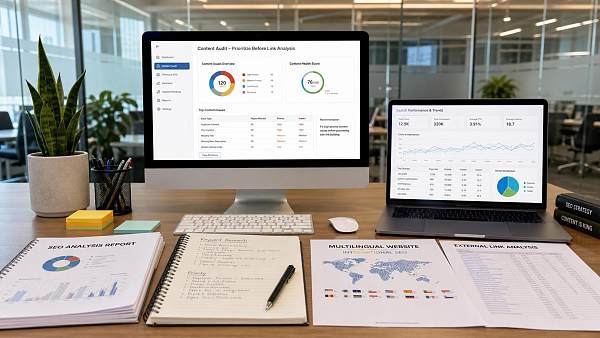
Start by gathering the basic data: impressions, clicks, average position, indexing status, and crawling information in Google Search Console. Then compare it with analytics tools to determine which directories, page templates, and country sites are receiving organic traffic. This step is especially important for B2B export websites, multilingual websites, and cross-border e-commerce stores, because the issue is often not that the entire site is performing poorly, but that a particular language version, product category, or type of template page has a problem.
In Most Projects, Content Deserves to Be Checked Before Backlinks
If there is no clear history of backlink anomalies, the usual troubleshooting order should be: indexing and crawling, content quality and relevance, internal site structure, and then backlinks. The reason is simple: content and page fundamentals determine whether Google is willing to continue distributing your pages, while backlinks mainly amplify existing signals. If the page itself is unstable, more backlinks may actually lead to greater fluctuations.
Checking content is not about whether articles have been published. It is about whether the page truly answers the search query. Many corporate websites commonly have three problems: first, product pages contain too little information, with only specifications and a few slogans; second, topics overlap between different pages, causing the site to compete with itself for rankings; third, titles are written for search engines, while the main content reads like a company brochure and fails to address search intent.
For example, users may be searching for solutions, material comparisons, application scenarios, delivery times, certification requirements, or procurement risks, while the page provides only a company profile, vision, and abstract advantages. Even if such content ranks temporarily, its position is unlikely to remain stable. In recent years, Google has become increasingly clear about its requirements for content relevance, information completeness, and page experience. This is especially true in the B2B sector, where explaining complex products clearly is more important than simply “writing more words.”
When Should You Suspect Backlinks First?
This does not mean backlinks can be ignored until the very end. If your website has acquired a large number of links from unknown sources within a short period, or if it has long relied on low-quality directory sites, private blog network articles, or bulk guest-posting pages, backlinks should be checked as a priority. In particular, when ranking fluctuations are concentrated around a small number of core keywords and the page content has not changed significantly recently, changes in backlink quality are worth investigating.
The risk with backlinks is usually not that there are too few links, but that the structure looks unnatural. Common anomalies include overly concentrated anchor text, thematically irrelevant link sources, sudden growth patterns, weak relationships between linking pages and target pages, or large numbers of links that generate no referral traffic at all. B2B corporate websites can easily fall into a common trap: in pursuit of higher Google rankings, they allocate their budget to seemingly inexpensive bulk backlink services. As a result, brand keywords remain unaffected while business keywords repeatedly fluctuate.
If most of the backlinks you identify cannot be explained from a reasonable business perspective, you should proceed cautiously. Highly relevant links that are visible to real readers in the industry are generally more stable, even if they are limited in number, than large numbers of links that exist solely for SEO purposes.
A More Practical Troubleshooting Order
In practice, you can follow an order that saves time:
First, check whether the issue is related to indexing. If pages are not being indexed consistently, it is too early to discuss content and backlinks. Next, check whether the pages have been changed incorrectly—for example, whether titles have shifted away from the intended topic, H tags have become disorganized, the main content has become thinner after a uniform template replacement, or language versions have become mixed up. Then check whether internal links are supporting priority pages, particularly whether the relationships between product pages, industry solution pages, and regional market pages are clear. By this point, you can often explain more than half of the causes behind the fluctuations.
If all of these elements are normal, then examine the backlinks: what has been added, what has been lost, whether anchor text is unbalanced, and whether there are abnormal sources. Many teams reverse the order by focusing on backlinks immediately, only to discover that the real issue is excessive content similarity after a page redesign or indexing confusion on a multilingual website.
A Simple Decision Table
Separating Website Development from Marketing Often Makes Problems Harder to Identify
Many companies do not lack SEO capabilities. Instead, website development, content operations, advertising, and social media traffic acquisition are handled by different teams or even different suppliers. As a result, when rankings fluctuate, each party can see only part of the picture. The website development provider says there is no problem with the pages, the advertising team says traffic is still coming in, and the content team says the articles have been published. In the end, no one can connect technology, content, traffic, and conversions into a single view.
This is also why integrated website and marketing service models have received more attention in recent years. For providers such as Yiyingbao that can coordinate website building systems, SEO, advertising, and multilingual operations, the value is not simply that they offer “more services,” but that they provide a more complete troubleshooting chain. When a page’s ranking fluctuates, is the cause a template generation issue, a deviation in content strategy, an unreasonable international site structure, or the impact of subsequent backlink-building and advertising activities on ranking signals? Without a unified data perspective, such issues are difficult to locate quickly.
Since 2013, Yiyingbao has focused on overseas digital marketing, covering intelligent website building, SEO optimization, advertising, social media marketing, and improving visibility in AI search. In essence, it evaluates “whether a website can be seen and whether it can convert after being seen” within the same methodology. For operational teams, this integration is not just a concept; it reduces repeated disputes and duplicated trial and error.
Ranking Fluctuations Are More Easily Misinterpreted on Multilingual and Export Websites
Export-oriented companies and brands expanding overseas have another special consideration: when Google rankings fluctuate, the problem may not be that the content or backlinks are poor, but that multilingual and multi-region settings are incorrect. For example, highly duplicated content across language pages, unclear distinctions between regional versions, disorganized directory structures and internal links, or translation quality that affects topic expression can all make Google uncertain about how to position a page.
If a website targets multiple markets, such as North America, Europe, Southeast Asia, Japan and South Korea, or the Middle East, its page strategy should not be one-size-fits-all. Search methods, terminology preferences, and purchasing priorities may differ significantly across markets. A product description that works on an English-language site may not necessarily suit the German, Spanish, or Japanese markets. When rankings fluctuate, relying only on the subjective understanding of a Chinese-speaking team can easily lead to localization shortcomings being misdiagnosed as a need for more backlinks.
What Actions Should You Avoid Taking Immediately When Rankings Fluctuate?
There are several actions that are more likely to cause mistakes when taken in a hurry. Do not make large-scale title changes before analyzing the data. Do not rewrite all of the website copy just because a few core keywords have declined. Do not rush to purchase a batch of backlinks from unclear sources. And do not mistake short-term organic fluctuations for an algorithmic penalty. Many ranking issues actually develop gradually. If you continuously change the structure, content, and links within one week, it will be nearly impossible to determine which step caused the impact during the subsequent review.
A more reliable approach is to first define the scope of the problem and then conduct targeted validation. For example, select the 10 pages with the most significant declines and review their indexing status, keyword coverage, competitor differences, internal link support, and backlinks page by page. Identifying common patterns is usually more effective than overturning the entire site.
Put the Causal Relationships in Order First, and Rankings Will Gradually Stabilize
When Google rankings fluctuate significantly, the answer to whether you should check content or backlinks first is usually not one or the other, but a matter of sequence. For most websites, checking indexing and content first, followed by internal structure and then backlinks, is more practical. Content determines whether a page is worth ranking, while backlinks determine whether its signals can be amplified. Both are essential, but using the wrong order wastes a great deal of time.
If your business also involves multilingual websites, B2B inquiry-generation sites, independent e-commerce stores, advertising landing pages, and social media traffic acquisition, SEO issues should not be viewed in isolation. Site structure, content strategy, channel traffic, and subsequent conversions are inherently connected. Clearly identify the problem first, then decide whether to fix the page, add content, or address backlinks. This is generally more effective than simply “doing something first.” Stable rankings do not depend on luck or a single action, but on an operating system that supports continuous review and optimization.
Related Articles


Related Products
 Yiyingbao SaaS Intelligent Website Building and Marketing SystemYiyingbao SaaS Intelligent Website Building and Marketing System, AI-powered no-code website building, rapid creation of multilingual B2B international websites in 10 minutes, global server acceleration, AI-powered SEO optimization, helping businesses connect efficiently with global markets. The perfect integration of technology and operation makes building an international trade website remarkably simple
 AI+SEM Intelligent Advertising Marketing SystemAI+SEM drives intelligent ad creation, empowering full-funnel precision advertising marketing. The system automatically generates weekly/monthly reports, AI recommends keywords and target countries, monitors core metrics in real-time with intelligent alerts, and enables one-click high-conversion ad solutions to help quickly acquire customers and improve ROI.
 AI+SEO Dual-Engine System Optimization ServicesYiyingbao’s AI+SEO dual-engine optimization system helps foreign trade enterprises acquire high-quality organic traffic through AI-powered keyword research, content generation, and comprehensive technical optimization, significantly improving search rankings and conversion rates.
 AI+SNS Social Media Marketing SystemYingbao AI+SNS Social Media Marketing System - Precision social capture for the social media era. Supports one-click content synchronization across major platforms like Facebook and LinkedIn. AI intelligently rewrites posts for enhanced relevance. 24/7 AI customer service and user profiling analysis empower businesses to efficiently expand into global markets.
 AI+SEO营销解决方案易营宝AI+SEO营销解决方案,通过AI批量写作、智能生成TDK、精准关键词扩词等功能,全面优化网站SEO效果,提升流量与转化率。助力企业构建高效智能网站新生态。
 AI+SEM Advertising Marketing SolutionsAI+SEM Advertising Marketing Solution leverages AI technology to deeply empower SEM ad campaigns. It automatically generates weekly/monthly reports using AI, presenting account data across multiple dimensions for comprehensive insights into campaign performance and trends. The system precisely recommends keywords and target countries, intelligently generates high-conversion ad copy, and enables one-click activation of efficient campaign plans to help businesses rapidly acquire customers. Simultaneously, it monitors core metrics in real time, intelligently identifies abnormal fluctuations, and issues timely alerts to ensure stable, high-return advertising results.
 Domain Name ServicesEasyWin provides professional domain name services, including intelligent queries, one-stop registration, brand protection, and full lifecycle management, helping businesses build a digital brand image.
 EasyOperate B2C Cross-Border E-Commerce Platform & Independent WebsiteEasyStore B2C Cross-border E-commerce Independent Store is an intelligent website building and cross-border e-commerce integrated solution independently developed by EasyStore Information Technology (Beijing) Co., Ltd. The system is specially designed for small and medium-sized as well as large export enterprises, integrating 'website building, operation, marketing, advertising, and conversion' into one, helping enterprises quickly establish cross-border e-commerce independent stores to achieve brand globalization and global sales growth.
The platform supports multiple languages, multiple currencies, and multi-channel marketing, with built-in AI intelligent translation and SEO optimization systems, suitable for mainstream markets such as Southeast Asia, Europe and America, Latin America, and the Middle East, assisting Chinese manufacturing enterprises in efficiently deploying international e-commerce strategies. SSL证书易营宝提供专业SSL安全证书服务,包括单域名和泛域名证书,确保网站数据传输加密、身份验证和完整性保护,助力企业建立安全可信的在线业务环境。









