









- Amazon Raises Fulfillment Fees Twice, Yet the Median Platform Fee Remains Around 40%Oct 22, 2026View details
- AliExpress and YouTube Partner to Expand Marketing Opportunities for Chinese Brands Going GlobalOct 22, 2026View details
- Publicis says AI marketing is developing at two speeds, with agentic AI helping win clientsOct 21, 2026View details
- Salesforce Plans to Acquire Braze for $5.66 Billion to Enhance AI Marketing CapabilitiesOct 21, 2026View details
- Levanta’s Inaugural China Summit Held in Shenzhen, Focusing on AI and Cross-Border Brand GrowthOct 20, 2026View details
- The October Edition of the 2026 GGE Shenzhen Cross-Border E-Commerce Expo OpensOct 20, 2026View details
How Can Keyword Research Expand Long-Tail Keywords from Customer Inquiries?
Questions in customer inquiries such as “Can you customize in small quantities?”, “Is it suitable for outdoor use?” and “How long will delivery take?” can all provide ideas for long-tail keywords. When researching keywords and expanding your long-tail keyword list, focus on identifying buyers’ needs, use cases and purchasing requirements, then express them in a way that matches how people search in the target market. Inquiries can provide topic ideas, but whether a page is worth creating should also be determined by its fit with the business and the search intent.
Turn inquiries into needs first; don’t rush to string keywords together
Select recent inquiries related to your core products from website forms, business email, online chats and sales follow-up records. In addition to inquiries from customers who made a purchase, review those that involved repeated communication but did not result in an order. Questions about lead times, minimum order quantities and material suitability often reveal information that the website has not explained clearly.
When organizing inquiries, retain the buyers’ original wording while breaking the information down into several fields: product name, use case, specifications and materials, purchasing requirements, concerns, and whether the business can meet the need. Customer names, email addresses, order details and other personal or sensitive information should not be included in public content. Remove such information before using AI to help categorize inquiries.
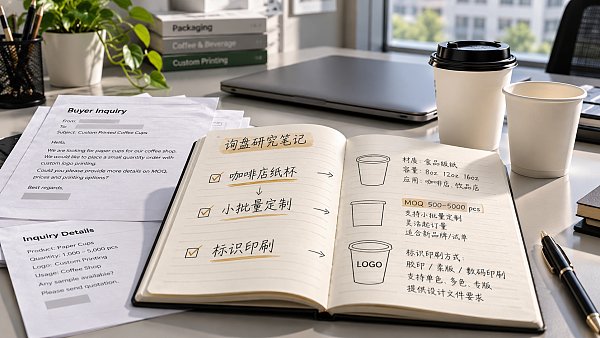
For example, a hypothetical inquiry might read: “We’d like to order custom paper cups for our coffee shop. The initial order won’t be large. Can you print our logo?” You can extract “paper cups,” “coffee shop,” “small quantity” and “custom logo printing.” This is more useful for expanding your keyword list later than simply noting “Customer asked about paper cup prices.”
Break a purchasing question into meaningful groups of long-tail keywords
Using this inquiry as an example, you can explore three directions:
- Product plus use case: custom paper cups for coffee shops, which reflects buyers’ need for products designed for a specific use.
- Product plus purchasing requirement: low minimum order custom paper cups, which reflects limitations related to trial orders, budgets or inventory.
- Product plus service requirement: paper cup suppliers that can print logos, which reflects the need to find a manufacturer or service provider that can handle customization.
For the English-speaking market, “custom paper cups for coffee shops” and “low minimum order custom paper cups” could be candidate phrases. Validate them against the wording buyers actually use in the local market. These are starting points for research, not evidence of consistent search volume.
The value of a long-tail keyword lies in how specific the need is, not in the number of words. Don’t cram “coffee shop, small quantity, eco-friendly, inexpensive, fast delivery” into a single phrase. Too many modifiers can make the phrase sound unnatural in search and may combine requirements the business cannot meet.
For multilingual websites, distinguish between formal industry terms, buyers’ everyday wording and regional terminology. Wording that sales staff understand may not be suitable as a page title without adaptation. Terms generated by translation tools should also be checked against search results in the target market.
When screening opportunities, check whether you can meet the need before assessing search potential
A need mentioned in an inquiry is not necessarily worth investing in content creation. Screen opportunities in the following order:
- Business fit: Does the company offer the relevant product, customization options and delivery terms? Needs the company cannot meet should not be a priority for customer acquisition.
- Recurring demand: Do different buyers ask similar questions repeatedly? Multiple follow-up questions from the same customer should be treated as one demand signal.
- Search intent: Are buyers looking for suppliers, comparing solutions or learning how to use a product? Different intents call for different types of pages.
- Content readiness: Are product information, specifications, service processes and other materials available to answer the question clearly?
Next, use Google Search Console to review relevant search queries for which the website already appears. Use keyword planning tools to explore related phrases and demand patterns, and examine search results in the target market. If the results mainly show product category pages, buyers are generally more inclined to shop. If they mostly show tutorials or guides, explanatory content may be a better fit.
A low search volume shown by a tool does not mean you should immediately abandon the opportunity. Specific purchasing requirements may not be tracked individually very often, but they can still be valuable to the business. In this case, you can first add information about the question to an existing product page and monitor related queries and inquiry feedback, rather than creating a new page right away. Conversely, even a high-volume keyword may not be worth prioritizing if it relates to downloading free templates while the company offers paid customization services.
Assign keywords to suitable pages instead of creating one page for each keyword
Once you have organized your keywords, group them by need and decide which page should address each group. “Custom paper cup supplier” is suited to a product or service page. “Minimum order quantity for custom paper cups” can be covered in the purchasing information on the same page. “How to prepare artwork files for paper cup printing” is better suited to a standalone guide that links to the customization service page.
If “small quantity custom paper cups” and “low minimum order custom paper cups” express the same need, they can usually be covered naturally on a single page. Creating a large number of similar pages increases maintenance costs and can cause multiple pages to compete for the same type of search traffic.
Pages should also answer the questions behind the keywords. If customers are concerned about small orders, explain which factors affect minimum order requirements and what information is needed before a quote can be prepared. If they are concerned about delivery times, explain how design approval, production and shipping affect the schedule. Where a single commitment cannot be made, describe the factors used to determine the conditions.
If you use a service solution such as Yiyingbao, which covers intelligent website building, SEO and overseas marketing, you can use an inquiry needs sheet as an input for website content planning. During collaboration, clarify which page will address each group of needs, who will provide the materials and how results will be monitored, so website development and promotion address the same set of buyer questions.
Use subsequent inquiries to assess whether your content is attracting the right customers
After publishing, monitor not only impressions and clicks for relevant queries, but also whether visitors reach the relevant product pages, submit related inquiries and have requirements that fit the business. If visits increase but inquiries remain consistently out of scope, you may need to adjust the keyword focus or explain the boundaries of the service more clearly on the page.
To get started, choose one core product and group recurring inquiry questions into several categories, then prioritize improving existing pages. Expand to new pages only when a need is distinct enough and you have enough information to answer it fully. This way, your long-tail keyword list grows gradually from real buyer questions, and each group of keywords has a clear purpose in your content.
Related Articles
 How Can Keyword Research Expand Long-Tail Keywords from Customer Inquiries?
 How to filter out irrelevant keywords after using AI for SEO keyword research?
 How Can You Prevent Language Page Mismatches in Google International SEO?
Related Products
 Yiyingbao SaaS Intelligent Website Building and Marketing SystemYiyingbao SaaS Intelligent Website Building and Marketing System, AI-powered no-code website building, rapid creation of multilingual B2B international websites in 10 minutes, global server acceleration, AI-powered SEO optimization, helping businesses connect efficiently with global markets. The perfect integration of technology and operation makes building an international trade website remarkably simple
 AI+SEM Intelligent Advertising Marketing SystemAI+SEM drives intelligent ad creation, empowering full-funnel precision advertising marketing. The system automatically generates weekly/monthly reports, AI recommends keywords and target countries, monitors core metrics in real-time with intelligent alerts, and enables one-click high-conversion ad solutions to help quickly acquire customers and improve ROI.
 AI+SEO Dual-Engine System Optimization ServicesYiyingbao’s AI+SEO dual-engine optimization system helps foreign trade enterprises acquire high-quality organic traffic through AI-powered keyword research, content generation, and comprehensive technical optimization, significantly improving search rankings and conversion rates.
 AI+SNS Social Media Marketing SystemYingbao AI+SNS Social Media Marketing System - Precision social capture for the social media era. Supports one-click content synchronization across major platforms like Facebook and LinkedIn. AI intelligently rewrites posts for enhanced relevance. 24/7 AI customer service and user profiling analysis empower businesses to efficiently expand into global markets.
 AI+SEO营销解决方案易营宝AI+SEO营销解决方案,通过AI批量写作、智能生成TDK、精准关键词扩词等功能,全面优化网站SEO效果,提升流量与转化率。助力企业构建高效智能网站新生态。
 AI+SEM Advertising Marketing SolutionsAI+SEM Advertising Marketing Solution leverages AI technology to deeply empower SEM ad campaigns. It automatically generates weekly/monthly reports using AI, presenting account data across multiple dimensions for comprehensive insights into campaign performance and trends. The system precisely recommends keywords and target countries, intelligently generates high-conversion ad copy, and enables one-click activation of efficient campaign plans to help businesses rapidly acquire customers. Simultaneously, it monitors core metrics in real time, intelligently identifies abnormal fluctuations, and issues timely alerts to ensure stable, high-return advertising results.
 Domain Name ServicesEasyWin provides professional domain name services, including intelligent queries, one-stop registration, brand protection, and full lifecycle management, helping businesses build a digital brand image.
 EasyOperate B2C Cross-Border E-Commerce Platform & Independent WebsiteEasyStore B2C Cross-border E-commerce Independent Store is an intelligent website building and cross-border e-commerce integrated solution independently developed by EasyStore Information Technology (Beijing) Co., Ltd. The system is specially designed for small and medium-sized as well as large export enterprises, integrating 'website building, operation, marketing, advertising, and conversion' into one, helping enterprises quickly establish cross-border e-commerce independent stores to achieve brand globalization and global sales growth.
The platform supports multiple languages, multiple currencies, and multi-channel marketing, with built-in AI intelligent translation and SEO optimization systems, suitable for mainstream markets such as Southeast Asia, Europe and America, Latin America, and the Middle East, assisting Chinese manufacturing enterprises in efficiently deploying international e-commerce strategies. SSL证书易营宝提供专业SSL安全证书服务,包括单域名和泛域名证书,确保网站数据传输加密、身份验证和完整性保护,助力企业建立安全可信的在线业务环境。









