









- Which customer acquisition channels will be affected by cross-border marketing trends in 2026?Sep 06, 2026View details
- Which homogenization risks should be considered in an analysis of the AI-powered website building industry?Aug 30, 2026View details
- How Will AI Marketing Trends 2026 Change Advertising Budget AllocationAug 28, 2026View details
- Is the EV SSL certificate market shrinking or upgrading? How should companies assess certificate procurement?Aug 11, 2026View details
- Why the old AMP SEO 2020 practices no longer work and what has changed in current optimization prioritiesAug 02, 2026View details
- How to Choose Topics for an Industry News Section to Attract More Organic Search TrafficJul 29, 2026View details
How can you avoid penalties when building backlinks for Google SEO?
How can Google SEO backlink building avoid penalties? This is one of the issues that concerns many companies most when conducting overseas marketing. The key is not how many backlinks are built, but whether their sources are genuine, relevant, and trustworthy. As long as a white-hat strategy is followed and attention is paid to content quality, website relevance, and the pace of growth, backlinks will not drag down a website. Instead, they can become an important asset for long-term ranking growth.
From the perspective of search intent, users are not really looking for a definition of backlinks. They want to know which backlink practices may trigger Google risks, how companies can determine whether an SEO service provider is compliant, and how to achieve stable rankings with controlled investment. Therefore, the article should focus on risk identification, compliant methods, evaluation criteria, and actionable strategies rather than general SEO fundamentals.
Why are companies more afraid of being penalized than of seeing no results when building backlinks for Google SEO?
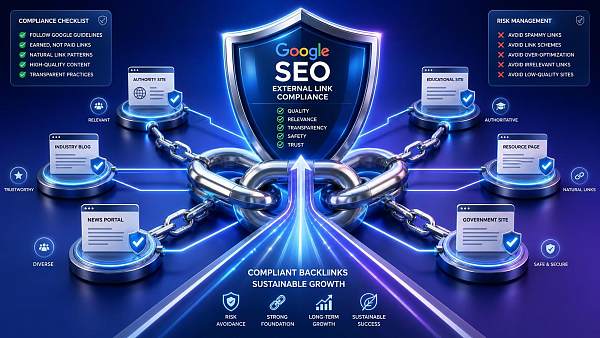
For companies, the value of backlink building is clear: improving website authority, strengthening page credibility, and helping core keywords reach more competitive positions. The problem is that many companies view backlink building as simply publishing links. They pursue quantity while ignoring quality. Although this may appear to produce fluctuations in the short term, it can easily lead to ranking declines or even manual penalties in the long run.
Google’s attitude toward backlinks has always been clear. It encourages naturally earned recommendation links and opposes any link behavior intended to manipulate rankings. If a website suddenly gains a large number of low-quality, irrelevant, or suspicious backlinks within a short period, search engines may suspect artificial manipulation, reduce the value of those links, and, in serious cases, affect the trustworthiness of the entire website.
This is why many foreign trade companies, cross-border sellers, and brands expanding overseas are more concerned about how to build backlinks safely than whether to build them at all when choosing SEO services. For corporate websites, B2B marketing websites, and independent websites, once rankings are affected by non-compliant backlinks, the recovery period is often longer than the construction period, disrupting both investment and returns.
Which backlink practices are most likely to trigger Google risks?
To answer how Google SEO backlink building can avoid penalties, the first step is to understand which practices are most dangerous. The first high-risk practice is purchasing large quantities of website resources that are clearly used to sell links. These websites usually have low-quality content, disorganized topics, and unusually concentrated outbound links, making it easy for Google to identify their link-selling nature.
The second common problem is publishing large numbers of links on industry-irrelevant directory sites, forum signatures, comment sections, or automatically generated guest-post content. On the surface, the number of links may appear high, but these backlinks generally lack editorial review and genuine user value. In the end, most can only become ineffective links or even create negative signals.
The third risk is over-optimized anchor text. For example, a company may direct a large number of backlinks to the same page while consistently using highly commercial keywords such as best China supplier or Google SEO service. Such a distribution is highly unnatural and may be regarded as deliberate keyword-ranking manipulation.
The fourth problem is abnormal backlink growth. A new website may originally have almost no brand exposure, yet suddenly gain a large number of similar links within a short period, with the source countries, languages, and topics being mismatched. This growth pattern generally does not align with genuine communication patterns and can easily trigger algorithmic review.
Which backlink quality standards should companies truly focus on?
Whether a backlink is safe cannot be determined solely by domain authority or the popularity of the platform. Truly valuable backlinks should first be relevant to the company’s industry, product application, or target market. For example, for a manufacturing company, links from industry media, supply chain information websites, and specialized blogs are usually more meaningful than links from general business websites.
Second, consider whether the link reflects genuine editorial judgment. In other words, did the link appear because the content was worth citing, recommending, or supplementing, rather than being mechanically inserted after payment? Google places more value on links that are recommended than on links that are arranged. This is the fundamental logic for evaluating backlink quality.
Third, examine whether the page containing the link itself provides content value. If a page was written solely to place a link, has empty content and a disorganized structure, and is unlikely to be read by users, then even if the domain itself appears reputable, the long-term value of that link is limited. Ultimately, backlink quality still depends on content quality.
Fourth, examine whether the distribution of sources appears natural. A normal website’s backlinks come from different types of platforms, including industry media, partner pages, case study citations, interview reports, resource pages, and blog content. A diversified and reasonable source structure is safer than mass placement through a single channel and is also closer to genuine brand communication.
How can Google SEO backlink building avoid penalties? Four principles companies can implement directly
First, create content before building links. Many companies immediately ask where to publish backlinks without answering a more important question: are the pages on your website worth citing? If landing page content is thin, case studies are insufficient, and technical explanations are unclear, backlinks may bring traffic but will struggle to generate lasting rankings and conversions.
Second, prioritize relevant links over cheap links. Truly safe backlinks often come from people, media, and platforms related to the business. For foreign trade companies, it is better to conduct fewer high-relevance content collaborations than to accumulate large quantities of low-cost resources. Low-quality links may appear inexpensive, but they are actually the most costly because subsequent recovery can be more expensive.
Third, control the distribution of anchor text. Brand terms, URL-based anchor text, natural phrases, and generic-term links should account for a higher proportion, while commercial keywords should appear only in moderation. A natural website will not have everyone using the same keyword to link to it. Therefore, the more uniform the anchor text, the easier it is for algorithms to identify artificial optimization.
Fourth, treat backlink building as part of brand exposure rather than as an isolated SEO activity. If a company obtains links through industry articles, case studies, data reports, media interviews, collaborative publications, and customer stories, it can improve visibility while better aligning with Google’s criteria for natural mentions.
If you are looking for an SEO service provider, how can you determine whether its backlink strategy is reliable?
Many companies encounter problems not because they fail to value SEO, but because they cannot understand the language used by service providers. To determine whether an SEO service provider is reliable, first check whether it promises a large number of backlinks in the short term, rapid placement on the first page, or guaranteed keyword rankings. Providers that overemphasize speed and quantity while avoiding discussion of source quality carry a high level of risk.
Second, check whether the provider is willing to explain the logic behind its backlink sources. Compliant service providers usually explain the link types, industry relevance, content strategy, anchor text planning, and construction pace rather than simply quoting a number of backlinks per month. A truly professional team sells strategy and quality, not the number of links.
Third, check whether the provider can coordinate backlink building with website development, content optimization, and page conversion. Backlinks do not exist in isolation. Especially for corporate websites, if the on-site structure, technical SEO, multilingual content, and inquiry conversion path are not properly established, simply adding backlinks will make it difficult to achieve sustainable results. Integrated operations are usually more stable than purchasing a single service.
Platforms such as Yiyingbao, which provide coordinated services for website development, SEO, advertising, and AI marketing, have the advantage of not implementing backlink strategies independently of the website foundation and market objectives. Instead, they plan around target countries, target keywords, content assets, and customer acquisition scenarios as a whole, making this approach more suitable for overseas companies seeking long-term growth.
If you have already built backlinks, how can you determine whether your website is at risk?
If a company has built backlinks before, it does not need to assume from the outset that there is definitely a problem. A more practical approach is to check several signals: whether core keywords have suddenly declined broadly, whether backlink sources are concentrated on irrelevant websites, whether anchor text is excessively commercialized, and whether there are obvious bulk directory links or spam guest-post links.
At the same time, you can use Google Search Console and third-party SEO tools to monitor changes in link sources, affected pages, and brand-term performance. If only a few low-quality backlinks exist, there is usually no need to panic. However, if the overall link profile is clearly abnormal, high-risk resources should be cleaned up promptly and subsequent backlink-building strategies should be adjusted.
For company managers, what matters more is not whether they can analyze backlinks one by one, but whether they have established a basic evaluation standard: are the backlinks genuine, relevant, and aligned with the brand and business objectives? As long as this standard is firmly applied, companies can avoid being misled by a quantity-based mindset and evaluate the value of SEO investment more rationally.
Conclusion: A safe backlink strategy is essentially a long-term growth strategy
Returning to the original question, how can Google SEO backlink building avoid penalties? The answer is not complicated: do not pursue volume through manipulation, avoid links designed to manipulate rankings, do not rely on shortcuts, and build backlinks on the foundation of content value, industry relevance, and brand credibility. The closer backlink building is to genuine communication, the lower the risk and the more stable the results.
For foreign trade companies, manufacturing factories, cross-border e-commerce businesses, and brands expanding overseas, avoiding penalties when building backlinks for Google SEO is not merely a matter of execution skills; it is also a choice of methodology. Long-term ranking and inquiry growth never come from piles of cheap links. They come from a systematic, compliant, and sustainable strategy that coordinates content and link building.
Related Articles

Related Products
 Yiyingbao SaaS Intelligent Website Building and Marketing SystemYiyingbao SaaS Intelligent Website Building and Marketing System, AI-powered no-code website building, rapid creation of multilingual B2B international websites in 10 minutes, global server acceleration, AI-powered SEO optimization, helping businesses connect efficiently with global markets. The perfect integration of technology and operation makes building an international trade website remarkably simple
 AI+SEM Intelligent Advertising Marketing SystemAI+SEM drives intelligent ad creation, empowering full-funnel precision advertising marketing. The system automatically generates weekly/monthly reports, AI recommends keywords and target countries, monitors core metrics in real-time with intelligent alerts, and enables one-click high-conversion ad solutions to help quickly acquire customers and improve ROI.
 AI+SEO Dual-Engine System Optimization ServicesYiyingbao’s AI+SEO dual-engine optimization system helps foreign trade enterprises acquire high-quality organic traffic through AI-powered keyword research, content generation, and comprehensive technical optimization, significantly improving search rankings and conversion rates.
 AI+SNS Social Media Marketing SystemYingbao AI+SNS Social Media Marketing System - Precision social capture for the social media era. Supports one-click content synchronization across major platforms like Facebook and LinkedIn. AI intelligently rewrites posts for enhanced relevance. 24/7 AI customer service and user profiling analysis empower businesses to efficiently expand into global markets.
 AI+SEO营销解决方案易营宝AI+SEO营销解决方案,通过AI批量写作、智能生成TDK、精准关键词扩词等功能,全面优化网站SEO效果,提升流量与转化率。助力企业构建高效智能网站新生态。
 AI+SEM Advertising Marketing SolutionsAI+SEM Advertising Marketing Solution leverages AI technology to deeply empower SEM ad campaigns. It automatically generates weekly/monthly reports using AI, presenting account data across multiple dimensions for comprehensive insights into campaign performance and trends. The system precisely recommends keywords and target countries, intelligently generates high-conversion ad copy, and enables one-click activation of efficient campaign plans to help businesses rapidly acquire customers. Simultaneously, it monitors core metrics in real time, intelligently identifies abnormal fluctuations, and issues timely alerts to ensure stable, high-return advertising results.
 Domain Name ServicesEasyWin provides professional domain name services, including intelligent queries, one-stop registration, brand protection, and full lifecycle management, helping businesses build a digital brand image.
 EasyOperate B2C Cross-Border E-Commerce Platform & Independent WebsiteEasyStore B2C Cross-border E-commerce Independent Store is an intelligent website building and cross-border e-commerce integrated solution independently developed by EasyStore Information Technology (Beijing) Co., Ltd. The system is specially designed for small and medium-sized as well as large export enterprises, integrating 'website building, operation, marketing, advertising, and conversion' into one, helping enterprises quickly establish cross-border e-commerce independent stores to achieve brand globalization and global sales growth.
The platform supports multiple languages, multiple currencies, and multi-channel marketing, with built-in AI intelligent translation and SEO optimization systems, suitable for mainstream markets such as Southeast Asia, Europe and America, Latin America, and the Middle East, assisting Chinese manufacturing enterprises in efficiently deploying international e-commerce strategies. SSL证书易营宝提供专业SSL安全证书服务,包括单域名和泛域名证书,确保网站数据传输加密、身份验证和完整性保护,助力企业建立安全可信的在线业务环境。









