









- Can the average annual growth rate reflect real opportunities in overseas markets?Oct 07, 2026View details
- Which customer acquisition channels will be affected by cross-border marketing trends in 2026?Sep 06, 2026View details
- Which homogenization risks should be considered in an analysis of the AI-powered website building industry?Aug 30, 2026View details
- How Will AI Marketing Trends 2026 Change Advertising Budget AllocationAug 28, 2026View details
- Is the EV SSL certificate market shrinking or upgrading? How should companies assess certificate procurement?Aug 11, 2026View details
- Why the old AMP SEO 2020 practices no longer work and what has changed in current optimization prioritiesAug 02, 2026View details
What Account Risks Should Be Avoided Before Running Google Ads in Germany?
When many companies prepare to launch Google Ads in the German market, the first topics they usually discuss are budgets, keywords, and landing pages. However, for business evaluation personnel, the real question to ask first is not “Can we run the ads?” but “Can this account structure and compliance foundation support continuous advertising?” In actual publicité google allemagne projects, once risks are embedded in account qualifications, payment, historical records, or data attribution, even the best creative materials and bidding strategies may subsequently be restricted by the platform, blocked by risk controls, or cause the budget to be consumed by ineffective traffic and incorrect judgments.
The German market is particularly sensitive to privacy, information transparency, and brand credibility. Platforms also place greater emphasis on advertiser identity, payment behavior, and consistency between website content and advertising. Many companies interpret advertising in Germany as “copying the account structure used in other European countries,” but this often creates problems during execution. If risks are not assessed during the business evaluation stage, operational issues may later be misjudged as market issues.
First determine: are you facing “advertising in a new market” or “reusing a high-risk account”?
To pursue a faster launch, many teams directly activate an existing Google Ads account or continue using the advertising framework of a website from another country. This approach is not necessarily wrong, but the risks can vary significantly.
For a completely new account, the focus is on establishing initial trust: Are the business details complete? Is the domain history clean? Is the payment method stable? Does the website provide basic compliant information? When reusing an account, the focus shifts to historical violations, appeal records, previously advertised industries, payment anomalies, changes in account operators, and other “old traces.” Many ads fail to run not because the German market is difficult, but because the account history has already been flagged by the system as requiring a high level of scrutiny.
During business evaluation, it is recommended to classify the account clearly before deciding whether to continue using it. A common misconception is that “an old account is more stable than a new account.” In reality, an old account with a complicated history may not be easier to scale than a newly created account.
Risk category one: inconsistencies between business qualifications and website information
Before advertising in Germany, the most common fundamental risk is inconsistency among the “advertising account entity, paying entity, entity displayed on the official website, and actual fulfillment entity.” The platform does not require every field to be completely identical in form, but if the differences are too large and lack a reasonable explanation, they can easily trigger prolonged reviews, requests for additional identity verification documents, or even advertising restrictions.
Several points should be reviewed specifically:
- Whether the entity that opened the Google Ads account is consistent with the company entity shown in the website footer, privacy policy, and contact page;
- Whether the domain holder, brand name, and billing company have a clear and traceable relationship;
- Whether the website clearly provides the company address, contact details, service scope, and return, exchange, or after-sales information;
- Whether the German-language pages merely have a translation, or whether they provide localized wording that can be properly understood during review.
In German advertising campaigns, if the German landing page is merely machine-translated, the company introduction is vague, or legal pages are missing, the platform may easily classify the issue as “low transparency” or “insufficient business information.” This is particularly common among B2B companies. Many believe that an industrial product advertisement only needs a product page, but the review system will not automatically fill in the missing trust elements based on industry experience.
Risk category two: payment-chain stability is more important than budget size
Business personnel often view payment as a financial issue, but in advertising, payment itself is a risk-control signal. In the early stages of a publicité google allemagne project, frequently changing credit cards, a long-term mismatch between the payment country and the account region, or a sharp increase in spending limits within a short period may all increase the likelihood of the account being re-reviewed by the system.
The real concern is not “Can the payment be charged?” but whether the payment behavior is continuous, explainable, and sustainable over the long term. Platforms generally prefer stable, regular financial activity from a consistent entity. Many companies use personal cards, temporary cards, or third-party payments during initial testing to reduce launch costs. In practice, this increases the risk of later spending limits, declined payments, or account suspension.
From an evaluation perspective, the following situations should be flagged in advance:
- No clear relationship between the company that opened the account and the paying company;
- Multiple payment instruments changed within a short period on the same account;
- The budget was rapidly increased immediately after the account resumed advertising;
- A history of declined payments, refund disputes, or appeals concerning abnormal charges.
If the company itself has a complex cross-border settlement chain, this area should preferably be confirmed jointly by the marketing, finance, and legal teams. Do not wait until the account is running before addressing it. Many advertising interruptions are not caused by traffic issues, but by account fluctuations resulting from insufficient payment stability.
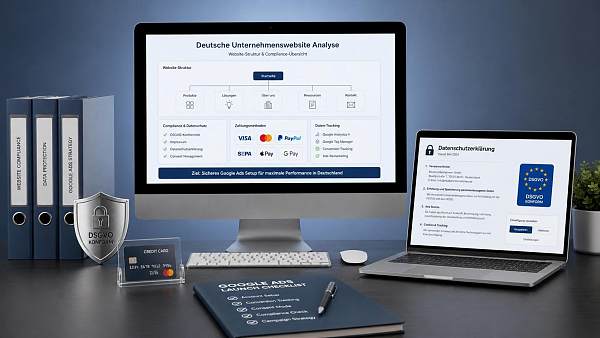
Risk category three: historical violations do not automatically disappear when you “change markets”
This is one of the points that teams most commonly underestimate. Some companies believe that because they previously advertised in another country or for another product line, their old issues are no longer relevant when they move into the German market. In reality, account history, domain history, Merchant Center records, administrator activity trails, and other factors may all be used by the platform to assess risk.
Particular attention should be paid to the following historical burdens:
- Previous warnings or suspensions for “misleading content,” “circumventing systems,” or “suspicious payment activity”;
- Large-scale revisions to an old website while the domain still retains traces of low-quality content;
- The account was repeatedly transferred among multiple agencies, resulting in disorganized permission management;
- Exaggerated claims between advertising materials, landing pages, and the actual business.
The difficulty here is that many business evaluations only check whether the account can currently be accessed and whether ads can be created, without reviewing historical appeals and the context of past violations. As a result, after the project is signed, they discover that the real problem is not that the account cannot be used, but that it cannot scale consistently.
If a company is undergoing digital transformation and rebuilding its advertising system, it can also supplement its understanding from the perspectives of corporate governance and technology management. For example, when assessing a budget, some teams may also read materials such as Practical Challenges and Countermeasures for Financial Technology to Promote Enterprise Innovation and Development, helping management understand that “system capabilities, risk-control mechanisms, and business growth” are not separate issues. In advertising, account governance is likewise part of the infrastructure for growth.
Risk category four: distorted data attribution can lead to incorrect judgments about the German market
During the early stages of advertising in Germany, many companies see that their ads are running and inquiries are being generated, but later find it increasingly difficult to determine whether additional budget is worthwhile. The root cause is often not useless traffic, but an unclear attribution chain. In particular, in the European market, conversion data is naturally more prone to deviations because of privacy policies, cookie consent mechanisms, browser restrictions, and other factors.
During the business evaluation stage, clarify in advance: What data will be used to determine whether the project succeeds or fails? If only front-end form submissions are considered, many phone, email, or cross-device conversions may be overlooked. If only the conversion figures in the platform backend are considered, the effectiveness reported by machine-learning models may be overestimated.
Several key items should be checked:
- Whether complete and verified conversion tracking has been implemented;
- Whether the cookie consent pop-up affects the triggering of statistics;
- Whether the CRM can receive lead-quality feedback instead of merely recording the number of leads;
- Whether the German website and websites in other languages use the same event definitions, resulting in inconsistent data standards.
For B2B companies, the common issue in the German market is not “no leads,” but “unclear lead quality.” Without connecting advertising data, website behavior, and sales follow-up, business personnel may easily conclude that the campaign is scalable simply because the short-term CPL looks attractive, only to discover later that the inquiries cannot be converted into sales.
Risk category five: landing pages involve more than conversion; they also involve review and trust
Many discussions about publicité google allemagne focus on keywords and bidding. In reality, the landing page often performs three functions at the same time: passing platform review, building trust with German users, and completing business conversions. None of these functions can be omitted.
If a page contains only marketing language but lacks delivery details, technical parameters, case boundaries, contact information, and privacy commitments, German users may not be convinced, and the platform may not relax its review. In particular, for manufacturing, software services, and cross-border B2B projects, pages lacking clear business explanations are often classified as having insufficient information or low relevance.
During business evaluation, it is useful to look directly at the following signals:
- Whether the German-language pages have been proofread by someone who understands the business, rather than merely translated literally;
- Whether there are independent privacy policy, legal notice, and contact pages;
- Whether product capabilities, service scope, and applicable regions are described with sufficient specificity;
- Whether website loading speed, mobile experience, and form usability have been tested in practice.
This also demonstrates the value of an integrated “website + marketing service” approach. Many advertising problems appear to originate in the advertising backend, but actually stem from the fragmented development of the website, content, tracking, and account systems. If business personnel purchase website development, SEO foundations, advertising landing pages, and attribution systems separately, the initial cost may be lower, but coordination costs are usually higher later.
When evaluating a service provider, do not ask only about ad management capabilities
If a company plans to outsource its Google advertising in Germany, the questions most commonly asked during quotation are “Have you worked in the German market before?”, “How many inquiries can you generate?”, and “How long will it take for the account to gain traction?” These questions should certainly be asked, but they are not enough.
More valuable questions concern whether the provider can complete a risk assessment before advertising begins and whether it can identify the specific level at which a problem occurs. A mature team should at least be able to answer:
These questions may appear more detailed, but they are actually more important for business evaluation. The factors that truly affect project ROI are often not whether the team “knows how to run ads,” but whether it can place account risks, website quality, and business objectives within the same execution framework.
Before advertising, first assess whether operations can continue sustainably
Google advertising in Germany can be launched quickly, but it is not suitable for a rushed launch when the account foundation is unclear. For business evaluation personnel, the most practical assessment standard is not the estimated number of clicks provided by an agency, but whether the project can operate stably and continuously over the next three to six months: the account will not be repeatedly restricted, payments will not fluctuate frequently, the data will be understandable, the landing page will be able to handle the traffic, and the sales team will be able to follow up effectively.
If two or more of these conditions remain unclear, the most appropriate action is often not to increase the budget immediately, but to complete the underlying assessment first. Once account risks have been identified, discussions about keyword expansion, bidding strategies, and lead costs will become meaningful. For advertising aimed at the German market, such as publicité google allemagne, identifying and addressing risks in advance is not slowing down the process; it prevents the company from paying a higher price later for early oversights.
Related Articles



Related Products
 Yiyingbao SaaS Intelligent Website Building and Marketing SystemYiyingbao SaaS Intelligent Website Building and Marketing System, AI-powered no-code website building, rapid creation of multilingual B2B international websites in 10 minutes, global server acceleration, AI-powered SEO optimization, helping businesses connect efficiently with global markets. The perfect integration of technology and operation makes building an international trade website remarkably simple
 AI+SEM Intelligent Advertising Marketing SystemAI+SEM drives intelligent ad creation, empowering full-funnel precision advertising marketing. The system automatically generates weekly/monthly reports, AI recommends keywords and target countries, monitors core metrics in real-time with intelligent alerts, and enables one-click high-conversion ad solutions to help quickly acquire customers and improve ROI.
 AI+SEO Dual-Engine System Optimization ServicesYiyingbao’s AI+SEO dual-engine optimization system helps foreign trade enterprises acquire high-quality organic traffic through AI-powered keyword research, content generation, and comprehensive technical optimization, significantly improving search rankings and conversion rates.
 AI+SNS Social Media Marketing SystemYingbao AI+SNS Social Media Marketing System - Precision social capture for the social media era. Supports one-click content synchronization across major platforms like Facebook and LinkedIn. AI intelligently rewrites posts for enhanced relevance. 24/7 AI customer service and user profiling analysis empower businesses to efficiently expand into global markets.
 AI+SEO营销解决方案易营宝AI+SEO营销解决方案,通过AI批量写作、智能生成TDK、精准关键词扩词等功能,全面优化网站SEO效果,提升流量与转化率。助力企业构建高效智能网站新生态。
 AI+SEM Advertising Marketing SolutionsAI+SEM Advertising Marketing Solution leverages AI technology to deeply empower SEM ad campaigns. It automatically generates weekly/monthly reports using AI, presenting account data across multiple dimensions for comprehensive insights into campaign performance and trends. The system precisely recommends keywords and target countries, intelligently generates high-conversion ad copy, and enables one-click activation of efficient campaign plans to help businesses rapidly acquire customers. Simultaneously, it monitors core metrics in real time, intelligently identifies abnormal fluctuations, and issues timely alerts to ensure stable, high-return advertising results.
 Domain Name ServicesEasyWin provides professional domain name services, including intelligent queries, one-stop registration, brand protection, and full lifecycle management, helping businesses build a digital brand image.
 EasyOperate B2C Cross-Border E-Commerce Platform & Independent WebsiteEasyStore B2C Cross-border E-commerce Independent Store is an intelligent website building and cross-border e-commerce integrated solution independently developed by EasyStore Information Technology (Beijing) Co., Ltd. The system is specially designed for small and medium-sized as well as large export enterprises, integrating 'website building, operation, marketing, advertising, and conversion' into one, helping enterprises quickly establish cross-border e-commerce independent stores to achieve brand globalization and global sales growth.
The platform supports multiple languages, multiple currencies, and multi-channel marketing, with built-in AI intelligent translation and SEO optimization systems, suitable for mainstream markets such as Southeast Asia, Europe and America, Latin America, and the Middle East, assisting Chinese manufacturing enterprises in efficiently deploying international e-commerce strategies. SSL证书易营宝提供专业SSL安全证书服务,包括单域名和泛域名证书,确保网站数据传输加密、身份验证和完整性保护,助力企业建立安全可信的在线业务环境。









