









- AliExpress Global Double 11: Brand Sales Grow Nearly 50% in the First Week, U.S. GMV Rises 70%Nov 21, 2026View details
- Ministry of Commerce Reports E-commerce Development from January to October 2026, with Cross-Border Imports Performing StronglyNov 21, 2026View details
- Amazon Black Friday Orders Sluggish on Day One; NRF Forecasts 4.2 Million Fewer ParticipantsNov 21, 2026View details
- 21st Century Business Herald: AI and CTV Become Core Growth Engines for Digital Marketing in Overseas MarketsNov 18, 2026View details
- China Presents 25 Cooperation Outcomes in Areas Including Cross-Border E-Commerce During APECNov 18, 2026View details
- AI Products Drive Hong Kong Exports Up 64.9% in September, Fastest Growth in Over 40 YearsNov 17, 2026View details
How Should You Set an Advertising Budget Based on Customer Acquisition Goals?
How Should You Set an Advertising Budget Based on Customer Acquisition Goals?
How should advertising spend be aligned with customer acquisition goals? The key is not to start by asking, “How much should we spend each month?” Instead, first determine how many customers you want to acquire, then work backward from lead quality, conversion rates, and cost per customer. For foreign trade and manufacturing businesses, not every inquiry generated by advertising will turn into a sale. Your website, sales follow-up, and choice of markets can also affect the final outcome.
Align on the Goal First: Inquiries or Paying Customers?
Even when everyone talks about “acquiring customers each month,” the marketing team may count form submissions, the sales team may focus on qualified inquiries with purchasing needs, and management may care most about new customers won. If you set the budget based only on the number of form submissions, the campaign may appear to meet its target while sales receives a large number of inquiries from students, competitors, or prospects whose needs fall outside your service scope.
Before setting a budget, define three things clearly: the number of new customers you need to win during the target period; what qualifies as a valid lead; and how you will attribute a sale. For example, must prospects provide company information, the products they want to purchase, or details of their project requirements? Do repeat submissions and inquiries from existing customers count? The clearer your definitions, the more reliably you can compare channel costs later.
You should also account for the sales cycle. Industrial equipment and custom manufacturing projects often require technical discussions, quotations, and procurement approval. Inquiries generated in a given month may not convert to sales that same month. It is fine to review lead costs monthly, but allow the same batch of leads a reasonable follow-up period before judging their impact on sales.
Work Backward from Your Sales Target to Set the Advertising Budget
If you have historical data, you can work backward in this order: number of customers won → number of qualified leads → website visits. The qualified-lead-to-customer conversion rate is the proportion of qualified leads that ultimately become customers. The visit-to-qualified-lead rate is the proportion of advertising visits that generate qualified leads. Wherever possible, use historical data from the same market, product, and channel for both rates; avoid applying figures from unrelated sources.
Calculation formulas: Required number of qualified leads = target number of customers won ÷ qualified-lead-to-customer conversion rate; required number of advertising visits = required number of qualified leads ÷ visit-to-qualified-lead rate; estimated media budget = required number of advertising visits × average cost per click.
For illustration only, suppose a company wants to win 4 customers, its qualified-lead-to-customer conversion rate is 20%, its advertising visit-to-qualified-lead rate is 2%, and its estimated average cost per click is 10 yuan. It would need 20 qualified leads and about 1,000 advertising visits, for an estimated media budget of about 10,000 yuan. If the visit-to-qualified-lead rate drops to 1%, with all other assumptions unchanged, the media budget would be about 20,000 yuan.
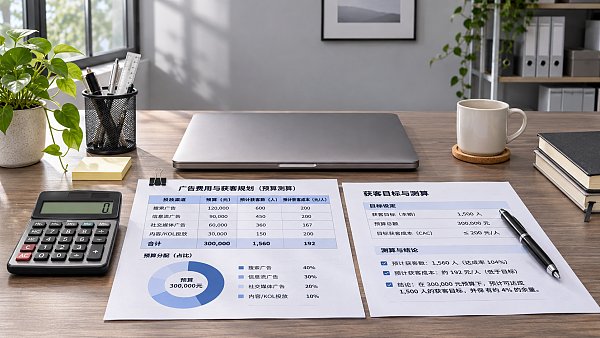
This example is neither an industry rate card nor a guarantee of advertising results. In practice, click volume may differ from the number of valid visits, and advertising costs can vary with competition and traffic quality. If you do not have reliable historical data, set conservative, baseline, and optimistic assumptions separately, and identify which figures need to be validated through testing. Do not treat projections as guaranteed performance commitments.
Your Budget Ceiling Also Depends on the Profit Each Customer Can Generate
Working backward shows you how much you may need to spend, but it does not mean the investment is necessarily worthwhile. To determine whether it is affordable, first estimate the profit contributed by each new customer, then subtract relevant costs such as sales, delivery, and after-sales support to determine a reasonable amount to allocate to acquisition. Do not use the contract value or revenue as your advertising budget.
For example, suppose your estimate is that the maximum amount available for customer acquisition per new customer over an agreed period is 5,000 yuan. In the example above, the media acquisition cost is 10,000 yuan ÷ 4, or 2,500 yuan per customer. However, this is not the full customer acquisition cost. Website development, landing page creation, content translation, campaign management, and related tools should also be included in the assessment based on the budget period and their actual use. If these investments also support organic search or existing-customer retention, agree on a reasonable cost-allocation method in advance.
Repeat purchases may increase customer value, but without reliable records, do not include all potential long-term orders that have not yet occurred in your budget calculations. When reconciling costs, distinguish between the amount added to the advertising account, actual ad spend, and service fees. Confirm whether quotes include tax and whether they cover creative revisions and data tracking, so that the same “monthly budget” does not end up covering different items.
Evaluate Channels and Your Website Together—Not as Separate Traffic Purchases
Channel selection depends on how customers look for suppliers. For customers with clear requirements who actively search for product specifications, search advertising may be worth prioritizing. For businesses that need to showcase use cases or build awareness first, social media advertising may be worth testing. Competition varies across countries, languages, and products, so do not apply the cost per click in one market directly to every region.
An ad click is only the beginning. If a landing page lacks relevant product specifications, clear information about your delivery capabilities, or an easy-to-find inquiry option, even well-targeted traffic may not convert. For multilingual pages, check that terminology, forms, and contact details are appropriate for the target market. Slow loading on mobile devices, failed form submissions, and missed emails can also waste budget after the click.
An integrated website and marketing approach can help you cross-check page, campaign, and lead data. Take 易营宝, which provides services such as intelligent website development, SEO, and advertising, as an example. When evaluating solutions of this kind, businesses can ask who maintains the advertising landing pages, how form data is passed into the sales process, whether website changes are included in the service, and who owns the advertising accounts and data. A broad range of tools and services does not mean these delivery details can be overlooked.
Test First, Then Adjust Based on Qualified Leads
When entering a new market without existing data, there is no need to launch across every country and channel at once. Start with products and markets your business can serve and for which you have relatively complete page content. Set a clear test period and spending limit. During the test, track search terms or audiences, cost per click, form submissions, qualified leads, and sales feedback. If there are too few leads, do not judge a channel’s performance based on just one or two inquiries.
When reviewing performance, do not focus only on cost per click. Cheap clicks with a low qualification rate can result in a higher cost per customer; a drop in inquiry volume may also mean that mismatched prospects are being filtered out. If traffic is normal but form submissions are low, first check the page and tracking. If there are many inquiries but few are valid, review targeting, ad claims, and the form. If there are many qualified leads but few sales, investigate factors such as quotations, response times, and the sales cycle.
Before setting the budget for the next phase, put your target number of customers, key conversion rates, cost ceiling, and assumptions to be validated in the same budget plan, and agree on a review date. That way, even if actual results differ from projections, you can identify whether the change is due to traffic costs, website conversion, or the sales process, and then decide whether to increase spend, adjust the campaign, or pause it.
Related Articles
 Microsoft Confirms Ads with “Made With AI” Labels in Bing AI Overviews
 How Should You Set an Advertising Budget Based on Customer Acquisition Goals?
 How Can Cross-Border E-Commerce Stores Reduce Invalid Clicks on Google Ads?
Related Products
 Yiyingbao SaaS Intelligent Website Building and Marketing SystemYiyingbao SaaS Intelligent Website Building and Marketing System, AI-powered no-code website building, rapid creation of multilingual B2B international websites in 10 minutes, global server acceleration, AI-powered SEO optimization, helping businesses connect efficiently with global markets. The perfect integration of technology and operation makes building an international trade website remarkably simple
 AI+SEM Intelligent Advertising Marketing SystemAI+SEM drives intelligent ad creation, empowering full-funnel precision advertising marketing. The system automatically generates weekly/monthly reports, AI recommends keywords and target countries, monitors core metrics in real-time with intelligent alerts, and enables one-click high-conversion ad solutions to help quickly acquire customers and improve ROI.
 AI+SEO Dual-Engine System Optimization ServicesYiyingbao’s AI+SEO dual-engine optimization system helps foreign trade enterprises acquire high-quality organic traffic through AI-powered keyword research, content generation, and comprehensive technical optimization, significantly improving search rankings and conversion rates.
 AI+SNS Social Media Marketing SystemYingbao AI+SNS Social Media Marketing System - Precision social capture for the social media era. Supports one-click content synchronization across major platforms like Facebook and LinkedIn. AI intelligently rewrites posts for enhanced relevance. 24/7 AI customer service and user profiling analysis empower businesses to efficiently expand into global markets.
 AI+SEO营销解决方案易营宝AI+SEO营销解决方案,通过AI批量写作、智能生成TDK、精准关键词扩词等功能,全面优化网站SEO效果,提升流量与转化率。助力企业构建高效智能网站新生态。
 AI+SEM Advertising Marketing SolutionsAI+SEM Advertising Marketing Solution leverages AI technology to deeply empower SEM ad campaigns. It automatically generates weekly/monthly reports using AI, presenting account data across multiple dimensions for comprehensive insights into campaign performance and trends. The system precisely recommends keywords and target countries, intelligently generates high-conversion ad copy, and enables one-click activation of efficient campaign plans to help businesses rapidly acquire customers. Simultaneously, it monitors core metrics in real time, intelligently identifies abnormal fluctuations, and issues timely alerts to ensure stable, high-return advertising results.
 Domain Name ServicesEasyWin provides professional domain name services, including intelligent queries, one-stop registration, brand protection, and full lifecycle management, helping businesses build a digital brand image.
 EasyOperate B2C Cross-Border E-Commerce Platform & Independent WebsiteEasyStore B2C Cross-border E-commerce Independent Store is an intelligent website building and cross-border e-commerce integrated solution independently developed by EasyStore Information Technology (Beijing) Co., Ltd. The system is specially designed for small and medium-sized as well as large export enterprises, integrating 'website building, operation, marketing, advertising, and conversion' into one, helping enterprises quickly establish cross-border e-commerce independent stores to achieve brand globalization and global sales growth.
The platform supports multiple languages, multiple currencies, and multi-channel marketing, with built-in AI intelligent translation and SEO optimization systems, suitable for mainstream markets such as Southeast Asia, Europe and America, Latin America, and the Middle East, assisting Chinese manufacturing enterprises in efficiently deploying international e-commerce strategies. SSL证书易营宝提供专业SSL安全证书服务,包括单域名和泛域名证书,确保网站数据传输加密、身份验证和完整性保护,助力企业建立安全可信的在线业务环境。









