









- CBP Finalizes Electronic Rail Export Manifest Rule, Effective October 26, 2026Oct 26, 2026View details
- Amazon’s 2026 peak season surcharge takes effect on October 25Oct 26, 2026View details
- AI Is Eating SaaS: Three Real-World Cases in One AfternoonOct 25, 2026View details
- Exiger CEO: The SaaS Apocalypse Is Real, but It Means Something DifferentOct 25, 2026View details
- Hengqin Cooperation Zone Shares Cross-Border E-Commerce Developments, Focusing on Macao-Hengqin Collaboration and International MarketsOct 24, 2026View details
- A Shenyang study highlights the development of the “cross-border e-commerce + industrial cluster” modelOct 24, 2026View details
Facebook Ad Optimization Tips: How to Identify Creative Fatigue
For project managers, mastering Facebook ad optimization techniques and identifying creative fatigue in time are essential to preventing budget from continuously being wasted on ads that “appear to still be spending but are no longer effective.” This is especially important for overseas businesses involving engineering equipment, industrial materials, and project services, where the decision cycle for a single lead is relatively long and fluctuations in ad data may not immediately be reflected in closed deals. Focusing only on surface-level click volume can easily cause early signs of creative decline to be missed.
Creative fatigue does not simply mean that “users have seen an ad once.” More precisely, it occurs when the same reachable audience repeatedly encounters similar creatives and their attention, willingness to click, or willingness to take action steadily declines. The Facebook ad system may continue delivery because it can find audiences that performed well historically; however, the real question for the person responsible for advertising is whether this creative can still consistently generate qualified inquiries that meet project requirements.
First, distinguish between creative fatigue and changes in the delivery environment
When many teams see a declining click-through rate and rising cost per lead, their first reaction is to replace images or re-edit videos. This can sometimes work, but it can also conceal the real issue. Creative fatigue is usually a gradual process rather than something that suddenly becomes ineffective one day, so it needs to be assessed together with frequency, engagement, the conversion path, and audience size.
Take engineering project lead generation as an example. If an “equipment parameter display” ad is targeted at a narrow audience of industry job roles, it may initially receive good clicks because the information is clear. After two or three weeks of delivery, however, the target audience repeatedly sees similar visuals, click-through rates gradually decline, comment engagement decreases, and form submission costs rise. This is closer to typical creative fatigue. Conversely, if an industry exhibition, holiday, logistics policy, or concentrated competitor promotion causes overall conversions to worsen during a particular week, it should not simply be attributed to the creative itself.
Four groups of signals to review together
- Frequency continues to rise: Frequency reflects the average number of times each reached user sees an ad, but there is no single “danger threshold” that applies to all accounts. B2B projects with high order values and long decision cycles can accommodate higher frequency; the key is whether performance deteriorates as frequency increases.
- CTR declines while impressions continue to grow: When impressions increase while link CTR or landing page view rate falls continuously, it often means that the creative is losing appeal to the existing audience. Review results by ad set, placement, and country to avoid averages concealing the issue.
- CPM remains relatively stable while CPC rises: If the cost per thousand impressions does not fluctuate significantly but the cost per click keeps increasing, this often indicates that the bidding environment has not become more expensive, but that the same exposure is generating fewer clicks.
- Lead quality shows a delayed decline: This is the metric most easily overlooked in engineering project advertising. Form volume may remain stable, but invalid email addresses, inquiries from non-target regions, and inquiries without purchase plans may increase, indicating that the creative is attracting “onlookers” rather than target decision-makers.
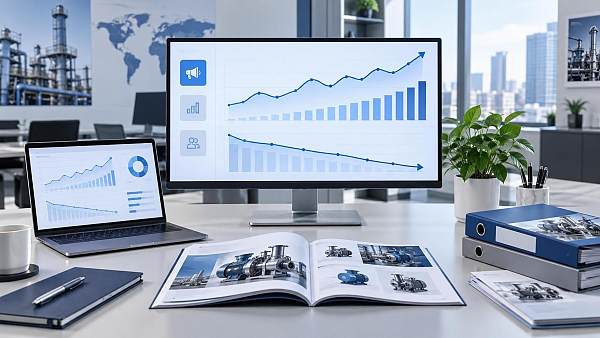
Use a “trend window” for assessment; do not draw conclusions from single-day data
A common misconception in Facebook ad optimization is making adjustments every day based on results. For project-based businesses with limited budgets and low conversion volume, this can cause normal fluctuations to be mistaken for fatigue, while frequent changes can disrupt system learning.
A more reliable approach is to establish a fixed observation window. Compare the most recent 7 days with the previous 7 days, and the most recent 14 days with the previous 14 days, paying attention at minimum to impressions, frequency, CTR, CPC, landing page views, form submissions, and qualified lead rate. If frequency rises while CTR, landing page view rate, or qualified lead rate declines for two consecutive observation periods, and there have been no major changes to the landing page, audience targeting, budget, or market conditions, creative fatigue can be considered a highly probable cause.
For teams already connected to a CRM, it is advisable to add a project-level layer by feeding back results by country, product line, job role, and lead stage. For example, the number of “quotation requests” may not decline, but the proportion entering the proposal discussion stage may decrease. In that case, the issue may not lie in the ad form, but rather in a mismatch between the creative promise and actual delivery capabilities. If the ad visual emphasizes low prices while the landing page requires complex customization projects, this inconsistency can also create an illusion similar to fatigue.
Creative fatigue is not only visual repetition; message repetition is more common
Many advertisers already rotate images but still find that performance is getting worse. The reason is that while colors, covers, and captions have changed, the core narrative has not. When users repeatedly see the combination of “factory capability—equipment image—inquire now,” they will quickly learn to ignore it even if the visuals differ each time.
Creative updates for project managers should be structured around different decision-making questions rather than merely producing banners in different sizes. A product or service can be broken down into several information angles:
- Start with project risks: how delivery schedule control, installation conditions, cross-border compliance, and after-sales response are handled;
- Start with technical validation: material standards, testing procedures, key parameters, and applicable operating conditions;
- Start with execution scenarios: how to choose for retrofit projects, capacity expansion projects, urgent spare parts, and EPC supporting requirements;
- Start with decision-making roles: show deployment and compatibility to engineering managers, specifications and delivery to procurement personnel, and project timelines and risk control to management.
These changes can not only extend the useful life of creatives but also help the ad account obtain clearer audience feedback. Video is not necessarily more resistant to fatigue than images; a short video that genuinely demonstrates installation steps, testing processes, or on-site details is generally more suitable for lead generation for complex projects than a generic brand promotional video.
Should creatives be “replaced” or “refined”? Use layered actions to control risk
Once fatigue is confirmed, it is not advisable to pause all old creatives at once. Declining performance does not mean they have no value at all. In particular, old creatives may still convert among remarketing audiences, branded search audiences, or audiences that have visited product pages. A better approach is to retain a benchmark creative while launching clearly differentiated new versions, then use small-scale testing to determine whether the change comes from the creative or the audience.
For mild fatigue, prioritize changes to the above-the-fold hook, the first three seconds of video content, headlines, and value propositions near the call-to-action button. For example, change “Get the product catalog” to “View the project selection checklist,” provided that the landing page actually offers the corresponding content. For moderate fatigue, replace the information theme and creative format, such as switching from static product images to short videos of on-site applications. If high frequency is accompanied by deterioration across multiple metrics, also check whether the audience pool is too narrow and expand countries, related industries, job seniority levels, or lookalike audience sources.
Let the landing page participate in the assessment to avoid focusing only on the ad side
The core of Facebook ad optimization techniques is not continuously refreshing creatives, but establishing a closed loop from ads to the website and then to sales follow-up. If ad CTR declines but landing page dwell time and form completion rate remain stable, first check changes in placements and audiences. If CTR is normal but landing page view rate is low, investigate page loading speed, redirect issues, or unclear ad promises. If form submissions are high but the sales qualification rate is low, reassess qualification fields and content positioning.
For overseas businesses with multilingual independent websites, matching landing pages can be configured for different regions, industries, and ad themes instead of directing all ads to the homepage. Yiyingbao's intelligent website building, advertising marketing, and SEO/GEO optimization capabilities are suitable for reviewing ad data, page behavior, and content assets within the same growth chain: which creatives bring visits, which pages generate lead submissions, and which keywords and content can accumulate into long-term organic traffic. In this way, when assessing creative fatigue, the team no longer sees only a fluctuating advertising metric.
Create an actionable creative health tracker
Project leaders are advised to conduct a fixed weekly review without getting caught up in complex reports. For every main creative, record the launch date, audience scope, frequency changes, CTR, CPC, lead volume, qualified lead rate, and the most recent update; then assign one of four statuses: “normal monitoring,” “minor adjustment needed,” “replacement testing,” or “recommended to pause.” Over time, the team will gradually understand which content is suitable for cold-start lead generation, which is better suited to remarketing, and which countries or industries are more responsive to videos, case studies, or technical materials.
The purpose of identifying creative fatigue is not to avoid repetition forever, but to continuously provide answers more relevant to users' project decisions before they lose interest. Treat frequency as a reminder, conversion quality as the basis, and creative iteration as routine operations, and Facebook ad budgets will have a better chance of becoming genuine, actionable overseas business opportunities.
Related Articles
 Multiple Amazon Peak-Season Fees Are Rising, Putting Pressure on Seller Profit Margins
 When Should You Split Facebook Ad Sets by Language?
 How should LinkedIn ads be targeted to B2B customers in Germany?

Related Products
 Yiyingbao SaaS Intelligent Website Building and Marketing SystemYiyingbao SaaS Intelligent Website Building and Marketing System, AI-powered no-code website building, rapid creation of multilingual B2B international websites in 10 minutes, global server acceleration, AI-powered SEO optimization, helping businesses connect efficiently with global markets. The perfect integration of technology and operation makes building an international trade website remarkably simple
 AI+SEM Intelligent Advertising Marketing SystemAI+SEM drives intelligent ad creation, empowering full-funnel precision advertising marketing. The system automatically generates weekly/monthly reports, AI recommends keywords and target countries, monitors core metrics in real-time with intelligent alerts, and enables one-click high-conversion ad solutions to help quickly acquire customers and improve ROI.
 AI+SEO Dual-Engine System Optimization ServicesYiyingbao’s AI+SEO dual-engine optimization system helps foreign trade enterprises acquire high-quality organic traffic through AI-powered keyword research, content generation, and comprehensive technical optimization, significantly improving search rankings and conversion rates.
 AI+SNS Social Media Marketing SystemYingbao AI+SNS Social Media Marketing System - Precision social capture for the social media era. Supports one-click content synchronization across major platforms like Facebook and LinkedIn. AI intelligently rewrites posts for enhanced relevance. 24/7 AI customer service and user profiling analysis empower businesses to efficiently expand into global markets.
 AI+SEO营销解决方案易营宝AI+SEO营销解决方案,通过AI批量写作、智能生成TDK、精准关键词扩词等功能,全面优化网站SEO效果,提升流量与转化率。助力企业构建高效智能网站新生态。
 AI+SEM Advertising Marketing SolutionsAI+SEM Advertising Marketing Solution leverages AI technology to deeply empower SEM ad campaigns. It automatically generates weekly/monthly reports using AI, presenting account data across multiple dimensions for comprehensive insights into campaign performance and trends. The system precisely recommends keywords and target countries, intelligently generates high-conversion ad copy, and enables one-click activation of efficient campaign plans to help businesses rapidly acquire customers. Simultaneously, it monitors core metrics in real time, intelligently identifies abnormal fluctuations, and issues timely alerts to ensure stable, high-return advertising results.
 Domain Name ServicesEasyWin provides professional domain name services, including intelligent queries, one-stop registration, brand protection, and full lifecycle management, helping businesses build a digital brand image.
 EasyOperate B2C Cross-Border E-Commerce Platform & Independent WebsiteEasyStore B2C Cross-border E-commerce Independent Store is an intelligent website building and cross-border e-commerce integrated solution independently developed by EasyStore Information Technology (Beijing) Co., Ltd. The system is specially designed for small and medium-sized as well as large export enterprises, integrating 'website building, operation, marketing, advertising, and conversion' into one, helping enterprises quickly establish cross-border e-commerce independent stores to achieve brand globalization and global sales growth.
The platform supports multiple languages, multiple currencies, and multi-channel marketing, with built-in AI intelligent translation and SEO optimization systems, suitable for mainstream markets such as Southeast Asia, Europe and America, Latin America, and the Middle East, assisting Chinese manufacturing enterprises in efficiently deploying international e-commerce strategies. SSL证书易营宝提供专业SSL安全证书服务,包括单域名和泛域名证书,确保网站数据传输加密、身份验证和完整性保护,助力企业建立安全可信的在线业务环境。









