









- CBP Finalizes Electronic Rail Export Manifest Rule, Effective October 26, 2026Oct 26, 2026View details
- Amazon’s 2026 peak season surcharge takes effect on October 25Oct 26, 2026View details
- AI Is Eating SaaS: Three Real-World Cases in One AfternoonOct 25, 2026View details
- Exiger CEO: The SaaS Apocalypse Is Real, but It Means Something DifferentOct 25, 2026View details
- Hengqin Cooperation Zone Shares Cross-Border E-Commerce Developments, Focusing on Macao-Hengqin Collaboration and International MarketsOct 24, 2026View details
- A Shenyang study highlights the development of the “cross-border e-commerce + industrial cluster” modelOct 24, 2026View details
Calculate customer acquisition costs before promoting your standalone website with Google Ads
When launching Google Ads for an independent website, the most easily underestimated factor is not the cost per click, but the entire cost chain between ad spend and qualified customers. If budget approval is based only on “how much to spend each month” or “how many inquiries are expected,” invalid traffic, sales follow-up losses, website conversion deficiencies, and payment collection cycles can easily be excluded. The result may be acceptable advertising account data while actual business results fail to cover the investment.
The metric that truly needs to be calculated first is customer acquisition cost (CAC): all related costs a company pays to acquire one confirmed new paying customer. For B2B export business, form submissions, WhatsApp inquiries, and even preliminary quotations do not constitute customer acquisition; only customers who complete an order and generate confirmed payment receipts are suitable as the denominator for CAC. If the sales cycle is long, “cost per qualified opportunity” may first be set as a phased approval metric, but it must not directly replace final customer acquisition cost.
Advertising Budget Is Not Customer Acquisition Cost: The Denominator Definition Determines the Conclusion
The basic calculation formula is not complicated:
Customer Acquisition Cost (CAC) = Total investment related to new customers during a given period ÷ Number of new paying customers during the same period
The challenge lies in determining what should be included in the “total related investment.” To assess whether a Google Ads campaign is commercially viable, direct media spending should at least be distinguished from the supporting costs required to close deals.
- Media costs: Actual Google Ads spend, ineffective spending during the testing period, remarketing budget, and any creative production costs that may arise.
- Campaign operations costs: Account setup, keyword research, bid adjustments, data analysis, landing page testing, and labor costs for third-party agencies or internal teams.
- Independent website conversion costs: Page development, server and tool subscriptions, multilingual content, form or CRM integrations, tracking implementation, and conversion tracking maintenance. These do not all need to be included in the first month, but should be amortized over a reasonable period.
- Sales follow-up costs: Lead qualification, translation and communication, quotations, samples, video meetings, and sales follow-up. For customized equipment, industrial products, or project-based exports, this portion often cannot be ignored.
For example, ad clicks generate 100 inquiries, of which only 30 meet requirements for the target market, purchasing scale, or product fit. After further follow-up by the sales team, 8 qualified opportunities are formed, and ultimately 1 customer is converted. If only ad spend is divided by 100 inquiries, the figure appears very low; only when advertising and necessary conversion costs are divided by 1 actual customer does it approach the true operating cost. The difference between these two calculation methods determines whether the budget is viewed as a “customer acquisition investment” or “traffic expenditure.”
Therefore, before approval, business departments should be required to clearly define every conversion level: what constitutes a lead, an effective inquiry, a qualified opportunity, and under what conditions it counts as a new customer. Without unified definitions, subsequent monthly reports cannot be compared horizontally even if all figures are available.
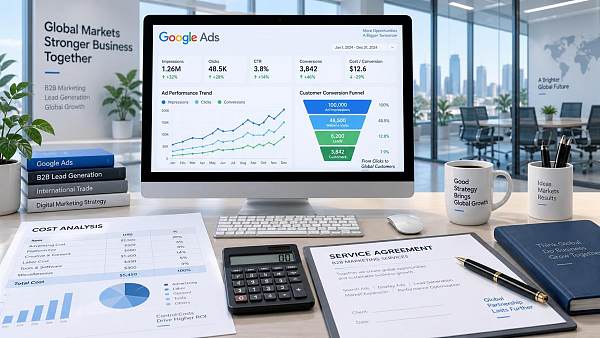
From Clicks to Payment Collection, the Maximum Affordable Cost Must Be Calculated Backward
Budgeting should not begin with “approximately how much competitors spend,” but should be calculated backward from the gross profit a single customer can contribute. A simplified model suitable for financial approval is:
Maximum affordable CAC = Expected gross profit per customer − Fulfillment and service costs − Target profit − Capital utilization and risk buffer
If a company evaluates advertising returns based on the first order, expected gross profit per customer should be based on the gross profit achievable from that first order, rather than contract value or tax-inclusive sales revenue. If the business has stable repeat purchases, spare-parts purchases, or long-term service revenue, customer lifetime value (LTV) may be included, provided that the repurchase model, gross margin level, and retention performance are supported by internal historical data. Future revenue over multiple years must not be included in the current advertising return merely because the product may theoretically be repurchased.
In B2B export business, profit does not equal cash that can be used immediately. Deposit ratios, payment terms, production cycles, sea freight or customs clearance delays, and after-sales responsibilities may all extend the payment collection period. For orders requiring advance payment of production, logistics, or sample costs, even if book gross profit is sufficient to cover CAC, it is still necessary to assess whether cash recovery aligns with the company’s funding arrangements.
A more prudent approval approach is to set three thresholds simultaneously: the maximum cost per effective lead, the maximum cost per qualified opportunity, and the maximum cost per actual customer. The first two are used for daily campaign control, while the last is used to validate the business model. Controlling only click costs or form costs cannot prevent low-quality leads from continuously consuming the budget.
Conversion Rate Is Not a Metric for the Website Department, but a Core Variable in the Budget Model
The cost outcome of Google Ads can be broken down into a clear chain:
Number of customers = Ad clicks × Website inquiry conversion rate × Lead qualification rate × Opportunity close rate
If any step is weak, it will increase the final CAC. Two accounts with the same cost per click may have entirely different customer acquisition costs because of differences in landing page relevance, inquiry screening mechanisms, or sales response speed. Therefore, when an independent website runs Google Ads, the advertising account and website cannot be evaluated as two unrelated procurement projects.
Ad keywords reflect the searcher’s immediate issue, and the landing page must answer their purchasing considerations within seconds: whether the product fits the application scenario, whether specifications are clear, whether the required compliance documentation for the target market is available, what the delivery time and customization capabilities are, and how to make contact next. Directing all ad traffic to the homepage, or using incomplete product pages to receive high-intent keywords, often results in clicks without sufficient inquiries.
The appearance of a “high conversion rate” also requires caution. If form fields are too few, there is no screening by country, region, or demand volume, and consultation channels do not request product or project background, the number of form submissions may increase, but the sales team will need to handle more invalid inquiries. For businesses with long quotation cycles and high average order values, moderately raising the inquiry threshold can sometimes reduce total customer acquisition cost because it reduces the proportion of sales resources occupied by low-intent demand.
Testing Budgets and Scaling Budgets Should Be Separated During Approval
When a new account lacks historical conversion data, the purpose of early-stage spending is not only to generate orders, but also to validate whether the relationship among keywords, markets, pages, and sales follow-up works. Applying the return requirements of a stable period directly to this investment can cause testing to be discontinued before a meaningful sample has been established. Conversely, using “still testing” as a reason to expand investment over the long term will also cause the budget to lose its constraints.
A more reasonable approach is to divide the budget into capped validation expenses and scaling expenses that can be released only after conditions are met. The validation stage should specify in advance: target country or language scope, product lines, keyword intent, acceptable cost per effective lead, observation period, and pause conditions. Scaling budgets should be based on a validated conversion chain, rather than determined solely by impressions, clicks, or account spending speed.
Pause conditions are particularly important. For example, if ads can consistently generate leads but the lead qualification rate remains low, keyword match types, negative keywords, geographic settings, and landing page messaging should be reviewed first rather than simply increasing the budget. If qualified opportunities exist but the close rate is low, the assessment should return to quotation competitiveness, delivery time, certifications, payment terms, or sales follow-up. Problems at different stages cannot be addressed using the same approach of “optimizing ads.”
Unclear Attribution Standards Will Distort ROI in Reports
Export orders often span weeks or even months. Customers may first visit an independent website through Google search, then submit an inquiry through email, trade shows, branded keyword searches, or direct visits. If the CRM does not record the first source, key touchpoints, and final deal information, the advertising platform will show only the conversions it can identify, while the finance team will have difficulty determining whether ads actually contributed new demand or merely received customers who would have arrived organically.
Approval and review should use the same traceable rules: the advertising side records clicks, forms, phone calls, or instant messaging initiations; the CRM records lead source, product, country, estimated amount, qualification status, and reasons for won or lost deals; and the order system confirms actual transaction value, gross profit, and payment collection status. For businesses with long sales cycles, batch tracking may be established based on the month leads enter the pipeline, rather than mechanically comparing this month’s ad spend with this month’s payment receipts.
Branded and non-branded keywords should also be observed separately. Branded keywords often have lower costs and better conversions, but some of this demand may come from existing customers, trade show contact, or organic brand awareness. Fully attributing branded keyword results to advertising will overestimate new customer acquisition capability. Non-branded product, application, and problem-related keywords better reflect whether advertising has expanded new demand entry points, but their conversion costs generally require more patient validation.
What Determines Whether Investment Should Continue Is Not Single-Month “Break-Even”
Google Ads is suitable for use as a measurable customer acquisition channel, rather than as a fixed expense that should continue simply because an account has been opened. The decision to expand spending should consider whether customer acquisition cost is within the gross profit tolerance range, whether qualified opportunities are being generated consistently, whether sales follow-up can convert opportunities into orders, and whether the payment collection cycle aligns with funding arrangements.
If an independent website does not yet have clear product messaging, a trackable conversion path, and a lead feedback mechanism, increasing ad spend first will usually only expose problems more quickly. Conversely, when customer value, the conversion funnel, and cost thresholds have been clearly defined, the budget for Google Ads will no longer be merely an unexplained marketing expense, but can become a customer acquisition investment managed according to a unit economics model and scaled gradually.
Related Articles
 Multiple Amazon Peak-Season Fees Are Rising, Putting Pressure on Seller Profit Margins
 When Should You Split Facebook Ad Sets by Language?
 How should LinkedIn ads be targeted to B2B customers in Germany?



Related Products
 Yiyingbao SaaS Intelligent Website Building and Marketing SystemYiyingbao SaaS Intelligent Website Building and Marketing System, AI-powered no-code website building, rapid creation of multilingual B2B international websites in 10 minutes, global server acceleration, AI-powered SEO optimization, helping businesses connect efficiently with global markets. The perfect integration of technology and operation makes building an international trade website remarkably simple
 AI+SEM Intelligent Advertising Marketing SystemAI+SEM drives intelligent ad creation, empowering full-funnel precision advertising marketing. The system automatically generates weekly/monthly reports, AI recommends keywords and target countries, monitors core metrics in real-time with intelligent alerts, and enables one-click high-conversion ad solutions to help quickly acquire customers and improve ROI.
 AI+SEO Dual-Engine System Optimization ServicesYiyingbao’s AI+SEO dual-engine optimization system helps foreign trade enterprises acquire high-quality organic traffic through AI-powered keyword research, content generation, and comprehensive technical optimization, significantly improving search rankings and conversion rates.
 AI+SNS Social Media Marketing SystemYingbao AI+SNS Social Media Marketing System - Precision social capture for the social media era. Supports one-click content synchronization across major platforms like Facebook and LinkedIn. AI intelligently rewrites posts for enhanced relevance. 24/7 AI customer service and user profiling analysis empower businesses to efficiently expand into global markets.
 AI+SEO营销解决方案易营宝AI+SEO营销解决方案,通过AI批量写作、智能生成TDK、精准关键词扩词等功能,全面优化网站SEO效果,提升流量与转化率。助力企业构建高效智能网站新生态。
 AI+SEM Advertising Marketing SolutionsAI+SEM Advertising Marketing Solution leverages AI technology to deeply empower SEM ad campaigns. It automatically generates weekly/monthly reports using AI, presenting account data across multiple dimensions for comprehensive insights into campaign performance and trends. The system precisely recommends keywords and target countries, intelligently generates high-conversion ad copy, and enables one-click activation of efficient campaign plans to help businesses rapidly acquire customers. Simultaneously, it monitors core metrics in real time, intelligently identifies abnormal fluctuations, and issues timely alerts to ensure stable, high-return advertising results.
 Domain Name ServicesEasyWin provides professional domain name services, including intelligent queries, one-stop registration, brand protection, and full lifecycle management, helping businesses build a digital brand image.
 EasyOperate B2C Cross-Border E-Commerce Platform & Independent WebsiteEasyStore B2C Cross-border E-commerce Independent Store is an intelligent website building and cross-border e-commerce integrated solution independently developed by EasyStore Information Technology (Beijing) Co., Ltd. The system is specially designed for small and medium-sized as well as large export enterprises, integrating 'website building, operation, marketing, advertising, and conversion' into one, helping enterprises quickly establish cross-border e-commerce independent stores to achieve brand globalization and global sales growth.
The platform supports multiple languages, multiple currencies, and multi-channel marketing, with built-in AI intelligent translation and SEO optimization systems, suitable for mainstream markets such as Southeast Asia, Europe and America, Latin America, and the Middle East, assisting Chinese manufacturing enterprises in efficiently deploying international e-commerce strategies. SSL证书易营宝提供专业SSL安全证书服务,包括单域名和泛域名证书,确保网站数据传输加密、身份验证和完整性保护,助力企业建立安全可信的在线业务环境。









