









- Which customer acquisition channels will be affected by cross-border marketing trends in 2026?Sep 06, 2026View details
- Which homogenization risks should be considered in an analysis of the AI-powered website building industry?Aug 30, 2026View details
- How Will AI Marketing Trends 2026 Change Advertising Budget AllocationAug 28, 2026View details
- Is the EV SSL certificate market shrinking or upgrading? How should companies assess certificate procurement?Aug 11, 2026View details
- Why the old AMP SEO 2020 practices no longer work and what has changed in current optimization prioritiesAug 02, 2026View details
- How to Choose Topics for an Industry News Section to Attract More Organic Search TrafficJul 29, 2026View details
- Digital Marketing Shenzhen Market Insights: Why Are Companies Expanding Overseas Looking for Growth Teams in Shenzhen?Jul 31, 2026View details
- Can Zhejiang foreign trade independent websites still be developed today? Look at changes in traffic and lead generationJul 28, 2026View details
How to Diagnose Falling Traffic on a Foreign Trade Website: Is It Indexing, Rankings, or the Conversion Path?
Troubleshooting methods for declining traffic on foreign trade websites: First, identify where the problem lies.
If your foreign trade website experiences a sudden drop in traffic, don't rush to redesign it or immediately increase your advertising budget. The truly effective way to troubleshoot a traffic decline is to first determine whether the drop is occurring in indexing, ranking, or the conversion process.
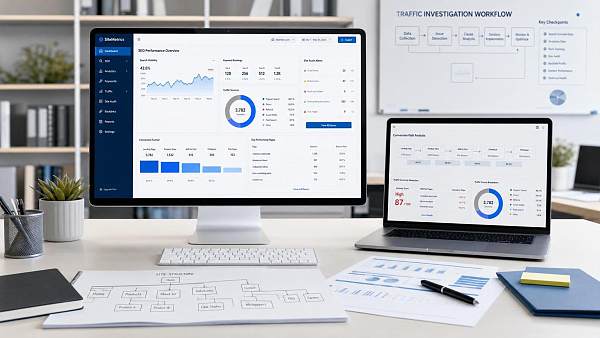
These three steps correspond to three completely different sources of problems. If the order of troubleshooting is reversed, it's easy to waste money without solving the core issue.
From a practical business perspective, many sites are not simply experiencing a decrease in traffic, but rather a loss of exposure for certain types of pages or a blockage in the inquiry process, ultimately resulting in an overall decline in data.
Therefore, this article will not discuss abstract theories, but will instead present a set of directly implementable methods for troubleshooting declining traffic on foreign trade websites, helping to quickly identify anomalies and reduce customer acquisition losses.
Step 1: First, determine whether the drop in traffic is genuine or due to a problem with the statistical method.
Before starting the indexing and ranking checks, first verify the accuracy of the data. Missing tracking points, malfunctioning statistics code, and abnormal site redirects can create the illusion of "apparently decreased traffic."
First check these four items
- Comparing the data from the past 30 days with the data from the previous 30 days, can we rule out seasonal fluctuations?
- Are organic search, direct visits, and ad traffic all declining in tandem?
- Are the statistics code, conversion events, and form submission records still being uploaded normally?
- Has the website been redesigned, changed servers, had its programs changed, or had its URLs adjusted?
If only organic search traffic is declining while other channels remain relatively stable, then the investigation of declining traffic on foreign trade websites should prioritize addressing the issues of search engine indexing and ranking.
If all channels experience a drop in traffic, the problem is likely more technical or related to the access environment, such as slow website loading, abnormal access from certain regions, SSL certificate failure, or server instability.
Step 2: First, check if the page is indexed, because if the page isn't in the database, ranking is out of the question.
Many people, upon seeing a decline in traffic, immediately focus on keyword rankings. However, a more reliable method for investigating traffic drops on foreign trade websites is usually to first check the website's indexing.
The reason is simple. If a page isn't properly crawled and indexed by search engines, even the best content won't consistently appear in search results.
What signals should we focus on?
- Has the total number of indexed pages suddenly decreased?
- Are core product pages, category pages, and case study pages excluded?
- Is the newly published page not indexed for a long time?
- Is there an error in submitting the site map?
- The robots.txt and noindex settings can be used to prevent important pages from being accidentally blocked.
If the number of pages indexed decreases, common reasons include changes in the link structure after a program redesign, generation of duplicate pages in batches, pages with too little content, wasted crawling budget, and slower server response.
A more obvious signal is that a certain type of page on the site almost simultaneously loses its display. This is usually not a content issue, but rather an anomaly at the level of technical rules or page templates.
How to handle inclusion errors
- First, check the core directory to see if it can return a 200 status.
- Check if canonical is pointing to the wrong page.
- Filter out duplicate titles, duplicate descriptions, and pages with thin content.
- Resubmit the site map and key pages.
- Prioritize restoring the crawlability of high-value pages.
Once this step is done, the ranking changes will be easier to analyze and make a more accurate judgment.
Step 3: Check the rankings again to determine whether the fluctuation is overall or a localized misalignment.
Normal indexing doesn't mean there are no traffic issues. The next step is to use methods for investigating traffic declines on foreign trade websites to determine if there are significant fluctuations in keyword rankings.
Ranking declines typically fall into three categories: a general drop in core keywords, a mass drop in long-tail keywords, and deteriorating performance in key country markets. The corresponding actions differ depending on the situation.
Let's break it down into three dimensions.
- Looking at keyword types, is it brand keywords, product keywords, or solution keywords that are declining?
- Looking at the page types, the drop is more noticeable on the homepage, product pages, and blog pages.
- By region, is it the European and American markets or emerging markets that have seen a decrease in exposure?
If only a few core keywords have declined, first check if competing pages have been upgraded, or if new modules such as ads, maps, and videos have appeared on the search results page, squeezing out organic clicks.
If a large number of long-tail keywords drop simultaneously, be wary of declining quality of content aggregation pages, weakened internal link structures, or replacement of on-site special pages.
Common reasons for ranking fluctuations
- Content updates have stalled, and page information is outdated.
- The title has been over-rewritten, and the intended meaning of the keywords has shifted.
- The number of high-quality backlinks has decreased, and the transfer of link equity has weakened.
- The industry has added new special topics, providing more comprehensive coverage.
- Page loading speed has decreased, resulting in a worse mobile experience.
Here's a key point to consider. If your ranking drops but your click-through rate doesn't significantly worsen, the problem might not be serious. However, if your impressions are still there but your click-through rate continues to decline, you should simultaneously check your title, description, and page appeal.
Step 4: Don't ignore the conversion path; many "traffic drops" are actually due to fewer inquiries.
In practice, many teams complain about a drop in website traffic, only to find that the real decline is in valid inquiries. In other words, visits are still happening, but the conversion path is blocked.
This is also the most easily overlooked aspect of troubleshooting declining traffic on foreign trade websites, because while it appears to be an SEO issue, it is actually due to insufficient page load capacity.
Focus on checking these conversion nodes
- Can the form be submitted normally? Are there any errors?
- Are the WhatsApp, email, and phone buttons clickable?
- Are buttons obscured or loading too slowly on mobile pages?
- Does the landing page content align with the keyword intent?
- Is the inquiry portal too deep, requiring users to click many times before they can make a contact?
If a product page bounce rate suddenly increases and the average dwell time decreases, while indexing and ranking are normal, the problem is most likely with the page content, trust elements, or contact information layout.
For example, missing certificate examples, unclear delivery instructions, outdated main images, and difficulties in language switching can all cause overseas visitors to abandon further inquiries.
A more practical method for troubleshooting declining traffic on foreign trade websites
To improve efficiency, you can prioritize technical aspects, then exposure, and finally conversion. This approach is more suitable for most foreign trade websites and makes it easier to quickly mitigate losses.
The advantage of this method for troubleshooting declining traffic on foreign trade websites is that it avoids the team repeatedly investing time and effort in the wrong areas. It focuses on fixing the specific layer where the problem lies.
In addition to investigation, a continuous monitoring mechanism should be established.
A single investigation can resolve the immediate issue, but to avoid repeated fluctuations, continuous monitoring is necessary. Because foreign trade websites operate in multi-regional, multi-language, and multi-terminal environments, anomalies often emerge faster than expected.
A more prudent approach is to monitor weekly indexing changes, daily core keyword fluctuations, and monthly reviews of high-value page conversion rates, while also keeping records of redesigns and campaign adjustments.
For businesses that simultaneously manage website building, SEO, advertising, and social media traffic generation, a unified dashboard is especially important. Otherwise, fragmented data from different channels can easily lead to misjudging conversion issues as traffic problems.
The value of integrated website and marketing service platforms like Yiyingbao lies in putting website building, indexing, SEO, advertising, and conversion data into a single chain for analysis, reducing gaps in the investigation process.
Ultimately, troubleshooting a decline in traffic to an international trade website shouldn't be done by guesswork, but by systematically checking the data, indexing, ranking, and conversion levels. First, clearly pinpoint the problem, then decide whether to fix technical issues, supplement content, or optimize the inquiry path. This approach is faster and more cost-effective.
Related Articles



Related Products
 Yiyingbao SaaS Intelligent Website Building and Marketing SystemYiyingbao SaaS Intelligent Website Building and Marketing System, AI-powered no-code website building, rapid creation of multilingual B2B international websites in 10 minutes, global server acceleration, AI-powered SEO optimization, helping businesses connect efficiently with global markets. The perfect integration of technology and operation makes building an international trade website remarkably simple
 AI+SEM Intelligent Advertising Marketing SystemAI+SEM drives intelligent ad creation, empowering full-funnel precision advertising marketing. The system automatically generates weekly/monthly reports, AI recommends keywords and target countries, monitors core metrics in real-time with intelligent alerts, and enables one-click high-conversion ad solutions to help quickly acquire customers and improve ROI.
 AI+SEO Dual-Engine System Optimization ServicesYiyingbao’s AI+SEO dual-engine optimization system helps foreign trade enterprises acquire high-quality organic traffic through AI-powered keyword research, content generation, and comprehensive technical optimization, significantly improving search rankings and conversion rates.
 AI+SNS Social Media Marketing SystemYingbao AI+SNS Social Media Marketing System - Precision social capture for the social media era. Supports one-click content synchronization across major platforms like Facebook and LinkedIn. AI intelligently rewrites posts for enhanced relevance. 24/7 AI customer service and user profiling analysis empower businesses to efficiently expand into global markets.
 AI+SEO营销解决方案易营宝AI+SEO营销解决方案,通过AI批量写作、智能生成TDK、精准关键词扩词等功能,全面优化网站SEO效果,提升流量与转化率。助力企业构建高效智能网站新生态。
 AI+SEM Advertising Marketing SolutionsAI+SEM Advertising Marketing Solution leverages AI technology to deeply empower SEM ad campaigns. It automatically generates weekly/monthly reports using AI, presenting account data across multiple dimensions for comprehensive insights into campaign performance and trends. The system precisely recommends keywords and target countries, intelligently generates high-conversion ad copy, and enables one-click activation of efficient campaign plans to help businesses rapidly acquire customers. Simultaneously, it monitors core metrics in real time, intelligently identifies abnormal fluctuations, and issues timely alerts to ensure stable, high-return advertising results.
 Domain Name ServicesEasyWin provides professional domain name services, including intelligent queries, one-stop registration, brand protection, and full lifecycle management, helping businesses build a digital brand image.
 EasyOperate B2C Cross-Border E-Commerce Platform & Independent WebsiteEasyStore B2C Cross-border E-commerce Independent Store is an intelligent website building and cross-border e-commerce integrated solution independently developed by EasyStore Information Technology (Beijing) Co., Ltd. The system is specially designed for small and medium-sized as well as large export enterprises, integrating 'website building, operation, marketing, advertising, and conversion' into one, helping enterprises quickly establish cross-border e-commerce independent stores to achieve brand globalization and global sales growth.
The platform supports multiple languages, multiple currencies, and multi-channel marketing, with built-in AI intelligent translation and SEO optimization systems, suitable for mainstream markets such as Southeast Asia, Europe and America, Latin America, and the Middle East, assisting Chinese manufacturing enterprises in efficiently deploying international e-commerce strategies. SSL证书易营宝提供专业SSL安全证书服务,包括单域名和泛域名证书,确保网站数据传输加密、身份验证和完整性保护,助力企业建立安全可信的在线业务环境。









