









- Which customer acquisition channels will be affected by cross-border marketing trends in 2026?Sep 06, 2026View details
- Which homogenization risks should be considered in an analysis of the AI-powered website building industry?Aug 30, 2026View details
- How Will AI Marketing Trends 2026 Change Advertising Budget AllocationAug 28, 2026View details
- Is the EV SSL certificate market shrinking or upgrading? How should companies assess certificate procurement?Aug 11, 2026View details
- Why the old AMP SEO 2020 practices no longer work and what has changed in current optimization prioritiesAug 02, 2026View details
- How to Choose Topics for an Industry News Section to Attract More Organic Search TrafficJul 29, 2026View details
What are the common technical blind spots when a foreign trade website receives no inquiries within six months after launch?
What Are the Common Technical Blind Spots When an Export Website Receives No Inquiries Within Six Months of Launch?
Introduction: Has your export website generated zero inquiries six months after completion? The problem often lies not in insufficient traffic, but in technical blind spots—such as missing multilingual SEO, ineffective GEO targeting, and undeployed structured data. Drawing on in-depth reviews of 100,000+ export websites, Yiyingbao reveals the frequently overlooked technical weaknesses.
I. “Website Built and Launched” Does Not Mean “Effective After Launch”: Technical Compliance Is the Starting Point for Conversion
Many export businesses mistakenly believe that everything is complete once the website is built, the domain is registered, and the server is deployed. However, the reality is that Google may not have indexed your homepage at all; multilingual pages may be identified as duplicate content and downgraded; and key product pages may lack Schema markup, making it impossible to display specifications and inquiry buttons in search results. Yiyingbao monitoring data shows that over 63% of websites with zero inquiries failed to pass a basic technical health check within 30 days of launch—an issue more critical than an insufficient advertising budget.
This is especially true for B2B categories such as heavy machinery and equipment, which involve long decision-making cycles and strong reliance on trust. On their first visit, users often need to repeatedly compare specifications, verify qualifications, and review real-world cases. If the official website loads 0.5 seconds slower, mobile forms are misaligned, or switching languages loses the current page path, visitor abandonment rates immediately surge by 47%. This is not a design issue, but a lack of coordination between front-end architecture and SEO engineering.
II. Multilingual Does Not Equal Text Translation: 90% of Export Websites Fail Due to “Pseudo-Localization”
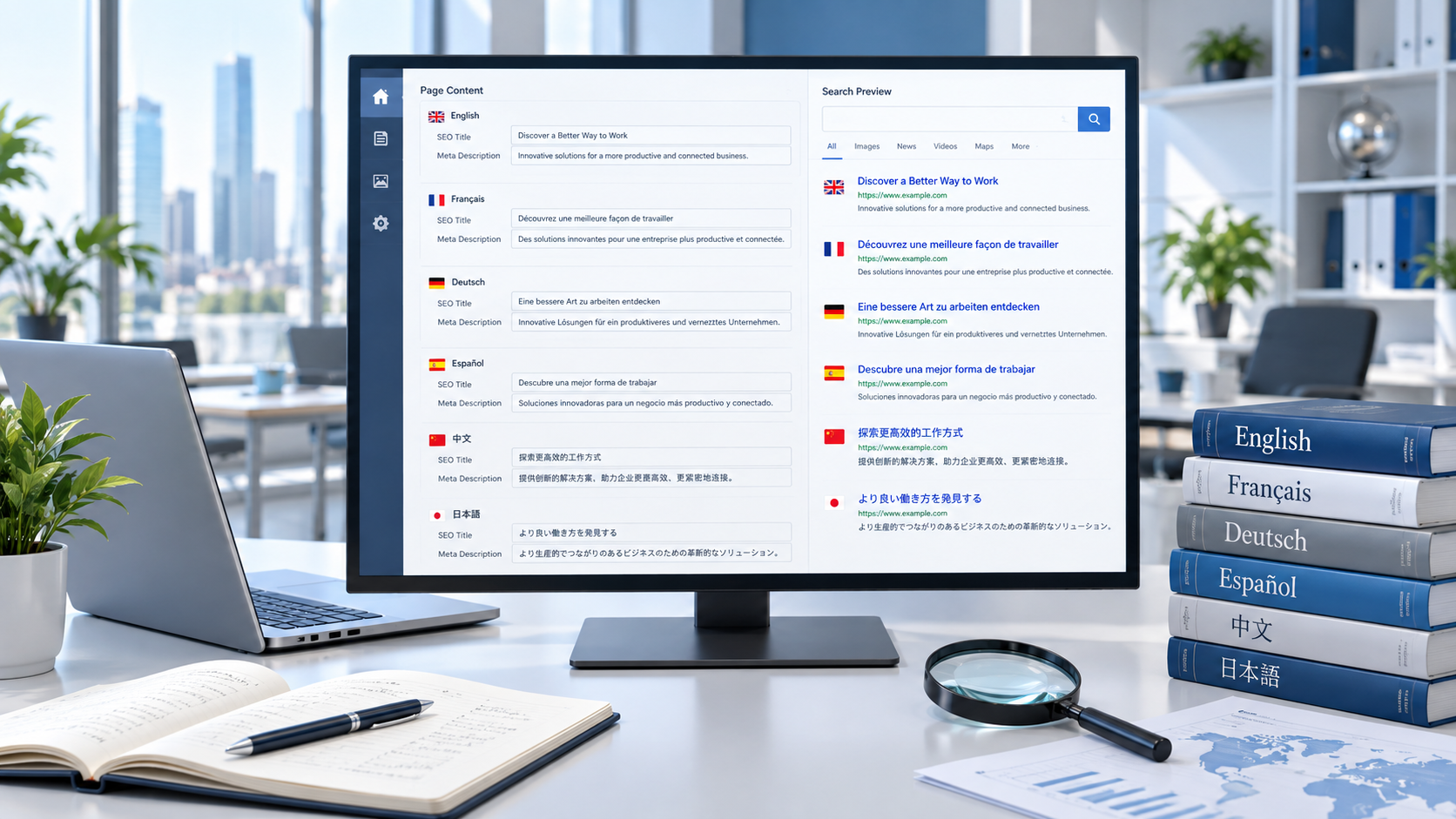
Using Google Translate to turn Chinese web pages into English/Spanish pages and then adding a language switcher is the most dangerous form of “multilingual illusion.” In a real-world scenario, when a native English-speaking purchasing manager searches for “heavy-duty construction machinery suppliers,” if your page does not accurately associate the en-US version in hreflang tags or optimize the title and H1 for this keyword, Google will classify it as a generic-language page, diluting its authority.
Even more hidden issues include Russian-speaking users clicking a Russian link only to land on a 404 page; Arabic pages displaying misaligned text and images because RTL (right-to-left) CSS is not adapted; and Japanese pages failing to enable JIS encoding, causing some technical terms to display as garbled characters. These are not content issues, but deficiencies in the website-building system’s underlying support for multilingual routing, character sets, and regional templates. Among the heavy industry clients served by Yiyingbao, heavy machinery and equipment, heavy industry websites saw 82% of their first-month inquiries come from landing pages with properly configured GEO and multilingual combinations.
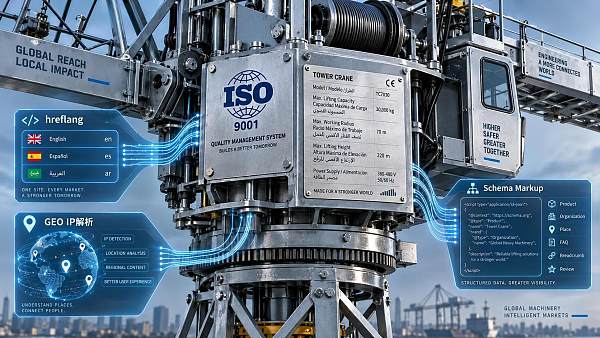
III. GEO Targeting Is Not About “Selecting a Country,” but a Complete Set of IP Resolution and Content Delivery Logic
Many companies believe that checking “US homepage” in the backend completes GEO optimization. In reality, effective GEO requires all of the following: CDN nodes matching the target country’s IP ranges, HTTP headers returning the correct Vary: Accept-Language, server response times below 300ms, and embedded page scripts that do not trigger cross-origin blocking. Yiyingbao’s AI diagnostic tool found that the GEO functionality of nearly half of export websites is ineffective—Chinese contact addresses still load when accessed from US IP addresses, while German users see specifications in metric units that have not been converted.
This is particularly critical for heavy equipment procurement: Middle Eastern customers focus on sand resistance certifications and high-temperature adaptation descriptions; Southeast Asian buyers prioritize ocean shipping packaging solutions and local agent directories. If GEO only redirects URLs without synchronously updating copy, contact information, currency units, and service commitments, the trust chain breaks within three seconds. We recommend deeply integrating GEO strategies with the product center. For example, on heavy machinery and equipment, heavy industry pages, automatically load waterfall displays of real-world application scenarios and localized service lists for the relevant region.
IV. Structured Data (Schema) Is Not a Bonus, but the Entry Ticket for B2B Search Visibility
Export B2B purchasing decisions rely heavily on direct answers from search engines (Featured Snippets). When users search for “crane manufacturer with ISO 9001 certification,” if your official website has not deployed the Organization+Product+Review triple Schema, Google cannot extract structured information such as qualifications, models, and customer testimonials, and therefore will not generate rich snippets. According to Yiyingbao statistics, websites with complete Schema deployment improve their average organic ranking for long-tail keywords by 2.8 positions and increase inquiry conversion rates by 34%.
Special reminder: Schema must strictly match the page content. One client marked “24-hour online customer service” on a product page, but form submissions actually required manual email responses—after detecting this inconsistency, Google directly removed all of its structured data displays. Heavy equipment websites are advised to prioritize the deployment of product specification tables (with units), application scenario maps, factory certification badges, and multilingual service coverage maps.
V. Behind Technical Blind Spots Lies a Fundamental Disconnect Between the Website-Building System and Marketing Goals
Traditional website-building tools focus on “attractive pages,” while export customer acquisition requires digital assets that are “indexable, targetable, verifiable, and convertible.” Yiyingbao’s self-developed cloud intelligent website-building system embeds SEO engineering into the website-building process: hreflang and GEO rules are automatically injected when new product pages are created; FAQ Schema is generated immediately when technical documents are uploaded; and Google Analytics event tracking and CRM lead tagging are triggered after inquiry forms are submitted.
A truly effective solution is not post-launch remediation, but embedding marketing DNA from the first day of website development. For example, on heavy industry websites, industry-wide scenario banners not only provide visual impact, but also incorporate dynamic GEO recognition modules—US visitors see real port lifting scenes, while Brazilian users see mining operation videos; core data metric modules automatically connect to ERP inventory APIs, ensuring that “delivery time ≤8 weeks” can be verified in real time.
Conclusion: Technical Blind Spots Are Not Bugs, but Unfulfilled Marketing Commitments
An export website is not an electronic version of a corporate brochure, but the first touchpoint for global buyers, a trust verifier, and the entrance to the sales funnel. Zero inquiries in six months may appear to be a traffic issue, but at a deeper level, it means the technical infrastructure does not meet requirements: multilingual content is not truly localized, GEO is not effectively implemented, structured data lacks a closed loop, and page performance is not adapted to B2B decision-making paths. These problems cannot be solved by increasing advertising spend; they can only be fundamentally addressed through a technical architecture with a marketing mindset.
Yiyingbao’s experience serving 100,000+ export businesses over the past decade shows that an export website capable of continuously acquiring customers must integrate AI website-building capabilities, SEO engineering capabilities, and localized operational capabilities. It does not pursue flashy technology; it simply ensures that every line of code paves the way for inquiries—from the first impression in Google search results to the final submission of an inquiry form.
Related Articles
Related Products
 Yiyingbao SaaS Intelligent Website Building and Marketing SystemYiyingbao SaaS Intelligent Website Building and Marketing System, AI-powered no-code website building, rapid creation of multilingual B2B international websites in 10 minutes, global server acceleration, AI-powered SEO optimization, helping businesses connect efficiently with global markets. The perfect integration of technology and operation makes building an international trade website remarkably simple
 AI+SEM Intelligent Advertising Marketing SystemAI+SEM drives intelligent ad creation, empowering full-funnel precision advertising marketing. The system automatically generates weekly/monthly reports, AI recommends keywords and target countries, monitors core metrics in real-time with intelligent alerts, and enables one-click high-conversion ad solutions to help quickly acquire customers and improve ROI.
 AI+SEO Dual-Engine System Optimization ServicesYiyingbao’s AI+SEO dual-engine optimization system helps foreign trade enterprises acquire high-quality organic traffic through AI-powered keyword research, content generation, and comprehensive technical optimization, significantly improving search rankings and conversion rates.
 AI+SNS Social Media Marketing SystemYingbao AI+SNS Social Media Marketing System - Precision social capture for the social media era. Supports one-click content synchronization across major platforms like Facebook and LinkedIn. AI intelligently rewrites posts for enhanced relevance. 24/7 AI customer service and user profiling analysis empower businesses to efficiently expand into global markets.
 AI+SEO营销解决方案易营宝AI+SEO营销解决方案,通过AI批量写作、智能生成TDK、精准关键词扩词等功能,全面优化网站SEO效果,提升流量与转化率。助力企业构建高效智能网站新生态。
 AI+SEM Advertising Marketing SolutionsAI+SEM Advertising Marketing Solution leverages AI technology to deeply empower SEM ad campaigns. It automatically generates weekly/monthly reports using AI, presenting account data across multiple dimensions for comprehensive insights into campaign performance and trends. The system precisely recommends keywords and target countries, intelligently generates high-conversion ad copy, and enables one-click activation of efficient campaign plans to help businesses rapidly acquire customers. Simultaneously, it monitors core metrics in real time, intelligently identifies abnormal fluctuations, and issues timely alerts to ensure stable, high-return advertising results.
 Domain Name ServicesEasyWin provides professional domain name services, including intelligent queries, one-stop registration, brand protection, and full lifecycle management, helping businesses build a digital brand image.
 EasyOperate B2C Cross-Border E-Commerce Platform & Independent WebsiteEasyStore B2C Cross-border E-commerce Independent Store is an intelligent website building and cross-border e-commerce integrated solution independently developed by EasyStore Information Technology (Beijing) Co., Ltd. The system is specially designed for small and medium-sized as well as large export enterprises, integrating 'website building, operation, marketing, advertising, and conversion' into one, helping enterprises quickly establish cross-border e-commerce independent stores to achieve brand globalization and global sales growth.
The platform supports multiple languages, multiple currencies, and multi-channel marketing, with built-in AI intelligent translation and SEO optimization systems, suitable for mainstream markets such as Southeast Asia, Europe and America, Latin America, and the Middle East, assisting Chinese manufacturing enterprises in efficiently deploying international e-commerce strategies. SSL证书易营宝提供专业SSL安全证书服务,包括单域名和泛域名证书,确保网站数据传输加密、身份验证和完整性保护,助力企业建立安全可信的在线业务环境。









