









- AliExpress Global Double 11: Brand Sales Grow Nearly 50% in the First Week, U.S. GMV Rises 70%Nov 21, 2026View details
- Ministry of Commerce Reports E-commerce Development from January to October 2026, with Cross-Border Imports Performing StronglyNov 21, 2026View details
- Amazon Black Friday Orders Sluggish on Day One; NRF Forecasts 4.2 Million Fewer ParticipantsNov 21, 2026View details
- 21st Century Business Herald: AI and CTV Become Core Growth Engines for Digital Marketing in Overseas MarketsNov 18, 2026View details
- China Presents 25 Cooperation Outcomes in Areas Including Cross-Border E-Commerce During APECNov 18, 2026View details
- AI Products Drive Hong Kong Exports Up 64.9% in September, Fastest Growth in Over 40 YearsNov 17, 2026View details
How Should a Manufacturing Export Business Allocate Its Digital Marketing Budget?
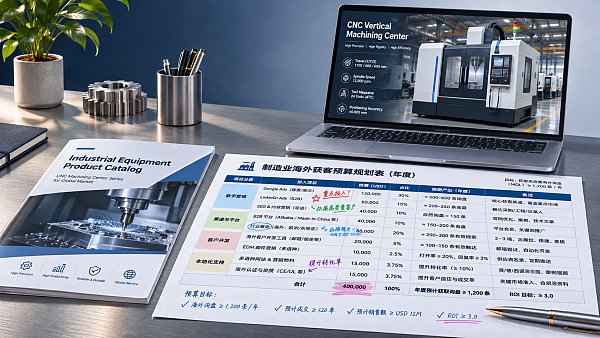
For manufacturing companies, the budget for digital marketing in international markets should first ensure that the website can generate qualified inquiries. Then use controlled ad spend to test the market, while reserving an ongoing budget for search optimization and sales follow-up. The allocation depends on the company's existing website, target markets, and sales cycle. Companies seeking leads quickly can increase the share allocated to advertising, but should not commit their entire budget to buying traffic.
If a company is just beginning to systematically generate leads overseas and needs a new website, it can start by allocating 30% to website development and conversion foundations, 35% to advertising, 20% to SEO and content, and 15% to data tools, testing, and optimization for its first budget cycle. This is an illustrative allocation to help get started and review results, not an industry standard. Companies with established websites can redirect some website development costs to ad testing or content creation. Companies whose products require extensive certification, samples, or technical discussions should allocate more resources to sales materials and inquiry handling.
First, Decide What Results the Budget Should Deliver
Budget discussions often start with questions like “How much does a website cost?” or “How much should we spend on advertising?” But decision-makers should first define the goal: verifying demand in a particular country, increasing qualified inquiries in an existing market, or supporting distributor development. Different goals call for different roles for each channel.
For example, a company planning to enter an untested market can initially focus on promoting a small number of products that it can deliver competitively, using advertising to test buyers’ search demand and the quality of inquiries. At this stage, the website should help buyers understand product specifications, applications, and how to get in touch. There is no need to translate all product information into multiple languages from the outset.
If a company already has a stable base of overseas customers and wants to reduce its reliance on a single lead-generation channel, it can increase ongoing investment in product content, application pages, and SEO. Search optimization often takes time to deliver results, so the budget should cover content updates and technical maintenance, not just one-off optimization fees.
Whichever path you choose, first define what qualifies a sales lead for follow-up: whether it comes from a target country, what type of product the buyer is looking for, whether the required volume is a good fit, and whether the contact details are valid. For manufacturing products, the sales process from inquiry to quotation, sampling, review, and closing can take a long time. Looking only at inquiry volume can therefore overstate marketing performance.
How to Allocate the Budget Across Four Areas
Website and conversion foundations: Address gaps that affect inquiries first. The budget should cover website development or redesign, mobile browsing, product pages, inquiry forms, and basic analytics. For products such as equipment, components, and industrial materials, buyers usually also need information about specifications, application requirements, delivery capabilities, and available technical documentation. Make this information easy to find, and ensure the form collects what sales needs to assess the inquiry while avoiding excessive fields that could discourage submissions.
Website costs do not necessarily need to be paid all at once. If the existing site is accessible and product information is reasonably complete, and only the inquiry form needs fixing and key product pages improving, there is no need for a complete rebuild just to accommodate the marketing budget. Setting aside funds for future page updates and maintenance is more valuable than leaving the site untouched for a long time after launch.
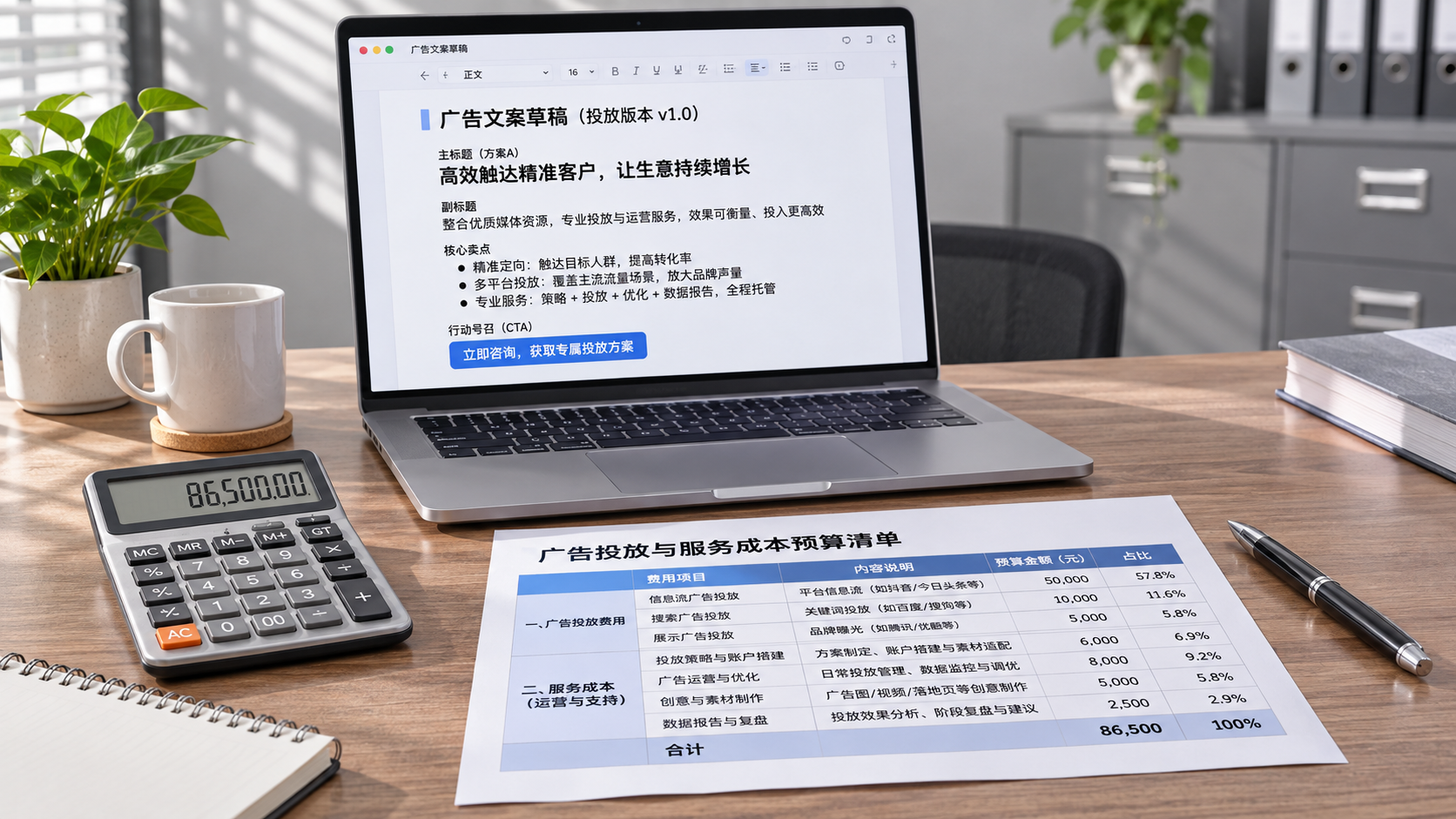
Advertising: Use small-scale tests to decide whether to increase spend. Search ads can capture searches with clear product or purchasing intent, but costs vary depending on the product, country, competition, and keyword selection. At launch, define a test scope around priority markets and products, review search terms, visitor behavior, and qualified inquiries, and then decide whether to expand. Keep media spend, agency fees, and creative production costs separate in the advertising budget rather than treating them as one expense.
SEO and content: Invest in information that helps buyers make decisions. Rather than producing a large volume of generic industry articles, prioritize completing the specifications, applications, selection guidance, and common purchasing questions for core products. This content can support organic search, and can also be used on ad landing pages and in sales conversations. If the company serves multiple language markets, prioritize regions that sales can support and account for translation, review, and future update costs.
Data and optimization: Set aside funds to evaluate performance. At a minimum, you should be able to distinguish inquiries by channel and record whether they meet target customer criteria. The budget should also include conversion tracking for forms and phone calls, landing page adjustments, and feedback from sales staff on lead status. Whether to budget separately for social media or short-form video depends on whether customers discover suppliers through these channels and whether the company can produce content consistently. If resources are limited, start with small-scale tests.
If a factory serves both wholesale and retail customers, the website budget should account for their different needs: wholesale customers may need to request quotes for multiple product specifications in one go, while retail customers are more focused on displayed prices and the shopping cart experience. When evaluating providers, consider options such as the B2B2C dual-model independent website solution, which supports multiple product specifications, shopping carts, and bulk quote requests. Still, check whether its pricing display rules, inquiry process, and ongoing maintenance suit your business.
Work Backward from Customer Acquisition Cost, Not Just Cost per Click
To evaluate return on investment, start with a simple measure: cost per qualified inquiry = total related marketing spend during the measurement period ÷ number of qualified inquiries during the same period. Total spend should include not only advertising costs but also related service fees, content production costs, and tool fees. One-time costs such as initial website development can be allocated over a usage period determined by the company and should be treated consistently when making comparisons.
Suppose a company spends RMB 100,000 in a given period and receives 100 inquiries, 20 of which meet the agreed criteria for a qualified inquiry. The cost per qualified inquiry is RMB 5,000. This figure alone does not show whether the campaign succeeded or failed. You also need to consider quotations, samples, progress toward closing, and whether the gross margin on orders can cover marketing and sales costs. The amounts and quantities here are illustrative examples, not cost benchmarks.
For equipment or customized products with long sales cycles, the company may not have final orders to show at the end of the budget period. In that case, track the number of qualified inquiries that progress to quotation, sampling, or technical discussions, and assess lead quality and progress while continuing to attribute eventual sales. Leads from different channels may be at different stages of maturity, so use comparable observation periods and consistent criteria when comparing them.
Clarify Cost Boundaries Before Purchase, Then Adjust After Reviewing Results
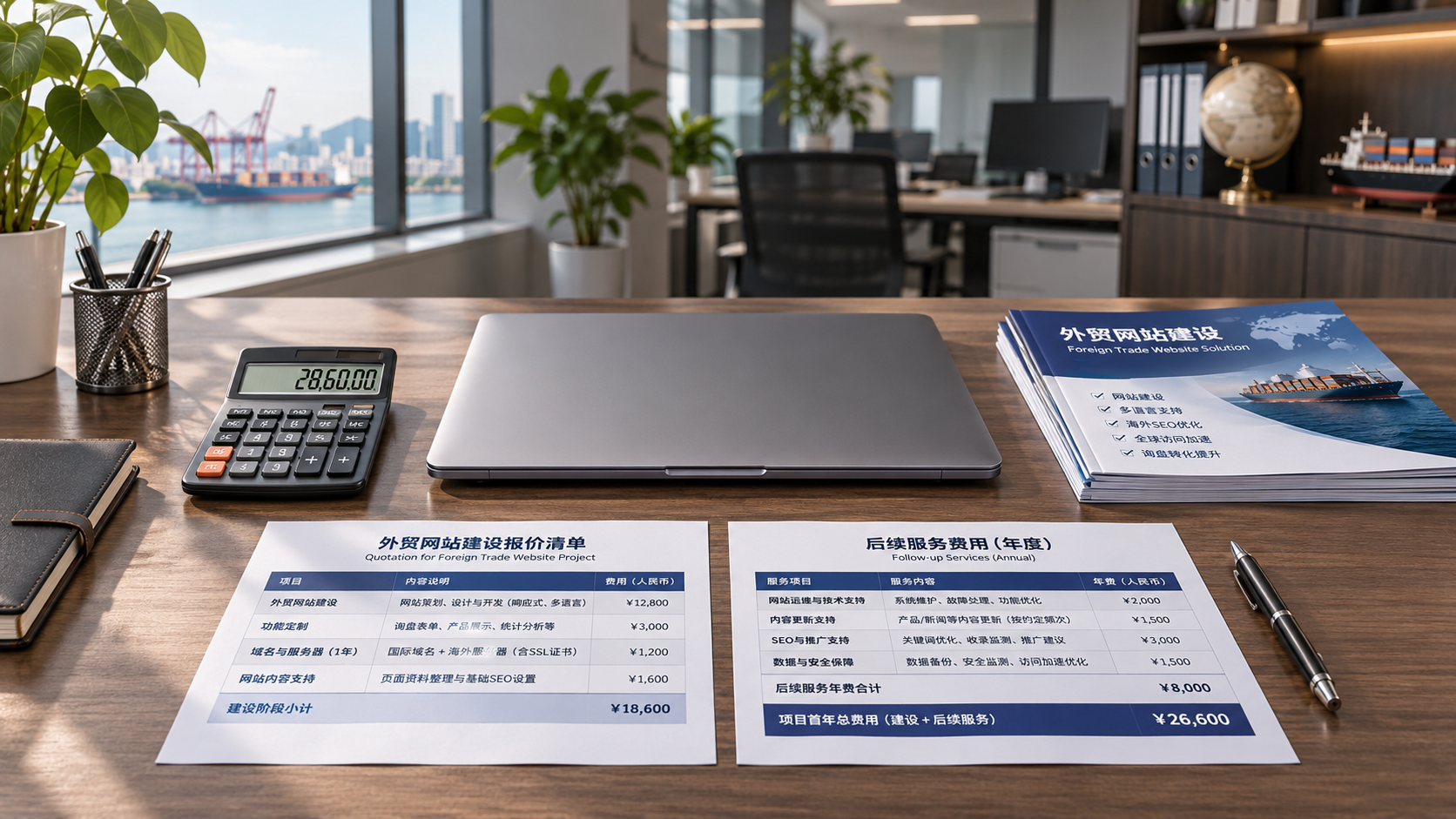
When choosing a website development or marketing service, ask for an itemized quote that specifies one-time development fees, recurring service fees, advertising media costs, third-party tool fees, and potential additional costs for translation, page additions, and maintenance. The contract should also specify ownership and usage rights for the domain, website content, advertising accounts, and data, to avoid disrupting business continuity if you later change providers.
After running the budget for a while, review each stage using consistent criteria. If clicks are coming in but inquiries are scarce, first check search terms, page content, and forms. If there are many inquiries but few are qualified, review the target regions, product positioning, and screening criteria. If qualified inquiries reach the quotation stage but make little progress, consider response times, pricing, delivery times, and sales follow-up. The budget should go to the stages that generate suitable opportunities and that the company can handle. Adjustments should be based on the full sales process, not on surface-level data from a single channel.
Related Articles
 What Factors Affect the Cost of Export Website Development Services in Jiangsu?
 What Factors Affect the Cost of Google SEO?
 How are the service fees for AI+SEM advertising strategies calculated?

Related Products
 Yiyingbao SaaS Intelligent Website Building and Marketing SystemYiyingbao SaaS Intelligent Website Building and Marketing System, AI-powered no-code website building, rapid creation of multilingual B2B international websites in 10 minutes, global server acceleration, AI-powered SEO optimization, helping businesses connect efficiently with global markets. The perfect integration of technology and operation makes building an international trade website remarkably simple
 AI+SEM Intelligent Advertising Marketing SystemAI+SEM drives intelligent ad creation, empowering full-funnel precision advertising marketing. The system automatically generates weekly/monthly reports, AI recommends keywords and target countries, monitors core metrics in real-time with intelligent alerts, and enables one-click high-conversion ad solutions to help quickly acquire customers and improve ROI.
 AI+SEO Dual-Engine System Optimization ServicesYiyingbao’s AI+SEO dual-engine optimization system helps foreign trade enterprises acquire high-quality organic traffic through AI-powered keyword research, content generation, and comprehensive technical optimization, significantly improving search rankings and conversion rates.
 AI+SNS Social Media Marketing SystemYingbao AI+SNS Social Media Marketing System - Precision social capture for the social media era. Supports one-click content synchronization across major platforms like Facebook and LinkedIn. AI intelligently rewrites posts for enhanced relevance. 24/7 AI customer service and user profiling analysis empower businesses to efficiently expand into global markets.
 AI+SEO营销解决方案易营宝AI+SEO营销解决方案,通过AI批量写作、智能生成TDK、精准关键词扩词等功能,全面优化网站SEO效果,提升流量与转化率。助力企业构建高效智能网站新生态。
 AI+SEM Advertising Marketing SolutionsAI+SEM Advertising Marketing Solution leverages AI technology to deeply empower SEM ad campaigns. It automatically generates weekly/monthly reports using AI, presenting account data across multiple dimensions for comprehensive insights into campaign performance and trends. The system precisely recommends keywords and target countries, intelligently generates high-conversion ad copy, and enables one-click activation of efficient campaign plans to help businesses rapidly acquire customers. Simultaneously, it monitors core metrics in real time, intelligently identifies abnormal fluctuations, and issues timely alerts to ensure stable, high-return advertising results.
 Domain Name ServicesEasyWin provides professional domain name services, including intelligent queries, one-stop registration, brand protection, and full lifecycle management, helping businesses build a digital brand image.
 EasyOperate B2C Cross-Border E-Commerce Platform & Independent WebsiteEasyStore B2C Cross-border E-commerce Independent Store is an intelligent website building and cross-border e-commerce integrated solution independently developed by EasyStore Information Technology (Beijing) Co., Ltd. The system is specially designed for small and medium-sized as well as large export enterprises, integrating 'website building, operation, marketing, advertising, and conversion' into one, helping enterprises quickly establish cross-border e-commerce independent stores to achieve brand globalization and global sales growth.
The platform supports multiple languages, multiple currencies, and multi-channel marketing, with built-in AI intelligent translation and SEO optimization systems, suitable for mainstream markets such as Southeast Asia, Europe and America, Latin America, and the Middle East, assisting Chinese manufacturing enterprises in efficiently deploying international e-commerce strategies. SSL证书易营宝提供专业SSL安全证书服务,包括单域名和泛域名证书,确保网站数据传输加密、身份验证和完整性保护,助力企业建立安全可信的在线业务环境。









