









- CBP Finalizes Electronic Rail Export Manifest Rule, Effective October 26, 2026Oct 26, 2026View details
- Amazon’s 2026 peak season surcharge takes effect on October 25Oct 26, 2026View details
- AI Is Eating SaaS: Three Real-World Cases in One AfternoonOct 25, 2026View details
- Exiger CEO: The SaaS Apocalypse Is Real, but It Means Something DifferentOct 25, 2026View details
- Hengqin Cooperation Zone Shares Cross-Border E-Commerce Developments, Focusing on Macao-Hengqin Collaboration and International MarketsOct 24, 2026View details
- A Shenyang study highlights the development of the “cross-border e-commerce + industrial cluster” modelOct 24, 2026View details
How can you prevent AI-generated content on a marketing website from misrepresenting your selling points?
When creating a marketing website, prevent AI-generated content from distorting your selling points. First define the evidence, applicable conditions, and boundaries of expression for each advantage, then let AI organize the wording. Before publishing, verify every statement about performance, delivery, scope of services, and results. If a statement lacks supporting evidence, send it back for additional documentation; do not fill the gap with “common industry claims.”
The most common distortion occurs when facts are quietly overstated: turning “customization is supported” into “any requirement can be met,” or changing “a certain feature is available” into “using it will inevitably produce a particular result.” The wording may read smoothly, but the commitment has changed.
Break selling points down into verifiable facts
If you simply give AI a brochure and ask it to continue writing, vague statements in the original are likely to be amplified. A more reliable approach is to create a source document for selling points, so every piece of information can be traced to valid supporting materials. At a minimum, the document should include the original fact, its source, scope of applicability, last updated date, and conclusions that must not be extended beyond the evidence.
For example, “multilingual websites are supported” is not specific enough: does this mean language-version management is available, or does it include translation services? Are product pages, form prompts, and system emails covered? If the documentation only confirms language-version management, do not generate the claim “professional localization across the entire website.”
- Feature-related selling points: Refer to the current version’s feature specifications or acceptance records, and state whether additional configuration is required. Do not present optional items as included by default.
- Keep the test conditions for performance metrics. Results such as loading speed and processing capacity depend on the device, network, page resources, and testing method. Quoting a single figure in isolation can easily be misleading.
- Document services and outcomes separately. The work included in a deliverable can be confirmed against the scope of services. Outcomes such as indexing, rankings, and inquiries are also affected by the site’s starting point, competitive environment, and execution, and cannot be inferred from the service name alone.
When documentation conflicts, first verify its version and validity period. Capabilities described in outdated plans, features not yet launched, and services provided only for specific projects should not be added directly to general-purpose pages.
Define AI’s rewriting permissions clearly
A prompt that only says “be accurate, professional, and conversion-focused” is still too broad. Clearly specify that AI may adjust sentence order, explain use cases, and organize paragraphs, while prohibiting it from adding specifications, customer testimonials, certifications, comparative conclusions, or promises about results. If information is missing, instruct it to flag items for confirmation in the internal draft rather than filling them in on its own.
You could assign the task as follows: “Write the page content using only the attached selling-point source document. Preserve all applicable conditions and service boundaries, and do not rewrite feature descriptions as guarantees of results. List any facts without a source as items requiring confirmation, and do not include them in the main copy. Also provide a fact-mapping table showing the source for each statement.”
The fact-mapping table is for internal review; only verified copy should be retained for publication. When working with specific models, service packages, or different versions, provide only the corresponding materials for each generation task to prevent AI from combining advantages from multiple versions on a single page.
Carefully review the reasoning from “fact” to “benefit”
Distorted selling points do not always involve fabricated numbers; they can also be hidden in causal claims. For example, “supports custom page titles and descriptions” is a feature fact; “makes it easier to configure search display information based on page topics” is a reasonable use case; “ensures higher search rankings” goes beyond what this feature can substantiate.
During review, break important statements down into “what is provided—under what conditions it is used—what work it can support.” If the statement ultimately claims results in sales, lead generation, or rankings, look for further evidence. The existence of a feature cannot substitute for verification of its results.
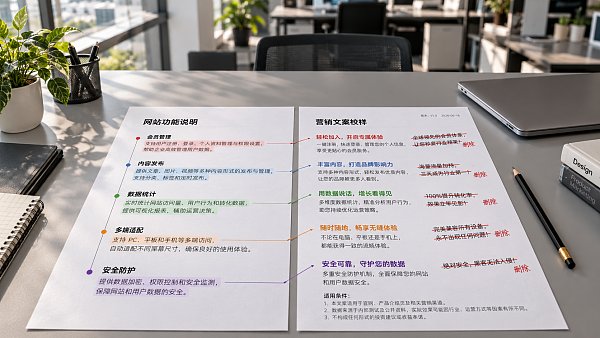
The following hypothetical rewrite comparison is intended to help identify the boundaries of acceptable claims:
Also watch for words that broaden the scope, such as “all,” “permanent,” and “zero barriers to entry.” After removing these words, check whether the sentence still implies unconditional applicability; do not settle for a superficial word swap.
Preserve SEO and conversion value without overstating promises
Tighter wording does not mean the page should stop answering specific questions. Rather than repeatedly using phrases such as “efficient,” “intelligent,” and “effective,” explain which operational obstacle a feature addresses, what information needs to be provided, what the deliverables include, and when additional configuration may be required. This information helps readers understand the page’s subject and reduces repeated clarification during inquiries.
Keywords should appear naturally in line with the actual content. If the page discusses AI content generation, explain the processes for organizing information, verifying facts, and publishing. There is no need to insert unrelated services just to cover search terms. Titles, subheadings, and summaries should follow the same standards: do not state unconditional guarantees in the title when the body copy includes conditions.
Multilingual pages require particular care to avoid strengthening claims in translation. Qualifiers such as “supported,” “optional,” and “under specified conditions” must be carried over along with the selling point. During review, check both the source and translated text rather than judging only whether the translation reads fluently.
Use the same source document for post-publication changes
After a page has passed review, retain the copy version together with its supporting materials. When features, packages, or service scope change, update the source document first, then synchronize the product page, landing page, and related summaries. This prevents one page from being updated while others continue to show outdated promises.
If inquiries repeatedly include comments such as “Doesn’t the page say this is already included?”, identify the specific sentence that caused the misunderstanding and check whether similar pages use the same wording. Add such expressions to the constraints for future content generation to reduce the risk of the same distortion recurring across bulk content.
Related Articles
 How can you prevent AI-generated content on a marketing website from misrepresenting your selling points?
 When does an intelligent website builder still require a technical team?
 Should You Consider Source Code Export When Choosing an AI Website Builder Platform?


Related Products
 Yiyingbao SaaS Intelligent Website Building and Marketing SystemYiyingbao SaaS Intelligent Website Building and Marketing System, AI-powered no-code website building, rapid creation of multilingual B2B international websites in 10 minutes, global server acceleration, AI-powered SEO optimization, helping businesses connect efficiently with global markets. The perfect integration of technology and operation makes building an international trade website remarkably simple
 AI+SEM Intelligent Advertising Marketing SystemAI+SEM drives intelligent ad creation, empowering full-funnel precision advertising marketing. The system automatically generates weekly/monthly reports, AI recommends keywords and target countries, monitors core metrics in real-time with intelligent alerts, and enables one-click high-conversion ad solutions to help quickly acquire customers and improve ROI.
 AI+SEO Dual-Engine System Optimization ServicesYiyingbao’s AI+SEO dual-engine optimization system helps foreign trade enterprises acquire high-quality organic traffic through AI-powered keyword research, content generation, and comprehensive technical optimization, significantly improving search rankings and conversion rates.
 AI+SNS Social Media Marketing SystemYingbao AI+SNS Social Media Marketing System - Precision social capture for the social media era. Supports one-click content synchronization across major platforms like Facebook and LinkedIn. AI intelligently rewrites posts for enhanced relevance. 24/7 AI customer service and user profiling analysis empower businesses to efficiently expand into global markets.
 AI+SEO营销解决方案易营宝AI+SEO营销解决方案,通过AI批量写作、智能生成TDK、精准关键词扩词等功能,全面优化网站SEO效果,提升流量与转化率。助力企业构建高效智能网站新生态。
 AI+SEM Advertising Marketing SolutionsAI+SEM Advertising Marketing Solution leverages AI technology to deeply empower SEM ad campaigns. It automatically generates weekly/monthly reports using AI, presenting account data across multiple dimensions for comprehensive insights into campaign performance and trends. The system precisely recommends keywords and target countries, intelligently generates high-conversion ad copy, and enables one-click activation of efficient campaign plans to help businesses rapidly acquire customers. Simultaneously, it monitors core metrics in real time, intelligently identifies abnormal fluctuations, and issues timely alerts to ensure stable, high-return advertising results.
 Domain Name ServicesEasyWin provides professional domain name services, including intelligent queries, one-stop registration, brand protection, and full lifecycle management, helping businesses build a digital brand image.
 EasyOperate B2C Cross-Border E-Commerce Platform & Independent WebsiteEasyStore B2C Cross-border E-commerce Independent Store is an intelligent website building and cross-border e-commerce integrated solution independently developed by EasyStore Information Technology (Beijing) Co., Ltd. The system is specially designed for small and medium-sized as well as large export enterprises, integrating 'website building, operation, marketing, advertising, and conversion' into one, helping enterprises quickly establish cross-border e-commerce independent stores to achieve brand globalization and global sales growth.
The platform supports multiple languages, multiple currencies, and multi-channel marketing, with built-in AI intelligent translation and SEO optimization systems, suitable for mainstream markets such as Southeast Asia, Europe and America, Latin America, and the Middle East, assisting Chinese manufacturing enterprises in efficiently deploying international e-commerce strategies. SSL证书易营宝提供专业SSL安全证书服务,包括单域名和泛域名证书,确保网站数据传输加密、身份验证和完整性保护,助力企业建立安全可信的在线业务环境。









