









- How to Choose Topics for an Industry News Section to Attract More Organic Search TrafficJul 29, 2026View details
- Can Zhejiang foreign trade independent websites still be developed today? Look at changes in traffic and lead generationJul 28, 2026View details
- What New Signals Are Emerging in Enterprise Services SaaS Marketing ReportsJul 27, 2026View details
- What Does a Global Traffic Ecosystem Service Provider Do? What Are the Differences from a Single Advertising AgencyJul 16, 2026View details
- What should you focus on in the latest enterprise SaaS report? From renewal rates and delivery costs to overseas growth opportunitiesJul 12, 2026View details
- What signals are worth paying attention to in a cross-border marketing trend report? B2B companies should look at these 6 signalsJul 11, 2026View details
- How to Read a Cross-Border Marketing Trends Report? Five Key Dimensions for Evaluating Channel OpportunitiesJul 11, 2026View details
- Which channel has the highest ROI in the global traffic ecosystem? Comparative analysis of search, social media, and advertisingJul 10, 2026View details
Will AI website acceleration technology improve user experience at a higher cost? How can input and output be evaluated
Is AI website acceleration technology expensive when improving user experience? First look at the cost structure, then look at the return logic
Is AI website acceleration technology expensive when improving user experience? On the surface, the answer is often not consistent. Some people think it is just about making the website a bit faster, and therefore not worth too much budget; others regard it as a fundamental capability that directly affects inquiries and conversions.
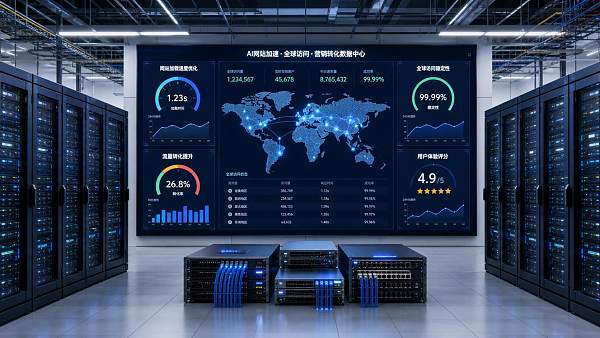
For procurement decisions, the real question is not whether a single quote is high or low, but whether this investment can bring lower traffic waste, higher conversion rates, and more stable long-term customer acquisition capability.
Especially in the website + marketing service integration scenario, page loading speed, content distribution efficiency, cross-region access experience, and search performance are no longer just technical team issues, but important variables affecting sales funnel costs.
In recent changes, overseas traffic competition has become more intense, advertising costs have generally risen, and enterprises are finding it harder to accept “spending money to buy clicks, only to lose customers because the website is slow.” This has also made AI website acceleration technology improving user experience a budget item that more and more enterprises evaluate seriously.
Why AI website acceleration technology improving user experience cannot be judged only by deployment cost
When many companies review approvals, they tend to compare website-building fees, server fees, and maintenance fees first. But AI website acceleration technology improving user experience is not an isolated technology procurement item.
It usually includes intelligent caching, access path optimization, global node scheduling, image and script compression, mobile experience optimization, as well as data monitoring and continuous optimization services.
In other words, what you buy is not only “speed,” but the smoothness of the entire process from the user entering the page to submitting, placing an order, and making an inquiry.
If you only look at the initial quote, it is easy to underestimate its value. Because a one-second slower page load may significantly increase bounce rate; a stuck form load may directly reduce sales leads; unstable access to multilingual pages overseas may also drag down organic rankings and ad conversion.
A more obvious signal is that many companies are not lacking traffic input, but lacking landing page conversion capacity. At this point, when discussing AI website acceleration technology improving user experience, you cannot only stare at “how much it costs,” but also look at “how much loss it saves.”
What makes up the price of AI website acceleration technology improving user experience
From a procurement perspective, the price of this type of solution is usually composed of four parts. After understanding them clearly, budget judgment becomes more accurate.
- Basic system cost: including the website foundation, server resources, global access nodes, and security capabilities.
- AI optimization capability cost: including intelligent compression, resource preloading, access path judgment, and dynamic scheduling.
- Continuous operation and maintenance cost: including monitoring, exception repair, speed iteration, and version updates.
- Marketing collaboration cost: including SEO adaptation, advertising landing page optimization, and multilingual page performance improvement.
If a solution only accelerates speed, the price may look low, but it often lacks follow-up conversion support. On the contrary, a solution that can connect website speed, search visibility, and customer acquisition conversion together may quote higher, but the return is usually easier to verify.
Yiyingbao Information Technology (Beijing) Co., Ltd. has long served foreign trade enterprises, manufacturing factories, cross-border e-commerce sellers, and brand companies going global. Its core advantage lies in integrating AI intelligent website building, SEO optimization, advertising, and overseas marketing collaboration to avoid enterprises repeatedly purchasing, repeatedly investing, and fragmenting results.
How to evaluate input-output: do not only calculate procurement amount, also calculate funnel and conversion costs
To determine whether AI website acceleration technology improving user experience is reasonable, the most effective method is to establish a simple but executable ROI evaluation framework.
It is recommended to first look at four core indicators: access speed, bounce rate, conversion rate, and cost per lead. These four items best reflect whether the investment truly generates business return.
Take a very practical example: if a company’s monthly advertising budget is 5万元, the original landing page is slow, and 1000 visits can only generate 20 leads; after optimization, leads rise to 28. Even if all other conditions remain unchanged, the cost per lead will also drop significantly.
At this point, looking at AI website acceleration technology improving user experience makes the logic clear. As long as the annual incremental lead value exceeds the solution investment, the budget has justification.
Which enterprises are more suitable to prioritize this budget
Not every enterprise needs to immediately choose a high-spec solution, but the following types of businesses are often more suitable to prioritize evaluating AI website acceleration technology improving user experience.
- Websites relying on Google SEO for long-term customer acquisition, where speed directly affects indexing and ranking performance.
- Enterprises continuously investing in Google ads and Facebook ads, where landing page conversion efficiency determines ad return.
- Websites targeting markets across North America, Europe, Southeast Asia, and other regions, where the access environment is complex and intelligent scheduling is more needed.
- Multilingual official websites, cross-border malls, and independent brand websites, where page volume is larger and performance issues are more likely to be exposed.
- Industries with high inquiry/order value and long sales cycles, where even a small conversion improvement may bring considerable returns.
In real business, what such enterprises fear most is not that the budget is spent, but that traffic comes in yet cannot be received. Compared with repeatedly increasing investment, first filling the website speed and experience shortcomings is often more in line with cost control thinking.
What to focus on during approval to avoid buying too expensively or buying the wrong thing
When reviewing AI website acceleration technology improving user experience, you can focus on checking the following points.
- Is there a clear optimization target, rather than only promising “faster speed”?
- Are before-and-after optimization data comparisons provided, including bounce rate, dwell time, and conversion changes?
- Does it support SEO, ad landing pages, and multilingual scenarios, rather than just single homepage acceleration?
- Does it include continuous monitoring and adjustment to avoid performance decline after launch?
- Can it work in coordination with website building, content, traffic acquisition, and SEO to reduce repeated procurement?
If the service provider can only give technical parameters but cannot clearly explain conversion impact, then AI website acceleration technology improving user experience is not necessarily worth buying even at a lower price. Conversely, if the solution can connect speed, indexing, conversion, and customer acquisition costs into a complete closed loop, a slightly higher price may be more worthwhile.
Conclusion: whether AI website acceleration technology improving user experience is expensive depends on whether it brings continuous return
Back to the original question: is AI website acceleration technology improving user experience expensive? Looking only at the bill amount, some solutions are indeed not cheap; but in real business, it is more like an operational investment that can reduce traffic waste, improve conversion efficiency, and lower long-term customer acquisition costs.
For enterprises hoping to grow overseas, the more stable approach is not just comparing quotes, but first measuring the current website’s speed loss, then combining SEO, advertising, and inquiry data to evaluate the value space that can be recovered within one year.
If the enterprise is already doing independent websites, multilingual official websites, cross-border malls, or overseas lead generation, then evaluating AI website acceleration technology improving user experience as early as possible is usually more cost-effective than later remedial actions, and it is also easier to make every marketing budget produce results.
Putting cost, conversion, and growth on the same table makes procurement decisions clearer. What is truly worth approval is not the cheapest solution, but the one that can steadily improve user experience and bring verifiable returns.
Related Articles



Related Products
 Yiyingbao SaaS Intelligent Website Building and Marketing SystemYiyingbao SaaS Intelligent Website Building and Marketing System, AI-powered no-code website building, rapid creation of multilingual B2B international websites in 10 minutes, global server acceleration, AI-powered SEO optimization, helping businesses connect efficiently with global markets. The perfect integration of technology and operation makes building an international trade website remarkably simple
 AI+SEM Intelligent Advertising Marketing SystemAI+SEM drives intelligent ad creation, empowering full-funnel precision advertising marketing. The system automatically generates weekly/monthly reports, AI recommends keywords and target countries, monitors core metrics in real-time with intelligent alerts, and enables one-click high-conversion ad solutions to help quickly acquire customers and improve ROI.
 AI+SEO Dual-Engine System Optimization ServicesYiyingbao’s AI+SEO dual-engine optimization system helps foreign trade enterprises acquire high-quality organic traffic through AI-powered keyword research, content generation, and comprehensive technical optimization, significantly improving search rankings and conversion rates.
 AI+SNS Social Media Marketing SystemYingbao AI+SNS Social Media Marketing System - Precision social capture for the social media era. Supports one-click content synchronization across major platforms like Facebook and LinkedIn. AI intelligently rewrites posts for enhanced relevance. 24/7 AI customer service and user profiling analysis empower businesses to efficiently expand into global markets.
 AI+SEO营销解决方案易营宝AI+SEO营销解决方案,通过AI批量写作、智能生成TDK、精准关键词扩词等功能,全面优化网站SEO效果,提升流量与转化率。助力企业构建高效智能网站新生态。
 AI+SEM Advertising Marketing SolutionsAI+SEM Advertising Marketing Solution leverages AI technology to deeply empower SEM ad campaigns. It automatically generates weekly/monthly reports using AI, presenting account data across multiple dimensions for comprehensive insights into campaign performance and trends. The system precisely recommends keywords and target countries, intelligently generates high-conversion ad copy, and enables one-click activation of efficient campaign plans to help businesses rapidly acquire customers. Simultaneously, it monitors core metrics in real time, intelligently identifies abnormal fluctuations, and issues timely alerts to ensure stable, high-return advertising results.
 Domain Name ServicesEasyWin provides professional domain name services, including intelligent queries, one-stop registration, brand protection, and full lifecycle management, helping businesses build a digital brand image.
 EasyOperate B2C Cross-Border E-Commerce Platform & Independent WebsiteEasyStore B2C Cross-border E-commerce Independent Store is an intelligent website building and cross-border e-commerce integrated solution independently developed by EasyStore Information Technology (Beijing) Co., Ltd. The system is specially designed for small and medium-sized as well as large export enterprises, integrating 'website building, operation, marketing, advertising, and conversion' into one, helping enterprises quickly establish cross-border e-commerce independent stores to achieve brand globalization and global sales growth.
The platform supports multiple languages, multiple currencies, and multi-channel marketing, with built-in AI intelligent translation and SEO optimization systems, suitable for mainstream markets such as Southeast Asia, Europe and America, Latin America, and the Middle East, assisting Chinese manufacturing enterprises in efficiently deploying international e-commerce strategies. SSL证书易营宝提供专业SSL安全证书服务,包括单域名和泛域名证书,确保网站数据传输加密、身份验证和完整性保护,助力企业建立安全可信的在线业务环境。









