









- Which customer acquisition channels will be affected by cross-border marketing trends in 2026?Sep 06, 2026View details
- Which homogenization risks should be considered in an analysis of the AI-powered website building industry?Aug 30, 2026View details
- How Will AI Marketing Trends 2026 Change Advertising Budget AllocationAug 28, 2026View details
- Is the EV SSL certificate market shrinking or upgrading? How should companies assess certificate procurement?Aug 11, 2026View details
- Why the old AMP SEO 2020 practices no longer work and what has changed in current optimization prioritiesAug 02, 2026View details
- How to Choose Topics for an Industry News Section to Attract More Organic Search TrafficJul 29, 2026View details
Will automated SEO tools cause technical teams to lose capabilities?
When crawler diagnostics, keyword clustering, page generation, log analysis, and content updates can all be completed automatically by a system, technical teams can easily develop a conflicting mindset: on the one hand, efficiency is finally freed from repetitive work; on the other hand, will the team gradually lose its ability to identify and break down problems?
Do automated SEO tools cause technical teams to lose capabilities? The answer does not depend on how "automated" a tool is, but on whether the team still retains validation mechanisms, strategic boundaries, and decision-making authority over critical matters. If tools are treated as black boxes that replace thinking, capabilities will indeed be diluted. If tools are used as infrastructure for observation and execution at scale, technical teams instead have an opportunity to step away from tedious operations and move into more valuable levels of optimization.
What should truly not be replaced is technical judgment
The first tasks replaced by SEO automation are often those that are frequent, rule-based, and high-volume: batch-checking missing titles and descriptions, identifying broken links and redirect chains, generating sitemaps, monitoring indexing fluctuations, detecting page duplication, and populating structured data using templates. These tasks are not inherently low-value, but if engineers spend substantial time on manually exporting reports, checking pages one by one, and repeatedly publishing content, it is difficult for them to build an overall understanding of the search ecosystem.
The problem lies in another way of using these tools: the team looks only at the "health score" provided by the tool and executes only the to-do items recommended by the system, without further asking why the data was produced. For example, when a tool indicates that a batch of pages has not been indexed, the cause may be insufficient internal link equity, but it may also be homogeneous page content, incorrect canonical tag configuration, server-side rendering errors, or even limited market demand itself. Automation tools can point out anomalies, but they do not inherently possess business context or architectural context.
For corporate websites targeting overseas markets, this difference is even more evident. A traffic decline on the German pages of a multilingual B2B website cannot simply be attributed to "lower keyword rankings"; technical evaluators also need to check hreflang mapping, regional directory strategy, page-loading resources, indexing coverage status, and whether translated content truly matches the way local buyers search. Tools provide clues, but people still need to complete the diagnosis.
Capability degradation usually does not happen suddenly; it goes through three stages
The first stage is "time saving." Teams use automated SEO tools to replace repetitive checks, improving efficiency with usually no risk. The second stage is "reliance on recommendations." The system assigns priorities, and the team begins to default to its judgment, although it still conducts sample-based reviews. The third stage is the truly concerning "black-box execution": no one understands the rule configuration, data sources, or false-positive rate; tasks are completed, but problems may be concealed.
The most typical signals include: the team cannot explain why a particular page should be optimized; it cannot clearly state which formula is used to calculate "high priority" in the tool; it applies the same set of keywords or content templates to all pages; it can only wait for the next system report after ranking changes; and when a vendor is switched or an integration is interrupted, basic monitoring and troubleshooting nearly come to a halt.
This is not a problem unique to SEO teams. Monitoring platforms, low-code tools, and AI coding assistants all bring similar challenges: as processes become smoother and smoother, people can easily forget what the processes were originally meant to solve. The core of technical capability has never been merely "being able to operate" tools, but being able to rebuild a chain of judgment when automation fails, business changes, or search rules are adjusted.
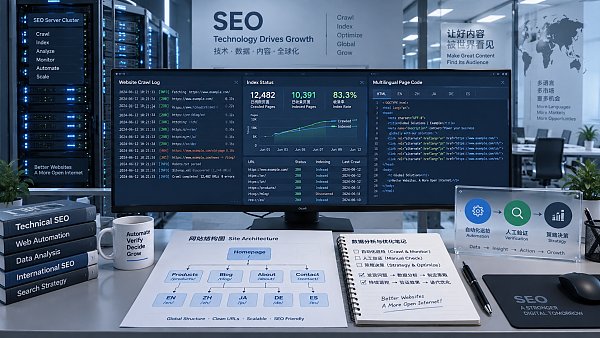
Automation is suited to handling "breadth," while people should safeguard "depth"
A more prudent division of responsibilities is neither to hand SEO over to tools nor to insist that every task be completed manually, but to assign responsibilities according to the nature of the problem.
In other words, tools should be responsible for "identifying problems at scale," while engineers need to determine "which problems are worth solving, why they should be solved now, and how to validate them after resolution." Especially in environments where website building, SEO, advertising, and social media operations are becoming increasingly coordinated, a single ranking metric is no longer sufficient to guide technical investment. A page gaining more organic traffic does not mean it can generate higher-quality inquiries; a technical fix marked as complete does not mean that the user experience and conversion path have improved.
When evaluating an automated SEO system, start by asking four questions
First, is the data traceable? Technical teams should know which data sources the system connects to, how often it crawls, and whether metric definitions are consistent. If the original URL, crawl time, status code, or page evidence cannot be viewed, so-called "intelligent diagnostics" are difficult to validate.
Second, can the rules be configured? Different companies have different website structures, product lifecycles, and target markets. A mature platform should allow teams to set excluded directories, page priorities, language markets, and alert thresholds, rather than mechanically applying one set of general rules to every website.
Third, can the recommendations be explained? The value of AI-generated optimization recommendations does not lie in whether the wording appears complete, but in whether they can explain the page issues addressed by the recommendations, their expected impact, and potential risks. In particular, before making batch changes to titles, body content, links, or structured data, review, rollback, and change records must be retained.
Fourth, can results be closed-loop? After optimization is completed, teams should track multiple layers of signals, including crawling, indexing, impressions, clicks, dwell time, and conversions. Automation without a closed loop is merely a task pipeline; automation with validation processes is a sustainably iterative growth system.
Move from "using tools" to "designing mechanisms"
For technical evaluators, the most valuable thing is not selecting the platform with the most features, but establishing a working mechanism that will not become ineffective due to tool upgrades. Fixed manual spot checks can be retained: review a batch of pages identified by the tool as high-risk every week; before each batch release, have technical, content, and marketing teams jointly confirm the scope of impact; after major revisions, conduct reviews based on actual crawling, indexing, and conversion data rather than relying solely on platform scores.
SEO knowledge can also be accumulated as a team asset: document common indexing issues, redirect rules, template field logic, multilingual page standards, and lessons from past revisions. This way, even if team members change, the team will not be left with only a set of automated tasks that no one can explain.
The foreign trade companies, manufacturing plants, and cross-border brands served by Yiyingbao often face complex scenarios simultaneously, including multilingual websites, large-scale updates to product pages, long-term Google SEO operations, and iterations of advertising landing pages. In such scenarios, the significance of an AI+SEO/GEO optimization system is not merely to accelerate content and technical inspections, but also to help teams bring fragmented website-building, promotion, and visibility data into a unified observation framework. Automation is responsible for lowering the barrier to execution, while professionals are responsible for defining growth paths.
Therefore, automated SEO tools do not inherently cause technical teams to lose capabilities. What truly causes degradation is giving up asking questions, giving up validation, and giving up understanding websites and users. A mature team should let tools handle repetitive work while investing the time saved in areas that are more difficult to standardize, such as architecture, content quality, market differences, and conversion experience. Technology is not strong because more work is done manually, but because when facing change, teams still know what to examine, what to change, and how to prove that the change was correct.
Related Articles

Related Products
 Yiyingbao SaaS Intelligent Website Building and Marketing SystemYiyingbao SaaS Intelligent Website Building and Marketing System, AI-powered no-code website building, rapid creation of multilingual B2B international websites in 10 minutes, global server acceleration, AI-powered SEO optimization, helping businesses connect efficiently with global markets. The perfect integration of technology and operation makes building an international trade website remarkably simple
 AI+SEM Intelligent Advertising Marketing SystemAI+SEM drives intelligent ad creation, empowering full-funnel precision advertising marketing. The system automatically generates weekly/monthly reports, AI recommends keywords and target countries, monitors core metrics in real-time with intelligent alerts, and enables one-click high-conversion ad solutions to help quickly acquire customers and improve ROI.
 AI+SEO Dual-Engine System Optimization ServicesYiyingbao’s AI+SEO dual-engine optimization system helps foreign trade enterprises acquire high-quality organic traffic through AI-powered keyword research, content generation, and comprehensive technical optimization, significantly improving search rankings and conversion rates.
 AI+SNS Social Media Marketing SystemYingbao AI+SNS Social Media Marketing System - Precision social capture for the social media era. Supports one-click content synchronization across major platforms like Facebook and LinkedIn. AI intelligently rewrites posts for enhanced relevance. 24/7 AI customer service and user profiling analysis empower businesses to efficiently expand into global markets.
 AI+SEO营销解决方案易营宝AI+SEO营销解决方案,通过AI批量写作、智能生成TDK、精准关键词扩词等功能,全面优化网站SEO效果,提升流量与转化率。助力企业构建高效智能网站新生态。
 AI+SEM Advertising Marketing SolutionsAI+SEM Advertising Marketing Solution leverages AI technology to deeply empower SEM ad campaigns. It automatically generates weekly/monthly reports using AI, presenting account data across multiple dimensions for comprehensive insights into campaign performance and trends. The system precisely recommends keywords and target countries, intelligently generates high-conversion ad copy, and enables one-click activation of efficient campaign plans to help businesses rapidly acquire customers. Simultaneously, it monitors core metrics in real time, intelligently identifies abnormal fluctuations, and issues timely alerts to ensure stable, high-return advertising results.
 Domain Name ServicesEasyWin provides professional domain name services, including intelligent queries, one-stop registration, brand protection, and full lifecycle management, helping businesses build a digital brand image.
 EasyOperate B2C Cross-Border E-Commerce Platform & Independent WebsiteEasyStore B2C Cross-border E-commerce Independent Store is an intelligent website building and cross-border e-commerce integrated solution independently developed by EasyStore Information Technology (Beijing) Co., Ltd. The system is specially designed for small and medium-sized as well as large export enterprises, integrating 'website building, operation, marketing, advertising, and conversion' into one, helping enterprises quickly establish cross-border e-commerce independent stores to achieve brand globalization and global sales growth.
The platform supports multiple languages, multiple currencies, and multi-channel marketing, with built-in AI intelligent translation and SEO optimization systems, suitable for mainstream markets such as Southeast Asia, Europe and America, Latin America, and the Middle East, assisting Chinese manufacturing enterprises in efficiently deploying international e-commerce strategies. SSL证书易营宝提供专业SSL安全证书服务,包括单域名和泛域名证书,确保网站数据传输加密、身份验证和完整性保护,助力企业建立安全可信的在线业务环境。









