









- Can the average annual growth rate reflect real opportunities in overseas markets?Oct 07, 2026View details
- Which customer acquisition channels will be affected by cross-border marketing trends in 2026?Sep 06, 2026View details
- Which homogenization risks should be considered in an analysis of the AI-powered website building industry?Aug 30, 2026View details
- How Will AI Marketing Trends 2026 Change Advertising Budget AllocationAug 28, 2026View details
- Is the EV SSL certificate market shrinking or upgrading? How should companies assess certificate procurement?Aug 11, 2026View details
- Why the old AMP SEO 2020 practices no longer work and what has changed in current optimization prioritiesAug 02, 2026View details
Why SaaS Companies Generate Plenty of Leads but Struggle to Convert Them
“New leads hit another record high this month, but sales says most of them are not sufficiently qualified.” This is a scenario experienced by many SaaS marketing leaders and managers. The number of form submissions in ad reports is growing, and content downloads are also performing well, yet the number of customers who actually enter the opportunity pipeline, complete a demo, and sign a contract has not increased accordingly.
In SaaS marketing, a high volume of leads combined with low conversion is usually not caused by the failure of a single channel. Rather, it results from gaps between acquisition, qualification, nurturing, and sales handoff. If companies focus only on customer acquisition cost and lead volume, they can easily keep allocating budget to traffic channels that “appear effective” while overlooking the fact that revenue growth truly depends on end-to-end operational efficiency.
When leads are “plentiful,” first ask: Are they close to buying?
An email address, a phone call, or a document download does not automatically equal a sales opportunity. Especially for SaaS products serving business customers, the decision-making cycle is often long and involves business departments, IT departments, procurement, and management. Someone downloading a white paper may simply be conducting industry research; someone submitting a trial request may not yet have internal budget approval or decision-making authority.
Therefore, managers should not only ask, “How many leads came in this week?” They should also ask: What types of companies do these people come from? Do their industries and business scenarios match? Do they have clear usage needs, a budget window, and a decision-making role? After entering the pipeline, are they willing to schedule a conversation, complete a product demo, or invite key stakeholders to participate?
If the marketing team measures performance by download volume while the sales team judges quality by contract-ready opportunities, the long-term coexistence of these two standards can easily lead to mutual doubt. A more reasonable approach is to jointly define lead stages: visitor, prospect, marketing-qualified lead, sales-qualified lead, opportunity, and customer. Each stage should have verifiable behaviors or conditions, rather than relying solely on subjective judgment for handoff.
Conversion bottlenecks are often hidden in four places that are not easy to see
First, broad positioning attracts “interested people” rather than “people who need a solution”
Many SaaS companies are accustomed to emphasizing “intelligence,” “one-stop solutions,” and “efficiency improvement” in their promotions. There is nothing inherently wrong with these messages, but when they are too broad, they can easily attract large volumes of general-interest traffic. Content that truly drives conversion should place product value in specific scenarios: which process takes too long for a certain type of company, why existing tools cannot solve the issue, and how improvement can be evaluated after switching solutions.
For example, for marketing digitalization services targeting foreign trade companies, rather than broadly discussing “overseas customer acquisition,” it is better to focus on practical issues such as multilingual website indexing, inquiry form quality, and data integration between advertising landing pages and CRM systems. The more clearly users can recognize their own situation on the page, the more likely the leads they leave will have subsequent value.
Second, the content promise is disconnected from the landing page experience
An ad or short video may use a sharp question to attract clicks, while the landing page is filled with feature descriptions, company introductions, and complex forms, causing users’ willingness to act to decline rapidly. A more common issue is that the content provides industry knowledge, but the form immediately asks users to schedule a sales demo; users are still in the learning stage, while the company expects them to enter the decision-making stage.
Different levels of intent should be matched with different actions. Early-stage visitors are better suited to receiving a clear diagnostic checklist, solution framework, or scenario-based materials; visitors with clearly defined needs can then be guided to request a demo, needs assessment, or consultation. A page does not need more information simply for the sake of it, but users must be able to understand within seconds: what problem this service solves, who it is for, and what will happen next.
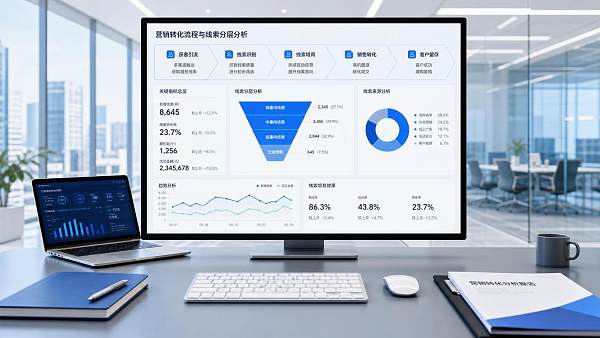
Third, insufficient lead segmentation causes sales time to be consumed by low-intent inquiries
Having all form submissions enter the sales queue with the same priority is a common reason for declining conversion efficiency. Sales representatives are busy responding to unsuitable inquiries, while customers showing genuine purchasing signals do not receive timely responses. For SaaS businesses with high average deal values and long sales cycles, this resource mismatch is particularly costly.
Companies can establish basic lead scoring through form fields, browsing behavior, and interaction records. Information such as company size, target market, currently used tools, and expected go-live date can help assess fit; repeatedly visiting pricing, solution, and case study pages, opening emails, or making multiple visits can serve as intent signals. The purpose of scoring is not to label customers, but to determine who should receive priority manual follow-up and who is better suited to automated nurturing first.
Fourth, follow-up is slow, or it becomes nothing more than “pressure-to-buy follow-up”
When users have just submitted their needs, they are often at the peak of their information-gathering and comparison process. If they receive the first contact only several days later, their interest may already have faded. Conversely, requesting a meeting or quotation too early and too frequently can pressure prospects who have not yet established trust.
A more mature approach is to create a relay between marketing automation and sales communication. High-intent leads should receive a response within a defined time frame; medium- and low-intent leads should continue receiving useful content based on the topics they care about, such as implementation processes, industry applications, frequently asked questions, and evaluation methods. Sales should step in when the prospect shows clearer purchase signals. This approach neither abandons long-cycle customers nor causes sales to spend time on contacts who are not yet ready.
Do not focus only on the “top of the funnel”; examine the reasons for drop-off at every stage
SaaS marketing requires a conversion map that management can understand. Starting with channel sources, continuously track visits, lead submissions, qualified leads, appointments, demos, quotations, and closed deals, while reviewing each channel separately. Users from organic search may not generate high volume initially, but their needs may be clearer; advertising provides controllable traffic, but requires ongoing optimization of keywords, audiences, and landing pages; social media content is suitable for building awareness, but its value should not be judged solely by likes.
It is recommended to consistently review three questions every month: Which channel generates the most sales-qualified leads? At which stage is the drop-off most abnormal? What are the specific reasons sales rejects leads? If rejection reasons are concentrated around budget mismatch, industry mismatch, or unclear needs, the marketing team should revisit targeting, content topics, and form design instead of simply increasing the budget.
From “website-based customer acquisition” to “sustainable conversion,” the website should become the marketing hub
For companies serving overseas markets, an official website is not only a brand showcase but also an important touchpoint for Google SEO, advertising, social media traffic generation, and AI search visibility. If the website loads slowly, language content remains at the literal translation stage, or pages fail to match the search habits of different markets, traffic from multiple channels will be difficult to retain.
Yiyingbao provides foreign trade companies, manufacturing factories, cross-border sellers, and global expansion teams with services including AI-powered website building, multilingual website development, Google SEO and advertising, overseas social media operations, short-video marketing, and GEO generative engine optimization. Its value lies not only in building pages, but also in placing website building, content, promotion, and conversion data within the same growth framework: ads direct users to pages for corresponding scenarios, SEO content covers long-term search demand, and forms connect with customer lead management, enabling teams to clearly see the quality generated by every subsequent marketing investment.
For business decision-makers, when choosing an integrated website and marketing service solution, it is worth focusing on three aspects: whether it supports content expansion across different countries and business lines; whether it can provide unified attribution for sources such as organic search, advertising, and social media; and whether it has the ability to continuously optimize pages, content, and lead paths. A single launch cannot solve conversion problems; continuous iteration is the key.
Make conversion rate a metric jointly owned by the organization
Difficulty converting leads does not mean the marketing team has no value, nor does it necessarily mean the product lacks competitiveness. More often, it means the company has not yet managed “customer acquisition” and “closing deals” as one continuous process. Marketing is responsible for attracting the right people, sales is responsible for advancing genuine opportunities, and product and delivery teams need to clearly communicate and deliver the value customers care about most.
When companies begin jointly reviewing lead quality, response speed, demo-to-opportunity conversion rate, and customer acquisition payback period, rather than blindly believing in the number of form submissions, SaaS marketing can move from a traffic competition toward more stable growth. What is truly worth pursuing is not more names on a list, but more customers who are willing to maintain an ongoing dialogue, can be effectively served, and ultimately recognize the value provided.
Related Articles


Related Products
 Yiyingbao SaaS Intelligent Website Building and Marketing SystemYiyingbao SaaS Intelligent Website Building and Marketing System, AI-powered no-code website building, rapid creation of multilingual B2B international websites in 10 minutes, global server acceleration, AI-powered SEO optimization, helping businesses connect efficiently with global markets. The perfect integration of technology and operation makes building an international trade website remarkably simple
 AI+SEM Intelligent Advertising Marketing SystemAI+SEM drives intelligent ad creation, empowering full-funnel precision advertising marketing. The system automatically generates weekly/monthly reports, AI recommends keywords and target countries, monitors core metrics in real-time with intelligent alerts, and enables one-click high-conversion ad solutions to help quickly acquire customers and improve ROI.
 AI+SEO Dual-Engine System Optimization ServicesYiyingbao’s AI+SEO dual-engine optimization system helps foreign trade enterprises acquire high-quality organic traffic through AI-powered keyword research, content generation, and comprehensive technical optimization, significantly improving search rankings and conversion rates.
 AI+SNS Social Media Marketing SystemYingbao AI+SNS Social Media Marketing System - Precision social capture for the social media era. Supports one-click content synchronization across major platforms like Facebook and LinkedIn. AI intelligently rewrites posts for enhanced relevance. 24/7 AI customer service and user profiling analysis empower businesses to efficiently expand into global markets.
 AI+SEO营销解决方案易营宝AI+SEO营销解决方案,通过AI批量写作、智能生成TDK、精准关键词扩词等功能,全面优化网站SEO效果,提升流量与转化率。助力企业构建高效智能网站新生态。
 AI+SEM Advertising Marketing SolutionsAI+SEM Advertising Marketing Solution leverages AI technology to deeply empower SEM ad campaigns. It automatically generates weekly/monthly reports using AI, presenting account data across multiple dimensions for comprehensive insights into campaign performance and trends. The system precisely recommends keywords and target countries, intelligently generates high-conversion ad copy, and enables one-click activation of efficient campaign plans to help businesses rapidly acquire customers. Simultaneously, it monitors core metrics in real time, intelligently identifies abnormal fluctuations, and issues timely alerts to ensure stable, high-return advertising results.
 Domain Name ServicesEasyWin provides professional domain name services, including intelligent queries, one-stop registration, brand protection, and full lifecycle management, helping businesses build a digital brand image.
 EasyOperate B2C Cross-Border E-Commerce Platform & Independent WebsiteEasyStore B2C Cross-border E-commerce Independent Store is an intelligent website building and cross-border e-commerce integrated solution independently developed by EasyStore Information Technology (Beijing) Co., Ltd. The system is specially designed for small and medium-sized as well as large export enterprises, integrating 'website building, operation, marketing, advertising, and conversion' into one, helping enterprises quickly establish cross-border e-commerce independent stores to achieve brand globalization and global sales growth.
The platform supports multiple languages, multiple currencies, and multi-channel marketing, with built-in AI intelligent translation and SEO optimization systems, suitable for mainstream markets such as Southeast Asia, Europe and America, Latin America, and the Middle East, assisting Chinese manufacturing enterprises in efficiently deploying international e-commerce strategies. SSL证书易营宝提供专业SSL安全证书服务,包括单域名和泛域名证书,确保网站数据传输加密、身份验证和完整性保护,助力企业建立安全可信的在线业务环境。









