









- Amazon Raises Fulfillment Fees Twice, Yet the Median Platform Fee Remains Around 40%Oct 22, 2026View details
- AliExpress and YouTube Partner to Expand Marketing Opportunities for Chinese Brands Going GlobalOct 22, 2026View details
- Publicis says AI marketing is developing at two speeds, with agentic AI helping win clientsOct 21, 2026View details
- Salesforce Plans to Acquire Braze for $5.66 Billion to Enhance AI Marketing CapabilitiesOct 21, 2026View details
- Levanta’s Inaugural China Summit Held in Shenzhen, Focusing on AI and Cross-Border Brand GrowthOct 20, 2026View details
- The October Edition of the 2026 GGE Shenzhen Cross-Border E-Commerce Expo OpensOct 20, 2026View details
Is AI conversion rate optimization suitable for low-traffic websites?
Low-traffic websites can use AI for conversion rate optimization, but it is generally better to start with diagnosing issues, improving content, and fixing the conversion path. Be cautious when evaluating optimization methods that rely on large numbers of visitors for real-time trial and error or automatic traffic allocation: with insufficient data, a system may mistake random fluctuations for meaningful patterns.
To assess whether investing in AI conversion rate optimization (conversionrate optimierung mit ki) is worthwhile, first consider how many valid conversions the target page can accumulate, whether leads can be tracked through to sales outcomes, and how much improvement the team is prepared to validate. Monthly traffic alone is not enough to determine the answer.
Assess traffic at the level of the target page and conversion event
Traffic to an export website may be spread across multiple countries, languages, and product categories. Overall site traffic may seem adequate, while the number of visitors available for testing on a specific ad landing page is quite small. Break the data down further by device or channel, and each group becomes even smaller.
A technical evaluation should start by defining the primary conversion event. For a B2B manufacturer, this might be a qualified inquiry, a request for a consultation, or the submission of complete purchasing requirements. Button clicks and document downloads can help track the process, but they are not equivalent to sales opportunities. If the system treats easier-to-achieve clicks as the ultimate goal, the result may simply be “more engagement,” with no improvement for the sales team.
Suppose a page receives 500 valid visits per month and has a baseline inquiry rate of 2%, resulting in about 10 inquiries. Even if the actual rate rises to 2.4%, that would mean only about two additional inquiries on average. These figures are for illustration only: natural fluctuations in a small number of events can easily obscure an increase of this size.
Therefore, do not accept claims that AI optimization can begin once a universal traffic threshold is reached. The required sample also depends on the baseline conversion rate, the minimum improvement you want to detect, the statistical method, and the acceptable risk of a false positive. Low-traffic websites can validate larger changes, but detecting modest improvements often takes longer.
Start by using AI to address data issues that do not require extensive testing
Even with low traffic, AI can help assess whether a page addresses purchasing questions, whether the form creates friction, whether multilingual content is accurate, and whether the landing page matches the promises made in the ad. These tasks can be carried out using page content, event records, and human review, without waiting for a large volume of sales data.
For example, if an industrial equipment page only lists specifications without explaining suitable operating conditions, delivery scope, or the information needed to request a quote, you can first add the details buyers need to make a decision. AI can help identify content gaps and prepare drafts, but business staff must verify product capabilities, certifications, lead times, and service scope to avoid generating promises that cannot be fulfilled.
Before optimizing, rule out basic issues: Can the form be submitted on mobile devices? Is the site accessible from overseas? Are inquiries reaching the CRM? Are traffic sources from ads and organic search being recorded correctly? If these steps are unreliable, the algorithm may adjust the page based on incorrect data.
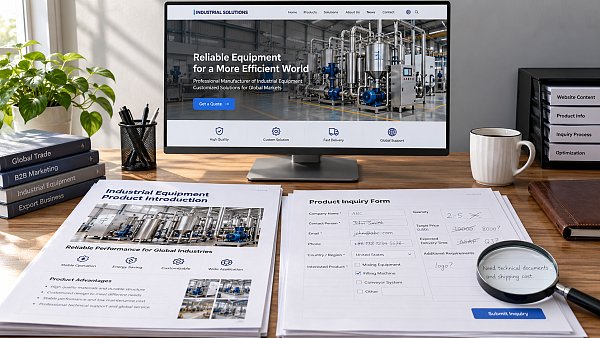
You can proceed in this order: “data collection reliability—page friction—information gaps—experimental validation.” The first three steps produce verifiable deliverables; only the last determines whether a change led to an attributable increase in conversions. Fixing a page can deliver clear value, but that does not in itself prove the size of any growth.
When choosing a solution, ask how it handles small samples
Solutions marketed as AI optimization can range from copy generation to behavioral analytics, experiment management, or dynamic personalization. Technical evaluators should ask vendors to link each feature to its data requirements and evidence of effectiveness, avoiding payment for automation capabilities that cannot yet be used.
- Can historical data be used? Can the solution connect to existing analytics tools, ad platforms, and CRM? Are historical event definitions consistent? How are duplicate inquiries, spam forms, and internal visits handled?
- How does it operate when data is insufficient? Does the system flag insufficient evidence, keep the groups unchanged, or automatically declare a winning version? Does it allow human approval, limit the scope of changes, and enable rollback at any time?
- How is data combined across pages? Do visitors across different languages, products, and channels have similar intent? If data from other pages or customers is used, can the vendor explain the limits of its applicability?
- Can the results be traced? Can the solution export versions, groups, conversion definitions, and change logs, and link form leads to their subsequent sales status?
Aggregating data across pages and using pretrained models can provide useful indications, but they cannot automatically prove that a change is effective on your site. Visitors searching for product specifications may have very different goals from those preparing to request a quote; combining their data without care can lead to misleading conclusions.
For websites where the same provider handles web development, SEO, and advertising, also confirm that all modules use consistent data definitions. During procurement, ask the provider to demonstrate a complete process—from traffic source to form submission and then to qualification as a valid lead—and explain how each step is verified.
During validation, focus changes on one question you can answer
If a low-traffic website changes its headline, form, navigation, and quote request entry point at the same time, even an increase in inquiries will not reveal which change made a difference. A better starting point is to choose a page with clear business value and relatively concentrated traffic, then form a hypothesis around one main obstacle—for example, whether removing unnecessary fields can increase the rate of qualified inquiry submissions.
When randomized tests are feasible, agree in advance on the primary metric, sample requirements, and stopping rules. Frequently checking results and ending a test as soon as one version takes a short-term lead increases the risk of false conclusions. Bayesian analysis and automated traffic allocation also have data requirements and cannot eliminate the uncertainty caused by an insufficient sample.
If traffic is too low to support a controlled experiment within a reasonable timeframe, improvements can be guided by form error rates, completion rates for key steps, user interviews, and sales feedback on lead quality. Before-and-after comparisons can also provide clues, but record changes in ad budgets, channel mix, seasonality, and products; their attribution strength is lower than that of a reliable randomized experiment.
This can help narrow procurement decisions: if the current issues are content gaps and conversion path failures, prioritize diagnostic capabilities, assisted editing, and data integration. Evaluate automated experimentation and personalization only after core pages can consistently accumulate valid events. Asking providers to specify applicability conditions, validation windows, and what they will deliver when evidence is insufficient is more useful for decision-making than accepting a promise of a fixed percentage improvement.
Related Articles
 Is AI conversion rate optimization suitable for low-traffic websites?
 Can AI marketing tools automatically follow up on website inquiries?
 Can an AI advertising assistant in a website-building tool reduce campaign management workload?


Related Products
 Yiyingbao SaaS Intelligent Website Building and Marketing SystemYiyingbao SaaS Intelligent Website Building and Marketing System, AI-powered no-code website building, rapid creation of multilingual B2B international websites in 10 minutes, global server acceleration, AI-powered SEO optimization, helping businesses connect efficiently with global markets. The perfect integration of technology and operation makes building an international trade website remarkably simple
 AI+SEM Intelligent Advertising Marketing SystemAI+SEM drives intelligent ad creation, empowering full-funnel precision advertising marketing. The system automatically generates weekly/monthly reports, AI recommends keywords and target countries, monitors core metrics in real-time with intelligent alerts, and enables one-click high-conversion ad solutions to help quickly acquire customers and improve ROI.
 AI+SEO Dual-Engine System Optimization ServicesYiyingbao’s AI+SEO dual-engine optimization system helps foreign trade enterprises acquire high-quality organic traffic through AI-powered keyword research, content generation, and comprehensive technical optimization, significantly improving search rankings and conversion rates.
 AI+SNS Social Media Marketing SystemYingbao AI+SNS Social Media Marketing System - Precision social capture for the social media era. Supports one-click content synchronization across major platforms like Facebook and LinkedIn. AI intelligently rewrites posts for enhanced relevance. 24/7 AI customer service and user profiling analysis empower businesses to efficiently expand into global markets.
 AI+SEO营销解决方案易营宝AI+SEO营销解决方案,通过AI批量写作、智能生成TDK、精准关键词扩词等功能,全面优化网站SEO效果,提升流量与转化率。助力企业构建高效智能网站新生态。
 AI+SEM Advertising Marketing SolutionsAI+SEM Advertising Marketing Solution leverages AI technology to deeply empower SEM ad campaigns. It automatically generates weekly/monthly reports using AI, presenting account data across multiple dimensions for comprehensive insights into campaign performance and trends. The system precisely recommends keywords and target countries, intelligently generates high-conversion ad copy, and enables one-click activation of efficient campaign plans to help businesses rapidly acquire customers. Simultaneously, it monitors core metrics in real time, intelligently identifies abnormal fluctuations, and issues timely alerts to ensure stable, high-return advertising results.
 Domain Name ServicesEasyWin provides professional domain name services, including intelligent queries, one-stop registration, brand protection, and full lifecycle management, helping businesses build a digital brand image.
 EasyOperate B2C Cross-Border E-Commerce Platform & Independent WebsiteEasyStore B2C Cross-border E-commerce Independent Store is an intelligent website building and cross-border e-commerce integrated solution independently developed by EasyStore Information Technology (Beijing) Co., Ltd. The system is specially designed for small and medium-sized as well as large export enterprises, integrating 'website building, operation, marketing, advertising, and conversion' into one, helping enterprises quickly establish cross-border e-commerce independent stores to achieve brand globalization and global sales growth.
The platform supports multiple languages, multiple currencies, and multi-channel marketing, with built-in AI intelligent translation and SEO optimization systems, suitable for mainstream markets such as Southeast Asia, Europe and America, Latin America, and the Middle East, assisting Chinese manufacturing enterprises in efficiently deploying international e-commerce strategies. SSL证书易营宝提供专业SSL安全证书服务,包括单域名和泛域名证书,确保网站数据传输加密、身份验证和完整性保护,助力企业建立安全可信的在线业务环境。









