









- Which customer acquisition channels will be affected by cross-border marketing trends in 2026?Sep 06, 2026View details
- Which homogenization risks should be considered in an analysis of the AI-powered website building industry?Aug 30, 2026View details
- How Will AI Marketing Trends 2026 Change Advertising Budget AllocationAug 28, 2026View details
- Is the EV SSL certificate market shrinking or upgrading? How should companies assess certificate procurement?Aug 11, 2026View details
- Why the old AMP SEO 2020 practices no longer work and what has changed in current optimization prioritiesAug 02, 2026View details
- How to Choose Topics for an Industry News Section to Attract More Organic Search TrafficJul 29, 2026View details
- Digital Marketing Shenzhen Market Insights: Why Are Companies Expanding Overseas Looking for Growth Teams in Shenzhen?Jul 31, 2026View details
- Can Zhejiang foreign trade independent websites still be developed today? Look at changes in traffic and lead generationJul 28, 2026View details
How to conduct user experience optimization testing?A breakdown of the testing process from heatmaps to form conversion
User experience optimization testing often gets stuck first at scenario judgment
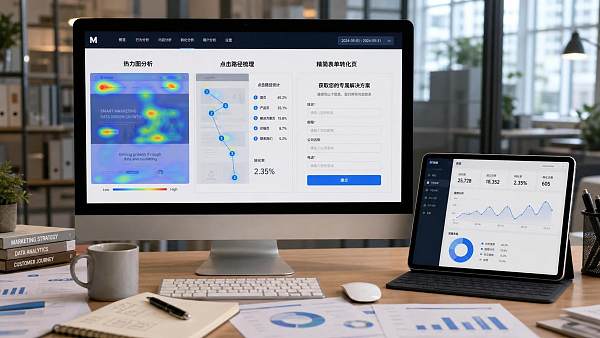
User experience optimization testing is not about making a page look prettier, but about making the path of visiting, understanding, clicking, and submitting smoother. For an integrated website + marketing service business, pages are responsible not only for customer acquisition, but also for screening leads, receiving advertising traffic, and supporting SEO growth.
When traffic declines, some websites have problems with unclear above-the-fold information, while others suffer from overly heavy forms, slow loading, or a mismatch between multilingual pages and target advertising regions. User experience optimization testing needs to be process-based in order to avoid redesigning based on intuition, only to find that the traffic is still there while conversions continue to leak away.
In actual applications, intelligent website building, advertising landing pages, multilingual official websites, and cross-border e-commerce stores may all look like website pages, but the testing focus is not the same. A service system like 易营宝, which covers website building, SEO, advertising, social media, and AI search optimization, is better suited to putting testing back into the real customer acquisition journey, rather than focusing only on single-page metrics.
Under different page types, the focus of user experience optimization testing is not the same
If a page mainly receives Google advertising traffic, the testing focus is usually whether the above-the-fold promise is consistent with the ad copy, whether the buttons are clear enough, and whether the form causes interruptions on mobile devices. What is pursued here is short-path conversion, rather than presenting information as completely as possible.
If a page is responsible for long-term customer acquisition through Google SEO, user experience optimization testing should focus more on content hierarchy, internal link guidance, reading depth, and inquiry trigger positions. Search traffic is more likely to show the behavior of “reading the content first, then deciding whether to leave a lead,” so the judgment method for advertising pages cannot be directly applied.
Multilingual official websites also have another layer of difference. North American users are more accustomed to quickly verifying credibility, European markets pay more attention to compliance information, while traffic from the Middle East and Southeast Asia is often affected by the mobile experience. If user experience optimization testing ignores regional differences, the heatmap may look lively, but the conclusions may be distorted.
Judgment differences in several high-frequency scenarios
Starting with heatmaps makes it easier to discover real page problems
Heatmaps are suitable as the first step in user experience optimization testing because they can quickly reveal where attention lands. If no one clicks above the fold, it usually means the main headline is unclear or the button does not look enough like a button; if a large number of clicks fall on non-clickable areas, it often means the layout is misleading or the information design is biased.
But a heatmap can only tell you “where something is seen”; it cannot directly explain “why there is no conversion.” On B2B inquiry pages, users may repeatedly check qualifications, case studies, and delivery explanations before considering submitting a form; on B2C pages, users may abandon an order because shipping fee information appears too late. Both need to be viewed together with the subsequent path.
A more common judgment method is to view the heatmap together with device dimensions. Concentrated clicks on navigation on desktop do not mean the same applies on mobile. If the above-the-fold section of a multilingual site loads slowly on mobile, the low clicks recorded by the heatmap are sometimes not a content issue, but because the visit has not truly begun.
Click path testing is suitable for judging whether information is truly understood
When the heatmap has already identified hotspot areas, the next step should be click path testing. This is not simply counting page jumps, but checking whether visitors move along the preset path, such as from the product page to the case study page and then to the contact page, or directly from an advertising page to an inquiry form.
If a large amount of traffic stays on middle-layer pages, there are usually two possibilities: first, the information is still not sufficient to support decision-making; second, the prompt for the next action is not clear enough. In integrated website + marketing service projects, this kind of problem is very common, especially during the content expansion stage after intelligent website building. Page content has increased, but the conversion path has been diluted.
For websites doing overseas promotion, it is also especially important to look at source channels. After entering, advertising traffic is more likely to want to complete an action directly, while SEO traffic may first make comparisons. If user experience optimization testing is not segmented by channel, it is easy to misjudge “normal information comparison behavior” as low page efficiency.
Points worth prioritizing in click paths
- Whether the above-the-fold button leads to a real conversion page, rather than another explanatory page.
- Whether the next-step entrance after the core selling point can still be seen after scrolling.
- Whether case studies, pricing, qualifications, logistics, or after-sales information appear before users start to hesitate.
- Whether internal jumps on pages in different languages have breakpoints that return to the default language.
Form conversion testing determines lead quality, not just the number of submissions
For many pages, the problem eventually falls on the form. When user experience optimization testing reaches this step, you cannot only ask “is the form short enough”; you also need to ask “are the fields necessary,” “are expectations after submission clear,” and “is mobile input convenient.” A form is a conversion entry point, not an information collection checklist.
B2B inquiry pages usually need information such as industry, requirements, and purchase volume, but once there are too many fields, first-time visitors will hesitate. A more reliable approach is layered collection: first obtain contact information and core requirements, then complete the rest through follow-up processes. Cross-border e-commerce stores pay more attention to whether address, payment, coupon code, and shipping fee prompts cause interruptions.
This step is also suitable for A/B testing. For example, changing button copy to a clearer action prompt, reducing the form from nine items to five, or moving the submission area from the bottom to after the selling point section. As long as the testing goal is clear, user experience optimization testing can shift from “page changes” to “conversion validation.”
What is most easily overlooked during implementation is not the tool, but the judgment criteria
One common misjudgment is looking at only a single metric. A high click-through rate does not mean high lead quality; a long dwell time does not necessarily mean a good experience, and may simply mean information is hard to find. User experience optimization testing must look at heatmaps, paths, form data, and source channels together for the conclusion to hold up.
Another easily overlooked point is treating similar pages as the same type of need. Multilingual official websites and advertising landing pages may both have forms, but the former places more emphasis on building trust, while the latter places more emphasis on conversion speed. If modules are copied directly, two opposite problems often appear: content that is too lengthy or information that is insufficient.
For websites that continuously carry out global promotion, the testing cycle should also be extended a little. Holidays in different regions, advertising rhythms, and changes in search intent can all affect the results. The advantage of a system like 易营宝, which combines website building, SEO, advertising, and AI optimization, lies in its ability to view page experience together with overall marketing data, reducing deviations caused by local optimization.
A truly executable user experience optimization testing process
If you want to make user experience optimization testing stable, you can proceed with a concise process: first distinguish page scenarios, then confirm conversion goals, then review heatmaps, click paths, and form performance in order, and finally decide which elements to change. The order cannot be reversed; otherwise, it is easy to change the page first and then look for reasons to explain the data.
- Define the goal first: inquiry, order placement, appointment, or download. Different goals require different testing criteria.
- Then break down traffic sources: SEO, advertising, social media, and direct visits should be observed separately.
- Next, look at page evidence: hot areas, scrolling, exit points, and form abandonment points.
- Finally, validate in small steps: change only a small number of variables each time and retain comparison data.
A more practical approach is to start with pages that have high traffic, low conversion, and high business value. First make key pages work smoothly, and then replicate the approach to other pages. This can both control testing costs and make it easier to establish judgment standards suitable for the website itself.
When a page needs to serve SEO while also receiving advertising and social media traffic, user experience optimization testing needs even more segmented judgment based on specific scenarios. The next step can be to first sort out page types, channel sources, key actions, and form structures, identify the nodes that truly affect conversion, and then enter continuous optimization, rather than making a one-time major overhaul of the entire site.
Related Articles



Related Products
 Yiyingbao SaaS Intelligent Website Building and Marketing SystemYiyingbao SaaS Intelligent Website Building and Marketing System, AI-powered no-code website building, rapid creation of multilingual B2B international websites in 10 minutes, global server acceleration, AI-powered SEO optimization, helping businesses connect efficiently with global markets. The perfect integration of technology and operation makes building an international trade website remarkably simple
 AI+SEM Intelligent Advertising Marketing SystemAI+SEM drives intelligent ad creation, empowering full-funnel precision advertising marketing. The system automatically generates weekly/monthly reports, AI recommends keywords and target countries, monitors core metrics in real-time with intelligent alerts, and enables one-click high-conversion ad solutions to help quickly acquire customers and improve ROI.
 AI+SEO Dual-Engine System Optimization ServicesYiyingbao’s AI+SEO dual-engine optimization system helps foreign trade enterprises acquire high-quality organic traffic through AI-powered keyword research, content generation, and comprehensive technical optimization, significantly improving search rankings and conversion rates.
 AI+SNS Social Media Marketing SystemYingbao AI+SNS Social Media Marketing System - Precision social capture for the social media era. Supports one-click content synchronization across major platforms like Facebook and LinkedIn. AI intelligently rewrites posts for enhanced relevance. 24/7 AI customer service and user profiling analysis empower businesses to efficiently expand into global markets.
 AI+SEO营销解决方案易营宝AI+SEO营销解决方案,通过AI批量写作、智能生成TDK、精准关键词扩词等功能,全面优化网站SEO效果,提升流量与转化率。助力企业构建高效智能网站新生态。
 AI+SEM Advertising Marketing SolutionsAI+SEM Advertising Marketing Solution leverages AI technology to deeply empower SEM ad campaigns. It automatically generates weekly/monthly reports using AI, presenting account data across multiple dimensions for comprehensive insights into campaign performance and trends. The system precisely recommends keywords and target countries, intelligently generates high-conversion ad copy, and enables one-click activation of efficient campaign plans to help businesses rapidly acquire customers. Simultaneously, it monitors core metrics in real time, intelligently identifies abnormal fluctuations, and issues timely alerts to ensure stable, high-return advertising results.
 Domain Name ServicesEasyWin provides professional domain name services, including intelligent queries, one-stop registration, brand protection, and full lifecycle management, helping businesses build a digital brand image.
 EasyOperate B2C Cross-Border E-Commerce Platform & Independent WebsiteEasyStore B2C Cross-border E-commerce Independent Store is an intelligent website building and cross-border e-commerce integrated solution independently developed by EasyStore Information Technology (Beijing) Co., Ltd. The system is specially designed for small and medium-sized as well as large export enterprises, integrating 'website building, operation, marketing, advertising, and conversion' into one, helping enterprises quickly establish cross-border e-commerce independent stores to achieve brand globalization and global sales growth.
The platform supports multiple languages, multiple currencies, and multi-channel marketing, with built-in AI intelligent translation and SEO optimization systems, suitable for mainstream markets such as Southeast Asia, Europe and America, Latin America, and the Middle East, assisting Chinese manufacturing enterprises in efficiently deploying international e-commerce strategies. SSL证书易营宝提供专业SSL安全证书服务,包括单域名和泛域名证书,确保网站数据传输加密、身份验证和完整性保护,助力企业建立安全可信的在线业务环境。









