









- Hengqin Cooperation Zone Shares Cross-Border E-Commerce Developments, Focusing on Macao-Hengqin Collaboration and International MarketsOct 24, 2026View details
- A Shenyang study highlights the development of the “cross-border e-commerce + industrial cluster” modelOct 24, 2026View details
- Three China Advertising Association GEO group standards take effect on October 23Oct 24, 2026View details
- Amazon Raises Fulfillment Fees Twice, Yet the Median Platform Fee Remains Around 40%Oct 22, 2026View details
- AliExpress and YouTube Partner to Expand Marketing Opportunities for Chinese Brands Going GlobalOct 22, 2026View details
- Publicis says AI marketing is developing at two speeds, with agentic AI helping win clientsOct 21, 2026View details
What should you prepare before requesting a free website design quote?
When a project enters the initiation, redesign, or overseas market expansion stage, the person in charge often needs to obtain a website development budget as soon as possible to arrange procurement, scheduling, and resources. However, simply writing “we want to build an official website” and submitting a request a free website design quote usually results only in proposals with very broad ranges: some include page design only, while others by default include content migration, language versions, or promotional configurations. As items are added later, both the budget and timeline will change.
Before requesting a free quote, the most important thing is not to determine the page style first, but to clearly define the project scope: what business problems the website needs to solve, who will provide the content, which functions must be launched, which can be deferred, and whether continuous lead generation will be needed after launch. The more specific the preparation, the easier it is for suppliers to break down costs using the same criteria, and the faster the project owner can determine whether different quotations are comparable.
Turn “building a website” into a project goal that can be assessed
Website objectives directly affect information architecture, functional complexity, and ongoing maintenance costs. For example, a B2B website aimed at engineering buyers usually focuses on product specifications, application scenarios, qualification document downloads, and inquiry paths; an online store aimed at end consumers must also consider product management, order processes, payments, logistics, and after-sales information. Even if the two types of websites have a similar number of pages, their development and testing work are not the same.
When submitting a quote request, use one or two sentences to clarify priorities, such as “We want overseas buyers to find materials by product category and submit inquiries,” “We need to organize existing Chinese materials for multilingual presentation,” or “Advertising landing pages need to be managed separately from the main website.” Do not write only “enhance brand image” or “make it look more premium,” as such descriptions cannot determine the workload and make it difficult to establish acceptance criteria.
Five categories of information to confirm before requesting a quote
You do not need to complete all page copy at the outset, but if the following information is missing, quotations often include conservative allowances or exclude key items from the basic quote.
- Existing assets: Whether you already have a domain name, server, old website backend, brand visual guidelines, product images, and videos; whether pages, articles, files, or user data need to be migrated from the old website.
- Content scale: The expected number of product lines, product detail pages, case study pages, news pages, and downloadable materials; whether content will be provided internally, organized jointly, or require writing and translation on your behalf.
- Languages and markets: Which languages are required, whether only interface translation is needed, or whether product materials, contact details, inquiry fields, and content priorities must be adjusted for different countries. Multilingual websites are not simply duplicated pages; different management approaches can also result in significant cost differences.
- Functional scope: Inquiry forms, file downloads, site search, membership, quote requests, product filtering, e-commerce transactions, and ERP or CRM integration—which of these are essential for launch. Whether technical documentation for the interfaces already exists should also be stated in advance.
- Post-launch activities: Whether search optimization, advertising, social media traffic generation, or ongoing content updates are planned. If the website needs to support promotion, page speed, conversion forms, tracking, and landing page management cannot be added temporarily only after launch.
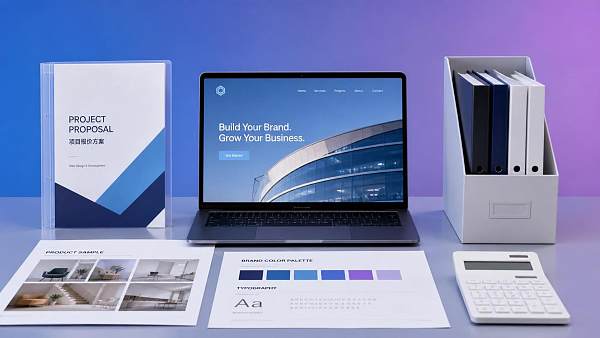
The most frequently underestimated aspect is material preparation. If product models, specifications, certification documents, and application images are scattered across different departments, incomplete information may only be discovered after design has begun, requiring repeated page revisions. For engineering-related projects, it should also be made clear which materials can be disclosed publicly and which parameters must be confirmed by the technical department, to avoid inconsistencies between marketing pages and actual delivery capabilities.
Do not provide only one total budget figure
A budget range is not intended to drive down the quotation, but to help the other party determine whether standard modules, custom development, or phased implementation should be prioritized. A practical approach is to provide an acceptable range and indicate what “must be completed in the first phase” and what can be “implemented if budget remains.” For example, the first phase may focus on core product presentation, inquiries, and two language versions, while the online store, complex filtering, or system integration are listed for the second phase. The resulting proposal will be closer to the actual procurement decision, rather than packaging every idea into a single delivery.
Use the same requirements summary to request quotes from multiple suppliers
To avoid suppliers quoting based on different interpretations, it is recommended to prepare a requirements summary of no more than two pages and send it together with the request. It may include the current website address or reference pages, target markets, core audience tasks, expected sections and languages, required functions, available materials, desired launch date, and phased budget considerations. Reference websites can help convey style and interaction preferences, but you should specify whether you are referring to their layout, information structure, or functions, rather than simply sending a few links and asking the other party to guess.
When a project involves approval by multiple departments, decision-makers and feedback methods should also be determined in advance. Who approves design drafts, who verifies product materials, and whether the legal or brand department needs to participate will all affect the actual timeline. Internal authority and process definition can refer to the approach to responsibility allocation discussed in An Exploration of Development Strategies for Establishing Internal Control Systems in Public Institutions: clarifying submission, review, and confirmation responsibilities during the quotation stage can reduce rework later caused by unclear sources of feedback.
After receiving a free quote, review the scope before the price
A low price does not necessarily mean lower costs, and a high price does not necessarily include more services. The project owner should ask the supplier to break down the quotation into verifiable deliverables rather than listing only “website design and development.” In particular, confirm whether it includes responsive pages, basic search settings, form notifications, testing, and launch support; whether backend accounts, source files, or exportable data will be delivered; and how additional pages, function changes, and urgent requests will be charged.
If two proposals differ substantially in price, first mark the differences in the same comparison table: whether one includes content migration while the other provides only templates; whether one includes independent proofreading for multiple languages while the other only provides a translation entry point; whether one includes promotional pages and data tracking while the other includes neither. Price comparisons are meaningful only after the scope has been aligned.
Items to quickly check before submission
- Whether the project goal can be explained in one sentence and whether the primary actions the website needs to support after launch can be determined.
- Whether functions required at launch have been separated from functions that can be deferred.
- Whether responsibility for providing content, images, translations, and technical materials has been clarified.
- Whether the budget is a total cap, a phased budget, or only intended to obtain an initial proposal.
- Whether the quotation is required to list the delivery scope, exclusions, timeline assumptions, and subsequent maintenance arrangements.
After preparing this information, submitting a request a free website design quote makes it easier for suppliers to provide an executable scope and schedule. Even if all details cannot yet be confirmed, undecided items should be marked as pending confirmation rather than assumed to be included; this is more conducive to subsequent progress than obtaining a seemingly low total price with unclear boundaries.
Related Articles
 How can a company website introduction page help visitors quickly understand the core business?
 How Can You Prevent a Video News Module from Slowing Down Page Loading?
 When choosing a website development company in Xiamen, how should you agree on source code delivery?

Related Products
 Yiyingbao SaaS Intelligent Website Building and Marketing SystemYiyingbao SaaS Intelligent Website Building and Marketing System, AI-powered no-code website building, rapid creation of multilingual B2B international websites in 10 minutes, global server acceleration, AI-powered SEO optimization, helping businesses connect efficiently with global markets. The perfect integration of technology and operation makes building an international trade website remarkably simple
 AI+SEM Intelligent Advertising Marketing SystemAI+SEM drives intelligent ad creation, empowering full-funnel precision advertising marketing. The system automatically generates weekly/monthly reports, AI recommends keywords and target countries, monitors core metrics in real-time with intelligent alerts, and enables one-click high-conversion ad solutions to help quickly acquire customers and improve ROI.
 AI+SEO Dual-Engine System Optimization ServicesYiyingbao’s AI+SEO dual-engine optimization system helps foreign trade enterprises acquire high-quality organic traffic through AI-powered keyword research, content generation, and comprehensive technical optimization, significantly improving search rankings and conversion rates.
 AI+SNS Social Media Marketing SystemYingbao AI+SNS Social Media Marketing System - Precision social capture for the social media era. Supports one-click content synchronization across major platforms like Facebook and LinkedIn. AI intelligently rewrites posts for enhanced relevance. 24/7 AI customer service and user profiling analysis empower businesses to efficiently expand into global markets.
 AI+SEO营销解决方案易营宝AI+SEO营销解决方案,通过AI批量写作、智能生成TDK、精准关键词扩词等功能,全面优化网站SEO效果,提升流量与转化率。助力企业构建高效智能网站新生态。
 AI+SEM Advertising Marketing SolutionsAI+SEM Advertising Marketing Solution leverages AI technology to deeply empower SEM ad campaigns. It automatically generates weekly/monthly reports using AI, presenting account data across multiple dimensions for comprehensive insights into campaign performance and trends. The system precisely recommends keywords and target countries, intelligently generates high-conversion ad copy, and enables one-click activation of efficient campaign plans to help businesses rapidly acquire customers. Simultaneously, it monitors core metrics in real time, intelligently identifies abnormal fluctuations, and issues timely alerts to ensure stable, high-return advertising results.
 Domain Name ServicesEasyWin provides professional domain name services, including intelligent queries, one-stop registration, brand protection, and full lifecycle management, helping businesses build a digital brand image.
 EasyOperate B2C Cross-Border E-Commerce Platform & Independent WebsiteEasyStore B2C Cross-border E-commerce Independent Store is an intelligent website building and cross-border e-commerce integrated solution independently developed by EasyStore Information Technology (Beijing) Co., Ltd. The system is specially designed for small and medium-sized as well as large export enterprises, integrating 'website building, operation, marketing, advertising, and conversion' into one, helping enterprises quickly establish cross-border e-commerce independent stores to achieve brand globalization and global sales growth.
The platform supports multiple languages, multiple currencies, and multi-channel marketing, with built-in AI intelligent translation and SEO optimization systems, suitable for mainstream markets such as Southeast Asia, Europe and America, Latin America, and the Middle East, assisting Chinese manufacturing enterprises in efficiently deploying international e-commerce strategies. SSL证书易营宝提供专业SSL安全证书服务,包括单域名和泛域名证书,确保网站数据传输加密、身份验证和完整性保护,助力企业建立安全可信的在线业务环境。









