









- Levanta’s Inaugural China Summit Held in Shenzhen, Focusing on AI and Cross-Border Brand GrowthOct 20, 2026View details
- The October Edition of the 2026 GGE Shenzhen Cross-Border E-Commerce Expo OpensOct 20, 2026View details
- Dongguan’s foreign trade imports and exports reached RMB 1.29 trillion in the first three quarters, a record high for the same periodOct 20, 2026View details
- Liaoning Holds Province-Wide Meeting to Advance Cross-Border E-Commerce, Emphasizing the Need to Explore Differentiated Development PathsOct 20, 2026View details
- Advanced Manufacturing Seizes Global Opportunities as Guangdong’s Q3 Foreign Trade Surpasses RMB 3 Trillion for the First TimeOct 20, 2026View details
- Can the average annual growth rate reflect real opportunities in overseas markets?Oct 07, 2026View details
How to balance brand experience, compliant content, and repeat purchase conversions when building an independent website for a beauty brand
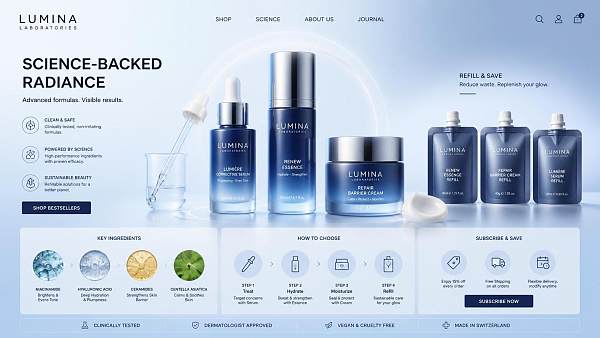
When building an independent website for a beauty brand, it is easy to fall into a "two-sided imbalance": the homepage visuals may be refined enough, yet users cannot find products suited to them; content may be comprehensive, yet compliance risks increase because claims about efficacy, ingredients, or privacy are not sufficiently cautious. For brands preparing to expand overseas or upgrade their official website, the core principle should be clear: first incorporate brand messaging, compliance boundaries, and conversion paths into one unified page logic, then decide on design styles and functional modules.
When users enter a beauty brand's independent website, they often make several judgments within a short time: whether products suit their skin type or usage scenario, whether the brand is trustworthy, whether shipping and returns are clear, and whether they can continue receiving valuable services after placing an order. If pages only emphasize brand tone, the conversion journey will break down; if they only pursue promotions, brand trust will be diluted. Building an independent website for a beauty brand should not separate a "brand site" from a "sales site" into two approaches. Instead, content should explain, guide selection, and encourage repeat purchases.
First determine what can be said and what must be communicated with caution
A common issue with beauty product detail pages is not too little information, but a disorganized information hierarchy. Ingredients, skin feel, suitable users, usage methods, precautions, and brand philosophy are piled together, making it difficult for users to quickly understand product value and causing inconsistent wording in subsequent updates by the operations team.
A more prudent approach is to establish content fields and review rules before building the website. Each product should at least consistently manage its product name, specifications, ingredient information, usage steps, suitable skin or hair types, circumstances in which it may not be suitable, storage requirements, and after-sales information. For efficacy-related terms such as "improve," "repair," and "reduce," the scope of wording should be determined based on actual supporting product documentation, avoiding absolute, medicalized, or unsubstantiated claims.
- Brand story pages should focus on ingredient concepts, R&D thinking, and value propositions, rather than replacing product evidence with emotional descriptions.
- Product detail pages should first answer: "What is it? Who is it for? How is it used? When can it be used? In what circumstances is it not recommended?"
- Ingredient information pages should explain formulation characteristics, but should not directly equate a single ingredient with a certain outcome.
- User review modules should avoid presenting individual experiences as universal results and retain backend mechanisms for reviewing, hiding, or removing abnormal content.
Multilingual websites in particular cannot rely solely on mechanical translation. The same product claim, warning, unit format, and shipping statement may require different versions in different markets. Localization personnel and legal or compliance reviewers should participate in confirming key pages, while content version records should be retained in the backend to avoid using different wording on advertising pages, social media landing pages, and product pages.
Turn "good-looking" into purchase actions users can complete
The visual system remains important, but its role is not to fill the above-the-fold area; it is to help users establish recognition and understanding. The first screen can retain hero visuals, core product lines, or brand propositions, while also providing clear entry points, such as shopping by skin type, shopping by care needs, viewing sets, or accessing usage guides. Users should not have to read a long brand story before knowing what to click next.
Product listing pages are well suited to filtering tasks. In addition to price, volume, and product line, it is advisable to provide dimensions relevant to actual purchasing decisions, such as dryness, oiliness, sensitivity, pre-makeup needs, nighttime care, or travel portability. Filter options should not be excessive, much less use vague labels to create a sense of complexity; every filter condition should correspond to a real product attribute.
Product detail pages should reduce users' "secondary searches"
When users need to leave the website to search for the order of use, pairing methods, or whether a product is suitable for a certain skin condition, their purchase intent often declines. An effective product detail page usually presents information in decision-making order: first explain the product positioning and primary feel of use, then show suitable conditions, key ingredients, or formulation concepts, followed by dosage, frequency, pairing recommendations, and precautions.
For example, a set should not only list the included individual products; it should also explain the morning and evening order of use, the role of each product, and which products are not recommended to layer in the same care routine. For new customers, brief needs-based Q&A or shopping guidance can be provided; for existing customers, replenishment reminders, recommended usage cycles, and related product recommendations can be offered through accounts, email subscriptions, or order pages.
Repeat purchases are not about frequently issuing coupons, but about identifying key post-purchase touchpoints
Beauty repurchases depend on continued use, and website operations should distinguish between different states, such as first purchases, the repeat-purchase threshold, product pairings, and inactive users. Sending the same set of promotional messages to every user often only reduces communication efficiency and can easily undermine the brand's price perception.
To achieve the above segmentation, the website needs to connect product, order, member behavior, and content engagement data, but the scope of collection should match its purpose. When building the website, it should clearly state which data are used and for what personalized content or marketing communications, and provide subscription management, preference adjustment, and necessary deletion or opt-out options. Privacy notices should not be ignored after being hidden in the footer; registration, subscriptions, checkout, and advertising remarketing should all remain consistent.
When selecting a solution, focus on whether the backend can support long-term operations
When making decisions, companies often focus on the number of templates, visual effects, and launch speed, while overlooking the subsequent cost of content maintenance. What truly affects the efficiency of an independent website is whether the backend enables business personnel to quickly modify product fields, manage multilingual versions, build campaign pages, view channel sources, and complete daily iterations without frequently relying on developers.
When selecting website-building and marketing services, it is advisable to test actual operational workflows rather than only viewing demonstration pages: whether required fields can be generated simultaneously when a new product goes live; whether a campaign can configure an independent landing page and tracking parameters; whether shipping fees, currencies, and tax notices can be set separately for different countries; and whether user subscriptions, orders, and on-site behavior can form a usable data view. When budgets, data definitions, and system permission allocation are involved, the discussion approach regarding information governance in Reflections on advancing financial management informatization in public institutions in the context of big data can also be referenced to clarify data responsibilities and management processes in advance.
In addition, advertising landing pages and brand official websites do not need to be exact copies of each other. The former should shorten the decision path around a single product, product line, or audience need, while the latter carries brand trust, product comparison, and member retention. The two types of pages should use consistent visual and compliance-content baselines, but may differ in information length, button placement, and recommendation logic.
Use a round of real tasks to check for breakpoints before launch
Before officially launching campaigns, the team can complete each step along the user journey: enter the page from a mobile device, filter products by skin type, review ingredients and usage methods, add products to the cart, switch markets or languages, complete checkout, and then enter the account to review orders and subscription settings. This process can quickly reveal issues such as overly small fonts, ineffective filters, unclear shipping information, conflicting discount rules, and hard-to-find privacy access points.
The value of building an independent website for a beauty brand does not lie in creating a glamorous page all at once, but in ensuring that every content update, new product launch, and user return operates according to clear rules. Brand experience establishes preference, compliant content maintains trust, and data and operational mechanisms turn a single purchase into a sustainable relationship.
Related Articles


Related Products
 Yiyingbao SaaS Intelligent Website Building and Marketing SystemYiyingbao SaaS Intelligent Website Building and Marketing System, AI-powered no-code website building, rapid creation of multilingual B2B international websites in 10 minutes, global server acceleration, AI-powered SEO optimization, helping businesses connect efficiently with global markets. The perfect integration of technology and operation makes building an international trade website remarkably simple
 AI+SEM Intelligent Advertising Marketing SystemAI+SEM drives intelligent ad creation, empowering full-funnel precision advertising marketing. The system automatically generates weekly/monthly reports, AI recommends keywords and target countries, monitors core metrics in real-time with intelligent alerts, and enables one-click high-conversion ad solutions to help quickly acquire customers and improve ROI.
 AI+SEO Dual-Engine System Optimization ServicesYiyingbao’s AI+SEO dual-engine optimization system helps foreign trade enterprises acquire high-quality organic traffic through AI-powered keyword research, content generation, and comprehensive technical optimization, significantly improving search rankings and conversion rates.
 AI+SNS Social Media Marketing SystemYingbao AI+SNS Social Media Marketing System - Precision social capture for the social media era. Supports one-click content synchronization across major platforms like Facebook and LinkedIn. AI intelligently rewrites posts for enhanced relevance. 24/7 AI customer service and user profiling analysis empower businesses to efficiently expand into global markets.
 AI+SEO营销解决方案易营宝AI+SEO营销解决方案,通过AI批量写作、智能生成TDK、精准关键词扩词等功能,全面优化网站SEO效果,提升流量与转化率。助力企业构建高效智能网站新生态。
 AI+SEM Advertising Marketing SolutionsAI+SEM Advertising Marketing Solution leverages AI technology to deeply empower SEM ad campaigns. It automatically generates weekly/monthly reports using AI, presenting account data across multiple dimensions for comprehensive insights into campaign performance and trends. The system precisely recommends keywords and target countries, intelligently generates high-conversion ad copy, and enables one-click activation of efficient campaign plans to help businesses rapidly acquire customers. Simultaneously, it monitors core metrics in real time, intelligently identifies abnormal fluctuations, and issues timely alerts to ensure stable, high-return advertising results.
 Domain Name ServicesEasyWin provides professional domain name services, including intelligent queries, one-stop registration, brand protection, and full lifecycle management, helping businesses build a digital brand image.
 EasyOperate B2C Cross-Border E-Commerce Platform & Independent WebsiteEasyStore B2C Cross-border E-commerce Independent Store is an intelligent website building and cross-border e-commerce integrated solution independently developed by EasyStore Information Technology (Beijing) Co., Ltd. The system is specially designed for small and medium-sized as well as large export enterprises, integrating 'website building, operation, marketing, advertising, and conversion' into one, helping enterprises quickly establish cross-border e-commerce independent stores to achieve brand globalization and global sales growth.
The platform supports multiple languages, multiple currencies, and multi-channel marketing, with built-in AI intelligent translation and SEO optimization systems, suitable for mainstream markets such as Southeast Asia, Europe and America, Latin America, and the Middle East, assisting Chinese manufacturing enterprises in efficiently deploying international e-commerce strategies. SSL证书易营宝提供专业SSL安全证书服务,包括单域名和泛域名证书,确保网站数据传输加密、身份验证和完整性保护,助力企业建立安全可信的在线业务环境。









