









- Which customer acquisition channels will be affected by cross-border marketing trends in 2026?Sep 06, 2026View details
- Which homogenization risks should be considered in an analysis of the AI-powered website building industry?Aug 30, 2026View details
- How Will AI Marketing Trends 2026 Change Advertising Budget AllocationAug 28, 2026View details
- Is the EV SSL certificate market shrinking or upgrading? How should companies assess certificate procurement?Aug 11, 2026View details
- Why the old AMP SEO 2020 practices no longer work and what has changed in current optimization prioritiesAug 02, 2026View details
- How to Choose Topics for an Industry News Section to Attract More Organic Search TrafficJul 29, 2026View details
- Digital Marketing Shenzhen Market Insights: Why Are Companies Expanding Overseas Looking for Growth Teams in Shenzhen?Jul 31, 2026View details
- Can Zhejiang foreign trade independent websites still be developed today? Look at changes in traffic and lead generationJul 28, 2026View details
How long does it take to implement a Headless CMS global website solution?5 factors affecting the schedule
How Long Does It Take to Implement a Headless CMS Global Website Solution? First Understand the Scheduling Logic
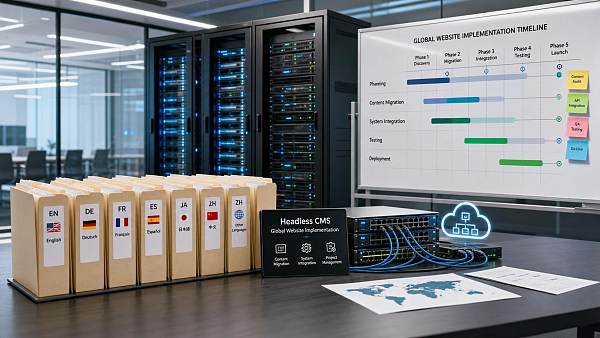
How long does it take to implement a Headless CMS global website solution? This is the first question many companies ask when launching a global official website, multilingual site, or overseas marketing platform.
Based on experience, there is no fixed answer that applies to every project. A short cycle may take 4 to 8 weeks, complex projects usually require 3 to 6 months, and projects involving cross-regional and multi-system collaboration may take even longer.
The assessment direction mentioned in the introduction is critical. How long it takes to implement a Headless CMS global website solution mainly depends on requirements complexity, the number of language sites, the depth of system integration, the scale of content migration, and the testing process.
If the early stage focuses only on the feature list while ignoring these variables, the schedule may look very optimistic, but once development actually begins, delays can easily continue to occur, and pressure on the budget and team collaboration will also increase.
Therefore, when discussing how long it takes to implement a Headless CMS global website solution, you should not only ask how long development will take to complete. More importantly, you need to see whether the entire delivery chain, from requirements confirmation to launch acceptance, is controllable.
1. Requirements Complexity Determines Whether the Project Is Standard Delivery or Custom Engineering
Many project delays are not caused by development speed, but by unclear requirements definition. For how long it takes to implement a Headless CMS global website solution, the first-level assessment is whether the requirements boundaries are stable.
If it is only a corporate website, multilingual pages, basic forms, news publishing, and SEO structure configuration, the implementation pace is usually relatively fast.
But if it also needs to connect to a product database, regional content distribution, role permissions, dealer portals, inquiry routing, and marketing automation, then it is no longer simple website building, but business-system-level construction.
In actual business, the easiest items to underestimate are “hidden requirements.” For example, version approval, regional content publishing restrictions, page component reuse rules, and differentiated SEO templates will all extend the implementation cycle.
- Standardized official website: usually can go live in 4 to 8 weeks.
- Marketing-oriented multilingual site: usually 8 to 12 weeks.
- Cross-system collaborative platform: usually more than 12 weeks.
To answer more accurately how long it takes to implement a Headless CMS global website solution, it is best to first complete requirements breakdown in the early stage, clearly separating “must go live” from “subsequent iterations.” This is more realistic than pursuing something large and comprehensive from the very beginning.
2. The Number of Languages and Sites Directly Affects Content Modeling and Delivery Pace
For how long it takes to implement a Headless CMS global website solution, the second key factor is the number of languages and regional sites. Many teams think it is enough to add a few more language packs, but in reality it is far more than just translation.
Global websites usually encounter differences in content structures across different markets. North America values case studies and white papers, Europe emphasizes compliance and privacy, while the Middle East and Southeast Asia often require localized expression and different conversion paths.
This also means that multilingual projects are not just about translating pages. They require replanning fields, components, URL structures, hreflang, regional content management rules, and publishing processes.
If a unified template and unified content logic are used, the cycle increase is still relatively linear. If each regional site requires partial customization, the implementation time will increase significantly.
Therefore, when evaluating how long it takes to implement a Headless CMS global website solution, you cannot only report the number of languages. You also need to explain whether templates and content models are shared, and whether there are requirements for independent regional operations.
3. System Integration Depth Often Takes More Time Than Front-End Development
Judging from recent changes, global websites are increasingly becoming part of a marketing middle platform. For how long it takes to implement a Headless CMS global website solution, the third variable is the depth of system integration.
If the website is only responsible for display and customer acquisition, the difficulty is relatively controllable. But when it needs to connect to CRM, ERP, PIM, advertising platforms, email systems, and data analytics tools, implementation complexity will rise rapidly.
The reason is very direct. Whether interface standards are unified, whether legacy systems are open, whether fields can be mapped, and how abnormal data is handled all need to be confirmed one by one.
Many project plans only write “connect to CRM,” but after the actual start, it is discovered that account systems, lead deduplication, form distribution, permission synchronization, and log tracking need to be supplemented, all of which affect the launch time.
- Insufficient completeness of interface documentation.
- Slow third-party response and difficulty coordinating joint debugging windows.
- Messy fields in legacy systems and high cleansing costs.
- Temporary increases in security and permission requirements.
Therefore, how long it takes to implement a Headless CMS global website solution cannot be judged only by the number of front-end pages. What truly creates the gap is often integration and joint debugging in the middle and back stages.
4. The Scale of Content Migration Determines Whether Queuing Bottlenecks Will Occur Before Launch
The fourth factor that is often underestimated is content migration. For how long it takes to implement a Headless CMS global website solution, many times the bottleneck is not technical implementation, but the handling of old content.
If the old site has little content and a clear structure, migration is relatively smooth. But once it involves thousands of articles, multilingual product pages, and case resource download pages, the workload can become very substantial.
A more obvious signal is that much historical content is not suitable for direct relocation. Old URLs, metadata, image naming, tag systems, duplicate content, and invalid pages all need to be reorganized.
If the migration strategy is not defined in advance, as the launch approaches, problems such as content supplementation, page rework, and missing SEO mapping can easily occur, causing the entire project to enter a waiting state.
- First conduct a content inventory and distinguish what to retain, rewrite, and discard.
- Establish migration templates and unify fields and naming rules.
- Handle redirects and SEO mapping in advance.
- Include content acceptance in the schedule instead of leaving it to the end.
If the company itself still relies on SEO organic traffic, then when answering how long it takes to implement a Headless CMS global website solution, content migration must be estimated as an independent stage rather than an incidental task.
5. Testing and Collaboration Processes Determine Whether the Project Can Be Delivered as Planned
The fifth factor is testing and organizational collaboration. For how long it takes to implement a Headless CMS global website solution, the final answer often depends on whether the acceptance process is mature, not whether the code has already been completed.
Before a global website goes live, it is usually necessary to check multi-device adaptation, page performance, SEO fundamentals, form links, permission control, regional access, tracking data, and consistency of content display.
If there are many participants, such as the headquarters marketing department, overseas teams, IT department, legal department, and third-party service providers all involved at the same time, communication costs will increase significantly.
Many delays are not caused by major failures, but by “small issues constantly flowing back.” Navigation is changed today, form fields are changed tomorrow, regional copy is changed the day after tomorrow, and as a result, every round requires retesting.
To control the implementation cycle of a Headless CMS global website solution, a relatively effective method is to move acceptance criteria forward, clearly define responsibility boundaries, and fix the review rhythm.
How to More Accurately Estimate the Implementation Cycle of a Headless CMS Global Website Solution
If you want to make schedule estimation more stable, it is recommended to first establish an assessment table based on five dimensions, and then set high, medium, and low complexity for each item.
For integrated website and marketing service projects, this approach is especially important. This is because a website is not an isolated asset. It usually also carries brand presentation, SEO indexing, advertising traffic reception, inquiry conversion, and global content operations.
AI-driven enterprise-level SaaS intelligent website building and overseas marketing digital platforms like 易营宝 usually place website building, SEO, advertising, social media, and content growth within the same delivery logic, which is more conducive to controlling the cycle and subsequent promotion efficiency.
Returning to the original question: how long does it take to implement a Headless CMS global website solution? A more practical answer is: first clarify the requirements, then evaluate the five variables, and finally schedule by stage, instead of giving an idealized date all at once.
When requirements boundaries, site scale, integration depth, content migration, and testing mechanisms are all identified in advance, the cycle assessment will be closer to real delivery and more beneficial to subsequent decision-making, resource allocation, and risk control.
If the project is in the selection stage, the most worthwhile thing to do first is not to ask about the shortest timeline, but to sort out these five items clearly. Only then will discussing how long it takes to implement a Headless CMS global website solution have real reference value.
Related Articles


Related Products
 Yiyingbao SaaS Intelligent Website Building and Marketing SystemYiyingbao SaaS Intelligent Website Building and Marketing System, AI-powered no-code website building, rapid creation of multilingual B2B international websites in 10 minutes, global server acceleration, AI-powered SEO optimization, helping businesses connect efficiently with global markets. The perfect integration of technology and operation makes building an international trade website remarkably simple
 AI+SEM Intelligent Advertising Marketing SystemAI+SEM drives intelligent ad creation, empowering full-funnel precision advertising marketing. The system automatically generates weekly/monthly reports, AI recommends keywords and target countries, monitors core metrics in real-time with intelligent alerts, and enables one-click high-conversion ad solutions to help quickly acquire customers and improve ROI.
 AI+SEO Dual-Engine System Optimization ServicesYiyingbao’s AI+SEO dual-engine optimization system helps foreign trade enterprises acquire high-quality organic traffic through AI-powered keyword research, content generation, and comprehensive technical optimization, significantly improving search rankings and conversion rates.
 AI+SNS Social Media Marketing SystemYingbao AI+SNS Social Media Marketing System - Precision social capture for the social media era. Supports one-click content synchronization across major platforms like Facebook and LinkedIn. AI intelligently rewrites posts for enhanced relevance. 24/7 AI customer service and user profiling analysis empower businesses to efficiently expand into global markets.
 AI+SEO营销解决方案易营宝AI+SEO营销解决方案,通过AI批量写作、智能生成TDK、精准关键词扩词等功能,全面优化网站SEO效果,提升流量与转化率。助力企业构建高效智能网站新生态。
 AI+SEM Advertising Marketing SolutionsAI+SEM Advertising Marketing Solution leverages AI technology to deeply empower SEM ad campaigns. It automatically generates weekly/monthly reports using AI, presenting account data across multiple dimensions for comprehensive insights into campaign performance and trends. The system precisely recommends keywords and target countries, intelligently generates high-conversion ad copy, and enables one-click activation of efficient campaign plans to help businesses rapidly acquire customers. Simultaneously, it monitors core metrics in real time, intelligently identifies abnormal fluctuations, and issues timely alerts to ensure stable, high-return advertising results.
 Domain Name ServicesEasyWin provides professional domain name services, including intelligent queries, one-stop registration, brand protection, and full lifecycle management, helping businesses build a digital brand image.
 EasyOperate B2C Cross-Border E-Commerce Platform & Independent WebsiteEasyStore B2C Cross-border E-commerce Independent Store is an intelligent website building and cross-border e-commerce integrated solution independently developed by EasyStore Information Technology (Beijing) Co., Ltd. The system is specially designed for small and medium-sized as well as large export enterprises, integrating 'website building, operation, marketing, advertising, and conversion' into one, helping enterprises quickly establish cross-border e-commerce independent stores to achieve brand globalization and global sales growth.
The platform supports multiple languages, multiple currencies, and multi-channel marketing, with built-in AI intelligent translation and SEO optimization systems, suitable for mainstream markets such as Southeast Asia, Europe and America, Latin America, and the Middle East, assisting Chinese manufacturing enterprises in efficiently deploying international e-commerce strategies. SSL证书易营宝提供专业SSL安全证书服务,包括单域名和泛域名证书,确保网站数据传输加密、身份验证和完整性保护,助力企业建立安全可信的在线业务环境。









