









- Is the EV SSL certificate market shrinking or upgrading? How should companies assess certificate procurement?Aug 11, 2026View details
- Why the old AMP SEO 2020 practices no longer work and what has changed in current optimization prioritiesAug 02, 2026View details
- How to Choose Topics for an Industry News Section to Attract More Organic Search TrafficJul 29, 2026View details
- Digital Marketing Shenzhen Market Insights: Why Are Companies Expanding Overseas Looking for Growth Teams in Shenzhen?Jul 31, 2026View details
- Can Zhejiang foreign trade independent websites still be developed today? Look at changes in traffic and lead generationJul 28, 2026View details
- What New Signals Are Emerging in Enterprise Services SaaS Marketing ReportsJul 27, 2026View details
Germany’s packaging EPR declaration upgraded: QR code binding required from August 12
The German EAR Foundation will adjust the registration requirements for packaging EPR from August 12, 2026: all newly submitted packaging EPR applications must be associated with a dedicated digital identifier QR code on the homepage or product page of the company's overseas independent website. For companies operating in the German market, relying on German retail channels such as Lidl and Aldi, or currently advancing packaging compliance declarations, this change is not merely an additional document requirement; it means that the registration process itself is becoming more stringent and deserves immediate attention.
New QR Code Association Requirement for Registration Applications
According to the information currently available, from August 12, 2026, the German EAR Foundation will impose a new association requirement on newly submitted packaging EPR registration applications: the application must be linked to a dedicated digital identifier QR code on the homepage or product page of the company's overseas independent website. The QR code must directly lead to the EPR registration number, compliance declaration, and packaging material composition list. At the same time, registrations without a completed association will be automatically rejected by the system. The purpose of this adjustment is to strengthen regulatory oversight and reduce the occurrence of “shell declarations.”
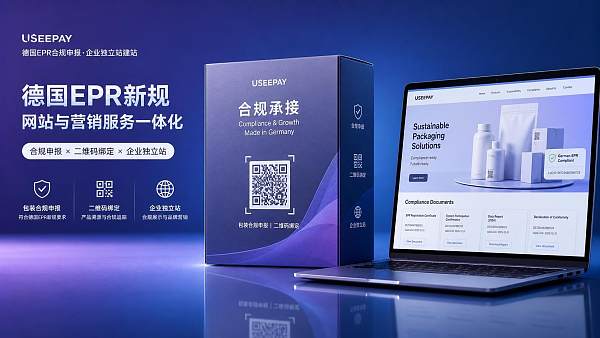
Which Business Processes Will Feel the Impact First
Cross-Border Sellers and Direct-Trading Companies
For companies selling directly to the German market, the impact will first be felt in two areas: registration applications and website information synchronization. In the past, companies could proceed after completing EPR registration and submitting basic materials. Now, they must also confirm that their independent website pages have a digital identifier that can be associated with the application, and that the page content can accommodate the registration number, compliance declaration, and packaging material information. For companies that rely on online independent websites for customer acquisition, conversion, and compliance disclosure, this means that website maintenance has become part of their compliance work.
Packaging Supply Chains and Processing Operations
Packaging EPR focuses on the packaging material composition list, which shifts attention further back to packaging design, procurement, and document archiving. Processing and manufacturing companies, packaging suppliers, and entities responsible for product shipments need to confirm earlier whether packaging material information can be accurately organized and presented externally. If internal documents, material descriptions, and website information are inconsistent, both the registration application and subsequent verification may be affected.
Channel Access and Fulfillment Communication
The information explicitly mentions that access to German retail channels such as Lidl and Aldi may be affected. This indicates that EPR registration is no longer solely an internal matter for the compliance department; it will directly affect channel reviews, customer communication, and fulfillment schedules. For companies already entering or preparing to enter German channels, a rejected registration may delay listing plans, replenishment arrangements, and contract progress. As a result, checking the completeness of materials in advance will become more important.
What Should Companies Pay Closer Attention to Now
First Confirm Whether the Independent Website Can Support Compliance Disclosure
The issue currently deserving greater attention is whether the homepage or product pages of the company's overseas independent website are already capable of displaying EPR-related information. This involves more than simply determining whether a QR code can be placed on the page. It also includes whether the content after redirection is stable and whether it corresponds to the registration number, compliance declaration, and packaging material composition list. For companies already operating in the German market, the website structure and information hierarchy may need to be reviewed again.
Information Consistency Is More Important Than a Single Submission
The core of this requirement is not merely to “add a code,” but to place the registration materials, compliance declaration, and packaging information within the same traceable chain. Based on the analysis, companies will need to focus on checking whether there are information gaps between procurement, legal, operations, and website maintenance. As long as there is any inconsistency among the registration information, page content, or packaging description, the declaration result may be affected.
Treat Rejection Risks as Process Risk Management
Since the system will automatically reject applications without an association, companies cannot view this as an ordinary request for supplementary materials. Instead, it should be treated as a prerequisite for the process. For companies that already have German customers, channel arrangements, or warehousing plans, internal review, customer alignment, and document archiving should be completed before submission. Otherwise, the impact of registration failure may extend beyond resubmitting a single document and could delay the entire business chain.
More Like a Periodic Signal of Tighter Regulation
Based on the analysis, this information is currently better understood as a periodic signal of upgraded regulatory practices rather than a purely technical adjustment. It moves EPR from “back-office declaration” toward a state that is “verifiable, traceable, and externally visible,” indicating that compliance disclosure is becoming part of the registration system. For the industry, the key issue to monitor is not the QR code itself, but whether more similar traceability requirements will subsequently be incorporated into other EPR or market-access processes.
The Change Can Initially Be Understood as a Compliance-First Requirement
Overall, the signal released by Germany's latest upgrade is clear: packaging EPR registration is moving toward more rigorous and comprehensive verification, and companies can no longer handle registration, website, and packaging materials separately. At present, the change is best understood as a compliance rule update that requires immediate follow-up, as well as a reference point for observing whether German market-access standards will continue to become stricter.
Scope of the Materials on Which This Article Is Based
This article was generated based on the information title, event date, and event summary provided by the user, and does not cite any specific official links that were not included in the input. Source types typically related to this type of information include official announcements, corporate announcements, industry association information, reports from authoritative media, and documents from standards organizations. For this particular item, the specific official source link was not provided in the input and still requires continuous verification.
Related Articles
Related Products
 Yiyingbao SaaS Intelligent Website Building and Marketing SystemYiyingbao SaaS Intelligent Website Building and Marketing System, AI-powered no-code website building, rapid creation of multilingual B2B international websites in 10 minutes, global server acceleration, AI-powered SEO optimization, helping businesses connect efficiently with global markets. The perfect integration of technology and operation makes building an international trade website remarkably simple
 AI+SEM Intelligent Advertising Marketing SystemAI+SEM drives intelligent ad creation, empowering full-funnel precision advertising marketing. The system automatically generates weekly/monthly reports, AI recommends keywords and target countries, monitors core metrics in real-time with intelligent alerts, and enables one-click high-conversion ad solutions to help quickly acquire customers and improve ROI.
 AI+SEO Dual-Engine System Optimization ServicesYiyingbao’s AI+SEO dual-engine optimization system helps foreign trade enterprises acquire high-quality organic traffic through AI-powered keyword research, content generation, and comprehensive technical optimization, significantly improving search rankings and conversion rates.
 AI+SNS Social Media Marketing SystemYingbao AI+SNS Social Media Marketing System - Precision social capture for the social media era. Supports one-click content synchronization across major platforms like Facebook and LinkedIn. AI intelligently rewrites posts for enhanced relevance. 24/7 AI customer service and user profiling analysis empower businesses to efficiently expand into global markets.
 AI+SEO营销解决方案易营宝AI+SEO营销解决方案,通过AI批量写作、智能生成TDK、精准关键词扩词等功能,全面优化网站SEO效果,提升流量与转化率。助力企业构建高效智能网站新生态。
 AI+SEM Advertising Marketing SolutionsAI+SEM Advertising Marketing Solution leverages AI technology to deeply empower SEM ad campaigns. It automatically generates weekly/monthly reports using AI, presenting account data across multiple dimensions for comprehensive insights into campaign performance and trends. The system precisely recommends keywords and target countries, intelligently generates high-conversion ad copy, and enables one-click activation of efficient campaign plans to help businesses rapidly acquire customers. Simultaneously, it monitors core metrics in real time, intelligently identifies abnormal fluctuations, and issues timely alerts to ensure stable, high-return advertising results.
 Domain Name ServicesEasyWin provides professional domain name services, including intelligent queries, one-stop registration, brand protection, and full lifecycle management, helping businesses build a digital brand image.
 EasyOperate B2C Cross-Border E-Commerce Platform & Independent WebsiteEasyStore B2C Cross-border E-commerce Independent Store is an intelligent website building and cross-border e-commerce integrated solution independently developed by EasyStore Information Technology (Beijing) Co., Ltd. The system is specially designed for small and medium-sized as well as large export enterprises, integrating 'website building, operation, marketing, advertising, and conversion' into one, helping enterprises quickly establish cross-border e-commerce independent stores to achieve brand globalization and global sales growth.
The platform supports multiple languages, multiple currencies, and multi-channel marketing, with built-in AI intelligent translation and SEO optimization systems, suitable for mainstream markets such as Southeast Asia, Europe and America, Latin America, and the Middle East, assisting Chinese manufacturing enterprises in efficiently deploying international e-commerce strategies. SSL证书易营宝提供专业SSL安全证书服务,包括单域名和泛域名证书,确保网站数据传输加密、身份验证和完整性保护,助力企业建立安全可信的在线业务环境。









