









- Which customer acquisition channels will be affected by cross-border marketing trends in 2026?Sep 06, 2026View details
- Which homogenization risks should be considered in an analysis of the AI-powered website building industry?Aug 30, 2026View details
- How Will AI Marketing Trends 2026 Change Advertising Budget AllocationAug 28, 2026View details
- Is the EV SSL certificate market shrinking or upgrading? How should companies assess certificate procurement?Aug 11, 2026View details
- Why the old AMP SEO 2020 practices no longer work and what has changed in current optimization prioritiesAug 02, 2026View details
- How to Choose Topics for an Industry News Section to Attract More Organic Search TrafficJul 29, 2026View details
Is resell multilingual SEO suitable for agencies as a long-term business?
Judging from recent changes in inquiry structures and website development requirements, resell multilingual seo has the potential to become a long-term business, but the prerequisite is not as simple as “translating one language into multiple languages and then launching the site.” The areas that truly generate sustained cooperation cycles are usually language version planning, keyword mapping, page template control, technical indexing, and ongoing maintenance. If any one of these links is handled carelessly, initial conversions may still occur, but the room for renewals and expansion will quickly narrow.
The fundamental reason multilingual SEO is becoming a stable service category is that the way content is organized on international websites has changed. In the past, many websites built only an English version and left traffic from other regions to advertising or third-party platforms. Today, more and more projects directly require localized pages in German, French, Spanish, Arabic, Japanese, and other languages, with each version having independent indexing capabilities. This means the business is no longer limited to “delivering webpages,” but extends to URL structures, internal navigation, hreflang tags, metadata translation, landing page expansion, regional keyword database updates, and long-term calibration based on search habits in different regions.
Why This Direction Is More Likely to Generate Ongoing Services
A common problem with single-language SEO is that its scope is clearly defined. After a page goes live, clients often understand the subsequent work as publishing a few articles or modifying a few titles. The delivery scope of resell multilingual seo is naturally longer because every additional language creates a set of independent yet interconnected tasks: whether the keyword database needs to be reclassified, whether category names should be localized, whether product parameter tables are suitable for direct translation, and whether logistics information, delivery lead times, installation requirements, and after-sales terms need to be rewritten for different languages. These tasks cannot be made completely stable through one-time delivery.
Especially in integrated website and marketing service scenarios, multilingual SEO is often tied to website development, content production, advertising landing pages, and social media traffic acquisition pages. If the page structure is modified for SEO, the quality score, bounce rate, and conversion path of advertising landing pages will also be affected; if traffic from social media short links lands on pages without explanations in the local language, the time on page is generally lower. In other words, these projects naturally span departments and processes, leaving more room for subsequent iteration and making it easier for cooperation to evolve from one-off outsourcing into monthly or quarterly services.
Long-Term Value Lies Not in the Number of Languages, but in “Maintainability”
The most common misjudgment in the market is treating the number of multilingual versions as the core selling point. In reality, five language versions sharing one chaotic template are far less valuable than two language versions with standardized page structures and clearly accumulated content assets. The greatest long-term risk is launching quickly through machine translation and batch publishing, only to leave English fragments in URLs, titles, descriptions, breadcrumbs, image alt text, and internal search entrances. Such a website may have many pages in the short term, but it is difficult to maintain in the long term, and every subsequent redesign requires extensive rework.
Valuable resell multilingual seo usually begins by dividing the website into several levels: basic brand pages, category pages, product detail pages, industry application pages, and knowledge content pages. It then determines which levels require full-language coverage and which only need versions for key regions. If content such as material descriptions, equipment parameters, machining accuracy, package dimensions, transportation methods, installation requirements, and maintenance cycles is synchronized across the entire site without distinction, translation costs can easily become high, updates can be delayed, and outdated versions can remain. Only after the page hierarchy and update frequency are clearly designed can subsequent services remain stable.
This principle applies across many industries. For example, for professional research content such as Research on the Current Status and Optimization Strategies of Human Resource Management in Public Hospitals, if the content enters a multilingual publishing process, the first considerations should be terminology consistency, the intended readers, and the search context—not simply expanding the number of languages. Once an SEO page is separated from content structure management, the larger the scale becomes, the more difficult it is to manage later.
Several Technical Points Most Likely to Be Underestimated During Delivery
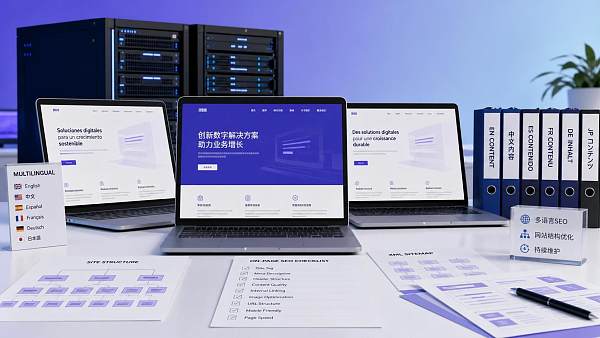
If the service only sells “multilingual article publishing,” the business usually cannot last long. If technical details are included in the delivery, customer retention can be significantly higher. The first thing to examine is not the copy, but the site structure. For directory-based structures such as /de/ and /fr/, it is necessary to determine whether they are consistent, whether secondary categories can be named independently in each language, whether breadcrumbs change accordingly, and whether pagination tags and canonical tags remain consistent. All of these factors affect indexing efficiency.
The next issue is hreflang. Many projects do not fail because they cannot write the tags, but because the implementation is incomplete: language and region codes are mixed, self-referencing annotations are missing, return tags are not properly closed, or mobile and desktop versions point to inconsistent destinations. After launch, all pages may appear accessible, but search engines may be unable to accurately understand the correspondence between versions, resulting in incorrect display or even competition between the English page and pages in smaller languages.
The next area is the content publishing process. When different language versions are maintained by different teams, the most common problems are not translation errors but unsynchronized publishing times, missing fields, and unreplaced attachments. For example, a parameter table may still use images in the source language, a PDF manual may not be localized, transportation restriction clauses may not be updated, or contact form fields may not match the language of the landing page. These may appear to be minor issues externally, but they directly affect page credibility and inquiry quality.
Why This Type of Business Is Better Suited to Being Tied to Website Development Capabilities
If resell multilingual seo is separated from the website infrastructure, it can easily fall into a pure content procurement model, putting pressure on profit margins and repeat business. By contrast, as long as website templates, field structures, and publishing mechanisms are controllable, many long-term problems can be prevented in advance through the front end and back end. For example, if fields such as technical specifications, materials, dimensions, tolerances, compatible voltage, and packaging methods on product detail pages are entered in a structured manner, they can be called by field in multilingual versions. When updates are needed later, only the source data needs to be changed instead of reworking each page.
This is also why integrated website and marketing services offer greater potential than selling SEO separately. When one language site expands into multiple regions, related issues often arise involving domain strategies, server locations, image compression, script loading, form routing, and internal recommendation logic. People who only handle keywords often find it difficult to address these issues. Those who can handle both website development and promotion are more likely to turn the business into a long-term partnership.
In addition, multilingual websites are more sensitive to page speed. Common problems include oversized font files, repeated loading of regional scripts, images that have not been compressed separately for different versions, and maps or chat plugins blocking the initial viewport. If the site targets markets with unstable network conditions, speed issues will surface before ranking issues. Such projects usually do not end after one delivery, because page performance, content expansion, and indexing stability all require repeated adjustment.
The Market Is Moving Toward “Refined Multilingualization,” Not Comprehensive Expansion
Based on changes in demand, multilingual SEO is not simply about adding more languages; it places greater emphasis on regional segmentation. Search terms in the same language are not necessarily interchangeable across markets. This is particularly true for industrial equipment, building materials, components, and cross-border retail, where purchasing habits, specification terminology, and units of measurement may all differ. Spanish pages targeting Europe and Latin America often need to be handled separately; English pages targeting North America, the Middle East, and Southeast Asia may also require different landing terms and page priorities.
This transforms resell multilingual seo from “translation delivery” into “regional content operations.” For example, installation instructions for a certain product may focus more on certifications and voltage parameters in one market, while another market may care more about transport packaging, spare parts lead times, and after-sales accessibility. The page content does not necessarily need to be longer, but it must be closer to local search logic. As long as these differences exist, the business is unlikely to be replaced by one-time delivery.
Another trend worth noting is that AI-generated content has made multilingual page expansion easier while also magnifying the risks of low-quality pages. The concentrated launch of large numbers of semantically similar and structurally repetitive pages may dilute site content, making indexing and rankings less stable. At this point, the value of a long-term business lies not in “generating content quickly,” but in determining which pages are worth generating, which fields require manual proofreading, and which technical descriptions must not be rewritten automatically. This judgment itself is central to sustainable services.
Projects That Do Not Last Often Get Stuck at Collaboration Points
Many people underestimate the collaboration costs involved in multilingual SEO. From keyword database confirmation to launch, a page usually passes through several stages, including content organization, translation, localization review, upload and formatting, technical checks, indexing submission, and data review. If there is no unified version management process, problems such as new pages being overwritten by outdated documents, parameters not being synchronized after product revisions, and inaccurate transportation lead times or inventory descriptions will occur frequently. This is especially true for international websites, manufacturing websites, and cross-border e-commerce stores, where product specifications often change faster than content teams expect.
Therefore, whether this business is suitable for long-term operation depends not only on market demand but also on whether the delivery model can withstand version iteration. Teams that can accumulate glossaries, page templates, language style requirements, technical checklists, and launch review records are more likely to keep projects reusable. Conversely, if every project starts from scratch with coordination, translation, publishing, and acceptance, marginal costs will rise as the project grows, making it difficult to maintain stability.
Another practical issue is content access. The back end, CDN, form system, and product system of many websites are not unified, and language pages are distributed across different modules. What appears to be SEO work may actually involve replacing image resources, synchronizing inventory status, updating logistics information, and controlling the versions of downloadable documents. Whoever can incorporate these non-obvious tasks into the process will have a better chance of turning resell multilingual seo into a sustainable service category.
Whether It Is Suitable for Long-Term Operation Depends on Whether a “Maintenance Contract Logic” Can Be Established
If the business revolves only around the initial batch of keywords and pages, its lifecycle is usually short. A model that can operate over the long term generally includes three types of ongoing actions: expanding languages or regions, expanding page levels, and revising existing pages. For example, after a new product line is added, should the existing multilingual category pages rebuild their internal links? After logistics rules change, should delivery information in the relevant languages be synchronized? If the indexing of certain older pages is unstable, should their titles, summaries, and body paragraphs be rewritten? Such work will not all be completed during the first delivery.
So, is resell multilingual seo suitable for long-term business? If it is viewed only as “selling multilingual pages,” the answer is uncertain. If it is placed within a continuous system of website structure, content governance, technical indexing, and regional operations, it does have long-term potential, and the further it develops, the more it depends on process control and detailed execution. The market does not lack people who can launch pages; what it lacks is the delivery capability to keep multilingual websites indexable, updateable, and scalable over the long term.
Related Articles


Related Products
 Yiyingbao SaaS Intelligent Website Building and Marketing SystemYiyingbao SaaS Intelligent Website Building and Marketing System, AI-powered no-code website building, rapid creation of multilingual B2B international websites in 10 minutes, global server acceleration, AI-powered SEO optimization, helping businesses connect efficiently with global markets. The perfect integration of technology and operation makes building an international trade website remarkably simple
 AI+SEM Intelligent Advertising Marketing SystemAI+SEM drives intelligent ad creation, empowering full-funnel precision advertising marketing. The system automatically generates weekly/monthly reports, AI recommends keywords and target countries, monitors core metrics in real-time with intelligent alerts, and enables one-click high-conversion ad solutions to help quickly acquire customers and improve ROI.
 AI+SEO Dual-Engine System Optimization ServicesYiyingbao’s AI+SEO dual-engine optimization system helps foreign trade enterprises acquire high-quality organic traffic through AI-powered keyword research, content generation, and comprehensive technical optimization, significantly improving search rankings and conversion rates.
 AI+SNS Social Media Marketing SystemYingbao AI+SNS Social Media Marketing System - Precision social capture for the social media era. Supports one-click content synchronization across major platforms like Facebook and LinkedIn. AI intelligently rewrites posts for enhanced relevance. 24/7 AI customer service and user profiling analysis empower businesses to efficiently expand into global markets.
 AI+SEO营销解决方案易营宝AI+SEO营销解决方案,通过AI批量写作、智能生成TDK、精准关键词扩词等功能,全面优化网站SEO效果,提升流量与转化率。助力企业构建高效智能网站新生态。
 AI+SEM Advertising Marketing SolutionsAI+SEM Advertising Marketing Solution leverages AI technology to deeply empower SEM ad campaigns. It automatically generates weekly/monthly reports using AI, presenting account data across multiple dimensions for comprehensive insights into campaign performance and trends. The system precisely recommends keywords and target countries, intelligently generates high-conversion ad copy, and enables one-click activation of efficient campaign plans to help businesses rapidly acquire customers. Simultaneously, it monitors core metrics in real time, intelligently identifies abnormal fluctuations, and issues timely alerts to ensure stable, high-return advertising results.
 Domain Name ServicesEasyWin provides professional domain name services, including intelligent queries, one-stop registration, brand protection, and full lifecycle management, helping businesses build a digital brand image.
 EasyOperate B2C Cross-Border E-Commerce Platform & Independent WebsiteEasyStore B2C Cross-border E-commerce Independent Store is an intelligent website building and cross-border e-commerce integrated solution independently developed by EasyStore Information Technology (Beijing) Co., Ltd. The system is specially designed for small and medium-sized as well as large export enterprises, integrating 'website building, operation, marketing, advertising, and conversion' into one, helping enterprises quickly establish cross-border e-commerce independent stores to achieve brand globalization and global sales growth.
The platform supports multiple languages, multiple currencies, and multi-channel marketing, with built-in AI intelligent translation and SEO optimization systems, suitable for mainstream markets such as Southeast Asia, Europe and America, Latin America, and the Middle East, assisting Chinese manufacturing enterprises in efficiently deploying international e-commerce strategies. SSL证书易营宝提供专业SSL安全证书服务,包括单域名和泛域名证书,确保网站数据传输加密、身份验证和完整性保护,助力企业建立安全可信的在线业务环境。









