









- Hengqin Cooperation Zone Shares Cross-Border E-Commerce Developments, Focusing on Macao-Hengqin Collaboration and International MarketsOct 24, 2026View details
- A Shenyang study highlights the development of the “cross-border e-commerce + industrial cluster” modelOct 24, 2026View details
- Three China Advertising Association GEO group standards take effect on October 23Oct 24, 2026View details
- Amazon Raises Fulfillment Fees Twice, Yet the Median Platform Fee Remains Around 40%Oct 22, 2026View details
- AliExpress and YouTube Partner to Expand Marketing Opportunities for Chinese Brands Going GlobalOct 22, 2026View details
- Publicis says AI marketing is developing at two speeds, with agentic AI helping win clientsOct 21, 2026View details
Resell Multilingual SEO: How Agencies Can Build Deliverable, Profitable Multilingual SEO Services
When an agency receives a client's request to expand overseas, it often encounters a familiar tension: the client wants to "do multilingual SEO," but what they want is not simply to translate English pages into German, French, or Spanish. They want to be genuinely found, understood, and trusted in different markets. For agencies, the challenge of resell multilingual seo has never been merely adding a few languages; it is about how to package complex localized search strategies as standardized products while balancing delivery quality, collaboration costs, and profit margins.
This is especially true when serving export manufacturers, cross-border brands, and B2B exporters, whose clients often target North America, Europe, the Middle East, or Southeast Asia simultaneously. Relying on a single English website to cover every region may generate initial exposure, but it is difficult to capture searches from local users with clear purchasing intent. By establishing a replicable multilingual SEO resale system, agencies can gradually evolve from "providers of website building or advertising execution" into long-term partners in their clients' global growth journeys.
Multilingual SEO Resale Is Not About Selling “Translated Pages”
Many teams at the initial stage tend to understand multilingual SEO as translating content, creating language directories, and submitting pages for indexing. Such services may appear easy to price, but they are difficult to retain on an ongoing basis. This is because different languages often represent different search expressions, purchasing habits, competitive environments, and compliance requirements.
For example, for the same type of industrial equipment, North American buyers may search by application scenario, while German purchasing professionals pay greater attention to models, standards, and technical specifications. Search terms in Latin American markets may lean more toward solutions or price inquiries. If Chinese or English keywords are simply converted word for word, pages may be indexed but still fail to match the actual search intent of local users.
Therefore, when designing resell multilingual seo services, agencies should shift the delivery object from "a number of translated pieces of content" to "visibility growth infrastructure for target markets." This means that each language should at least answer four questions: Who are the target customers? What terms do they use to search? Which pages should capture those searches? How should the pages be continuously refined after launch?
Segment Clients First to Avoid Entering a Language-Volume Race from the Start
When clients say, "We want to offer eight languages," it does not mean all eight should be launched at the same time. Agencies should first help clients identify the initial pilot languages based on market priorities, existing order sources, website foundations, and product complexity. For most enterprises with limited resources, establishing a complete content and technical loop for "English plus one high-potential regional language" is usually more valuable than rolling everything out at once.
- Lead-generation B2B companies: Prioritize product terms, industry solution terms, and long-tail keywords related to certifications or specifications. Key pages typically include product details, application scenarios, capability introductions, and inquiry landing pages.
- Cross-border retail and brand websites: In addition to category terms, consider consumer search habits, delivery and after-sales information, review content, and the presentation of local currencies and payment information.
- Companies with existing English traffic: Search terms, visitor regions, and conversion paths can be used to work backward and determine priority languages, avoiding decisions on market sequence based solely on management preferences.
This step is crucial for agencies to build trust. Rather than directly promising "full-language coverage," it is better to clearly explain which markets are worth prioritizing, which languages should temporarily retain only basic presentation, and which pages must be localized first. Clients are more likely to accept a growth path with clear trade-offs and are more willing to pay for ongoing optimization.
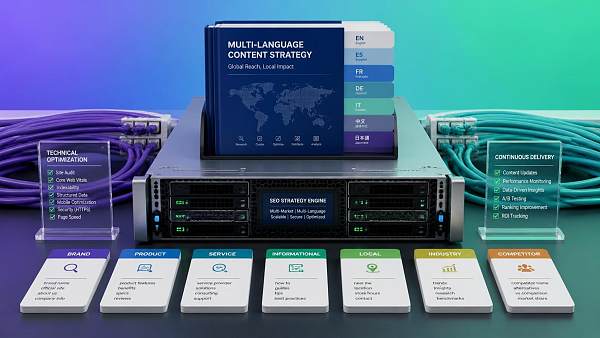
A Resellable Delivery Package Should Be Divided into Three Connected Layers
The first layer is market and keyword strategy. Each language market needs its own independent keyword pool rather than a mechanical copy of an English keyword list. Agencies can organize keywords into five categories—brand, product, problem, application, and purchasing decision—and label their search intent, competitiveness, commercial value, and corresponding pages. In this way, clients no longer see a vague promise to "improve rankings," but a roadmap that shows what to do first and why.
The second layer is on-site technology and content coverage. Language directories, URL rules, hreflang annotations, sitemaps, page speed, mobile experience, and duplicate-content handling all affect how search engines understand multilingual pages. At the content level, "core commercial pages" should be differentiated from "continuous growth content": the former emphasizes product value, applications, and conversion actions, while the latter can continuously expand around industry issues, selection guides, technical knowledge, and regional purchasing concerns.
The third layer is monitoring, iteration, and explainable reporting. Multilingual SEO is not about waiting for results after pages are published. Agencies need to track indexing, rankings, organic traffic, page engagement, and inquiry sources across different markets, promptly identifying issues such as "impressions without clicks," "traffic without conversions," or "being outranked by pages in the wrong language." What truly makes clients willing to renew is often not an attractive report, but the ability to understand what was done each month, what was discovered, and how adjustments will be made next month.
Move Technical Capabilities to the Backend So Sales Can Stay Lightweight on the Frontend
What agencies worry about most is that multilingual projects may seem to have a good average order value, but are actually overwhelmed by keyword organization, content scheduling, technical troubleshooting, and repeated communication. The solution is neither to outsource every aspect nor to let sales promise too much, but to choose foundational capabilities that can systematize repetitive work.
For example, an AI+SEO dual-engine system optimization service for foreign trade enterprises can incorporate keyword competitiveness and commercial value assessment, keyword matrix generation, multilingual content production, TDK optimization, image ALT tags, intelligent internal linking, and technical SEO audits into a single workflow. Agencies can retain the parts where they create the most value—market judgment, client communication, content review, and growth strategy—while allowing systems to assist with high-frequency, standardized execution tasks.
It should be emphasized that AI does not mean "automatic publishing." Particularly in sectors such as industrial products, medical-related products, and technical equipment, multilingual content still requires review of terminology, parameters, regulatory wording, and brand tone. A good resale model uses AI to shorten the time from strategy to first draft and from issue discovery to repair recommendations, rather than using low-cost content to dilute the credibility of a client's website.
Profit Comes from Clear Boundaries, Not Lower Delivery Costs
A profitable resell multilingual seo service requires clear service boundaries before pricing. It is advisable to divide projects into a launch phase, a build phase, and an ongoing optimization phase: the launch phase completes market diagnosis, language planning, and technical inspection; the build phase delivers core page optimization, content frameworks, and necessary multilingual configurations; and the ongoing phase focuses on content updates, data reviews, issue resolution, and opportunity expansion.
At the same time, separate "what is included" from "what can be added as needed." For example, a basic package may limit the initial languages, number of core pages, monthly content output, and reporting frequency; additional languages, large-scale product page restructuring, local media backlinks, in-depth content editing, or complex store modifications can be assessed separately as add-on items. Such a design not only prevents teams from endlessly taking on ad hoc requests, but also gives clients natural upgrade opportunities as their business grows.
Agencies should also establish an internal acceptance checklist: whether pages can be crawled, whether language versions are correctly linked, whether keywords have clear landing pages, whether content has undergone terminology validation, and whether conversion entry points suit local users. By standardizing these checks, new team members will not have to rely solely on experience when taking over projects, and service quality will be more stable.
Beware of Three Practices That Seem Convenient but Actually Harm Long-Term Delivery
First, pricing only by language without assessing market complexity. Even for the same language, the level of competition, the difficulty of content review, and the workload of website modifications may be entirely different. Second, focusing only on rankings without considering whether business pages can capture traffic. It is not difficult to gain low-intent traffic; the challenge is directing high-value searches to pages that can generate inquiries or orders. Third, treating a multilingual website as a one-time project. Search environments, product lines, and competitors all change, and websites without ongoing maintenance can easily cause early investments to gradually lose effectiveness.
For dealers, distributors, and agencies seeking to expand the scope of their overseas marketing services, multilingual SEO does not have to become a capital-intensive business that is difficult to control. The key is to break down localization strategy, technical execution, content production, and data review into clear modules, then combine and sell them in ways suited to their own client structures. Leveraging Yiyingbao's integrated capabilities in AI website building, SEO, advertising, and overseas social media, agencies can more smoothly connect the two service stages of "website launch" and "continuous customer acquisition," enabling clients' globalization goals to go beyond simply adding more language entry points and gradually form overseas digital assets that can be searched, understood, and more likely to convert.
Related Articles
 Can You Become a Website Development Reseller Without a Technical Team? What Support Should You Focus On?
 What Support Should You Verify Before Partnering with an Export Website Development Service Provider?
 How to Apply for Exclusive Agency Rights for Foreign Trade Websites? First Confirm Regional Authorization



Related Products
 Yiyingbao SaaS Intelligent Website Building and Marketing SystemYiyingbao SaaS Intelligent Website Building and Marketing System, AI-powered no-code website building, rapid creation of multilingual B2B international websites in 10 minutes, global server acceleration, AI-powered SEO optimization, helping businesses connect efficiently with global markets. The perfect integration of technology and operation makes building an international trade website remarkably simple
 AI+SEM Intelligent Advertising Marketing SystemAI+SEM drives intelligent ad creation, empowering full-funnel precision advertising marketing. The system automatically generates weekly/monthly reports, AI recommends keywords and target countries, monitors core metrics in real-time with intelligent alerts, and enables one-click high-conversion ad solutions to help quickly acquire customers and improve ROI.
 AI+SEO Dual-Engine System Optimization ServicesYiyingbao’s AI+SEO dual-engine optimization system helps foreign trade enterprises acquire high-quality organic traffic through AI-powered keyword research, content generation, and comprehensive technical optimization, significantly improving search rankings and conversion rates.
 AI+SNS Social Media Marketing SystemYingbao AI+SNS Social Media Marketing System - Precision social capture for the social media era. Supports one-click content synchronization across major platforms like Facebook and LinkedIn. AI intelligently rewrites posts for enhanced relevance. 24/7 AI customer service and user profiling analysis empower businesses to efficiently expand into global markets.
 AI+SEO营销解决方案易营宝AI+SEO营销解决方案,通过AI批量写作、智能生成TDK、精准关键词扩词等功能,全面优化网站SEO效果,提升流量与转化率。助力企业构建高效智能网站新生态。
 AI+SEM Advertising Marketing SolutionsAI+SEM Advertising Marketing Solution leverages AI technology to deeply empower SEM ad campaigns. It automatically generates weekly/monthly reports using AI, presenting account data across multiple dimensions for comprehensive insights into campaign performance and trends. The system precisely recommends keywords and target countries, intelligently generates high-conversion ad copy, and enables one-click activation of efficient campaign plans to help businesses rapidly acquire customers. Simultaneously, it monitors core metrics in real time, intelligently identifies abnormal fluctuations, and issues timely alerts to ensure stable, high-return advertising results.
 Domain Name ServicesEasyWin provides professional domain name services, including intelligent queries, one-stop registration, brand protection, and full lifecycle management, helping businesses build a digital brand image.
 EasyOperate B2C Cross-Border E-Commerce Platform & Independent WebsiteEasyStore B2C Cross-border E-commerce Independent Store is an intelligent website building and cross-border e-commerce integrated solution independently developed by EasyStore Information Technology (Beijing) Co., Ltd. The system is specially designed for small and medium-sized as well as large export enterprises, integrating 'website building, operation, marketing, advertising, and conversion' into one, helping enterprises quickly establish cross-border e-commerce independent stores to achieve brand globalization and global sales growth.
The platform supports multiple languages, multiple currencies, and multi-channel marketing, with built-in AI intelligent translation and SEO optimization systems, suitable for mainstream markets such as Southeast Asia, Europe and America, Latin America, and the Middle East, assisting Chinese manufacturing enterprises in efficiently deploying international e-commerce strategies. SSL证书易营宝提供专业SSL安全证书服务,包括单域名和泛域名证书,确保网站数据传输加密、身份验证和完整性保护,助力企业建立安全可信的在线业务环境。









