









- Which customer acquisition channels will be affected by cross-border marketing trends in 2026?Sep 06, 2026View details
- Which homogenization risks should be considered in an analysis of the AI-powered website building industry?Aug 30, 2026View details
- How Will AI Marketing Trends 2026 Change Advertising Budget AllocationAug 28, 2026View details
- Is the EV SSL certificate market shrinking or upgrading? How should companies assess certificate procurement?Aug 11, 2026View details
- Why the old AMP SEO 2020 practices no longer work and what has changed in current optimization prioritiesAug 02, 2026View details
- How to Choose Topics for an Industry News Section to Attract More Organic Search TrafficJul 29, 2026View details
Which businesses are suitable for integrated website development and promotion? How can you evaluate ROI and implementation risks?
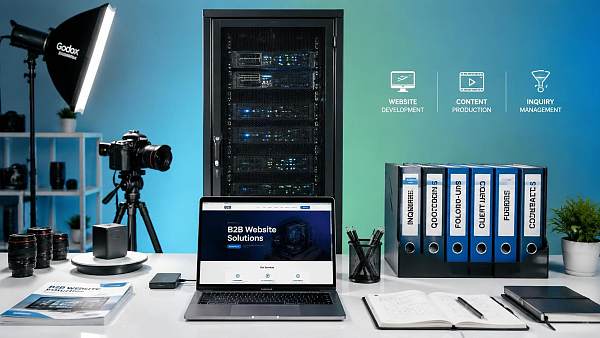
The value of an integrated website-building and promotion approach lies not in bundling the procurement of "website development" and "marketing," but in aligning website architecture, content production, traffic acquisition, and inquiry handling around the same overseas customer acquisition goal. For companies that have clearly defined their target markets, product portfolios, and sales follow-up methods, this model can reduce gaps in multi-supplier collaboration. For companies whose product positioning is still unclear or that cannot continuously provide content and sales follow-up internally, adopting an integrated solution too early may instead concentrate the budget on an unvalidated growth funnel.
The most common misjudgment in procurement is using website launch speed, number of pages, or advertising impressions as substitutes for business results. What truly needs to be evaluated is whether the website can be understood and found by target customers, whether visitors can submit effective inquiries, and whether the sales team can identify, follow up on, and convert these inquiries. If any one of these stages fails, integrated website building and promotion will struggle to generate verifiable returns.
Which Companies Are Better Suited to an Integrated Model
B2B manufacturing companies with highly specialized products and long decision-making cycles are generally well suited to this model. Their overseas customers do not place orders based solely on a product page; they also consider specifications, materials, certifications, delivery capabilities, customization scope, application scenarios, and quality control. The website needs to serve screening and explanatory functions, while SEO content, Google Ads landing pages, and inquiry forms must be designed around the same set of procurement questions. If the website developer does not understand advertising logic, the website may lack pages capable of receiving keyword traffic; if the promotion provider does not understand the product structure, advertising traffic may easily be directed to a generic homepage.
Companies with an existing export foundation that wish to reduce dependence on a single platform or trade show should also consider this model. An independent website does not mean immediately replacing traditional channels, but it can accumulate product information, customer visit behavior, and inquiry sources, while providing a unified landing foundation for search advertising, organic search, social media content, and remarketing. The prerequisite is that the company is willing to treat its independent website as a business asset requiring continuous operation, rather than a one-time electronic brochure.
Companies selling to multiple countries and facing language and market differences may likewise benefit from integration. Multilingual development is not simply the direct translation of Chinese or English copy into different languages; it also involves adjustments to page keywords, commonly used local measurement units, certification wording, inquiry fields, logistics, and delivery instructions. If website development, translation, SEO, and advertising are outsourced separately, version updates and content consistency are often difficult to manage. Integrated services can reduce the number of interfaces, but they cannot replace the company's own judgment regarding market priorities.
Conversely, investment should be approached cautiously in the following situations: product margins and average order value are insufficient to cover ongoing customer acquisition costs; target markets and key product categories are changing frequently; the company cannot provide qualified images, parameters, credentials, and quotation rules; the sales department has no clear inquiry response mechanism; or management accepts only short-term returns while planning to rely on SEO to build organic traffic. In such cases, a more reasonable approach is to first narrow the market and product scope, validate a minimum viable customer acquisition funnel, and then expand investment in website development and promotion.
Do Not Evaluate Investment by Quotation Alone; Break Down the Cost Structure
The budget for integrated website building and promotion usually consists of one-time development investment and ongoing operational investment. The former includes information architecture, visual design, front-end and back-end configuration, multilingual pages, content migration, data tracking implementation, forms, and CRM integration; the latter includes server or SaaS subscriptions, content updates, technical maintenance, SEO optimization, advertising account management, media budgets, creative production, and data reviews. Combining these costs into a single "annual package" deprives decision-making of a sound basis for evaluation.
It is especially important to distinguish service fees from media spend. Google Ads and social platform advertising are variable media purchasing costs, whereas the service provider's management fee reflects the manpower invested in account setup, keyword research, landing page optimization, data analysis, and ongoing operations. An increase in media spend does not necessarily produce a proportional increase in qualified leads; when search term matching, page relevance, or sales follow-up are insufficient, expanding the budget only amplifies low-quality visits.
Attention should also be paid to change costs not stated in the initial quotation. Adding languages, expanding product lines, redesigning page templates, integrating ERP or CRM systems, adding compliance pages, repairing historical data tracking, and migrating domain names and email configurations may all affect the total project cost. Procurement documents should clearly specify which items are charged by page, language, working hours, or functional module, which are included in basic maintenance, and how data and creative assets will be delivered after the partnership ends.
Returns Should Be Measured by "Attributable Qualified Opportunities"
Website traffic, keyword rankings, and form submission volumes are only intermediate metrics. For businesses involving stages such as requests for quotations, sampling, factory audits, and contract negotiations, a metric closer to business results is the cost per qualified opportunity, rather than simply the cost per acquired lead.
A simple but more practical evaluation approach can be used:
Promotion investment ÷ number of qualified opportunities = cost of acquiring qualified opportunities;
number of qualified opportunities × opportunity close rate × gross profit per order = attributable gross profit contribution.
Among these, a "qualified opportunity" must first be defined. For example, whether it comes from a target country, matches the target product and expected purchase volume, provides contactable company information, and has entered the quotation, sample, or video communication stage. Without a unified definition, the marketing department may regard the number of form submissions as results, while the sales department considers that there are no customers worth following up, ultimately making it impossible to determine whether the service creates value.
The evaluation period must also match the channel mechanism. Advertising can reveal clicks, conversions, and lead quality within a relatively short period, provided that conversion tracking is configured correctly; the value of SEO is more reflected in high-intent pages gradually being indexed, gaining organic visits, and accumulating content assets, and its overall success or failure cannot be judged by rankings only a few weeks after launch. A more realistic approach is to treat advertising as a tool for early demand validation and market testing, treat organic search as a channel for reducing marginal customer acquisition costs over the medium and long term, and set separate objectives for each.
If the product inquiry cycle is long, stage data from the CRM should be fed back into the evaluation system, distinguishing at minimum between raw leads, contacted leads, qualified opportunities, quotation opportunities, and closed orders. Relying only on website forms or conversion events from advertising platforms can easily miscount spam inquiries, duplicate inquiries, and even internal test traffic as results.
Implementation Risks Often Arise Outside the "Delivery Scope"
The primary risk of an integrated project is not whether pages are visually appealing, but insufficient definition of requirements. Many companies make only abstract requests at project kickoff, such as "internationalization," "premium positioning," or "more inquiries," without defining target countries, core product categories, customer roles, key competitive alternatives, and inquiry qualification criteria. The resulting website may appear visually complete while containing vague content, and it becomes difficult to establish a correspondence between keywords and landing pages during promotion.
The second category of risk is unclear content responsibility. Suppliers can be responsible for page editing, SEO structure, and content optimization recommendations, but product parameters, certification scope, delivery commitments, case authorization, and brand claims should still be confirmed internally by the company. Especially in sectors such as medical, food, chemicals, and machinery safety, unverified compliance or performance statements can not only affect trust but may also create market access and promotional risks. External materials should have clearly designated reviewers and update cycles.
The third category of risk is data asset lock-in. The registrant of the domain name, website administration permissions, ownership of advertising accounts, Analytics and Tag Manager permissions, search management platforms, pixels, and customer data export rules should all be confirmed before signing the contract. Companies should retain administrator permissions for core accounts and be able to obtain raw traffic data, advertising history, page source files, or transferable data structures. Otherwise, even if promotion is effective, changing service providers later may involve high migration costs.
The fourth category of risk comes from internal response speed. The value of overseas inquiries declines with response delays, but this issue cannot be solved by website development or advertising services alone. Companies need to clarify form assignment rules, the language of the first response, quotation authority, technical support interfaces, and methods for marking invalid leads. If the sales team does not provide feedback on lead quality, the promotion team cannot exclude invalid search terms, correct audience targeting, or adjust page screening mechanisms.
Website Type Must Match the Customer Acquisition Path
The design priorities of websites vary significantly by industry. Taking agricultural products and food exports as an example, buyers not only focus on the categories themselves but also review origin, packaging specifications, supply seasons, processing capabilities, quality documentation, and customization conditions. Using a page solution such as Agriculture, Agricultural Products, Food, which emphasizes category grids, service commitments, news content, and custom packaging forms, can help visitors locate information more quickly; however, if minimum order quantities, applicable markets, certificate status, and required inquiry fields are not clearly indicated, even a complete visual presentation may not improve business cooperation efficiency.
For complex industrial products, the focus may instead be model selection, technical document downloads, industry application pages, project quotation forms, and contact points for sales engineers. For B2C cross-border online stores, the importance of payment, inventory, taxes, logistics lead times, return and exchange policies, and advertising attribution increases significantly. Integrated website building and promotion is not a universal set of pages combined with multiple channels; rather, it determines information architecture and conversion actions according to the transaction method.
Before Procurement, Verify Coordination Capability Rather Than a "Capability List"
A supplier displaying service offerings such as SEO, advertising, social media, and website development does not mean that these capabilities are genuinely coordinated during delivery. What is more worth verifying is whether keyword research influences website categories and page planning; whether advertising can correspond to dedicated landing pages; whether content updates are based on search demand and sales feedback; whether the technical team can address issues related to speed, mobile devices, indexing, structured data, and conversion tracking; and whether monthly reports can be traced back to specific pages, channels, and opportunity stages.
The contract should state deliverables in verifiable terms, such as website language versions and page scope, who provides and confirms page content, forms and data tracking events, advertising account ownership, optimization frequency, reporting methodology, issue response time limits, and asset handover after exit. Solutions that promise "guaranteed rankings" or a "guaranteed number of inquiries" without specifying keyword scope, budget conditions, lead definitions, and sales follow-up prerequisites should be treated with caution.
Integrated website building and promotion is suitable for companies with a clear overseas expansion direction, the ability to continuously provide business content, and the willingness to integrate marketing data into sales management. Its return comes from continuously reducing information gaps and trial-and-error costs, rather than from a single launch or advertising campaign. Only by first defining qualified opportunities, then breaking down total costs, confirming data ownership, and clarifying internal collaboration responsibilities can a company determine whether this investment is building cumulative customer acquisition capability or merely purchasing a seemingly complete set of service offerings.
Related Articles


Related Products
 Yiyingbao SaaS Intelligent Website Building and Marketing SystemYiyingbao SaaS Intelligent Website Building and Marketing System, AI-powered no-code website building, rapid creation of multilingual B2B international websites in 10 minutes, global server acceleration, AI-powered SEO optimization, helping businesses connect efficiently with global markets. The perfect integration of technology and operation makes building an international trade website remarkably simple
 AI+SEM Intelligent Advertising Marketing SystemAI+SEM drives intelligent ad creation, empowering full-funnel precision advertising marketing. The system automatically generates weekly/monthly reports, AI recommends keywords and target countries, monitors core metrics in real-time with intelligent alerts, and enables one-click high-conversion ad solutions to help quickly acquire customers and improve ROI.
 AI+SEO Dual-Engine System Optimization ServicesYiyingbao’s AI+SEO dual-engine optimization system helps foreign trade enterprises acquire high-quality organic traffic through AI-powered keyword research, content generation, and comprehensive technical optimization, significantly improving search rankings and conversion rates.
 AI+SNS Social Media Marketing SystemYingbao AI+SNS Social Media Marketing System - Precision social capture for the social media era. Supports one-click content synchronization across major platforms like Facebook and LinkedIn. AI intelligently rewrites posts for enhanced relevance. 24/7 AI customer service and user profiling analysis empower businesses to efficiently expand into global markets.
 AI+SEO营销解决方案易营宝AI+SEO营销解决方案,通过AI批量写作、智能生成TDK、精准关键词扩词等功能,全面优化网站SEO效果,提升流量与转化率。助力企业构建高效智能网站新生态。
 AI+SEM Advertising Marketing SolutionsAI+SEM Advertising Marketing Solution leverages AI technology to deeply empower SEM ad campaigns. It automatically generates weekly/monthly reports using AI, presenting account data across multiple dimensions for comprehensive insights into campaign performance and trends. The system precisely recommends keywords and target countries, intelligently generates high-conversion ad copy, and enables one-click activation of efficient campaign plans to help businesses rapidly acquire customers. Simultaneously, it monitors core metrics in real time, intelligently identifies abnormal fluctuations, and issues timely alerts to ensure stable, high-return advertising results.
 Domain Name ServicesEasyWin provides professional domain name services, including intelligent queries, one-stop registration, brand protection, and full lifecycle management, helping businesses build a digital brand image.
 EasyOperate B2C Cross-Border E-Commerce Platform & Independent WebsiteEasyStore B2C Cross-border E-commerce Independent Store is an intelligent website building and cross-border e-commerce integrated solution independently developed by EasyStore Information Technology (Beijing) Co., Ltd. The system is specially designed for small and medium-sized as well as large export enterprises, integrating 'website building, operation, marketing, advertising, and conversion' into one, helping enterprises quickly establish cross-border e-commerce independent stores to achieve brand globalization and global sales growth.
The platform supports multiple languages, multiple currencies, and multi-channel marketing, with built-in AI intelligent translation and SEO optimization systems, suitable for mainstream markets such as Southeast Asia, Europe and America, Latin America, and the Middle East, assisting Chinese manufacturing enterprises in efficiently deploying international e-commerce strategies. SSL证书易营宝提供专业SSL安全证书服务,包括单域名和泛域名证书,确保网站数据传输加密、身份验证和完整性保护,助力企业建立安全可信的在线业务环境。









