









- Why the old AMP SEO 2020 practices no longer work and what has changed in current optimization prioritiesAug 02, 2026View details
- How to Choose Topics for an Industry News Section to Attract More Organic Search TrafficJul 29, 2026View details
- Digital Marketing Shenzhen Market Insights: Why Are Companies Expanding Overseas Looking for Growth Teams in Shenzhen?Jul 31, 2026View details
- Can Zhejiang foreign trade independent websites still be developed today? Look at changes in traffic and lead generationJul 28, 2026View details
- What New Signals Are Emerging in Enterprise Services SaaS Marketing ReportsJul 27, 2026View details
- What Does a Global Traffic Ecosystem Service Provider Do? What Are the Differences from a Single Advertising AgencyJul 16, 2026View details
What makes it difficult to achieve a 3% CTR when running Google Ads in the German market
When running Google Ads in the German market, many accounts remain stuck below 3% CTR for a long time. On the surface, this may look like a problem with keywords, creatives, and bids, but in essence, it is often because the “ad promise” and the “landing page experience” are not truly aligned. This is especially true for independent websites targeting European users. If even the question of how to keep global node access latency within 100ms has not been solved, the waiting time after the click, bounce behavior, and fluctuations in Quality Score will directly drag down the click-through rate and subsequent conversions.
For enterprises, advertising in Germany is not simply a matter of increasing the budget to generate volume. German users are more sensitive to information accuracy, page response speed, privacy compliance, and professional credibility. Whether CTR can reach 3% is essentially the result of traffic matching, ad trust, and site experience working together. Whoever can do these three things well at the same time will find it easier to raise both the click-through rate and the inquiry rate.
Why Achieving a 3% CTR for Google Ads in the German Market Is Harder Than Many Enterprises Expect
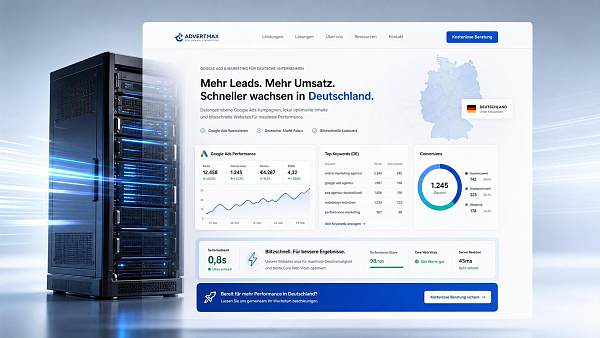
The first challenge in the German market is not that “no one clicks”, but that “users are more selective”. They quickly judge whether the ad headline is specific, whether the page is professional, and whether the company is trustworthy. Once the ad message is vague, or the landing page loads slowly, users will immediately return to the search results page, and account performance will continue to be affected.
Second, the commercial intent of German search traffic is often clearly layered. Many enterprises directly copy the advertising logic used in the domestic or English-speaking market, using overly broad keywords, generic copy, and standardized landing pages. As a result, although the ads receive impressions, they struggle to generate sufficiently strong click intent, making it difficult to steadily raise CTR to 3%.
Looking further, the competitive environment is also raising the threshold. Local German enterprises generally run more refined campaigns for industry terms, brand terms, and high-intent terms, and their ad content is more closely connected to procurement, certification, delivery, and after-sales scenarios. If overseas enterprises still remain at the stage of “product introduction-style advertising”, it is usually difficult to create differentiated appeal in search results.
When CTR Gets Stuck, What Should the Target Audience Really Check First
If ad CTR remains low for a long time, the first thing to check is not a single button color, nor should you blindly raise bids. Instead, you should examine whether search term intent, ad copy promises, and above-the-fold landing page information are consistent. Whether users are searching for a solution, a supplier, a price, or a local service determines how the ad headline and page structure must match.
The second key point is page performance. Many enterprises overlook one fact: the click-through rate of Google Ads is not completely independent of the landing page experience. Slow page loading, blank above-the-fold content, oversized image resources, and complex cross-border access paths can all indirectly affect subsequent impressions and click performance through bounce rate, dwell time, and Quality Score.
This is also why more and more globalizing enterprises are starting to pay attention to how to keep global node access latency within 100ms. In the German market, the first few seconds after an ad click determine whether users are willing to continue browsing, whether they believe this is a professional supplier, and whether Google is willing to give you more stable traffic distribution.
How to Keep Global Node Access Latency Within 100ms, and Why It Affects Advertising Performance in Germany
From the perspective of user experience, keeping latency within 100ms means smoother scheduling of page resources, faster above-the-fold loading, and almost no noticeable waiting time for users. For ad campaigns, this not only improves the browsing experience, but also reduces bounces caused by unstable network paths, allowing clicks to truly enter the subsequent browsing and conversion stages.
From the perspective of platform mechanisms, Google places greater emphasis on landing page experience and relevance. Although CTR mainly occurs before the click, landing page speed, mobile usability, and content consistency affect Quality Score and ad ranking. When the system determines that your page experience is better, you can often obtain a higher position and a higher click-through rate at a more reasonable cost.
From the perspective of business outcomes, controlling how to keep global node access latency within 100ms is not simply about pursuing a technical metric, but about shortening the time “from search to trust”. Once German users perceive that the page responds quickly, the structure is clear, and the information is rigorous, the probability that they will continue reading, submit inquiries, and revisit the site will increase significantly.
What Conditions Must a Landing Page Meet If German Ads Aim to Push CTR Above 3%
First, the above-the-fold area must directly answer the user’s question. Do not make users click in only to see large images, slogans, or vague brand introductions first. For pages related to industrial products, foreign trade services, and enterprise solutions, the above-the-fold area should quickly explain what you provide, who it is suitable for, what certifications or capability proof you have, and how to contact you in the next step.
Second, the page language and information structure should align with the decision-making habits of German users. Unlike communication that emphasizes emotional stimulation, German users pay more attention to parameters, standards, delivery times, cases, qualifications, and service boundaries. If the landing page is merely a translated English template and lacks localized expression and professional information density, it will be difficult to support trust building after the ad click.
Third, the basic technical experience must meet the standard. This includes optimization of European access paths, compression of static resources, regional distribution of images, script reduction, caching strategies, and mobile response speed. If there is not even an effective solution for how to keep global node access latency within 100ms, even the most refined advertising front end will be held back by the back-end experience.
Besides Page Speed, Which Advertising Details Are Most Easily Overlooked
One common problem is overly broad keyword matching. In pursuit of traffic scale, many accounts overuse broad match but fail to clean up ineffective search terms in time. As a result, ads frequently appear in low-relevance search results. Impressions increase, but click intent is diluted, making it naturally difficult to achieve a stable increase in CTR.
The second type of problem is ad copy that lacks business scenarios. German users are more likely to be persuaded by clear, specific, and verifiable information, such as industry experience, certification standards, delivery capabilities, service scope, and response time. General statements such as “high quality” and “professional service” rarely provide a reason to click and cannot establish differentiation.
The third type of problem is ignoring mobile. Although German B2B users may make deeper evaluations on desktop, initial searches and comparisons do not necessarily happen only on computers. If mobile buttons are hard to tap, fonts are crowded, and forms are cumbersome, the decline in page experience will also affect overall ad performance and subsequent remarketing efficiency.
How Should Enterprise Managers Judge Whether the Problem Lies in Advertising or the Website
A practical judgment method is to look at data by layers. If impressions are normal and the average ranking is not poor, but CTR remains low, first look at search term matching and ad appeal. If CTR is acceptable and click costs are also manageable, but bounce rate is high and conversions are low, you should focus on checking whether there are obvious obstacles in site speed, page content, and form paths.
Another method is to conduct regional access testing. Enterprises should not only check whether the page can be opened on a domestic office network. They should simulate access by local German users and observe above-the-fold loading, resource requests, and interaction latency. If overseas node distribution is unstable, it will be difficult to truly answer the core question of how to keep global node access latency within 100ms.
For managers, what truly deserves attention is not a certain CTR number itself, but whether the increase in click-through rate brings growth in valid inquiries. If the ad click-through rate rises but the page fails to receive traffic effectively and lead quality is low, the input-output ratio will still be unsatisfactory. Conversely, integrated optimization of advertising and the website often brings more stable growth than adjusting ads alone.
Why Website and Marketing Integration Is More Suitable for Customer Acquisition in the German Market
Search-based customer acquisition in the German market is not suitable for separating website development, speed optimization, SEO, and ad campaigns too much. This is because the user journey from seeing an ad, clicking in, browsing the page, and submitting an inquiry is a continuous chain. If any link breaks, it will magnify the waste of previous investment, especially during the stage of bidding on high-cost keywords.
The value of an integrated solution lies in the fact that it can reserve SEO and advertising reception structures during the website-building stage, while also using multilingual websites, European node deployment, page performance optimization, and conversion path design to retain ad traffic more steadily. In this way, discussing how to keep global node access latency within 100ms is no longer an isolated technical issue, but a growth issue.
For foreign trade enterprises, manufacturing factories, and global brand teams, the truly effective approach is usually not single-point remediation, but the synchronized optimization of keyword strategy, ad creatives, localized pages, and access speed. Only in this way can CTR, dwell time, conversion rate, and customer acquisition cost form positive synergy instead of dragging each other down.
Conclusion: Achieving a 3% CTR in the German Market Is Not About “Spending More”, but About “Receiving Traffic More Reliably”
When running Google Ads in the German market, achieving a 3% CTR is not impossible, but the challenge has never been only about writing more attractive headlines. The real threshold is whether you understand how German users make judgments, whether your ad content remains consistent with the page promise, and whether you turn how to keep global node access latency within 100ms into a real experience.
When enterprises view search intent analysis, ad structure, localized content, and website performance within the same growth logic, CTR improvement is usually only the result, not an isolated goal. For enterprises that want to operate in the European market over the long term, solidifying the post-click experience first is often closer to truly effective growth than simply increasing the budget.
Related Articles
 How to Choose Digital Marketing Services in Guangzhou: Which Delivery Metrics Should Be Verified First?
 Which social media platforms should manufacturing companies entering overseas markets start with for a more reliable approach?
 How to Determine Whether a Standalone Website with Global Server Nodes Meets the Required Access Speed

Related Products
 Yiyingbao SaaS Intelligent Website Building and Marketing SystemYiyingbao SaaS Intelligent Website Building and Marketing System, AI-powered no-code website building, rapid creation of multilingual B2B international websites in 10 minutes, global server acceleration, AI-powered SEO optimization, helping businesses connect efficiently with global markets. The perfect integration of technology and operation makes building an international trade website remarkably simple
 AI+SEM Intelligent Advertising Marketing SystemAI+SEM drives intelligent ad creation, empowering full-funnel precision advertising marketing. The system automatically generates weekly/monthly reports, AI recommends keywords and target countries, monitors core metrics in real-time with intelligent alerts, and enables one-click high-conversion ad solutions to help quickly acquire customers and improve ROI.
 AI+SEO Dual-Engine System Optimization ServicesYiyingbao’s AI+SEO dual-engine optimization system helps foreign trade enterprises acquire high-quality organic traffic through AI-powered keyword research, content generation, and comprehensive technical optimization, significantly improving search rankings and conversion rates.
 AI+SNS Social Media Marketing SystemYingbao AI+SNS Social Media Marketing System - Precision social capture for the social media era. Supports one-click content synchronization across major platforms like Facebook and LinkedIn. AI intelligently rewrites posts for enhanced relevance. 24/7 AI customer service and user profiling analysis empower businesses to efficiently expand into global markets.
 AI+SEO营销解决方案易营宝AI+SEO营销解决方案,通过AI批量写作、智能生成TDK、精准关键词扩词等功能,全面优化网站SEO效果,提升流量与转化率。助力企业构建高效智能网站新生态。
 AI+SEM Advertising Marketing SolutionsAI+SEM Advertising Marketing Solution leverages AI technology to deeply empower SEM ad campaigns. It automatically generates weekly/monthly reports using AI, presenting account data across multiple dimensions for comprehensive insights into campaign performance and trends. The system precisely recommends keywords and target countries, intelligently generates high-conversion ad copy, and enables one-click activation of efficient campaign plans to help businesses rapidly acquire customers. Simultaneously, it monitors core metrics in real time, intelligently identifies abnormal fluctuations, and issues timely alerts to ensure stable, high-return advertising results.
 Domain Name ServicesEasyWin provides professional domain name services, including intelligent queries, one-stop registration, brand protection, and full lifecycle management, helping businesses build a digital brand image.
 EasyOperate B2C Cross-Border E-Commerce Platform & Independent WebsiteEasyStore B2C Cross-border E-commerce Independent Store is an intelligent website building and cross-border e-commerce integrated solution independently developed by EasyStore Information Technology (Beijing) Co., Ltd. The system is specially designed for small and medium-sized as well as large export enterprises, integrating 'website building, operation, marketing, advertising, and conversion' into one, helping enterprises quickly establish cross-border e-commerce independent stores to achieve brand globalization and global sales growth.
The platform supports multiple languages, multiple currencies, and multi-channel marketing, with built-in AI intelligent translation and SEO optimization systems, suitable for mainstream markets such as Southeast Asia, Europe and America, Latin America, and the Middle East, assisting Chinese manufacturing enterprises in efficiently deploying international e-commerce strategies. SSL证书易营宝提供专业SSL安全证书服务,包括单域名和泛域名证书,确保网站数据传输加密、身份验证和完整性保护,助力企业建立安全可信的在线业务环境。









