- EasyOperate Experience Test: Deployment Cycle, Stability, and Post-Sale Evaluation2025-12-17View details
- Guide to Choosing a Foreign Trade Website System: How to Evaluate Multilingual Website Capabilities2025-12-17View details
- From the perspective of quality control and security, experience the use of EasyStore: vulnerabilities, backups, and permission management2025-12-17View details
- Foreign Trade Marketing System in Action: 5 Key Configuration Points to Enhance Overseas Lead Conversion2025-12-17View details
- How to Choose a Smart Website Building Platform for Distributors: Recommended Smart Website Platforms and Profit-Sharing Models2025-12-17View details
- Complete Breakdown of Foreign Trade Independent Website Construction Solutions: 7 Key Steps from Selection to Launch That Project Managers Must Know2025-12-16View details
- Comparison of SaaS Costs for Foreign Trade Independent Websites: How was the annual 30,000 website construction plan selected?2025-12-17View details
- Comparison of SaaS Costs for Foreign Trade Independent Websites: How was the annual 30,000 website construction plan selected?2025-12-17View details
A template for evaluating foreign trade website systems tailored for enterprise decision-makers

This is an evaluation template for foreign trade website building systems prepared for enterprise decision-makers. It covers a comparison of YiYingBao and other intelligent website building platforms to help with selection and implementation.
This template for evaluating foreign trade website building systems is designed for business decision-makers. It compares YiYingBao with competing intelligent website building platforms to assist in selection and implementation. This article is aimed at users/operators, technical evaluators, purchasing personnel, quality control and security managers, after-sales maintenance teams, and distributor channel managers, addressing key pain points of foreign trade website building systems in areas such as feature matching, technical specifications, compliance and localization, operating costs, and ROI assessment.
Decision-makers typically worry about: whether multilingual support is adequate, whether SEO and page performance can be guaranteed, whether advertising and social media traffic can form a closed loop, and whether system security and SLAs meet overseas deployment requirements. This article will provide actionable evaluation dimensions, comparison methods, key indicators, and decision-making suggestions to help companies quickly reach actionable conclusions during the competitive analysis phase of intelligent website building platforms, reduce selection risks, and shorten the launch cycle.
I. Core Evaluation Dimensions: Functionality, Performance, Operational Support, and Cost
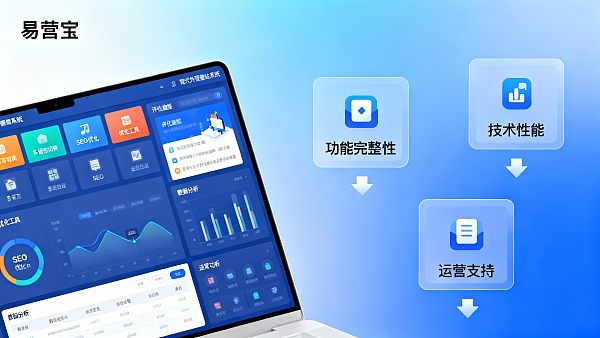
When evaluating a website building system for foreign trade, a scoring table should be established based on four dimensions: functional completeness, technical performance, operational support, and total cost of ownership. Functionality includes: multilingual website building and AI translation, SEO automation (automatic TDK generation, on-site keyword expansion), landing pages and form collection functions, and CRM/ERP/payment and logistics interface adaptation. Performance focuses on global CDN acceleration, page load time, server cluster and availability, mobile experience, and the first-screen rendering speed of core pages; it is recommended to use real overseas nodes for speed testing and record the average load improvement ratio during the evaluation. Operational support includes social media automation, advertising integration, content production efficiency, and localized customer service and training cycles; it is recommended to quantify operational capabilities as an estimate of the time from launch to visible traffic in the first month. Cost evaluation should not only consider the setup cost but also estimate long-term hosting, traffic and advertising costs, technology upgrades and customized development investments, and potential compliance expenses. Establishing a weighted scoring table (with customizable weights) can help purchasing and technical evaluation personnel quickly reach a consensus during meetings.
II. Key Comparison Points Between YiYingBao and Competitors: Differentiation Capabilities and Commercial Value Validation
When comparing YiYingBao with competitors, the focus should be on evaluating its differentiated capabilities and return on commercial value. YiYingBao is an AI-driven one-stop intelligent marketing platform with capabilities such as multilingual independent website building, AI translation engine, intelligent keyword expansion, and automatic TDK generation. It is suitable for foreign trade enterprises that focus on large-scale content production and cross-language SEO. When comparing with competitors, each item should be verified: whether multilingual domains are independent domains or subdirectory strategies, whether there are third-party or customer case studies to endorse SEO score improvement data, whether AI content quality supports manual verification and rapid correction, and whether global server cluster coverage can bring significant improvements in loading speed. Technical evaluators should request the vendor to provide actual customer data samples from the past three months, such as the percentage increase in search engine traffic, page load time comparison reports, and changes in site SEO scores. From a procurement perspective, attention should be paid to the SLA, data ownership, and exit/migration costs in the contract terms. Combining YiYingBao's "technological innovation + localized service" strategy with industry awards and partner qualifications can be considered as trust endorsements in the competitor evaluation, thereby improving the explainability and traceability of the selection decision.
III. Technical and Security Assessment: Algorithms, Data Governance, Compliance, and Operational Capabilities
Technology and security are core concerns for enterprise quality control personnel and security management teams. The assessment should cover the frequency of AI algorithm iterations and technology patents, the scope of data collection and governance strategies, third-party cloud and CDN providers, and the implementation details of SSL and DDoS protection mechanisms. It is recommended that technical assessors request vendors to provide: algorithm model update records, data source descriptions and privacy compliance documents, security drills and fault recovery cases from the past year, and supported encryption and certificate automation capabilities. For overseas deployments, compliance capabilities in each region must be verified, including the privacy policies of the EU, the US, and the target country, data cross-border transfer processes, and localization compliance recommendations. Operational assessments should cover response time, problem escalation paths, monitoring and alerting, and backup and recovery strategies, quantifying risks with actual SLA terms. Finally, these dimensions should be presented in a tabular scoring system to facilitate standard review by the quality control and technical teams during the acceptance phase, ensuring stable and secure operation of the system in global multilingual website hosting scenarios after delivery.
IV. Marketing and Traffic Monetization Capabilities: Content, Social Media, Advertising, and Data Closed Loop

The evaluation of a foreign trade website building system should not overlook its marketing and traffic monetization capabilities, especially the search traffic and paid advertising effectiveness that foreign trade enterprises rely on. Operational evaluation should include: whether the AI marketing engine can achieve high-quality content output daily; whether its social media automation capabilities support a multi-platform matrix; and whether its advertising diagnostic tools can provide real-time suggestions for creative materials and account optimization. For clients requiring precise ad targeting and visualized results, third-party ad performance samples can be added to the evaluation checklist for verification, such as whether they can provide historical backtesting data on keyword performance, audience profiles, and smart bidding. For projects aiming for rapid scaling through paid channels, it is recommended to simultaneously test actual campaign samples to verify cost-per-click, inquiry quality, and conversion rates. If direct integration with search platforms and advertising services is required, consider using managed services provided by platform partners to reduce trial-and-error costs. For example, during the evaluation period, try and compare the performance of Google Ads campaigns , combining this with the system's built-in AI advertising diagnostics to determine the overall customer acquisition ROI and estimate the marginal return on investment and operations. Such practical testing can significantly reduce later promotion risks and provide quantitative data for decision-makers.
V. Implementation, Training, and Channel Support: Implementation Capabilities and Long-Term Cooperation Model
The final assessment item is implementation and long-term operational capabilities, which is the dimension most important to distributors, agents, and after-sales teams. A high-quality supplier should provide integrated services from needs assessment, template building, content migration, to localization configuration and post-launch operational training, and should provide a clear timeline and delivery milestones. Decision-makers need to check the supplier's delivery team composition, whether they have industry templates (e.g., manufacturing, e-commerce, education), and whether they support regional partnership models for localized customer service. Training plans should cover site management, SEO optimization, advertising strategies, and data report interpretation, ensuring that internal users and operations teams can independently operate the site in a short period. Regarding channel support, agent policies, revenue-sharing mechanisms, and the priority of technical support should be verified to avoid a decline in service quality during large-scale replication. Incorporating these implementation and channel capability assessment items into contract negotiations will significantly reduce friction costs during future expansion and internationalization.
Summary and Action Guidance
In summary, a mature foreign trade website building system evaluation template should cover five major modules: functionality, performance, technical security, marketing monetization, and implementation. It should also verify the vendor's commitments through a quantitative scoring table and real-world test samples. Combined with EasyCreation's AI and big data-driven multilingual website building and global service capabilities, businesses can prioritize verifying data support and localized delivery capabilities when comparing with competitors. If you wish to obtain an editable scoring table for this template, third-party test cases, or arrange a product trial and technical evaluation meeting, please contact us immediately for customized evaluation services and to learn more about our solutions. Contact us now to initiate your foreign trade website building system selection and pilot program, ensuring measurable improvements in traffic and conversion rates within the first month.
- Platform
- Foreign Trade Website
- Multilingual standalone site
- Inquiry quality
- Independent website building
- Campbell (name)
- SEO
- free-standing station
- SEO optimization
- Intelligent website building
- AI Translation
- AI Marketing Engine
- Social Media Automation
- AI Translation Engine
- Global CDN Acceleration
- Global multilingual website
- Foreign Trade Website System
- Smart Website Platform
- 智能建站平台竞品分析
- EasyStore product competition comparison
- Multilingual Website
Related Articles
 Guide to Choosing a Foreign Trade Website System: How to Evaluate Multilingual Website Capabilities
- Foreign Trade Marketing System in Action: 5 Key Configuration Points to Enhance Overseas Lead Conversion
- Complete Breakdown of Foreign Trade Independent Website Construction Solutions: 7 Key Steps from Selection to Launch That Project Managers Must Know



Related Products
- EasyStore SaaS Intelligent Website Marketing SystemEasyStore SaaS Intelligent Website Marketing System, AI-driven zero-code website building, enabling rapid setup of multilingual foreign trade independent websites in just 10 minutes, global server acceleration, AI-powered SEO optimization, helping businesses efficiently connect with global markets. The perfect fusion of technology and operation makes foreign trade website construction simple to the extreme.
 AI+SEM Intelligent Advertising Marketing SystemAI+SEM drives intelligent creation and full-chain empowerment for precise advertising marketing. The system automatically generates weekly/monthly reports, with AI recommending keywords and target countries, real-time monitoring of core metrics and intelligent alerts, one-click activation of high-conversion solutions, helping businesses quickly acquire customers and improve ROI.
- AI+SEO Dual Engine Optimization ServiceEasyOperate AI+SEO dual engine optimization system leverages AI-powered keyword mining, content generation, and comprehensive technical optimization to help foreign trade enterprises acquire high-quality organic traffic, significantly improving search rankings and conversion rates.
 AI+SNS Social Media All-in-One Intelligent Marketing SystemEasyWin AI+SNS Social Media All-in-One Intelligent Marketing System - Precision social engagement in the social media era, supports one-click content synchronization across mainstream platforms like Facebook and LinkedIn, AI-powered post rewriting to enhance adaptability, 24/7 intelligent customer service with user profiling, helping businesses efficiently expand global markets.
- Multilingual Foreign Trade Independent Website SolutionEasyStore SAAS Intelligent Website System provides 300+ minor language precise translations, solving language barriers for foreign trade enterprises and improving order conversion rates. Supports all terminal devices, global languages, SEO optimization, and full-channel promotion, helping you effortlessly expand into international markets.
- AI+SEO Marketing SolutionEasyWin AI+SEO Marketing Solution enhances website SEO performance through AI-powered batch content creation, intelligent TDK generation, and precise keyword expansion. It boosts traffic and conversion rates, helping businesses build an efficient and intelligent website ecosystem.
- AI+SEM Advertising Marketing SolutionAI+SEM Advertising Marketing Solution leverages AI technology to deeply empower SEM ad placements. AI intelligently generates weekly/monthly reports, presenting multi-dimensional client data for comprehensive insights into ad performance and trends. AI precisely recommends keywords and target countries, automatically generates high-converting ad copy, and enables one-click activation of high-performance campaigns to accelerate customer acquisition. The system monitors core metrics in real-time, intelligently detects anomalies, and provides timely alerts to ensure stable ad performance with high ROI.
- Domain Name ServicesEasyBiz provides professional domain name services, including intelligent query, one-stop registration, brand protection, and full-cycle management, helping enterprises build a digital brand image.
- EasyStore B2C Cross-border E-commerce PlatformEasyStore B2C Cross-Border E-Commerce Platform is an all-in-one intelligent website building and cross-border e-commerce solution independently developed by EasyStore Information Technology (Beijing) Co., Ltd. The system is specifically designed for small, medium, and large export enterprises, integrating 'website building, operation, marketing, advertising, and conversion' to help businesses quickly establish independent cross-border e-commerce sites, achieving brand globalization and global sales growth.
The platform supports multiple languages, currencies, and multi-channel marketing, featuring built-in AI intelligent translation and SEO optimization systems, and is suitable for mainstream markets such as Southeast Asia, Europe & America, Latin America, and the Middle East, assisting Chinese manufacturing enterprises in efficiently deploying international e-commerce strategies.