- Le calendrier tarifaire sino-américain a suscité un consensus positif, et le Conseil de commerce sera établiJun 15, 2026Voir les détails
- Non-tarifaire à la frontière sino-marocaine, importation marocaine de marchandises chinoises, baisse des coûts à explorerJun 11, 2026Voir les détails
- Quel signal opérationnel la suspension des exportations vers le Japon libère-t-elleJun 10, 2026Voir les détails
- Les importations chinoises de GNL ont rebondi en mai, les importations supplémentaires de la Russie et du Canada comblent le déficit au Moyen-OrientJun 10, 2026Voir les détails
- GEO va-t-il modifier sa stratégie SEO ?Jun 04, 2026Voir les détails
- À quelles activités les solutions de bout en bout conviennent-elles ?Jun 03, 2026Voir les détails
- Tendances des canaux de croissance mondiale 2026Jun 02, 2026Voir les détails
- Évolution des facteurs de classement des moteurs de recherche en 2026Jun 06, 2026Voir les détails
Quels sont les processus de création d’un site indépendant transfrontalier ? De la configuration du nom de domaine au lancement et à la mise en ligne, explication détaillée des étapes
Process of building an independent cross-border website, why can’t we just focus on page design?
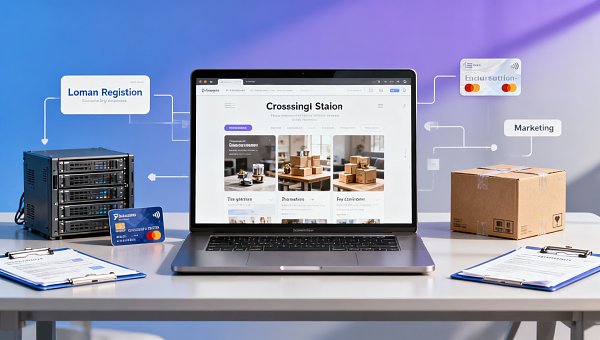
Building an independent cross-border website may seem like making a website, but in fact it is more like building a complete overseas expansion infrastructure from scratch. The page is only the surface layer; what really affects launch efficiency and subsequent conversion is often whether the domain name, server, payment, logistics, compliance, and promotion routes are planned in advance.
Many projects get stuck not because they cannot build pages, but because only before launch do they discover that payments cannot be collected, shipping fee rules are confused, privacy terms are missing, or even the search engine crawling structure has not been handled properly. In this way, the building cycle of an independent cross-border website will be extended, and customer acquisition costs will also rise.
A more stable approach is to push the website as a “building+marketing service integration” project. Like 易营宝, a global digital marketing service provider with ten years of deep industry experience, the reason it can help enterprises go online faster is that it integrates intelligent website building, SEO optimization, advertising placement, and multilingual operations into the same growth logic, rather than treating the website as a separate module.
Starting from 0 to build an independent cross-border website, what should be decided first?
In real projects, the first step is usually not “choosing a template”, but first confirming the target market and website type. Because whether you are targeting North America, Europe, or Southeast Asia determines the domain name strategy, server deployment, multilingual structure, payment methods, and content style.
If the main goal is lead generation, the website focus should be on product presentation, form conversion, case studies, and search visibility. If it is an e-commerce independent website, the building process of a cross-border independent site must include shopping cart, inventory, logistics shipping fees, and tax fee display in advance.
Next, several basic decisions usually come into play:
- Whether the domain name is short, easy to remember, and related to the brand or business;
- Whether the server node is close to the target customer access region;
- Whether the website system supports multilingual support, SEO rules, and later expansion;
- Whether the content structure is designed around the customer acquisition path, rather than only pursuing aesthetics.
Simply put, once the direction is set in the early stage, every subsequent step will go much smoother. Especially in the building of an independent cross-border website, once the technical selection is biased, the later modification cost will increase significantly.
How to choose the domain name, server, and program system without easily making mistakes?
The most common problem in this part is that people tend to only look at price and ignore long-term operation. It is recommended to prioritize mainstream domain name suffixes to ensure brand recognition. The server should take into account access speed, stability, and security protection, rather than only looking at configuration parameters.
The choice of program system is more critical. A system suitable for overseas business should at least support page customization, mobile adaptation, structured SEO settings, form management, data tracking, and multi-region expansion. 易营宝’s self-developed cloud intelligent website building system and cross-border e-commerce system are more suitable for such projects precisely because they have integrated website building and promotion needs in advance.
To reduce judgment bias, you can first look at this table:
At which stage are payment, logistics, and compliance steps usually introduced?
A more common judgment is to introduce them synchronously after the page framework is confirmed, rather than waiting until the website is finished. Because payment interfaces, logistics rules, and compliance pages will in turn affect the page structure, checkout process, and trust-building.
The payment link needs to confirm supported currency types, collection paths, risk control requirements, and refund mechanisms. Logistics should be combined with product attributes to clearly define shipping fee templates, delivery time, destination country restrictions, and after-sales boundaries. As for compliance, at least privacy policy, terms of service, return and exchange rules, and Cookie prompts must be covered.
Some teams ignore this stage, resulting in the inability to truly launch or collect payments even after the cross-border independent website is completed. In practice, the earlier these contents are confirmed, the smoother the later launch will be. Even for content-oriented official websites, form compliance and data collection specifications should be considered.
If the company is still synchronizing its digital transformation upgrade internally, reading Reconstructing the core capabilities of enterprise financial personnel under AI-driven content can also help understand the impact of payment, data, and process collaboration on overseas business.
Why should SEO and advertising preparation be synchronized as soon as the website goes live?
Because the launch of an independent website is not the end point, but the starting point for traffic acquisition. Many people understand cross-border independent website building as merely “being able to open and display”, but a truly valuable website must be searchable, able to support advertising, and able to continuously convert.
SEO preparation usually needs to be placed in the website building stage in advance, such as category structure, URL rules, page titles, content layout, image compression, mobile speed, and multilingual indexing. If these are not handled in advance, it will usually cost more to fix them later.
Advertising placement is the same. Whether the landing page is clear, whether the tracking code is complete, and whether the form is smooth will directly affect the advertising results. The advantage of 易营宝 in this regard is that it combines Google SEO optimization, advertising placement, social media marketing, and website system integration, so that the website has promotion conditions from the very beginning, instead of being rebuilt after launch.
By the way, when planning website materials, the content team can also appropriately refer to Reconstructing the core capabilities of enterprise financial personnel under AI-driven such cross-departmental topics, and train the way content is organized so that the page information is more logical, rather than simply piling up materials.
How should the website cycle, investment, and common misconceptions be estimated?
There is no uniform answer to this question, but it can be judged according to project complexity. Display websites usually have shorter cycles, while e-commerce websites take longer because they involve payment, logistics, and order processes. When multilingual and multi-market launches are synchronized, content preparation is often more time-consuming than technical development.
In the building of an independent cross-border website, common misconceptions mainly include several types:
- Treating the homepage visual design as the whole thing and ignoring the conversion path;
- Doing Chinese logic first, then forcibly translating it into multiple languages;
- Not setting data points, making optimization impossible after launch;
- Handling payment, logistics, and SEO separately, resulting in low implementation efficiency;
- Only looking at the initial construction cost, not the later operation cost.
It should be noted that cost includes not only website building, but also content production, visual standards, promotion preparation, and later maintenance. A truly reliable plan should calculate the investment before and after launch together.
When preparing to start building an independent cross-border website, what checklist should be organized first?
If you want the project to move forward more smoothly, it is recommended to first organize a concise execution checklist. It does not need to be very long, but it should cover the points that truly affect progress. In this way, when communicating with service providers, internal coordination, or evaluating plans, judgment will be clearer.
- Clarify the target market, website type, and main conversion actions;
- Prepare the domain name, brand materials, core product data, and compliance text;
- Confirm payment, logistics, tax fees, and after-sales rules;
- Synchronize SEO structure, advertising tracking, and social media traffic acquisition plans;
- Evaluate system scalability to avoid frequent rebuilds later.
Overall, building an independent cross-border website is not a one-shot task, but a continuous path from infrastructure to traffic growth. Putting the domain name, server, payment, logistics, compliance, and marketing into the same roadmap makes it easier for the website to be indexed, visited, inquired about, or receive orders after launch.
If the project is to be advanced next, a more practical approach is to first sort out the requirements, then compare system capabilities, implementation cycles, and promotion support, and finally establish an executable launch standard. Doing so often saves more time than rushing to start construction, and is closer to truly effective overseas expansion results.
- Yiyingbao
- SEO
- Site indépendant
- Système de création de site intelligent
- Adaptation mobile
- Marketing sur les réseaux sociaux
- Optimisation SEO
- Création de site web intelligente
- Référencement Google
- Marketing numérique mondial
- Services de marketing digital
- Prestataire de services de marketing digital
- Diffusion publicitaire
- Boutique en ligne transfrontalière
- Système de centre commercial transfrontalier
- Optimisation SEO Google
- Création de site web indépendant transfrontalier
Articles connexes
 Le calendrier tarifaire sino-américain a suscité un consensus positif, et le Conseil de commerce sera établi
 Cold start for B2B foreign trade factories : How to use 1 landing page to add 5 long-tail keywords and drive the first order at low cost ?
 Pourquoi faire du commerce extérieur avec une voiture ? Google site indépendant est le cœur



Produits associés
 EasyCamp SaaS Système intelligent de création de sites Web et de marketingSystème intelligent de marketing web E-Yingbao SaaS : création de sites web sans code, basée sur l'IA. Créez rapidement des sites e-commerce multilingues indépendants en seulement 10 minutes. L'accélération mondiale des serveurs et l'optimisation SEO basée sur l'IA permettent aux entreprises de se connecter efficacement aux marchés mondiaux. La fusion harmonieuse entre technologie et convivialité rend la création d'une présence e-commerce internationale remarquablement simple.
 Service d'optimisation du système double moteur AI+SEOLe système d'optimisation double moteur AI+SEO d'YiYingBao, grâce à l'exploitation intelligente de mots-clés par l'IA, la génération de contenu et une optimisation technique complète, aide les entreprises de commerce extérieur à obtenir un trafic naturel de haute qualité, améliorant considérablement le classement des recherches et le taux de conversion.
 Système de marketing publicitaire intelligent AI+SEMAI+SEM propulse une création publicitaire intelligente, permettant un marketing publicitaire précis sur toute la chaîne. Le système génère automatiquement des rapports hebdomadaires/mensuels, l'IA recommande des mots-clés et des pays de diffusion, surveille en temps réel les indicateurs clés et fournit des alertes intelligentes, lance en un clic des solutions de diffusion à haut taux de conversion, aidant à acquérir rapidement des clients et à améliorer le ROI.
 Système de marketing sur les réseaux sociaux AI+SNSSystème de marketing intelligent Yingyingbao AI+SNS pour les réseaux sociaux - Capture sociale précise pour l'ère des réseaux sociaux. Prend en charge la synchronisation du contenu en un clic sur les principales plateformes, notamment Facebook et LinkedIn. La réécriture des publications alimentée par l'IA améliore la localisation. Un service client intelligent disponible 24 h/24, 7 j/7 et l'analyse du profil des utilisateurs permettent aux entreprises de se développer efficacement sur les marchés mondiaux.
 Solutions marketing publicitaire IA+SEMLes solutions publicitaires SEM basées sur l'IA exploitent l'intelligence artificielle pour améliorer considérablement la gestion des campagnes SEM. Grâce à l'IA, elles génèrent des rapports hebdomadaires et mensuels qui présentent les données des comptes sous plusieurs angles, permettant ainsi une supervision complète des performances et des tendances publicitaires. L'IA fournit des recommandations précises sur les mots-clés et les pays cibles, rédige de manière intelligente des textes publicitaires à fort taux de conversion et lance des campagnes efficaces en un seul clic, accélérant ainsi l'acquisition de clients pour les entreprises. Parallèlement, le système surveille les indicateurs clés en temps réel, identifie intelligemment les fluctuations anormales et émet des alertes en temps opportun, garantissant ainsi des performances publicitaires stables et des rendements élevés.
 AI+SEO营销解决方案易营宝AI+SEO营销解决方案,通过AI批量写作、智能生成TDK、精准关键词扩词等功能,全面优化网站SEO效果,提升流量与转化率。助力企业构建高效智能网站新生态。
 Services de noms de domaineEasy Marketing propose des services professionnels de noms de domaine, comprenant la recherche intelligente, l'enregistrement en un clic, la protection de marque et la gestion complète du cycle de vie, aidant les entreprises à construire une image de marque numérique.
 EasySell B2C Place de Marché Transfrontalière, Site Indépendant易营宝B2C跨境商城独立站是由易营宝信息科技(北京)有限公司自主研发的智能建站与跨境电商一体化解决方案。系统专为中小型及大型出口企业打造,集“建站、运营、营销、投放、转化”于一体,帮助企业快速打造跨境电商独立站,实现品牌出海与全球销售增长。
平台支持多语言、多币种、多渠道营销,内置AI智能翻译与SEO优化系统,适配东南亚、欧美、拉美、中东等主流市场,助力中国制造企业高效布局国际电商版图。 B2B2C双模式独立站解决方案易营宝推出的B2B2C双模式独立站解决方案,专为同时开展批发与零售业务的企业打造。平台支持商品价格展示、商品多规格管理、购物车与购物车弹窗、购物车总价计算,以及统一批量询价等功能,帮助企业以更高效、更直观的方式触达B端与C端客户。通过云建站、大数据分析与广告智能投放体系,助力企业打破渠道壁垒,实现国内外市场拓展与品牌价值提升。