









- What stages does the cross-border services ecosystem include? How do website building, promotion, payment, and compliance work togetherJun 22, 2026View details
- How will email marketing costs change in 2026Jun 22, 2026View details
- The China-US tariff arrangement has reached a preliminary consensus, and the trade association will be establishedJun 15, 2026View details
- Should overseas brand marketing start with ads or contentJun 21, 2026View details
- What determines B2C cross-border e-commerce website development costs? A breakdown of features, interfaces, and deployment methodsJun 17, 2026View details
- China-Morocco zero-tariff access, a breakthrough in the cost of Moroccan goods exports to ChinaJun 11, 2026View details
- What signal should be released for the suspension of exports to JapanJun 10, 2026View details
- China's May LNG imports rebounded, with increased volumes from Russia and Canada filling the Middle East supply gapJun 10, 2026View details
Common Mistakes in English Inquiry Reply Templates Checklist
Why does the English inquiry reply template so often "look fine, but fail to convert"?
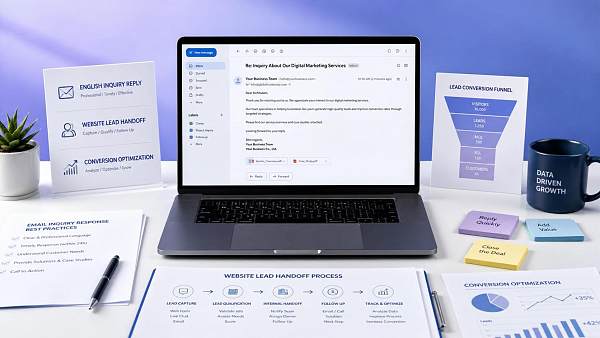
Many teams prepare an English inquiry reply template, and at first glance there seems to be nothing wrong with it. The real problem is that the template is treated as a "send directly" answer, rather than a starting point for "quickly organizing information." After customers receive the email, if the content feels like mass mail or the key points are unclear, they often will not reply further.
In a website + marketing services integrated scenario, this problem is even more obvious. Because inquiries may come not only from email, but also from independent site forms, ad landing pages, SEO pages, and private messages on social media. Different channels, different customer expectations, and using the same English inquiry reply template across all of them will almost certainly lead to poor results.
A more common situation is that the front-end promotion is done well, the website brings traffic, and ads generate leads, but the reply stage fails to connect. As a result, the traffic value obtained from website building, SEO, and advertising is diluted in the very first round of communication.
If inquiry replies are treated as a conversion action, then the value of a template lies not in "saving effort," but in being "faster, more accurate, and more human-like." This is also why many companies re-examine their English inquiry reply templates.
Where are the points where customers are most likely to be turned off?
First, look at the places that are most easily overlooked. They may not make customers reject you immediately, but they will significantly reduce the chance of continued communication.
The most dangerous type is a reply that "looks complete and polite, but in fact has no push-forward effect." There are no obvious mistakes on the surface, but in practice it is difficult to drive the next round of interaction. This is also one of the most common misconceptions in English inquiry reply templates.
What should be kept and what should be removed from an English inquiry reply template?
A template is not unusable; it needs to keep the "structure" and remove the "empty talk." A truly useful English inquiry reply template usually includes four parts: confirming requirements, responding to key points, adding proof, and pushing the next step.
Confirming requirements is not about repeating the customer's original words, but about extracting keywords. For example: quantity, use case, delivery time, region, certification requirements. This lets the customer know that you truly understood the content, rather than mechanically copying it.
Responding to key points does not mean saying everything at once. In many cases, the first reply is more suitable for providing key information first, then leaving an opening that makes it easy to reply. This both reflects efficiency and makes it easier to keep the conversation moving forward.
Supplementary evidence often determines professionalism. It can be case studies, delivery experience, website pages, parameter documents, or related content resources. A mature content marketing team will use website articles, FAQ pages, and product pages together, so that the English inquiry reply template is not just email text, but connected with on-site content.
For example, some companies will sync sales materials and content links in an internal knowledge base. Logically, it is similar to analysis of application strategies in the transformation practice of enterprise financial management types of material organization methods, with the focus all being on making information transmission more accurate and more evidence-based.
It is not enough to just change the wording; why do website and online lead sources also affect reply effectiveness?
If a customer enters from an independent site through organic search, they usually have already made a preliminary comparison, so the reply cannot just stop at "thanks for your email." If a customer comes from an ad landing page, they are often still in the rapid screening stage, so the reply should be shorter, more direct, and emphasize matching more strongly.
This is why more and more companies are putting website building, SEO, ad placement, and inquiry handling into the same system. Yiyingbao's long-term services for multilingual website development, overseas promotion, and AI marketing automation have a simple core idea: because the front-end customer acquisition methods are different, the back-end reply strategy cannot be exactly the same.
In practical applications, a good English inquiry reply template often needs to be linked with the following information:
- Which page the customer came from, and which content they viewed.
- Whether the inquiry fields are complete and whether any key parameters are missing.
- Whether the source channel is SEO, advertising, or social media.
- Whether different reply rhythms need to be assigned automatically.
Once this information is connected, the reply is no longer just a "template," but a communication action based on data judgment. For websites that value global lead generation, this difference is very direct.
Which details are most likely to expose unprofessionalism, and even make high-quality inquiries go cold?
High-quality inquiries going cold is often not because of price, but because trust has not been established. Especially in cross-border communication, a few small details are enough to affect judgment.
The email subject and opening are too generic
If the subject is only "Re: Inquiry," it is hard for the customer to identify it quickly. If the opening is only thanks for contacting us, it also lacks a memory point. A more stable approach is to write the product, requirement point, or region into the subject and first sentence.
There is a lot of information, but no hierarchy
Many English inquiry reply templates like to cram an email full of company introductions, all advantages, and multiple attachments. The result is not that it looks professional, but that the customer cannot grasp the key point. Short paragraphs and bullet points are more effective than stacking information.
There is no clear response to the points customers actually care about
If the customer asks about certification, you reply with factory strength; if the customer asks about delivery time, you reply with the brand story. The content is not useless, but the order is wrong. Answer the key question first, then add background, which is a more search- and communication-friendly way of expressing it.
No executable next step is left behind
For example, suggest confirming specifications, quantity range, target market, or call time. As long as the customer can easily reply with one sentence, the communication can continue. Otherwise, even a complete English inquiry reply template may stop at the first email.
If you want the template to really work, how should you review and optimize it?
Rather than rewriting it frequently, it is better to create a reusable checklist. In this way, every time you handle a different inquiry, you can quickly judge what to keep and what to add.
- First check timeliness, whether the first reply can be sent within a short time.
- Then check matching, whether the customer's needs and the source page are mentioned accurately.
- Check the structure, whether short sentences and bullet points are used to improve readability.
- Verify attachments and links, whether they really help the customer make a judgment.
- Finally check the promotion, whether a clear next step action has been set.
If a company is already building a multilingual official website, Google SEO, ad landing pages, and social media traffic, it should even more so integrate the English inquiry reply template into the overall conversion process. Because the inquiry is not the endpoint; reply quality determines whether the leads can continue to accumulate.
From this perspective, Yiyingbao's integrated services covering website building, SEO, advertising, and AI optimization are valuable not only for bringing traffic, but also for helping the front-end customer acquisition and back-end handling remain consistent, avoiding the disconnect of "effective promotion, but lost replies."
If you are organizing your own English inquiry reply template, you can first review real inquiries from the past 30 days: which emails were opened but did not continue to be replied to, and whether the problem was timeliness, expression, or information organization. Fixing these loss points one by one is more useful than simply copying a new template. If necessary, you can also refer to analysis of application strategies in the transformation practice of enterprise financial management kinds of materials that emphasize process organization, first make the internal information flow smooth, and then optimize external communication.
Related Articles
 Are you really hitting the right target with Google FB for truck bed exports?
 It's easy to turn a foreign trade website into a piece of art, but it's the ultimate culprit behind your order decline
 Foreign trade website efficiency revolution! Yiyingbao component upgrade + inquiry optimization, inquiries surge!

Related Products
 EasyCamp SaaS Smart Website Marketing SystemE-Yingbao SaaS Smart Website Marketing System: AI-powered, zero-code website building. Rapidly launch multilingual independent e-commerce sites in just 10 minutes. Global server acceleration and AI-driven SEO optimization empower businesses to efficiently connect with global markets. The seamless integration of technology and user-friendly operation makes building e-commerce sites incredibly simple.
 AI+SEM Intelligent Advertising Marketing SystemAI+SEM drives intelligent ad creation, empowering full-funnel precision advertising marketing. The system automatically generates weekly/monthly reports, AI recommends keywords and target countries, monitors core metrics in real-time with intelligent alerts, and enables one-click high-conversion ad solutions to help quickly acquire customers and improve ROI.
 AI+SEO Dual Engine Optimization ServiceEasyWin AI+SEO Dual Engine Optimization System leverages AI-powered keyword mining, content generation, and comprehensive technical optimization to help foreign trade enterprises acquire high-quality organic traffic, significantly improving search rankings and conversion rates.
 AI+SNS Social Media Marketing SystemYingbao AI+SNS Social Media Marketing System - Precision social capture for the social media era. Supports one-click content synchronization across major platforms like Facebook and LinkedIn. AI intelligently rewrites posts for enhanced relevance. 24/7 AI customer service and user profiling analysis empower businesses to efficiently expand into global markets.
 AI+SEO营销解决方案易营宝AI+SEO营销解决方案,通过AI批量写作、智能生成TDK、精准关键词扩词等功能,全面优化网站SEO效果,提升流量与转化率。助力企业构建高效智能网站新生态。
 AI+SEM Advertising Marketing SolutionsAI+SEM Advertising Marketing Solution leverages AI technology to deeply empower SEM ad campaigns. It automatically generates weekly/monthly reports using AI, presenting account data across multiple dimensions for comprehensive insights into campaign performance and trends. The system precisely recommends keywords and target countries, intelligently generates high-conversion ad copy, and enables one-click activation of efficient campaign plans to help businesses rapidly acquire customers. Simultaneously, it monitors core metrics in real time, intelligently identifies abnormal fluctuations, and issues timely alerts to ensure stable, high-return advertising results.
 Domain Name ServicesEasyWin provides professional domain name services, including intelligent queries, one-stop registration, brand protection, and full lifecycle management, helping businesses build a digital brand image.
 EasyOperate B2C Cross-Border E-Commerce Platform & Independent WebsiteEasyStore B2C Cross-border E-commerce Independent Store is an intelligent website building and cross-border e-commerce integrated solution independently developed by EasyStore Information Technology (Beijing) Co., Ltd. The system is specially designed for small and medium-sized as well as large export enterprises, integrating 'website building, operation, marketing, advertising, and conversion' into one, helping enterprises quickly establish cross-border e-commerce independent stores to achieve brand globalization and global sales growth.
The platform supports multiple languages, multiple currencies, and multi-channel marketing, with built-in AI intelligent translation and SEO optimization systems, suitable for mainstream markets such as Southeast Asia, Europe and America, Latin America, and the Middle East, assisting Chinese manufacturing enterprises in efficiently deploying international e-commerce strategies. SSL证书易营宝提供专业SSL安全证书服务,包括单域名和泛域名证书,确保网站数据传输加密、身份验证和完整性保护,助力企业建立安全可信的在线业务环境。









