









- What Does a Global Traffic Ecosystem Service Provider Do? What Are the Differences from a Single Advertising AgencyJul 16, 2026View details
- What should you focus on in the latest enterprise SaaS report? From renewal rates and delivery costs to overseas growth opportunitiesJul 12, 2026View details
- What signals are worth paying attention to in a cross-border marketing trend report? B2B companies should look at these 6 signalsJul 11, 2026View details
- How to Read a Cross-Border Marketing Trends Report? Five Key Dimensions for Evaluating Channel OpportunitiesJul 11, 2026View details
- Which channel has the highest ROI in the global traffic ecosystem? Comparative analysis of search, social media, and advertisingJul 10, 2026View details
- What multilingual website services are available in Sanya? Which model is more suitable for local businesses going global?Jul 08, 2026View details
- How to view the complete list of China SaaS companies in the top 100? Practical methods for screening website-building and marketing service providersJul 08, 2026View details
- How to view pricing in the global traffic ecosystem? Cost comparison of search, social media, and content channel advertisingJul 06, 2026View details
In website analytics reports, which metrics truly reflect the quality of overseas user engagement
Time on Page ≠ Quality of Engagement: The Deeper Logic for Decoding Overseas User Behavior
In website analytics reports, relying only on ‘average time on page’ or ‘bounce rate’ may misjudge the real behavior of overseas users. The key indicators that truly reflect engagement quality are hidden in user path depth, interaction heat zones, dwell ratio on multilingual pages, and cross-device revisit rate——based on data validation from 100,000+ going-global enterprises, EasyRank has found that only by choosing the right metrics can you optimize the ROI of AI website building and SEO campaigns.
When a North American B2B buyer stays on a German product page for 47 seconds without clicking any CTA, while a Southeast Asian consumer scrolls through 3 screens on an English landing page and completes a form submission, the two sessions may have similar durations, but their quality differs dramatically. Traditional metrics cannot capture this difference, yet it directly determines whether the content structure of an AI-built website is reasonable, whether the SEO keyword layout is precise, and whether ad creatives match local cognitive habits.
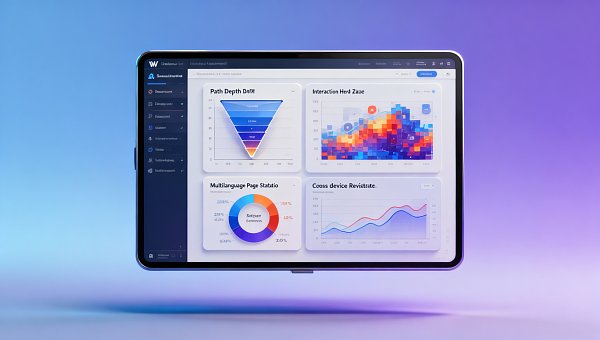
B2B Inquiry Scenarios: Path Depth Speaks Louder Than Duration
For overseas customers in industries with long decision cycles, such as industrial equipment and raw materials, repeated comparison of technical parameters, certifications, and case details is often necessary. In such cases, staying on a single page for more than 2 minutes does not necessarily indicate interest, while a complete path from homepage → product page → PDF download page → contact form page is the real signal of valid intent.
EasyRank monitoring shows that enterprises successfully acquiring high-quality inquiries have an average user path depth of 4.2 steps, far above the industry average of 2.6 steps; among them, users who “continue browsing the same product line after switching languages” have a conversion rate 3.8 times higher. This means that simply improving homepage loading speed is less important than optimizing multilingual navigation consistency.
B2C Branded Independent Sites: Interaction Heat Zones Reveal the True Focus of Attention
For brands in fast fashion, home furnishing, and beauty going global, users often browse by scrolling quickly. In this case, “average time on page” is highly prone to distortion——one user may get stuck on the first screen for 30 seconds because an image fails to load, while another completes 3 product image zoom actions within 3 seconds.
The truly valuable basis for judgment is the distribution of interaction heat zones: if areas with high click density are concentrated around price tags, size selectors, or the “Add to Cart” button, it indicates that the information architecture is effective; if a large number of clicks fall on blank areas or broken links, it exposes mobile adaptation flaws or misleading copy issues. Insights like these directly feed back into the visual-layer optimization loop of the AI website-building system.
Multilingual Official Website Operations: Page Dwell Ratio Reveals the Effectiveness of Localization
When French-speaking users enter a website, 90% of the traffic remains on English pages, while only 10% switch to the French version and their average dwell time is less than 12 seconds——this is not a language capability issue, but rather because the French pages lack local payment methods, lack French compliance statements, or product descriptions are not adapted to local terminology habits.
EasyRank includes the “multilingual page dwell ratio” (time spent on a page in a given language/total time spent by users of that language) as a core diagnostic dimension. Data shows that for websites with a dwell ratio >65%, the share of Google organic search first-page rankings in the corresponding language regions increases by an average of 22%, and the recognition accuracy of GEO generative engines is also significantly enhanced.
Cross-Device Revisit Rate: An Invisible Benchmark for Identifying High-Potential Users
A Middle Eastern buyer first browses 3 mechanical parts on a mobile phone, then opens the same domain on a laptop the next day and downloads a technical white paper——this kind of continuous cross-device behavior is often split into two separate sessions in GA4, causing the “bounce rate” to be artificially high and the “share of new users” to be distorted.
By contrast, the cross-device revisit rate (the proportion of users who visit using ≥2 devices within 7 days) can more accurately reflect the user decision-making process. Among the manufacturing clients served by EasyRank, enterprises with this metric >18% see their inquiry conversion cycle shortened by an average of 11 days. This data has already been deeply integrated into the AI advertising marketing system for dynamically adjusting the weighting of remarketing audience packages.
Common Misjudgments and Adaptation Recommendations
- Mistakenly equating a “high bounce rate” with content failure——in reality, it may mean ad targeting is accurate, and users convert immediately after reaching the target page (such as making a phone call or initiating a WhatsApp inquiry); event tracking must be used for verification.
- Ignoring regional interaction habits——Latin American users prefer autoplay video, while Japanese and Korean users rely more on image-and-text comparison charts; applying one unified Western UI template will reduce the effectiveness of heat zones.
- Overlooking data collection bias——some browsers in Russian-speaking regions block JS by default, resulting in undercounting in GA4; server-side log analysis should be used for cross-validation.
For enterprises building global digital infrastructure, it is recommended to prioritize calibrating baseline values for four types of metrics: path depth (by channel), interaction heat zones (by device + region), multilingual dwell ratio (by language), and cross-device revisit rate (rolling 7-day window). These data points are not only part of website analytics reports, but also the core fuel driving AI website-building iteration, SEO strategy optimization, and advertising creative updates.
In actual business advancement, you may also refer to the “multi-source behavioral attribution framework” proposed in Research on Internal Audit and Risk Management Countermeasures for Real Estate Development Enterprises, linking online user behavior with offline lead conversion and order fulfillment cadence for correlated modeling, so as to further strengthen the decision-making foundation driven by data.
Related Articles


Related Products
 EasyCamp SaaS Smart Website Marketing SystemE-Yingbao SaaS Smart Website Marketing System: AI-powered, zero-code website building. Rapidly launch multilingual independent e-commerce sites in just 10 minutes. Global server acceleration and AI-driven SEO optimization empower businesses to efficiently connect with global markets. The seamless integration of technology and user-friendly operation makes building e-commerce sites incredibly simple.
 AI+SEM Intelligent Advertising Marketing SystemAI+SEM drives intelligent ad creation, empowering full-funnel precision advertising marketing. The system automatically generates weekly/monthly reports, AI recommends keywords and target countries, monitors core metrics in real-time with intelligent alerts, and enables one-click high-conversion ad solutions to help quickly acquire customers and improve ROI.
 AI+SEO Dual Engine Optimization ServiceEasyWin AI+SEO Dual Engine Optimization System leverages AI-powered keyword mining, content generation, and comprehensive technical optimization to help foreign trade enterprises acquire high-quality organic traffic, significantly improving search rankings and conversion rates.
 AI+SNS Social Media Marketing SystemYingbao AI+SNS Social Media Marketing System - Precision social capture for the social media era. Supports one-click content synchronization across major platforms like Facebook and LinkedIn. AI intelligently rewrites posts for enhanced relevance. 24/7 AI customer service and user profiling analysis empower businesses to efficiently expand into global markets.
 AI+SEO营销解决方案易营宝AI+SEO营销解决方案,通过AI批量写作、智能生成TDK、精准关键词扩词等功能,全面优化网站SEO效果,提升流量与转化率。助力企业构建高效智能网站新生态。
 AI+SEM Advertising Marketing SolutionsAI+SEM Advertising Marketing Solution leverages AI technology to deeply empower SEM ad campaigns. It automatically generates weekly/monthly reports using AI, presenting account data across multiple dimensions for comprehensive insights into campaign performance and trends. The system precisely recommends keywords and target countries, intelligently generates high-conversion ad copy, and enables one-click activation of efficient campaign plans to help businesses rapidly acquire customers. Simultaneously, it monitors core metrics in real time, intelligently identifies abnormal fluctuations, and issues timely alerts to ensure stable, high-return advertising results.
 Domain Name ServicesEasyWin provides professional domain name services, including intelligent queries, one-stop registration, brand protection, and full lifecycle management, helping businesses build a digital brand image.
 EasyOperate B2C Cross-Border E-Commerce Platform & Independent WebsiteEasyStore B2C Cross-border E-commerce Independent Store is an intelligent website building and cross-border e-commerce integrated solution independently developed by EasyStore Information Technology (Beijing) Co., Ltd. The system is specially designed for small and medium-sized as well as large export enterprises, integrating 'website building, operation, marketing, advertising, and conversion' into one, helping enterprises quickly establish cross-border e-commerce independent stores to achieve brand globalization and global sales growth.
The platform supports multiple languages, multiple currencies, and multi-channel marketing, with built-in AI intelligent translation and SEO optimization systems, suitable for mainstream markets such as Southeast Asia, Europe and America, Latin America, and the Middle East, assisting Chinese manufacturing enterprises in efficiently deploying international e-commerce strategies. SSL证书易营宝提供专业SSL安全证书服务,包括单域名和泛域名证书,确保网站数据传输加密、身份验证和完整性保护,助力企业建立安全可信的在线业务环境。









