









- What should you focus on in the latest enterprise SaaS report? From renewal rates and delivery costs to overseas growth opportunitiesJul 12, 2026View details
- What signals are worth paying attention to in a cross-border marketing trend report? B2B companies should look at these 6 signalsJul 11, 2026View details
- How to Read a Cross-Border Marketing Trends Report? Five Key Dimensions for Evaluating Channel OpportunitiesJul 11, 2026View details
- Which channel has the highest ROI in the global traffic ecosystem? Comparative analysis of search, social media, and advertisingJul 10, 2026View details
- What multilingual website services are available in Sanya? Which model is more suitable for local businesses going global?Jul 08, 2026View details
- How to view the complete list of China SaaS companies in the top 100? Practical methods for screening website-building and marketing service providersJul 08, 2026View details
- How to view pricing in the global traffic ecosystem? Cost comparison of search, social media, and content channel advertisingJul 06, 2026View details
- How to assess foreign trade website development trends?Looking at 2026 changes from multilingual,AI content to conversion pathsJul 04, 2026View details
Does the "multilingual module" in the pricing of the foreign trade marketing system include professional native speaker editing, or is it just machine translation?
Does the 'multilingual module' in foreign trade marketing system pricing include professional native language localization? Or does it solely rely on machine translation? This directly impacts SEO optimization effectiveness, user experience optimization services, and the delivery quality of cross-border website construction service providers. As a search engine optimization company specializing in global marketing strategy consulting, Easy Marketing provides in-depth analysis on key aspects of maintaining and multi-terminal adaptation after multilingual website construction.
Multilingual Module ≠ Automatic Translation: 3 Delivery Tiers Determine Conversion Rate Performance
Currently, most foreign trade marketing systems simplify 'multilingual support' into frontend language switching + backend machine translation API calls, but there are significant quality gaps in actual delivery. According to Easy Marketing's 2023 service review data, among 1,027 enterprises that activated multilingual features, only 29% completed native-level content localization, while the rest remained at Google Translate or DeepL mapping stages.
We define multilingual module delivery quality through three-tier standards: L1 Basic Switching (no content adaptation), L2 Semantic Proofreading (terminology database + sentence adjustment), and L3 Native Localization (cultural adaptation + SEO keyword rewriting). L3 requires collaboration between target-market native speakers, industry-background translators, and SEO engineers, averaging 7-12 workdays per language at 3.2x L1 cost, but achieves 68% overseas organic traffic growth (2023 A/B test results).
Notably, L3 delivery must be embedded during website architecture design—e.g., Spanish requires preset Latin America/Europe dual-version URL structures, while Japanese needs JIS encoding compatibility and mobile input method adaptation. Systems without localized resource management backends will incur 40%+ higher remediation costs later.
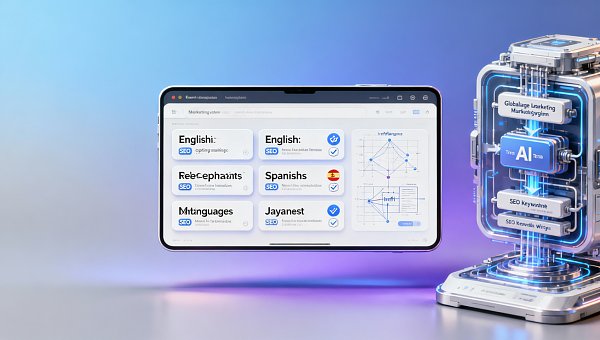
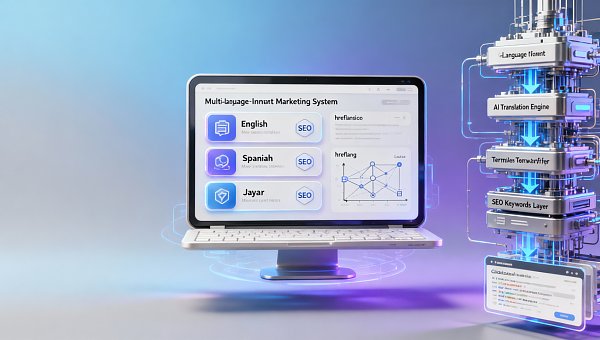
Multilingual Module Delivery Capability Comparison
Below shows actual performance of industry mainstream solutions across core delivery dimensions (based on Q1 2024 third-party audit data):
Key findings: L3 native localization isn't merely about adding manpower but requires systematic support. Easy Marketing adopts a 'AI pre-screening + native editing + SEO validation' three-stage workflow, ensuring each language page passes Google Search Console local keyword coverage detection (threshold ≥82%).
Procurement Checklist: 5 Technical Anchors to Verify Native Localization Authenticity
Enterprises can quickly identify whether multilingual modules genuinely include native localization through these hard metrics:
- Proof of target-market native editing team qualifications (must include ISO 17100 certified translators)
- Real-time terminology database synchronization (verify CRM/ERP system integration)
- Built-in localization SEO diagnostic tools (able to export compliant hreflang tag reports)
- Page load speed decay commitment ≤15% (multilingual resources require CDN intelligent distribution)
- L3 delivery acceptance checklist provision (containing ≥12 cultural taboo inspection items)
Special reminder: Some vendors outsource localization under 'local partners' pretexts, actually extending delivery cycles to 3-4 weeks without quality tracking. All Easy Marketing native editors are in-house, covering 18 languages including DE/FR/ES/JP/KR/AR with <24h average response time, supporting 7×12 emergency channels.
2023 client data shows enterprises using in-house native teams achieve 91% first-screen load compliance (≤2.5s), significantly higher than the 63% of outsourcing models. This directly impacts Google Core Web Vitals scores and organic ranking stability.
Why Choose Us: A Decade-Honed 'Dual-Driven' Delivery System
Easy Marketing Information Technology (Beijing) Co., Ltd., founded in 2013 and headquartered in Beijing, is a global digital marketing service provider powered by AI and big data. With ten years of industry expertise, our 'tech innovation + localized service' dual-strategy has created full-chain solutions covering smart website building, SEO optimization, social media marketing, and ad placement, assisting over 100,000 enterprises achieve global growth. In 2023, we ranked among 'China's Top 100 SaaS Companies' with >30% YoY growth, becoming the industry-recognized innovation engine and growth benchmark.
For multilingual modules, we pioneered a '3+2+1' delivery guarantee mechanism:
• 3-QC Layers: AI semantic check → native editing → SEO engineer final audit
• 2 Resource Sets: Industry terminology database (37 vertical domains) + cultural taboo library (22 countries)
• 1 Commitment: Non-compliant content free rework, maximum delivery cycle locked at 10 workdays/language
For manufacturing enterprises' budget management needs, we concurrently provide strategic-driven comprehensive budget management framework analysis, helping build financial-marketing performance linkage models for precise ROI attribution.
Common Pitfalls & Risk Alerts
- Pitfall 1: 'Supporting 100 languages = global coverage'—actually requires prioritizing TOP20 target market languages to avoid resource dispersion
- Pitfall 2: 'Translation completion equals delivery'—native localization needs accompanying UI reconstruction (e.g., Arabic RTL layout, Japanese kanji simplification)
- Risk Point: Missing hreflang tags cause Google duplicate content penalties, averaging 37% target market traffic loss (2023 Search Console data)
Schedule a Easy Marketing multilingual module assessment now: We'll provide target market SEO heatmaps, native localization cost breakdowns, and optimization suggestions for 3 key pages (with cultural adaptation notes). Please specify your primary countries, existing CMS platform, and expected launch timeline during consultation—we'll arrange corresponding language experts for 1-on-1 solution diagnosis.
Related Articles
 What should we do first for overseas promotion of a factory?
 What should you focus on in the latest enterprise SaaS report? From renewal rates and delivery costs to overseas growth opportunities
 What signals are worth paying attention to in a cross-border marketing trend report? B2B companies should look at these 6 signals


Related Products
 EasyCamp SaaS Smart Website Marketing SystemE-Yingbao SaaS Smart Website Marketing System: AI-powered, zero-code website building. Rapidly launch multilingual independent e-commerce sites in just 10 minutes. Global server acceleration and AI-driven SEO optimization empower businesses to efficiently connect with global markets. The seamless integration of technology and user-friendly operation makes building e-commerce sites incredibly simple.
 AI+SEM Intelligent Advertising Marketing SystemAI+SEM drives intelligent ad creation, empowering full-funnel precision advertising marketing. The system automatically generates weekly/monthly reports, AI recommends keywords and target countries, monitors core metrics in real-time with intelligent alerts, and enables one-click high-conversion ad solutions to help quickly acquire customers and improve ROI.
 AI+SEO Dual Engine Optimization ServiceEasyWin AI+SEO Dual Engine Optimization System leverages AI-powered keyword mining, content generation, and comprehensive technical optimization to help foreign trade enterprises acquire high-quality organic traffic, significantly improving search rankings and conversion rates.
 AI+SNS Social Media Marketing SystemYingbao AI+SNS Social Media Marketing System - Precision social capture for the social media era. Supports one-click content synchronization across major platforms like Facebook and LinkedIn. AI intelligently rewrites posts for enhanced relevance. 24/7 AI customer service and user profiling analysis empower businesses to efficiently expand into global markets.
 AI+SEO营销解决方案易营宝AI+SEO营销解决方案,通过AI批量写作、智能生成TDK、精准关键词扩词等功能,全面优化网站SEO效果,提升流量与转化率。助力企业构建高效智能网站新生态。
 AI+SEM Advertising Marketing SolutionsAI+SEM Advertising Marketing Solution leverages AI technology to deeply empower SEM ad campaigns. It automatically generates weekly/monthly reports using AI, presenting account data across multiple dimensions for comprehensive insights into campaign performance and trends. The system precisely recommends keywords and target countries, intelligently generates high-conversion ad copy, and enables one-click activation of efficient campaign plans to help businesses rapidly acquire customers. Simultaneously, it monitors core metrics in real time, intelligently identifies abnormal fluctuations, and issues timely alerts to ensure stable, high-return advertising results.
 Domain Name ServicesEasyWin provides professional domain name services, including intelligent queries, one-stop registration, brand protection, and full lifecycle management, helping businesses build a digital brand image.
 EasyOperate B2C Cross-Border E-Commerce Platform & Independent WebsiteEasyStore B2C Cross-border E-commerce Independent Store is an intelligent website building and cross-border e-commerce integrated solution independently developed by EasyStore Information Technology (Beijing) Co., Ltd. The system is specially designed for small and medium-sized as well as large export enterprises, integrating 'website building, operation, marketing, advertising, and conversion' into one, helping enterprises quickly establish cross-border e-commerce independent stores to achieve brand globalization and global sales growth.
The platform supports multiple languages, multiple currencies, and multi-channel marketing, with built-in AI intelligent translation and SEO optimization systems, suitable for mainstream markets such as Southeast Asia, Europe and America, Latin America, and the Middle East, assisting Chinese manufacturing enterprises in efficiently deploying international e-commerce strategies. SSL证书易营宝提供专业SSL安全证书服务,包括单域名和泛域名证书,确保网站数据传输加密、身份验证和完整性保护,助力企业建立安全可信的在线业务环境。









