









- The China-US tariff arrangement has reached a preliminary consensus, and the trade association will be establishedJun 15, 2026View details
- What determines B2C cross-border e-commerce website development costs? A breakdown of features, interfaces, and deployment methodsJun 17, 2026View details
- China-Morocco zero-tariff access, a breakthrough in the cost of Moroccan goods exports to ChinaJun 11, 2026View details
- What signal should be released for the suspension of exports to JapanJun 10, 2026View details
- China's May LNG imports rebounded, with increased volumes from Russia and Canada filling the Middle East supply gapJun 10, 2026View details
- Will GEO change its SEO strategy?Jun 04, 2026View details
- What types of businesses are end-to-end solutions suitable for?Jun 03, 2026View details
- 2026 Global Growth Channel TrendsJun 02, 2026View details
What overseas trade marketing channels are available? How should SEO, advertising, and social media investment be allocated?
Foreign trade network marketing is not simply about allocating a budget to a few channels, but about building a combination around “where traffic comes from, why inquiries convert, and how the brand can continue to scale.” SEO, advertising, and social media can all bring customers, but each solves a different problem, and the pace of investment is different. For businesses that rely on overseas independent sites to acquire customers, what truly affects results is often not whether a single channel is strong, but whether the website, content, paid promotion, and data feedback can form a closed loop.
First, understand the channel structure of foreign trade network marketing
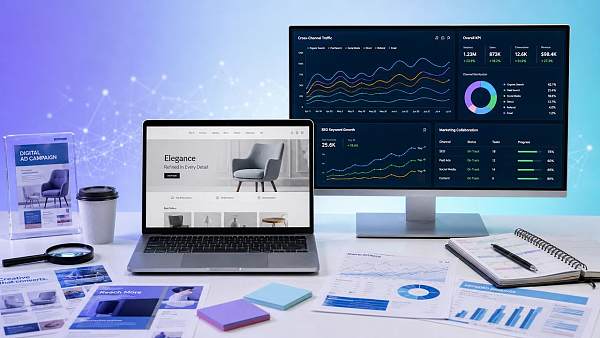
From actual customer acquisition paths, foreign trade network marketing can generally be divided into search traffic, paid traffic, social traffic, and referral traffic. Among them, the most frequently discussed are still SEO, ad placement, and overseas social media operations.
SEO is more focused on long-term asset building. It relies on website structure, page content, keyword layout, technical optimization, and continuous indexing, making it suitable for steadily accumulating traffic and reducing long-term customer acquisition costs.
Advertising is more focused on rapid traffic generation. Whether it is search ads, display ads, or social ads, they can validate the market, test products and landing pages, and quickly obtain leads in a short period of time.
Social media sits between brand building and traffic reach. It may not immediately bring in a large number of deals, but it can help establish brand credibility, amplify content distribution, and provide supporting signals for advertising and organic search.
Therefore, when discussing how to allocate a foreign trade network marketing budget, the premise is not “which channel is better,” but “what is most lacking at the current stage.”
Why budget allocation is the key issue at present
In the past, many companies relied on platform traffic or offline exhibitions, with online channels serving only as a supplement. Today, overseas purchasing behavior happens earlier on search, social media, and content platforms, and independent websites are gradually becoming the core arena for carrying inquiries and brand expression.
This also means that foreign trade network marketing is no longer just “opening an account and placing ads,” but a coordinated push involving website development, content strategy, data analysis, and multi-channel operations. If the site cannot be indexed, or if the pages are not conversion-friendly, even a high advertising budget will be consumed quickly.
What is even more noteworthy is that the overseas traffic environment is changing. Search is no longer limited to traditional search engines, social media content also influences purchasing decisions, and AI search visibility is beginning to enter the marketing evaluation scope. The boundaries between channels are becoming increasingly blurred, so budget allocation can no longer rely on experience alone.
The value of integrated website and marketing service platforms like Yiyingbao lies in connecting website building, SEO, advertising, social media, and data systems. The significance of doing so is not only to save coordination costs across multiple parties, but more importantly to improve the efficiency of every unit of traffic.
What SEO, advertising, and social media solve, respectively
If we understand them in terms of growth rhythm, the three types of channels have distinct roles.
Simply put, SEO is about “accumulation,” advertising is about “validation,” and social media is about “amplification.” The three are not substitutes for one another, but a classic complementary relationship.
In many foreign trade network marketing projects, advertising first identifies high-conversion keywords and high-intent pages, SEO then builds content depth around these directions, and social media continuously supplements brand stories, case studies, videos, and interactive content, making the website conversion rate more stable.
How to allocate budget depends on the stage, not on following trends
There is no single answer to budget allocation, but it can be judged according to the business stage.
Startup stage: first get the channels running
When an independent site has just gone online, content is limited and authority is insufficient, so SEO is difficult to bring stable inquiries immediately. At this time, it is more suitable to prioritize advertising, use social media as a supplement, and build SEO foundations in parallel.
- Advertising can account for a relatively high proportion and be used to validate the market and keywords.
- SEO should focus on site structure, core pages, and foundational content.
- Social media should first establish the account matrix to ensure complete brand information.
Growth stage: shift from buying traffic to building assets
When the website already has inquiry data, the focus of foreign trade network marketing should shift from “is there enough traffic” to “can costs be reduced and quality improved.” At this stage, SEO investment usually needs to increase.
Advertising continues to handle traffic generation and remarketing functions, but should not be relied on entirely. Social media should continue to output cases, factory strength, product applications, and industry content to help overseas customers complete trust judgments.
Mature stage: pursue efficiency and brand synergy
After the business enters its mature phase, budget allocation will emphasize greater refinement. Different countries, different product lines, and different page types may all require different strategies.
What is needed at this time is not only ad execution, but also data attribution and full-funnel optimization. This includes which types of keywords bring high-quality inquiries, which social media content can lift conversion, and which pages are suitable for additional SEO resources.
Why the website is the hub of foreign trade network marketing
Many channel issues ultimately return to the website itself. Search needs pages to be indexed, advertising needs to carry clicks, social media needs to direct interest to landing pages, and inquiry forms, online communication, and multilingual content all happen on the website.
If the website is only a display page, lacks keyword layout, loads slowly, has weak mobile experience, or lacks persuasive copy, then no matter how much is invested in SEO or advertising, conversion will still be limited.
The thinking behind integrated solutions like Yiyingbao is precisely to first enable the website to have the underlying capabilities of being “promotable, indexable, and convertible,” and then use AI+SEO, advertising systems, and social media operations to amplify results. This is especially important for multi-regional markets, because multilingual content, multi-landing pages, and multi-channel linkage all require system support.
When making annual plans, in addition to focusing on customer acquisition budgets, it is also possible to synchronously refer to research materials that affect industrial upgrading and business decisions, such asGreen tax systems helping enterprise innovation and industrial upgrading research. Such content does not directly determine advertising results, but it helps broaden the dimensions for market judgment.
Several common misunderstandings are more worthy of caution than budget ratios
Doing foreign trade network marketing poorly is often not because of insufficient investment, but because the judgment is biased.
- Only looking at traffic, not inquiry quality, easily wastes budget on invalid clicks.
- Mistaking SEO for article publishing and ignoring technical optimization and page structure results in slow indexing and unstable rankings.
- Social media updates are long-term interrupted, with content posted only during promotions, making it difficult to form stable reach.
- Advertising and the website are disconnected, with landing page content not matching keyword intent, leading to high bounce rates.
- Using one set of content uniformly across multiple markets, without localization, usually results in unsatisfactory conversion performance.
Once these problems exist, even the most refined budget allocation will have difficulty producing ideal results.
A more practical approach is to first establish an allocation logic
If you are currently evaluating foreign trade network marketing investment, you can first build a judgment framework from four dimensions: current website foundation, market competition intensity, customer acquisition cycle requirements, and content operations capability.
If the website foundation is weak, first improve the site and conversion pages; if the customer acquisition cycle is short, advertising should carry more weight; if keywords are expensive, SEO and long-tail content layout should be accelerated; if the product requires market education, social media and content investment cannot be too low.
A more stable approach is to integrate SEO, advertising, and social media into the same growth model, continuously observing the relationship between impressions, clicks, dwell time, inquiries, and deals, rather than looking only at a single channel’s monthly data.
When the direction is still not clear enough, it is better to first sort out the existing website, target market, and core product lines, and then conduct phased testing based on the role and cost structure of different channels. The truly effective allocation method for foreign trade network marketing is often not finding the standard answer at the beginning, but gradually forming an investment model that suits your own business through continuous validation.
Related Articles



Related Products
 EasyCamp SaaS Smart Website Marketing SystemE-Yingbao SaaS Smart Website Marketing System: AI-powered, zero-code website building. Rapidly launch multilingual independent e-commerce sites in just 10 minutes. Global server acceleration and AI-driven SEO optimization empower businesses to efficiently connect with global markets. The seamless integration of technology and user-friendly operation makes building e-commerce sites incredibly simple.
 AI+SEM Intelligent Advertising Marketing SystemAI+SEM drives intelligent ad creation, empowering full-funnel precision advertising marketing. The system automatically generates weekly/monthly reports, AI recommends keywords and target countries, monitors core metrics in real-time with intelligent alerts, and enables one-click high-conversion ad solutions to help quickly acquire customers and improve ROI.
 AI+SEO Dual Engine Optimization ServiceEasyWin AI+SEO Dual Engine Optimization System leverages AI-powered keyword mining, content generation, and comprehensive technical optimization to help foreign trade enterprises acquire high-quality organic traffic, significantly improving search rankings and conversion rates.
 AI+SNS Social Media Marketing SystemYingbao AI+SNS Social Media Marketing System - Precision social capture for the social media era. Supports one-click content synchronization across major platforms like Facebook and LinkedIn. AI intelligently rewrites posts for enhanced relevance. 24/7 AI customer service and user profiling analysis empower businesses to efficiently expand into global markets.
 AI+SEO营销解决方案易营宝AI+SEO营销解决方案,通过AI批量写作、智能生成TDK、精准关键词扩词等功能,全面优化网站SEO效果,提升流量与转化率。助力企业构建高效智能网站新生态。
 AI+SEM Advertising Marketing SolutionsAI+SEM Advertising Marketing Solution leverages AI technology to deeply empower SEM ad campaigns. It automatically generates weekly/monthly reports using AI, presenting account data across multiple dimensions for comprehensive insights into campaign performance and trends. The system precisely recommends keywords and target countries, intelligently generates high-conversion ad copy, and enables one-click activation of efficient campaign plans to help businesses rapidly acquire customers. Simultaneously, it monitors core metrics in real time, intelligently identifies abnormal fluctuations, and issues timely alerts to ensure stable, high-return advertising results.
 Domain Name ServicesEasyWin provides professional domain name services, including intelligent queries, one-stop registration, brand protection, and full lifecycle management, helping businesses build a digital brand image.
 EasyOperate B2C Cross-Border E-Commerce Platform & Independent WebsiteEasyStore B2C Cross-border E-commerce Independent Store is an intelligent website building and cross-border e-commerce integrated solution independently developed by EasyStore Information Technology (Beijing) Co., Ltd. The system is specially designed for small and medium-sized as well as large export enterprises, integrating 'website building, operation, marketing, advertising, and conversion' into one, helping enterprises quickly establish cross-border e-commerce independent stores to achieve brand globalization and global sales growth.
The platform supports multiple languages, multiple currencies, and multi-channel marketing, with built-in AI intelligent translation and SEO optimization systems, suitable for mainstream markets such as Southeast Asia, Europe and America, Latin America, and the Middle East, assisting Chinese manufacturing enterprises in efficiently deploying international e-commerce strategies. SSL证书易营宝提供专业SSL安全证书服务,包括单域名和泛域名证书,确保网站数据传输加密、身份验证和完整性保护,助力企业建立安全可信的在线业务环境。









